R E S E A R C H
Open Access
Structure method for solving the nearest
Euclidean distance matrix problem
Suliman Al-Homidan
**Correspondence:
[email protected] Department of Mathematics and Statistics, King Fahd University of Petroleum and Minerals, Dhahran, Saudi Arabia
Abstract
A matrix with zero diagonal is called a Euclidean distance matrix when the matrix values are measurements of distances between points in a Euclidean space. Because of data errors such a matrix may not be exactly Euclidean and it is desirable in many applications to find the best Euclidean matrix which approximates the non-Euclidean matrix. In this paper the problem is formulated as a smooth unconstrained
minimization problem, for which rapid convergence can be obtained. Comparative numerical results are reported.
Keywords: Euclidean distance matrix; positive semidefinite matrix; Newton method; BFGS method
1 Introduction
Symmetric matrices with non-negative off-diagonal elements and zero diagonal elements arise as data in many experimental sciences. This occurs when the values are measure-ments of squared distances between points in a Euclidean space (e.g.atoms, stars, cities). Such a matrix is referred to as aEuclidean distance matrix.Because of data errors such a matrix may not be exactly Euclidean and it is desirable to find the best Euclidean ma-trix which approximates the non-Euclidean mama-trix. The aim of this paper is to study a new method for solving the Euclidean distance matrix problem and compare it with other older methods [].
An important application arises in the conformation of molecular structures from nu-clear magnetic resonance data (see [] and []). Here a Euclidean distance matrix is used to represent the squares of distances between the atoms of a molecular structure. An attempt to determine such a structure by nuclear magnetic resonance experiments gives rise to a distance matrixF which, because of data errors, may not be Euclidean. There are many other applications in subjects as diverse as archeology, cartography, genetics, geography, and multivariate analysis. Pertinent references are given by Al-Homidan [, ].
Characterization theorems for the Euclidean distance matrix have been given in many forms. In Section we show a very important characterization which brings out the un-derlying structure and is readily applicable to the algorithms that follow.
This paper addresses a non-smooth optimization problem in which some matrix, de-fined in terms of the problem variables, has to be positive semidefinite. One way to handle this problem is to impose a functional constraint in which the least eigenvalue of the ma-trix is non-negative. However, if there are multiple eigenvalues at the solution, which is
usually the case, such a constraint is non-smooth, and this non-smoothness cannot be modeled by a convex polyhedral composite function. An important factor is the determi-nation of the multiplicity of the zero eigenvalues, or alternatively therankof the matrix at the solution. If this rank is known it is usually possible to solve the problem by conven-tional techniques.
Gluntet al.[] formulate the Euclidean distance matrix problem as a constrained least distance problem in which the constraint is the intersection of two convex sets. The Dykstra-Han alternating projection algorithm can then be used to solve the problem. This method is globally convergent but the rate of convergence is very slow. However, the method does have the capability to determine the correct rank of the solution matrix. Recently, there has been much interest in the interior point methods applied to prob-lems with semidefinite matrix constraints (e.g.the survey papers [] and [] and the refer-ences therein). Semidefinite programming optimizes a linear function subject to a positive semidefinite matrix. It is a convex programming problem since the objective and con-straints are convex. In this paper, we deal with a problem that is a little different since the objective is quadratic; also an additional rank constraint is added which makes the prob-lem non-convex and harder to solve. Here, we use a different approach from the interior point methods. If the correct rank of the solution matrix is known, it is shown in Sec-tion how to formulate the problem as a smooth unconstrained minimizaSec-tion problem, for which rapid convergence can be obtained by for example the BFGS method. We give expressions for the objective function and its first derivatives.
In [] a hybrid method is studied between a projection method and a quasi-Newton method; a similar study can be performed as regards all its features. Finally, in Section , numerical comparisons are carried out.
2 The Euclidean distance matrix problem
In this section the definition of the Euclidean distance matrix is given, and the relation-ship between points and distances is summarized. A characterization theorem for the Eu-clidean distance matrix is proved in a concise way that brings out the underlying structure and is readily applicable to the algorithms that follow.
It is necessary to distinguish between distance matrices that are obtained in practice and those that can be derived exactly fromnvectors in an affine subspace.
Definition . A matrixF∈Rn×nis called a distance matrix iff it is symmetric, the
diag-onal elements are zero
fii= , i= , . . . ,n,
and the off-diagonal entries are non-negative
fij≥, ∀i=j.
Definition . A matrixD∈Rn×nis called a Euclidean distance matrix iff there existn
vectorsx, . . . ,xnin an affine subspace of dimensionRr(r≤n– ) such that
The Euclidean distance problem can now be stated as follows: Given a distance matrix
F∈Rn×n, find the Euclidean distance matrixD∈Rn×nthat minimizes
F–DF, (.)
where · Fdenotes the Frobenius norm.
The theorem is essentially due to Schoenberg [].
Theorem . The distance matrix D∈Rn×nis a Euclidean distance matrix if and only if
the(n– )×(n– )symmetric matrix A defined by
aij=
[ds+dt–dst] (≤i,j≤n– ) (.)
is positive semidefinite,where s=i+ ,t=j+ ,and D is irreducibly embeddable inRr
(r<n)where r=rank(A).Moreover,consider the spectral decomposition
A=UUT. (.)
Letrbe the matrix of non-zero eigenvalues inand define X by
X=Ur, then A=XrXT, (.)
wherer∈Rr×ris a diagonal matrix and Ur∈R(n–)×r.
3 The method
In this section we consider a different approach to the Euclidean distance matrix problem (.). The main idea is to replace (.) by a smooth unconstrained optimization problem in order to use superlinearly convergent quasi-Newton methods. To do this it is necessary to estimate therankras this piece of information is not generally known. Once a value ofr
is chosen, the problem (.) is solved by the BFGS method. We give the relevant formulas for the derivatives. At the end of the section we discuss details of the initialization and implementation.
If therankris known, it is possible to express (.) as a smooth unconstrained opti-mization problem in the following way. The unknowns in the problem are chosen to be the elements of the matrixXandrintroduced in (.). We takeXto havercolumns and
ra diagonal matrix as shown below. This gives us an unconstrained optimization
prob-lem inr(n– ) – r(r+) unknowns. We therefore parametrizeXandr in the following
way:
A=XrXT, whereX=
⎡ ⎢ ⎢ ⎢ ⎢ ⎢ ⎢ ⎢ ⎢ ⎢ ⎢ ⎢ ⎣
x
..
. x
..
. ... xr+,r
..
. ... ...
xm xm xmr
⎤ ⎥ ⎥ ⎥ ⎥ ⎥ ⎥ ⎥ ⎥ ⎥ ⎥ ⎥ ⎦
,r=
⎡ ⎢ ⎢ ⎣ λ
. ..
λr
⎤ ⎥ ⎥
The objective functionφ(X) is readily calculated by first formingDfromXandras
indicated by (.), after whichφis given byφ(X,r) =D–FF. Whens=t, thendst= ,
using (.) we getaii=[ds+ds– ] =ds, then the elements of the matrixDtake the
form
ds=aii= i–
k=
xikλk+λi ifi= , . . . ,r,s=i+ ,
ds=aii= r
k=
xikλk ifi=r+ , . . . ,n– ,
dst=aij= i–
k=
xikxjkλk+xij+λi ifi≤rorj≤r,
dst=aij= r
k=
xikxjkλk ifi>randj>r,
wheret=j+ . Hence
φ=
n
s,t=
(dij–fij)= n
s=
(ds–fs)+
n
s,t=
s<t
(dst–fst)
= r i= i– k=
xikλk+λi–fs
+
n–
i=r+
r
k=
xikλk–fs
+
r
i,j=
i<j i–
k=
xikλk+λi+ j–
k=
xkjλk+λj– i–
k=
xikxkjλk+xijλi–fst
+ r i= n–
j=r+
i–
k=
xikλk+λi+ r
k=
xkjλk– i–
k=
xikxkjλk+xijλi–fst
+
n–
i,j=r+
i<j r
k=
xikλk+ r
k=
xkjλk– r
k=
xikxkjλk–fst
. (.)
Our chosen method to minimizeφ(X) is the BFGS quasi-Newton method (see for ex-ample []). This requires expressions for the first partial derivatives ofφ, which are given from (.) by
∂φ ∂λi = i l= n–
k=l+i
(dk+l–fk+l)xik+ n–
k=i+
(dk+i+–fk+i+)
+xik– xik
+
r
l=i+
n–
k=l
(dk+l–fk+l)
xil–+xik– xi,l–xik)
for alli= , . . . ,r. Forj= , . . . ,r, andi=j+ , . . . ,n– :
∂φ ∂xij
=
i–
k=
(dj+k+–fj+k+)(xijλj) + n–
k=i
(dj+k+–fj+k+)(xijλj– xkjλj). (.)
The BFGS method also requires the Hessian approximation to be initialized. Where nec-essary, we do this using a unit matrix.
Some care has to be taken when choosing the initial value of the matrixXandr, in
particular the rank must ber. If not, the minimization method may not be able to increase the rank ofX. An extreme case occurs when the initial matrixX= andr= are chosen,
andF= . It can be seen from (.) and (.) that the components of the gradient vector are all zero, so thatX= andr= are stationary points, but not minimizers. A gradient
method will usually terminate in this situation and so fail to find the solution.
A reliable method for initializingXandr= is to use the construction suggested by
(.) and (.). Thus we define the elements ofAby those ofFby
aij=
(fij–fi–fj), i≥,j≥. (.)
The first row and column of Aare zero and are ignored. We then find the spectral de-composition UUT of the nontrivial part ofA. Finally the nontrivial part of Xand
r
in (.) is initialized to the matrix/
r UrTwherer=diag(σi),i= , . . . ,ris composed of
therlargest eigenvalues in, and the columns ofUrare the corresponding eigenvectors.
Whenris positive definite, this procedure ensures thatAhas the correctrankr.
Other-wise the process must be modified in some way, for example by ensuring that the diagonal elements inrlie above a positive threshold.
An advantage of this method is that it allows the spatial dimensions to be chosen by the user. This is useful when the rank is already known. For example if the entries inF are derived from distances between cities then the dimension will be no higher thanr= . Likewise, if the entries are derived from distances between atoms in a molecule or stars in space, then the maximum dimension isr= .
In general, however, the rank is not known, for example the atoms in a molecule may turn out to be collinear or coplanar. We therefore must consider an algorithm in which we are prepared to revise our estimate ofr. A simple strategy is to repeat the entire method for different values ofr. Ifr∗ denotes the correct value ofrwhich solves (.), then it is observed that the BFGS method converges rapidly ifr≤r∗, and that it exhibits superlinear convergence. On the other hand ifr>r∗then slow convergence is observed. One reason is that there are more variables in the problem. Also redundancy in the parameter space may have an effect. Thus it makes sense to start with a small value ofr, and increase it by one until the solution is recognized. One way to recognize termination is whenD(r)agrees
sufficiently well withD(r+), whereD(r)denotes the Euclidean distance matrix obtained by
minimizingφwhenrin (.) hasrdiagonal elements. Numerical experience is reported
in [] for solving various test problems by other methods which will be compared with this method.
has some negative eigenvalues so a modified form of Newton’s method would be required. A simple example serves to illustrate the possibility of a negative eigenvalue. Taken= ,
r= , and letF=– –,X= [], andr= [λ]. Thenφ= ( –λ). This has global
mini-mizers atλ=±, a local maximizer atλ= , and the Hessian is negative for allλsuch
that λ< .
This method has entirely different features, some good, some bad, which suggests that a combination of both this method and a projection method [] might be successful. Projec-tion methods are globally convergent and hence potentially reliable, but the rate of con-vergence is first order or slower, which can be very inefficient. Quasi-Newton methods are reliable and locally superlinearly convergent, but they require that the correctrankr∗
is known. Therefore hybrid methods should be established along the lines of [], in which the projection algorithm is used sparingly as a way of establishing the correct rank, while the BFGS method is used to provide rapid convergence.
4 Numerical results
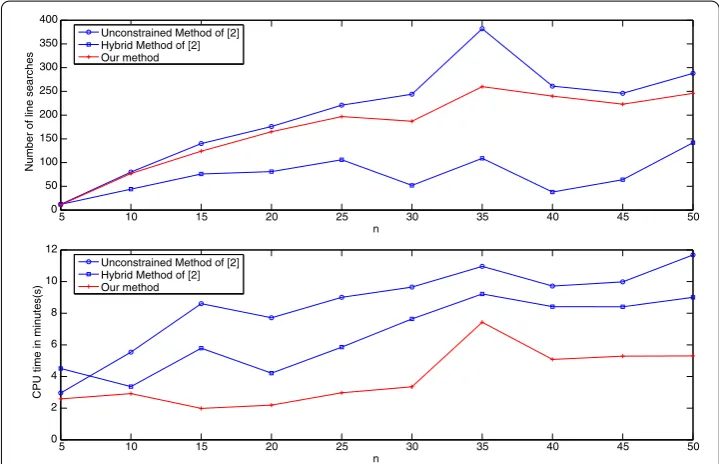
In this section, we compare three methods, our method, the hybrid method in [] and the unconstrained method of the same reference. The algorithms have been tested on randomly generated distance matricesFwith values distributed between –and . All calculations were performed with Mathlab . Figure compares the line searches and CPU time of the three methods. The termination criterion for both methods isD(k)–D(k–)< –. All methods converge to essentially the same values.
[image:6.595.117.477.466.698.2]In Figure , the upper figure shows that the number of line searches for our method is slightly lower than the unconstrained method and higher than the hybrid method. How-ever, in the lower figure it is clear that our method is much faster and this because our method has r(r+)less CPU time. A hybrid method uses much less line searches from both
methods, however, it consumes much more time than our method because it uses a pro-jection method as a start. This makes our method more efficient and faster.
The housekeeping associated with each line search isO(n). Also, if care is taken, it is
possible to calculateφ(X) and∇φ(X) inO(n) operations. The initial valuer()is tabulated, andris increased by one until the solution is found. The total number of line searches is tabulated, and in this figure, it is found that fewer line searches are required asrincreases. Also the initial valuer()= is rather arbitrary: a smaller value ofr()would have given an
even larger number of line searches.
Competing interests
The author declares that they have no competing interests.
Acknowledgements
The author is grateful to King Fahd University of Petroleum & Minerals for providing excellent research facilities.
Received: 2 September 2014 Accepted: 24 November 2014 Published:12 Dec 2014 References
1. Al-Homidan, S, Fletcher, R: Hybrid methods for finding the nearest Euclidean distance matrix. In: Du, D, Qi, L, Womersley, R (eds.) Recent Advances in Nonsmooth Optimization, pp. 1-17. World Scientific, Singapore (1995) 2. Havel, T, Kuntz, I, Crippen, GM: The theory and practice of distance geometry. Bull. Math. Biol.45, 665-720 (1983) 3. Crippen, GM: Rapid calculation of coordinates from distance measures. J. Comput. Phys.26, 449-452 (1978) 4. Al-Homidan, S: Hybrid methods for optimization problems with positive semi-definite matrix constraints. Ph.D. thesis,
Dept. of Mathematics and Computer Science, University of Dundee, Dundee, Scotland (1993)
5. Al-Homidan, S, Fletcher, R: Rationalizing foot and ankle measurements to conform to a rigid body model. Comput. Methods Biomech. Biomed. Eng.9(2), 103-111 (2006)
6. Glunt, W, Hayden, TL, Hong, S, Wells, J: An alternating projections method for computing the nearest Euclidian distance matrix. SIAM J. Matrix Anal. Appl.4, 589-600 (1990)
7. Al-Homidan, S, Wolkowicz, H: Approximate and exact completion problems for Euclidean distance matrices using semidefinite programming. Linear Algebra Appl.406, 109-141 (2005)
8. Wolkowicz, H, Saigal, R, Vandenberghe, L: Handbook of Semidefinite Programming: Theory, Algorithms, and Applications. Kluwer Academic, Dordrecht (2000)
9. Schoenberg, IJ: Remarks to M. Frechet’s article ‘Sur la definition axiomatique d’une classe d’espace distances vectoriellement applicable sur l’espace de Hilbert’. Ann. Math.36, 724-732 (1935)
10. Fletcher, R: Practical Methods of Optimization, 2nd. edn. Wiley, Chichester (1987)
10.1186/1029-242X-2014-491