Dental Hygiene Program Directors’ Knowledge and Implementation of OSCE Testing by
Valerie Nieto, RDH, MS
A thesis submitted in partial fulfillment of the requirements for the degree of
Master of Science Dental Hygiene in the University of Michigan
2019
Thesis Committee:
Danielle Furgeson, RDH, MS, DHSc, Clinical Assistant Professor, Chair Tae-Ju Oh, DDS, MS, Clinical Professor
Dina Korte, RDH, MS, Clinical Lecturer
ii Dedication
I dedicate this thesis to my husband Scott and children April, Mason, Karrigan, and Lennox. Thank you for the countless personal sacrifices that you have made so that I could pursue my dreams. Your selfless love made this research possible.
iii
Acknowledgements
I would like to convey my sincerest gratitude to Drs. Danielle Furgeson and William Giannobile for allowing me to be the first Master of Science in Dental Hygiene Teaching and Clinical Research Fellow, at the University of Michigan School of Dentistry. Without Dr. Furgeson’s vision of the fellowship and Dr. Giannobile’s support, this experience would not have been possible.
I would like to recognize my committee members, Clinical Assistant Professor and Thesis Committee Chair Danielle Furgeson, Clinical Lecturer Dina Korte, Clinical Professor Tae-Ju Oh, and Research Psychologist Katherine Buchholz. I appreciate your expertise and commitment to my thesis research project.
iv
Table of Contents
Dedication ii
Acknowledgements iii
List of Tables vi
List of Figures vii
Abstract viii
Chapter I Introduction 1
1.1 Problem Statement 1
1.2 Goal Statement 3
1.3 Specific Aims 3
1.4 Significance 4
1.5 Thesis Overview 4
Chapter II Review of the Literature 5
2.1 Introduction 5
2.2 Dental Professional Licensure in the U.S. 5
2.3 Changes in Denal Professional Licensure Examinations 6
2.4 The OSCE 10
v
Chapter III Materials and Methods 13
3.1 Study Design and Population 13
3.2 Recruitment and Procedures 13
3.3 Data Analysis 14
3.5 Consultants 14
Chapter IV Results 15
4.1 Participation and Demographics 15
4.2 Analysis of OSCE Utilization in U.S. Dental Hygiene Programs 15
4.3 Analysis of Reported Barriers of OSCE Utilization 16
4.4 Analysis of Program Directors' Awareness of and Attitudes Toward the DLOSCE 17
Chapter V Discussion 18
5.1 Summary 19
5.2 Limitations 21
5.3 Suggestions for Future Research 22
Chapter VI Conclusion 23
Bibliography 24
vi
List of Tables
1. Dental Hygiene Program Directors’ Demographics 31 2. Utilization of OSCEs in Dental Hygiene Program Programs 32 3. Comparison of mean ratings of attitudes between program directors who did and did
not utilize OSCEs 33
vii List of Figures
1. Trends of OSCE Utilization 35
viii Abstract .
Objective Structured Clinical Examinations (OSCEs) have been established as a gold standard assessment for determining clinical competence. The Coalition for Dental Licensure Reform called for the acceptance of the Dental Licensure Objective Structured Clinical Examination (DLOSCE) to replace the live-patient examinations (LPE) for dental licensure, which are often viewed as biased, unreliable, and in some cases unethical. The purpose of this study was to assess dental hygiene program directors’ awareness of and attitudes toward a DLOSCE, whether their curricula included OSCEs, and perceived barriers to implementing OSCE’s. Methods: IRB Exemption was obtained (HUM00147564). A nine-question electronic survey was developed, pilot tested by five-dental hygiene program directors across three-dental hygiene institutions and was then emailed to 332 dental hygiene program directors across the United States. Results: A response rate of 36% (n=121) was achieved. Nearly 30% of
ix
1 Chapter 1 Introduction
1.1 Problem Statement
The purpose of clinical licensure examinations are for clinicians to demonstrate their knowledge to a governing agency prior to serving the public.1,2 Debates surrounding the use of human subjects in dental and dental hygiene clinical licensure examinations, have been discussed throughout dental organizations and education for decades.2–5 While some argue the situation necessitates the use of human subjects, others counter that live-patient examinations (LPE) assess a narrow range of clinical skills, and raise considerable ethical concerns for the patient, candidate, and profession.5 Consequently, alternative methods to assess the clinical competence of dental professionals have been explored across the United States (U.S.) however, LPE remain to be the most frequently used method to date.6
Requirements for dental professional licensure in the U.S. include a degree from an accredited program and passing scores on written national board examinations, as well as regional/state clinical examinations.7 Five-regional testing agencies administer clinical licensure examinations, while individual states have authority over the licenses.7,8 This current structure limits licensure portability, ultimately limiting where individual dental professionals are allowed to practice within the U.S.
2
Assessment of Readiness for Practice, in 2016. In 2017, the Task Force issued a report recommending further development and pilot testing of alternative clinical licensure
examinations. The American Student Dental Association (ASDA) then joined the Task force, forming the Coalition Reform for Licensure. This coalition called for the abolishment of LPEs and the acceptance of Objective Structured Clinical Examinations (OSCEs) as a valid
replacement. Additionally, the report recommended that state dental boards collaborate to alter the current licensure structure; proposing the establishment of universally accepted credentials that ascertain competency to practice, listing OSCEs as a federally recognized solution to the portability issues.9
Since the mid-1970’s OSCEs have been universally recognized as the gold standard for the assessment of clinical competence of allied health and other professional students.10,11 The purpose of an OSCE is to minimize patient and evaluator variations while standardizing the skills and knowledge assessed.10,12,13 OSCEs are designed to include multiple timed stations that are often supervised by a calibrated proctor. Stations require the application of critical thinking and/or a clinical skill, while never altering the health-status of a human subject. 10,11
Furthermore, OSCEs have been incorporated in dental school curricula since the 1990’s to assess various skill sets including communications, patient education, clinical skills, and critical
thinking.11,14,15
3
Objective Structured Clinical Licensure Examination (DLOSCE). A pilot of the DLOSCE is scheduled to take place in 2019 and is planned to replace LPE by August 2020.20,21
Currently, the DLOSCE will only affect dental candidates for licensure in the United States. Little is known regarding how similar licensure changes for would impact the current dental hygiene education system as well as dental hygiene licensure. Furthermore, while OSCE utilization is widely recognized in dental schools, a significant gap in the literature exists regarding the use of OSCEs in dental hygiene programs. This raises the question, should dental hygiene licensure eliminate LPE, are dental hygiene programs across the United States equipped to prepare candidates for this professional licensure change.
1.2 Goal Statement
The goal of this cross-sectional study was to assess U.S. dental hygiene program directors’ attitudes toward and experience with OSCEs, as well as their knowledge of the developing DLOSCE.
1.3 Specific Aims
Specific Aim 1: To evaluate current utilization of OSCEs within dental hygiene programs across the U.S.
Specific Aim 2: Identify barriers reported by dental hygiene program directors who do not currently utilize OSCEs within program curricula.
Specific Aim 3: To assess dental hygiene program directors’ awareness of and attitudes toward the developing DLOSCE.
1.4 Significance
4
noteworthy, as currently it is unknown whether dental hygiene licensure will be mandated to replace the long-standing, single-encounter, live-patient clinical licensure examination with an OSCE, like that of dental licensure. Additionally, while limited existing data suggests that dental hygiene program directors favor the elimination of LPEs for licensure,22 to the researcher’s knowledge, no research exists regarding dental hygiene program directors’ knowledge of and attitude toward DLOSCE. Therefore, this study serves to assess dental hygiene program director’s current utilization and perceived barriers to implementation of OSCEs in their curricula, and to further assess their awareness of and attitudes toward DLOSCE. 1.5 Thesis Overview
5 Chapter 2
Review of the Literature
2.1 Introduction
The purpose of licensure exams is to protect the public from unqualified healthcare providers.1 However, every year thousands of citizens are used as test subjects for dental and dental hygiene clinical licensure examinations. Ethical concerns and questions regarding the validity and reliability of these examinations have been debated by dental organizations for more than half of a century.2,3,13,22,23 In recent years, alternative clinical licensure examinations have been developed by dental organizations and schools to replace the widely-accepted single-encounter live-patient exam (LPE) which include: (a) one-year general practice residency (PGY-1), (b) clinical portfolio, (c) non-patient based objective structured clinical examination (OSCE). However, the LPE remains to be the most frequently used and accepted method to assess the clinical competence of dental professionals.6
2.2 Dental Professional Licensure in the U.S.
6
examinations which are recognized by all states and territories. However, clinical licensure exam acceptance is often limited to specific geographical regions and individual states, limiting
licensure portability.
To develop and administer clinical exams, state boards of dentistry have grouped together to form regional boards.8 These boards rely on regional testing agencies to administer clinical licensure examinations. Though licensure requirements may vary from state to state due to differences in state laws, there are three standard national requirements for licensure (a) a degree from an accredited program, (b) a passing score on the written national board examination, (c) a passing score on a regional/state clinical examination.
2.3 Changes in Dental Professional Licensure Examinations
Modern dentistry calls for the modernization of dental professional licensure
examinations. The need for licensure reform has been recognized at the national and state levels by dental organizations and leaders in dental education.1,22,25,26
Written national licensure examinations. Written board exams were not designed to be comprehensive evaluations, but rather were a means to narrow down the providers who would be capable of patient care.27 For nearly a decade, the IJCNDE have been in the process of
developing the Integrated National Board Dental Examinations (INBDE) to replace the long-standing written licensure examinations. The purpose of these new written board exams are to assess the complex decision making processes of evidence-based dentistry while focusing less on rote knowledge, which has been the standard to date.28,29 Part I of the INBDE is scheduled to begin August 1, 2020 and INBDE Part II is scheduled to begin August 1, 2022.
7
Live-patient clinical licensure examinations. Dentistry remains the only healthcare
profession that requires live-patient examinations for licensure.30. Cosby states that these
examinations are mechanisms to identify both competence and incompetence in regard to crucial clinical subjects.1 A 2015 survey of dental hygiene program directors by Fleckner and Rowe, reported that 29% of respondents felt the use of human subjects was essential to assess clinical competence for initial licensure.31
Ethical concerns of LPE. The concerns surrounding the use of live patients for licensure
examination are well founded, as they introduce by their nature, potential harm of the patient during the delivery of care.32 As a result, significant ethical challenges have emerged, centering on how the integrity of patient-centered care is compromised through these high-stakes, single-encounter exams. However, the greater ethical challenges center around the recruitment and treatment of these patients prior to, during and post exam. Students paying financial incentives to recruit patients for these exams has long been a challenge. This financial compensation raises the question of whether or not the patients are volunteering or being coerced.32
Other common ethical concerns for live patient testing includes the potential and sometimes irreversible harm to patients’ health and well-being.5 In the context of the exam, students are likely to attend more to exam requirements for licensure than the patient’s more critical care needs. This care result in mistreatment or delayed care.2,4 Mistreatment of these patients also occurs once the examination is completed. For example, lack of follow-up care, or failure to plan who is responsible for substandard care, or the correction of substandard
8
Validity and reliability of LPE. Live-patient clinical licensure examinations are generally
administered in educational institutions, overseen by regional testing agencies. Current testing is graded on a pass/fail basis and cannot be fully standardized due to the use of individual human subjects and the need for subjective examiner evaluations.1,5 The patients being treated introduce variability, lessening the consistency and validity of LPE.1–3,5,33
A purpose of regional testing agencies was to introduce a third-party examiner to reduce potential bias in favor of the candidate by eliminating instructor evaluations. However, the nature of having multiple testing agencies inherently introduces inconsistencies between grading and evaluation amongst testing agencies, complicating standardization. This has resulted in individual states not accepting outside testing agencies’ examination results as valid, further limiting licensure and licensure portability.7 Other challenges to the validity of LPE include retest statistics demonstrating that virtually every person who retakes the live patient exam passes on the second or third attempt.27 This demonstrates that LPE do not prevent candidates from obtaining licensure, and implies that there are likely variables other than candidates’ skill contributing to initial failure of the exam.5,27
Licensure portability. State boards of dentistry and insufficient licensure reciprocity have
constrained licensure portability in the U.S. Though regional clinical examinations are often accepted by various states within a geographic region, a federally recognized clinical licensure exam does not exist.
Alternative Credentialing at the State Level
9
results, several states, including New York, Delaware, Colorado, Minnesota, and California also credential candidates who have completed a PGY-1. California and Colorado further credential candidates who have completed a clinical portfolio, and Minnesota accepts the Canadian NBDE OSCE.4,17
A 2016 survey of ADEA members of the Council of Allied Dental Program Directors (CADPD) reported that 86% of dental hygiene educator respondents supported the use of alternative examinations as pathways for licensure.22 The development and acceptance of alternative clinical examinations have helped address issues surrounding LPE and licensure portability, yet a federally accepted alternative clinical licensure exam does not exist. Leaving the LPE the most widely accepted and practiced pathway for clinical licensure across states and territories, with regional restrictions largely remaining.
National Licensure Reform
To address the concerns surrounding LPE and licensure portability, the ADA and ADEA formed the Task Force on Assessment of Readiness for Practice (TARP). In 2017, TARP issued a report recommending further development and pilot testing of alternative clinical licensure examinations. The American Student Dental Association (ASDA) then joined the Task force, forming the Coalition Reform for Licensure, which went on to call for the abolishment of LPE further calling for the acceptance of a federally recognized Dental Licensure Objective
Structured Clinical Examination (DLOSCE) as a valid replacement.
Dental Licensure OSCE. Currently, OSCEs are used as licensure pathways for the U.S.
10
adopt the Dental Licensure Objective Structured Clinical Examination (DLOSCE) further calling for a federally recognized clinical licensure examination.
During the 2018 American Dental Hygienists’ Association (ADHA) House of Delegates annual meeting, the ADHA voted to support the elimination of LPE and to join the Coalition for Dental Licensure reform.35 However, currently it remains to be seen if and when a similar licensure change may affect dental hygiene licensure. A pilot of the DLOSCE is scheduled to take place late 2019, and it is planned to replace LPE by August 2020.20
2.4 The OSCE
Since its inception in the 1970’s, the OSCE has been universally recognized as a gold standard for the evaluation of clinical performance in a simulated environment.3637 OSCEs are used as assessment tools in education as well as licensure examinations. The purpose of an OSCE is to assess performance, based on the principles of objectivity and standardization.37 To obtain objectivity, the exam uses calibrated examiners and standardized grading parameters such as rubrics and checklists. OSCEs are designed to test specific clinical tasks that align with the competencies a curriculum needs to assess.
An OSCE is a station-based examination that requires an individual to perform clinical tasks while demonstrating higher-order thought processes.10 Stations are timed and require a student to successfully complete one or more problem-solving tasks before moving on to the next station. Each station requires the application of different skills while challenging different
thought processes.16 OSCEs require various levels of supervision and examiner involvement.16 OSCE Development
Developing an OSCE requires a deep appreciation of the underlying educational
11
the desired outcome adequately. This is because OSCEs are not reflective of whether a student knows something, but rather that they know how to perform something.37,38 For this reason, performance is often assessed with standardized patients, computer simulations, or hands-on demonstrations.
OSCEs are resource intensive compared to other assessment tools, making feasibility a practical consideration. Time constraints and lack of resources are common barriers reported in literature.39–41 Though labor intensive, studies show that educators do feel OSCEs are valid and reliable tools to assess the clinical performance of their students.12,13,22,39,42
OSCE in Dental Education
Dental education requires the compilation of didactic and clinical education to produce the level of knowledge needed to practice. Truly assessing students’ knowledge is often challenging for educators. For this reason, OSCEs have been a common practice among dental schools in the U.S. for decades.14,15 In dental curricula, OSCEs assess various skill sets including communications, patient education, clinical skills, readiness to transition from preclinical to clinical care, and critical thinking.14,16,43–45 A retrospective OSCE study by Graham, et al., assessed the clinical preparedness of students entering their first year of dental education. The study found moderately-high correlations between performances on the OSCE and performances assessed later that year.42 This suggests that OSCEs are a reliable method to predict future student performances, allowing for programs to modify curricula as areas of weakness or confusion are identified through their use.14,16
Though the use of OSCEs are widely recognized in dental education, gaps in the
12
explore the use of various standardized clinical examinations in dental hygiene curricula. The study reported that 59% of dental hygiene programs utilize OSCEs. Thirty-seven percent reported time as a barrier for OSCE utilization, yet 46% reported OSCEs as an effective tool to verify the clinical performance in dental hygiene students.39
2.4 Summary
While OSCE utilization has been widely recognized in dental schools, there is a
significant gap in literature specifically regarding the use of OSCE in dental hygiene programs. Additionally, little is known about any future impact that dental licensure changes may have on dental hygiene licensure examinations. Therefore, the purpose of this study was to assess Dental Hygiene program directors’ (a) current utilization of OSCEs in dental hygiene program curricula (b) perceived barriers of OSCE utilization (c) attitudes and awareness of the developing
13 Chapter 3
Materials and Methods 3.1 Study Population and Design
This research study surveyed a convenience sample of 332 dental hygiene program directors across the U.S. A nine-question, electronic survey was developed using Qualtrics, and analyzed by the University’s Survey Research Center for content validity and reliability. Survey questions explored demographic information including years as program director, and highest degree offered at the respective institution, questions related to OSCE utilization and awareness of the developing DLOSCE. Five-point Likert-scale questions assessed the perceptions of program directors regarding support of replacing live patient board examinations with an OSCE for licensure, and their perception of the validity and reliability of OSCE to assess the clinical competence of dental hygiene students. The survey was pilot tested by five dental hygiene program directors across three-dental hygiene programs. Modifications to the survey were made based on feedback.
3.2 Recruitment and Procedure
The study investigator obtained a list of U.S. dental hygiene program directors’ email addresses from the American Dental Hygienists’ Association (ADHA) Entry-Level Dental Hygiene Program Directory. A recruitment email introducing the purpose of the study and informed consent (appendix B) was sent containing a link to the study. The survey was open to participants for eight weeks, with three reminder notifications emailed every two weeks.
14
3.3 Data Analysis
Data were collected and analyzed in Qualtrics Survey Software and SPSS (Version 25, IBM Corp. Released 2017) for further analysis. Descriptive statistics such as frequency
distributions, percentages, and standard deviations were calculated to provide a summary of the findings. Inferential statistics such as ANOVA and Independent T-Tests were sought to provide inferences about the sample population. Significance was set at (p<0.05.)
3.4 Protection of Human Subjects
The study was submitted to the University of Michigan Institutional Review Board (IRB) for approval and was determined exempt from IRB oversight. (HUM00147564). There was no risk to participants and no consequence for not participating.
3.5 Consultants/Collaborators
15 Chapter 4
Results 4.1 Participation and Demographics
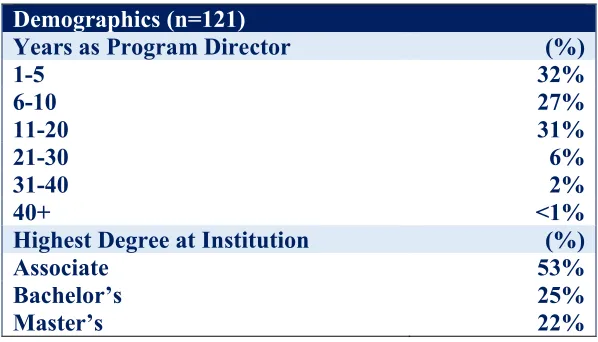
Three-hundred thirty-two subjects were recruited, 129 chose to participate, and 121 competed the survey, for a response rate of 36%. Demographic information was reported in (Table 1). The majority of respondents (60%) served as a dental hygiene program director for ten years or less and the majority (53%) reported the highest dental hygiene degree offered at their learning institution as an Associate Degree.
4.2 Analysis of OSCE Utilization in U.S. Dental Hygiene Programs
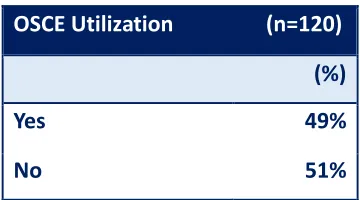
An aim of this study was to evaluate whether dental hygiene program directors utilize OSCEs in their program curricula to assess the clinical performance of their students. The results showed that nearly half of program directors 49% (n=59) reported incorporating OSCEs in program curricula (Table 2). When comparing degree level to OSCE utilization, master’s degree programs reported the highest percentage of utilization 65% (n=17) compared to bachelor’s 48% (n=14) and associate programs 43% (n=28).
16
4.3 Analysis of Reported Barriers of OSCE Utilization by Program Directors
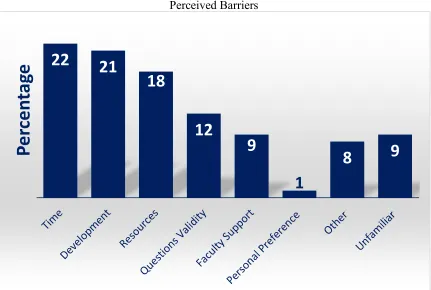
Of the total respondents, 51% (n=61) reported that they do not currently utilize OSCEs in their dental hygiene curricula. These respondents were then asked to identify the barriers that best supported why their programs do not utilize OSCEs and to select all that applied. Time (22%), evidence-based development processes (21%), and resources (18%) were most frequently reported, while 9% reported that they were unfamiliar with OSCEs (Figure 3).
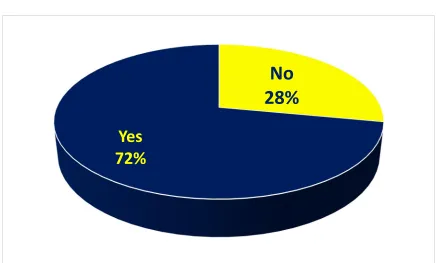
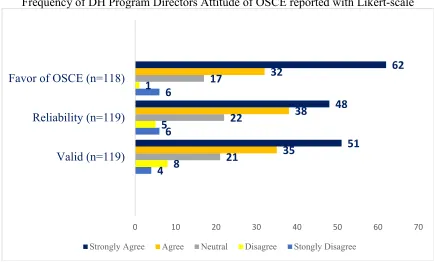
4.4 Analysis of Program Directors’ Awareness of and Attitude toward the DLOSCE The final aim of this study was to assess dental hygiene program directors’ awareness of the DLOSCE and their attitudes toward such a change. Nearly a third of program directors were unaware of the developing DLOSCE (figure 4), however 80% were in favor of the change (Figure 5). Furthermore, 72% of respondents reported OSCE as reliable and valid methods for evaluating clinical performance of dental hygiene students (Figure 5).
17
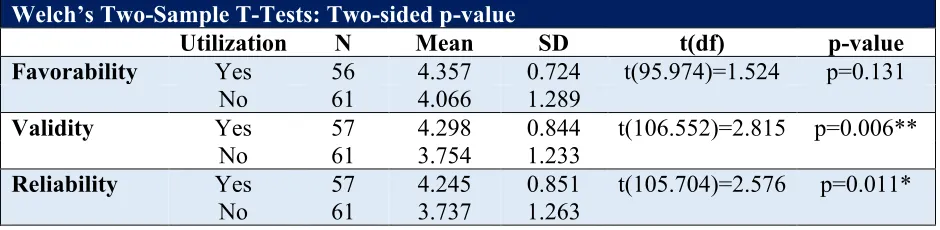
significantly higher ratings (M= 4.245, SD= 0.851) than directors who did not use OSCEs ((M=3.737, SD= 1.263); t(105.704)=2.576, p= 0.011). Significance was set at (p= 0.05).
OSCE Favorability, Years as Program Director, and Degrees Offered Two ANOVA tests were conducted to compare if the number of years as program director or the highest dental hygiene degree offered at an institution effected favorability of replacing LPE with an OSCE. No significant difference between the average favorability rating among program directors based on ranges of years of service were observed (f (5,12) =0.336, p=0.890). There was also no
18 Chapter 5 Discussion 5.1 Summary
OSCEs have been a trusted tool to assess the clinical performance of dental students for decades.14 In light of recent clinical licensure changes for dentistry and due to significant gaps in the literature regarding OSCE utilization in dental hygiene programs, the overarching goal of this thesis research project was to twofold, (a) to obtain primary data from dental hygiene program directors regarding the current utilization and perceived barriers of OSCEs in dental hygiene programs across the U.S., (b) to obtain feedback regarding program director’s awareness of and attitudes toward the elimination of the long-standing single-encounter patient-based dental licensure exam and the subsequent DLOSCE.
In this study, nearly half (49%) of program directors reported utilizing OSCEs in their program which is considerably less than the Navicki’s 2009 national study which reported 59% of program directors used of OSCEs in their dental hygiene curricula.39 Though this study cannot confirm a decrease in OSCE utilization nationally, there does not seem to be a positive trend in the growth of OSCE utilization over the past decade.
19
however, workloads do not permit the time needed to develop such an assessment. This echo’s the time constraint responses reported in this study.
There are decades of evidence in the literature supporting the validity of OSCE assessments as best practices. In fact, between 2011 and 2016, over 400 articles were
published.36 Despite this evidence, more than half of program directors in this study reported not utilizing OSCEs within their curricula, with approximately 9% unsure of what an OSCE is. It would be worthwhile to examine how these program directors obtain information and stay current in regarding trends in dental hygiene education such as the use of OSCE, and alternative clinical competency assessment strategies. Of those not currently utilizing OSCEs, there was concern regarding a lack of best practices in OSCE development. The design of an OSCE is crucial to its success, and the desire for an understanding of best practices is a valid concern.
The results of this survey showed that dental hygiene program directors who currently utilized OSCE assessments in their curricula had a statistically significant belief of OSCE as a valid and reliable means to assess clinical performance in dental hygiene students. This begs further investigation as to why this contradiction exists in the knowledge and understanding of OSCE implementation across DH program directors.
Furthermore, this is of concern considering that OSCEs have been used in dental education for many years and is now becoming the center of a new pathway to licensure in dentistry. Interestingly, even though half respondents do not use OSCEs in their curriculum, 80% are in favor of replacing live patient testing with OSCEs for licensure. These results are
20
The decision to develop the DLOSCE is based on the consistent evidence that OSCEs are the gold standard among clinical assessments for their ability to expose clinical and didactic strengths and weaknesses, in addition to enriching student learning.46,1,5 This firmly counters the argument that an LPE is the only valid way to determine competency for clinical practice in dentistry. By the same rationale, it begs the question of the validity of how we currently assess student performance in clinical education settings. In clinic, student assessments are dependent on the often-unknown patient presenting and the faculty member performing the assessment which introduces a host of variability and subjectivity across the assessment. Alternatively, OSCE assessments remove the often unpredictable and unreliable variables of standard clinical patient-based graded assessments.36
While the OSCE has been firmly established, as a valid, reliable and practical way to assess the clinical performance, it is not the only option.36 After the Coalition for Licensure Reform disseminated its report, ADEA began the development of a compendium of clinical competency assessments that will determine the competency of graduates from dental education programs.47 Additionally, ASDA published its White Paper calling for the elimination of LPE while providing alternative methods to assess the clinical competence of dental students.23
With the implementation of the DLOSCE in 2020, the dental hygiene licensure exam will be the only healthcare licensure examination that requires the use of human beings as
21
requirements to determine clinical competency and readiness to safely serve the public.31 This earlier finding supports the efforts of ADEA to create a compendium of clinical competency assessments, and presents opportunity for dental hygiene educators to take a lead in shaping how these changes will impact dental hygiene education and licensure.
Licensure change is likely on the horizon for dental hygiene licensure, therefore it is crucial to consider standardizing the use of OSCE assessments in all dental hygiene programs. The development of a dental hygiene OSCE consortium or standardized dental hygiene OSCE guidelines or blueprints would be effective tools to mitigate the barrier of time constraints, development processes and resources that were identified within this study. Implementing OSCEs throughout a students’ dental hygiene education can be an effective, valid, and reliable way to not only accurately assess clinical performance but can also serve to dental hygiene education programs for the potential changes to licensure. As the Coalition for Reform in Dental Licensure prepares to lobby state boards of dentistry for dental licensure, dental hygiene
educators must actively prepare its programs for similar licensure changes. 5.2 Limitations
22 5.3 Suggestions for Future Research
23 Chapter 6 Conclusion
25
1. Cosby JC. The American board of dental examiners clinical dental licensure examination: A strategy for evidence-based testing. J Evid-Based Dent Pract. 2006 Mar 1;6(1):130–7.
2. Lantzy MJ, Muzzin KB, DeWald JP, et al. The ethics of live patient use in dental hygiene clinical licensure examinations: A national survey. J Dent Educ. 2012 Jun 1;76(6):667–81.
3. Buchanan RN. Problems related to the use of human subjects in clinical
evaluation/responsibility for follow-up care. J Dent Educ. 1991 Dec;55(12):797–801.
4. Gambacorta JE, Glick M, Anker AE, et al. The Buffalo model: Shifting the focus of clinical licensure exams in dentistry to address ethical concerns regarding patient care. J Dent Educ. 2016 Jun 1;80(6):641–7.
5. Formicola A, Shub J, Murphy F. Banning live patients as test subjects on licensing examinations [Internet]. 2002 [cited 2018 Feb 8]. Available from:
https://pdfs.semanticscholar.org/13b5/b0e5b37295599271e16c32ada2dfb324bbcf.pdf
6. Solana K. Shifting focus on patients: New licensure exam seeks to address ethical dilemmas [Internet]. American Dental Association. 2016 [cited 2019 Jun 16]. Available from:
https://www.ada.org/en/publications/ada-news/2016-archive/august/shifting-focus-on-patients
7. National Board Dental Examination, Part II 2017 Guide [Internet]. [cited 2018 Feb 8]. Available from:
http://www.ada.org/~/media/JCNDE/pdfs/nbde02_examinee_guide.pdf?la=en
8. National Board of Dental Examination, Part I 2017 Guide [Internet]. 2017 [cited 2018 Feb 8]. Available from:
http://www.ada.org/~/media/JCNDE/pdfs/nbde01_examinee_guide.ashx
9. Report of the Task Force on Assessment of Readiness for Practice [Internet]. [cited 2018 Sep 7]. Available from: https://www.adea.org/tarpreport/
10. Harden RM, Stevenson M, Downie WW, et al. Assessment of clinical competence using objective structured examination. Br Med J. 1975 Feb 22;1(5955):447–51.
26
11. Rushforth HE. Objective structured clinical examination (OSCE): Review of literature and implications for nursing education. Nurse Educ Today. 2007 Jul 1;27(5):481–90.
12. Aronowitz T, Aronowitz S, Mardin-Small J, et al. Using objective structured clinical examination (OSCE) as education in advanced practice registered nursing education. J Prof Nurs. 2017 Mar 1;33(2):119–25.
13. Gerrow JD, Murphy HJ, Boyd MA, et al. Concurrent validity of written and OSCE components of the Canadian dental certification examinations. J Dent Educ. 2003 Aug;67(8):896–901.
14. Graham R, Bitzer LAZ, Mensah FM, et al. Dental student perceptions of the educational value of a comprehensive, multidisciplinary OSCE. J Dent Educ. 2014 May 1;78(5):694– 702.
15. Park SE, Kim A, Kristiansen J, et al. The influence of examiner type on dental students’ OSCE scores. J Dent Educ. 2015 Jan 1;79(1):89–94.
16. United States Medical Licensing Examination | USMLE Bulletin | Overview [Internet]. [cited 2018 Feb 2]. Available from: http://www.usmle.org/bulletin/overview/#TestFormat
17. Licensure Pathways [Internet]. [cited 2018 Feb 8]. Available from:
https://www.ada.org/en/education-careers/licensure/licensure-dental-students/licensure-pathways
18. Dental Licensure Objective Structured Examination FAQ [Internet]. American Dental Association. [cited 2018 Feb 8]. Available from: https://www.ada.org/en/education-careers/objective-structured-clinical-examination
19. MCCQE Part II | Medical Council of Canada [Internet]. [cited 2018 Feb 2]. Available from: http://mcc.ca/examinations/mccqe-part-ii/
20. Black R, Waldschmidt D. The DLOSCE: A national standardized high-stakes dental licensure examination [Internet]. American Dental Association; 2018 [cited 2018 Mar 23]. Available from:
27
21. DLOSCE [Internet]. [cited 2019 May 5]. Available from:
https://www.ada.org/en/education-careers/dental-licensure-objective-structured-clinical-examination?utm_source=adaorg&utm_medium=vanityurldlosce
22. American Dental Hygienists’ Association. ADEA dental hygiene clinical licensure survey summary and results [Internet]. Washington, DC; 2016 Sep [cited 2019 Jan 28] p. 8. Available from:
https://www.adea.org/uploadedFiles/ADEA/Content_Conversion/Allied/Clinical-Licensure-Survey-Summary-and-Results.pdf
23. American Student Dental Association. Use of human subjects in clinical licensure examinations: a white pages of the American Student Dental Association [Internet]. American Student Dental Association; 2016 [cited 2019 Jun 30]. Available from:
https://www.asdanet.org/docs/advocate/issues/asda_white-paper_licensure_web_final.pdf?sfvrsn=18
24. Kalkwarf KL. Ho the licensure process will evolve. J Am Dent Assoc. 1999 Dec 1;130(12):1737–42.
25. Abdelkarim A, Sullivan D. Attitudes and perceptions of U.S. dental students and faculty regarding dental licensure. J Dent Educ. 2015 Jan 1;79(1):81–8.
26. American Dental Education Association. Moving toward a national clinical licensure exam? a status report. ADEA Bull Dent Educ [Internet]. 2005 Jan [cited 2019 Jul 5];38(1). Available from:
https://www.adea.org/ADEA/Blogs/Bulletin_of_Dental_Education/Moving_Toward_a_Nat ional_Clinical_Licensure_Exam__A_Status_Report.html
27. Gerrow JD, Murphy HJ, Boyd MA, et al. An analysis of the contribution of a patient-based component to a clinical licensure examination. J Am Dent Assoc 1939. 2006
Oct;137(10):1434–9.
28. New National Board Dental Examination to begin in 2020 [Internet]. [cited 2019 Jul 6]. Available from: https://www.ada.org/en/publications/ada-news/2018-archive/june/new-national-board-dental-examination
28
30. Lasky RE, Shub JL. Dental licensure reaches a crossroads: the rationale and method for reform. J Dent Educ. 2003 Mar 1;67(3):295–300.
31. Fleckner LM, Rowe DJ. Assuring dental hygiene clinical competence for licensure: A national survey of dental hygiene program directors. Am Dent Hyg Assoc. 2015 Feb 1;89(1):26–33.
32. Chu T-MG, Makhoul NM, Silva DR, et al. Should live patient licensing examinations in dentistry be discontinued? two viewpoints: viewpoint 1: alternative assessment models are not yet viable replacements for live patients in clinical licensure exams and viewpoint 2: ethical and patient care concerns about live patient exams require full acceptance of justifiable alternatives. J Dent Educ. 2018 Mar 1;82(3):246–51.
33. Dugoni AA. Licensure--entry-level examinations: Strategies for the future. J Dent Educ. 1992 Jan;56(4):251–3.
34. Mills EA. Non-patient-based clinical licensure examination for dentistry in Minnesota: Significance of decision and description of process. J Dent Educ. 2016 Jun;80(6):648–51.
35. American Dental Hygienists’ Association. American Dental Hygienists’ Association supports the elimination of a patient procedure based single encounter clinical licensure Examination [Internet]. 2018 [cited 2019 Jul 1]. Available from:
https://www.adha.org/resources-docs/single_encounter_exam_changes_v2.pdf
36. Harden R, Stevenson M, Downie W, et al. Assessment of clinical competence using objective structured examination [Internet]. 1975 [cited 2018 Feb 8]. Available from: https://drive.google.com/drive/folders/10xiMDI0n_8RSl112HxSitQ0yGyHSP6Ix
37. Khan KZ, Ramachandran S, Gaunt K, et al. The Objective Structured Clinical Examination (OSCE): AMEE Guide No. 81. Part I: an historical and theoretical perspective. Med Teach. 2013 Sep;35(9):e1437–46.
38. Miller GE. The assessment of clinical skills/competence/performance. Acad Med J Assoc Am Med Coll. 1990 Sep;65(9 Suppl):S63–7.
39. Navickis MA, Bray KK, Overman PR, et al. Examining clinical assessment practices in U.S. Dental Hygiene Programs. J Dent Educ. 2010 Mar 1;74(3):297–310.
29
40. Sturpe DA. Objective Structured Clinical Examinations in Doctor of Pharmacy programs in the United States. Am J Pharm Educ [Internet]. 2010 Oct 11;74(8). Available from:
https://www.ncbi.nlm.nih.gov/pmc/articles/PMC2987288/
41. Solà M, Pulpón AM, Morin V, et al. Towards the implementation of OSCE in undergraduate nursing curriculum: A qualitative study. Nurse Educ Today. 2017 Feb;49:163–7.
42. Graham R, Bitzer LAZ, Anderson OR. Reliability and predictive validity of a
comprehensive preclinical OSCE in dental education. J Dent Educ. 2013 Feb 1;77(2):161– 7.
43. Kerkstra R, Giblin-Scanlon L, Smallidge D, et al. Assessing dental hygiene students’ test anxiety in examiner-ddministered vs. camera-supervised OSCEs: A pilot study. J Dent Educ. 2018 Sep;82(9):968–73.
44. McComas MJ, Wright RA, Mann NK, et al. M-OSCE as a method to measure dental hygiene students’ critical thinking: A pilot study. J Dent Educ. 2013 Apr 1;77(4):485–93.
45. Cannick GF, Horowitz AM, Garr DR, et al. Use of the OSCE to evaluate brief
communication skills training for dental students. J Dent Educ. 2007 Sep;71(9):1203–9.
46. Schoonheim-Klein M, Muijtjens A, Habets L, et al. On the reliability of a dental OSCE, using SEM: effect of different days. Eur J Dent Educ Off J Assoc Dent Educ Eur. 2008 Aug;12(3):131–7.
31 Table 1
Dental Hygiene Program Directors’ Demographics
Demographics (n=121)
Years as Program Director (%)
1-5 32%
6-10 27%
11-20 31%
21-30 6%
31-40 2%
40+ <1%
Highest Degree at Institution (%)
Associate 53%
Bachelor’s 25%
32 Table 2
Utilization of OSCE in Dental Hygiene Programs
OSCE Utilization (n=120)
(%)
Yes 49%
33 Table 3
Comparison of mean ratings of attitudes between program directors who did and did not utilize OSCEs
Welch’s Two-Sample T-Tests: Two-sided p-value
Utilization N Mean SD t(df) p-value
Favorability Yes 56 4.357 0.724 t(95.974)=1.524 p=0.131 No 61 4.066 1.289
Validity Yes 57 4.298 0.844 t(106.552)=2.815 p=0.006** No 61 3.754 1.233
Reliability Yes 57 4.245 0.851 t(105.704)=2.576 p=0.011* No 61 3.737 1.263
35 Figure 1
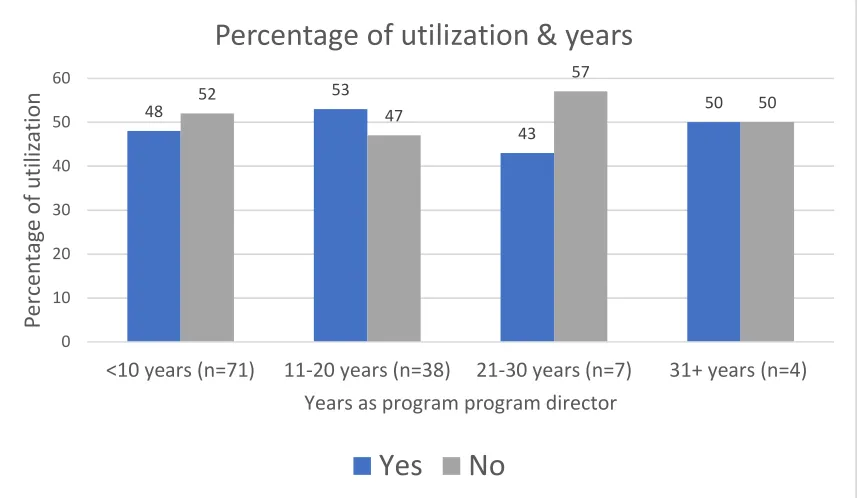
Trends of OSCE Utilization
48 53 43 50 52 47 57 50 0 10 20 30 40 50 60
<10 years (n=71) 11-20 years (n=38) 21-30 years (n=7) 31+ years (n=4)
P ercen tag e of ut iliz ation
Years as program program director
Percentage of utilization & years
36 Figure 2 OSCE Utilization
20
18
4
8
5
16
11
12
6
Per
ce
n
37 Figure 3 Perceived Barriers
22
21
18
12
9
1
8
9
P
er
cen
tag
38 Figure 4
Percentage of DH Program Directors Aware of DLOSCE Development (n=118)
No
28%
39 Figure 5
Frequency of DH Program Directors Attitude of OSCE reported with Likert-scale
4 6 6
8 5 1
21 22 17
35 38 32
51 48
62
0 10 20 30 40 50 60 70
Valid (n=119) Reliability (n=119) Favor of OSCE (n=118)
41 Appendix A
Survey
How many years have you served as a Dental Hygiene Program Director? 1-5 years
6-10 years 11 - 20 years 21-30 years 31-40 years 40 +
What is the highest degree offered in dental hygiene at your institution? Associate degree
Bachelor's degree Master's degree
Do you currently incorporate OSCEs within your curriculum? Yes
No
How and/or when are OSCEs used to assess clinical competence in your program? Select all that apply.
Pre-Clinic
Clinic (competencies, test cases, proficiencies) Mid-Term Exam
Final Exam
Computer Simulated
Patient Assessment (medical history, treatment plan)
Patient Management (patient concerns, best practice of care) End of semester clinical competency
As a requirement for graduation
Which of these reasons best supports why your program does not currently incorporate OSCEs within the curriculum? Select all that apply.
42 Unsure how to best develop an OSCE
Unsure of the validity of an OSCE Lack of faculty support
Personal preference Time
Resources Other
Are you aware of the partnership between the ADA and ADEA to develop an OSCE to replace live patient board examinations for licensure?
Yes No
Please indicate how strongly do you agree or disagree with each of the following statements?
Strongly
agree Agree
Neither agree nor
disagree Disagree
Strongly disagree I am in favor of
replacing live patient testing with OSCE’s for
licensure.
I feel OSCE’s are a valid method for assessing clinical competence in dental hygiene students.
I feel OSCE’s are a reliable mean of measuring clinical competence in dental hygiene students.
43
44 Appendix B Informed Consent
In a joint effort to replace patient-based licensure exams, Objective Structured Clinical Examinations (OSCEs) are being explored as an option for dental licensure by the American Dental Association and the American Dental Education Association.
The objective of this study is to gain an understanding of dental hygiene program
directors' experience and perceptions of utilization of OSCEs within their curricula. You will be presented with information relevant to OSCEs and asked to answer questions about it. Please be assured that your responses will be kept completely confidential.
This survey has been deemed exempt from oversight by the University of Michigan IRB (HUM00148962). The survey should take you approximately five minutes to complete. Your participation in this research is voluntary. You have the right to withdraw at any point during the study, for any reason, and without any prejudice. Please complete the survey by Tuesday, July 31, 2018. If you would like to contact the Principal Investigator in the study to discuss this research, please e-mail Dr. Danielle Furgeson at [email protected].
By clicking the button below, you acknowledge that your participation in the study is voluntary, you must be a legal adult in the state where you live, and that you are aware that you may choose to terminate your participation in the study at any time and for any reason.