© 2015, IRJET ISO 9001:2008 Certified Journal Page 854
Controlling of Distribution Voltage for DC Micro-grids Using MRAS,
Fuzzy Control and Gain-Scheduling Technique
A.Ganesh
1, M.Balaji Naik
21
PG Scholar, Department of EEE, JNTU Anantapur, Andhra Pradesh, India
2
PG Scholar, Department of EEE, JNTU Anantapur, Andhra Pradesh, India
---***---Abstract -
Micro-grid is a novel conceptual power system for smooth installation of many Distributed Generators which is used for distributing the power in order to provide high quality. The most of micro-grids adopt ac distribution as well as conventional power systems, in these days dc micro-grids have gained more popularity because DC output type sources such as photovoltaic (PV) system, fuel cell and energy storages can be interconnected to distribution system without any converters. So the conversion losses are reduced from source to load which leads increase system efficiency and high-quality power can be supplied continuously even though voltage sags or blackouts occur in utility grids. Low-voltage bipolar type DC micro-grid is used with one energy storage unit with a converter to maintain the DC bus voltage. Gain scheduling control technique adopted as droop controller for adding energy storage units for sharing output powers. If the DC micro-grid has two or more energy storage units and those converters can be operated in parallel, it contributes to the voltage regulation and system redundancy. If the converters connect to energy storage units, the controller should consider not only the output power balance, but also the stored energy. If gain scheduling control technique is adopted to share the storage unit outputs, the storage energy would become unbalanced. The energy storage units are selected by fuzzy controller for stored energy balance to carry out the operation of grid under an unbalanced condition of the stored energy. In general, the droop controller detects the output power or current as a feedback parameter, and the deviation of DC voltage is controlled in proportion to the output power.This paper presents a new control that combines MRAS, Fuzzy control with gain scheduling to accomplish both power sharing and energy management by using current as feedback parameter.
Index Terms
—DC power systems, Fuzzy control,Gain-scheduling control, micro-grids, MRAS.
1.
INTRODUCTION
Energy and environmental problems such as greenhouse gas, growth of energy demand and depletion of energy resources (fossil fuels, coal, etc.) are remarkably concerned in recent years. A large number of distributed generations (DGs) are being installed into power systems in order to accomplish the above problems. Depending on the common bus voltage the micro-grids are classified as AC and DC. During past decade DC micro-grid field has started attracting considerable attention. Particularly due to a potential of bringing many advantages such as higher efficiency, continuous of power supply, more natural interface of Renewable Energy Sources, better compliance with consumer electronics, etc. Furthermore, reactive power flow, power quality and frequency control are not an issue in DC systems, making the corresponding primary control notably less complex than its AC version. Currently, most common applications of dc micro-grids are electrical power supply of isolated systems like vehicles, space crafts, data centers, telecom systems or rural areas.
Low-voltage bipolar type DC micro-grid is used with one energy storage unit with a DC/DC converter to maintain the DC-bus voltage. Gain scheduling control technique adopted as droop controller for adding energy storage units for sharing power outputs. If the DC micro-grid has two or more energy storage units and those converters can be operated in parallel, it contributes to the voltage regulation and system redundancy. If the converters connect to energy storage units, the controller should consider not only the output power balance, but also the stored energy. If gain scheduling control technique is adopted to share the storage unit outputs, the storage energy would become unbalanced.
© 2015, IRJET ISO 9001:2008 Certified Journal Page 855 fuzzy control was applied to maximum power point
tracking control of a photovoltaic system in an isolated micro-grid to improve the response against rapidly changing weather conditions.
Sometimes conventional feedback controllers may not perform well because of the variation in process dynamics due to nonlinear actuators, changes in environmental conditions and variation in the character of the disturbances. In this paper, we propose a novel control method that combines MRAS with fuzzy control, gain-scheduling control technique by taking current as feedback parameter in order to accomplish both power sharing and energy management simultaneously. The simulation results show that the DC distribution voltages were within 340 V ± 5%, and the energy ratios of the storage units were approximately equal.
2. DC MICROGRID FOR A RESIDENTIAL COMPLEX
A. System Configuration
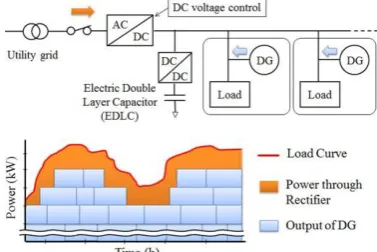
Renewable Energy Sources integrated together with other distributed generation (DG) are steadily becoming more competitors in new electricity grids because it had gained popularity. Fig. 1 shows a proposed DC micro-grid for a residential complex. These system consists of around 50–100 houses, each having a micro combined heat and power unit which is called micro-CHP unit, such as a gas engine or a fuel cell. The micro-CHP units are connected to a DC distribution line (3 wired, ±170 V), and the output electric power is shared among the houses. Cogenerated hot water is either used by individual house or shared between adjacent houses. By using Rectifier circuit the utility grid is connected to the system. At the load side, various forms of electric power (such as AC 100 V and DC 48 V) can be obtained by using various type converters. Electric Double Layer Capacitors (EDLCs) are used as the main energy storage unit because of having more advantages such as fast response, easy measurement of the stored energy, safety (especially compared with Li-ion batteries) and no toxicity of the constituent materials. If energy storage system using an EDLC unit, the voltage and maximum energy limits are 500 V and 5 MJ, respectively. So EDLC is considered viable as an energy storage system in a small grid. The capital cost per kilowatt-hours (kWh) for EDLC is 300–2000 dollars, while that for lead-acid and Li-ion batteries is 200–400 and 600–2500 dollars, respectively. The capital cost per kWh-per cycle for EDLC is 2–4 cents, while that for lead-acid and Li-ion batteries is 20–100 and 15–100 cents, respectively. EDLCs having more life compared to others because it can handle many charge–discharge cycles as well as low cost per cycle. The capital cost per kWh-per
[image:2.595.320.544.226.379.2]cycle for EDLC is 2–4 cents, while that for lead-acid and Li-ion batteries is 20–100 and 15–100 cents, respectively. The disadvantage of EDLC is its low-energy density. If a large energy capacity is needed for a micro-grid, a relatively large EDLC is required. However, a large-energy capacity is not necessary for the proposed DC micro-grid because the micro-CHP units are operated to prevent over charge/discharge of the EDLCs as described in the following section.
Fig. 1 System configuration of the DC micro-grid for a residential complex
B. System Operation
1. Interconnected operation
Fig. 2 shows interconnected operation of dc micro-grid. By changing the number of running micro-CHP units the total output power of micro-CHP units can be controlled. When the system is connected to the utility grid, any deficiency in the power supplied by the micro-grid is compensated by the power from the utility micro-grid as shown in Fig.2. In the interconnected operation, the rectifier controls the DC distribution voltage, and the supervisor computer changes the number of the running micro-CHP units such that the power from the utility grid is within the contract demand. In addition, the supervisor computer decides the order of the operation of the micro-CHP units so as to meet the heat commitment.
[image:2.595.338.527.611.737.2]© 2015, IRJET ISO 9001:2008 Certified Journal Page 856
2. Intentional islanding operation.
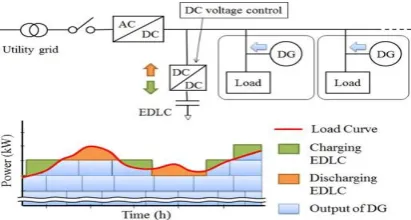
Fig.3 shows Intentional islanding operation of dc micro-grid. When the system is disconnected from the utility grid, the surplus, or deficient power is compensated by the EDLC. The DC distribution voltage in intentional islanding operation is controlled by EDLC converter controls and the number of the operating micro-CHP units is determined by not only the load consumption, but also the stored energy of the EDLCs.
Fig. 3. Intentional islanding operation.
When the stored energy in the storage devices exceeds a maximum limit, the system stops one of the operating micro-CHP units. Then the total output power of the micro-CHP units becomes less than the load consumption and the EDLC discharges until less than the minimum limit of stored energy. On this basic, when the stored energy falls under the minimum limit, the system starts a micro-CHP unit. Then the total output power of micro-CHP units becomes more than the load consumption, and the EDLC charges until the stored energy exceeds the maximum limit. In intentional islanding operation these two modes are repeated alternately. The heat commitment is not fundamentally considered in intentional islanding operation because continuous electricity supply is a priority during the operation. The energy storage unit does not need a large capacity, if this system chooses the suitable micro-CHP units that can start up in a few minutes. Therefore, EDLC can be a candidate of the main energy storage unit in this system.
C. DC Voltage Control
According to the system operation in previous section in the interconnected operation the DC distribution voltage is normally controlled by a grid connected rectifier. The DC/DC converters of the storage systems are controlled to maintain the DC distribution voltage within a specified range. In intentional islanding operation, the DC/DC converters of the storage systems need to maintain the DC distribution voltage. Gain scheduling control technique adopted as droop controller for adding energy storage units for sharing power outputs.
If the DC micro-grid has two or more energy storage units and those converters can be operated in parallel, it contributes to the voltage regulation and system redundancy. if the converters connect to energy storage units, the controller should consider not only the output power balance, but also the stored energy. If gain scheduling control technique is adopted to share the storage unit outputs, the storage energy would become unbalanced. The energy storage units for charge or discharge of power are selected by fuzzy controller for stored energy balance to carry out the operation of grid under an unbalanced condition of the stored energy.
Adaptive control is one of the widely used control strategies to design advanced control systems for better performance and accuracy. Model Reference Adaptive Control (MRAC) is a direct adaptive strategy with some adjustable controller parameters and an adjusting mechanism to adjust them.
In general, the droop controller detects the output power or current as a feedback parameter, and the deviation of DC voltage is controlled in proportion to the output power. This paper presents a new control that combines MRAS, Fuzzy control with gain scheduling to accomplish both power sharing and energy management by using current as feedback parameter.
3.
CONTROL STRATEGY OF CONVERTER FOR ENERGY
STORAGE UNIT
[image:3.595.55.261.230.340.2]Fig. 5 shows the circuit and proposed control diagram of a DC/DC converter for energy storage devices. The circuit designed as to be symmetric with respect to the neutral line, because the converter is supposed to function as a voltage balancer under the appropriate control.
Fig.5. Control for DC/DC converter for energy storage.
A. Gain-Scheduling Control Technique for Output
Power Sharing:
[image:3.595.338.546.539.685.2]© 2015, IRJET ISO 9001:2008 Certified Journal Page 857 sharing output powers. If the DC micro-grid has two or
more energy storage units and those converters can be operated in parallel, it is difficult to achieve good voltage regulation and output power sharing at the same time. As illustrated in Fig. 6, for better voltage regulation the controller requires a higher DC gain, but it can decrease load sharing. Therefore, by adopting Gain Scheduling Control Technique the gain Kc value controlledaccording to the output power in order to obtain better voltage regulation and load sharing simultaneously.
Fig.6. Droop control feature.
The steady-state DC voltage error can be determined by simulating the Fig.7 by changing the gain Kc or the output power. Fig. 7 and Table I shows the circuit, control diagram, and parameters for the simulation. The rated output voltage and capacity were 340 V and 3 kW, respectively.
Fig.7. Circuit and control diagrams to obtain the relation between the steady state error and the gain Kc TABLE1
PARAMETERS
CEDLC1 18 F C1 1500 µF
REDLC1 0.16 Ω C2 220 µF
LEDLC1 7 mH CDG 220 µF
K1 14 Cload 1500 µF
The steady-state error of the dc voltage becomes larger when the load is heavier or the gain Kc is smaller and the steady-state error of the dc voltage becomes smaller when the load is low or the gain Kc is heavier as shown in Fig. 8.
Fig.8. Gain-DC/DC converter output power characteristics (Voltage variation 2%).
If the variation in the DC voltage is permitted within 2% then it is easy to obtain the relation between the gain Kc and output power (per unit) as shown in Fig. 8. The gain Kc can be expressed by a linear function of the output power. Similarly, we can obtain the relation between the gain and input power when the voltage variation is permitted within 2%.
Fig.9. Gain-DC/DC converter input power characteristics (Voltage variation 2%).
© 2015, IRJET ISO 9001:2008 Certified Journal Page 858 Kc = max (1.3 |Pout |, 0.1) ---(1)
Where, Pout-output power (p.u.), Kc-gain and the input power is expressed by a negative number, and the minimum value of gain Kc is determined as 0.1. This gain-scheduling control allows better load sharing and voltage regulation simultaneously. However, a stored energy control is also needed for the converter energy storage unit device to prevent a surplus or deficient of stored energy.
B. Fuzzy Control for Stored Energy Balancing
The energy storage units are selected by fuzzy controller for stored energy balance to carry out the operation of grid under an unbalanced condition of the stored energy. The DC voltage control that incorporates a Fuzzy control which changes the DC voltage reference to balance the stored energy. The membership functions of fuzzy control are showed in Fig. 10.The input Xkis the ratio of the stored energy and the average of all stored energies is obtained as follows.
Wk is the charged energy of the kth EDLC bank, which is described as follows:
Where,
n --total number of EDLC banks, Ck --Capacitance of the kth EDLC bank, vk --voltage of the kth EDLC bank,
Vmax--maximum operation voltage of EDLC banks
Vmin--minimum operation voltage of EDLC banks In order to obtain the dc voltage reference , initially the value of Xk is calculated from equations (2) and (3). Then, a membership value is calculated from the membership function of PB, PS, Z, NS, and NB. The DC voltage reference is obtained from the resulting membership function finally. For example, if X1 is 1.7, the values of PS and PB in the antecedent membership function are 0.4 and 0.6 respectively.
Fig.10. Membership functions of fuzzy control. The value of V*dc of EDLC1 is calculated from the consequent membership function as follows
V*dc= 345 x 0.4 + 350 x 0.6 = 348 [V]---(4) If assumed that the DC-distribution voltage has a tolerance of ±5% with reference to AC systems then upper and lower reference should be within limits of 3% because the gain-scheduling control includes a tolerance of ±2%. Therefore, the upper and lower limit was selected 350 V and 330 V in the membership function of consequent, respectively. An isosceles triangle is usually used as a membership function. However, to realize a good voltage regulation, the peaks of PS and NS in the antecedent are shifted to 1.1 and 0.9, respectively. Initially membership function is obtained from the above numerical values is fuzzy rule was determined on the basis of experience, its effectiveness results was demonstrated through simulations described in the following sections.
C. MRAS for current control
Model Reference Adaptive Control strategy is used to design the adaptive controller that works on the principle of adjusting the controller parameters so that the output of the actual plant tracks the output of a reference model having the same reference input. The droop controller detects the output power or current as a feedback parameter, and the deviation of DC voltage is controlled in proportion to the output power. Sometimes conventional feedback controllers may not perform well online because of the variation in process dynamics due to nonlinear actuators, changes in environmental conditions and variation in the character of the disturbances. Current taken as adjustable parameter which is varying proportional to output power and it is adjusted with the adoptive gain.
4. SIMULATION
A. Simulation Results of Proposed Method
© 2015, IRJET ISO 9001:2008 Certified Journal Page 859 stored energy ratio, the current from EDLC, and the
terminal voltage of EDLC are showed in Fig. 14. From the results the maximum voltage of Vdc(EDLC1) and Vdc(EDLC2) was 348 V which was about 340 V+3%, and the minimum voltage of them was 332 V which was about 340V–2%. The distribution voltages at the output converter of the EDLCs were within limits 340V±2% but the stored energy of EDLCs was not balanced and the maximum of the ratio (W2/W1) reached 4.2.
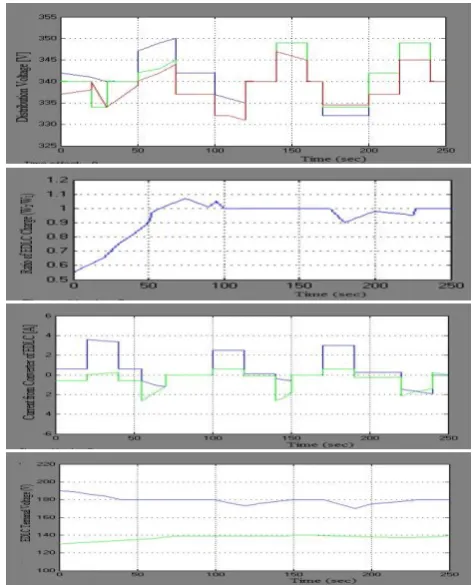
The Gain Scheduling Control Technique and fuzzy control simulation results of the DC distribution voltage, the stored energy ratio, the current from EDLC, and the terminal voltage of EDLC are showed in Fig. 15.The stored energy ratio tended to be 1.The EDLC currents were different from those used in Fig. 14 because EDLC2 had 1.3 times energy at the initial state. EDLC2 initially discharged its power to minimum limit and then the energies to maximum limit of both EDLCs balanced at around 80s.
Fig.14. Simulation results (gain-scheduling control only) (Initial condition W2 /W1 ≈ 2).
Due to stored energy ratio unity the EDLC terminal voltages, VEDLC1 and VEDLC2 are different. The maximum and
the minimum distribution voltages at the output converters of the EDLCs are 349.9 and 331.7 V, respectively. Although the range of the voltage was a little wider than the previous results, the range was within 340V±3%, which was satisfied with the assumed specification (340 V±5%) described in Section III-B.
Fig.15.Simulation results (gain-scheduling control and fuzzy control) (Initial condition W2 /W1 =2).
B. Simulation Results of Droop Control
© 2015, IRJET ISO 9001:2008 Certified Journal Page 860 conditions. The Gain Scheduling Control Technique and
droop control results of the DC distribution voltage, the stored energy ratio, the current from EDLC, and the terminal voltage of EDLC are showed in Fig. 17 when Kv was set to 50. Stored energy ratio tended to be about 1 and energies are balanced around 80s which was same as the results of the Fuzzy control shown in Fig. 15.
Fig.16. Simulation results (gain-scheduling control and droop control, Kv = 10) (Initial condition W2/W1=2).
C. Comparison between Fuzzy Control and Droop
Control
By keeping same configuration, parameters and gain values simulation was conducted with the exchanged all parameters of EDLC1 and EDLC2. That is, EDLC1 (rated voltage-216 V and rated capacitance -18.75 F) and EDLC2 (rated voltage-160 V and rated capacitance-18 F). The minimum voltage of both EDLCs was also set to be 100 V, and the initial voltages of EDLC1 and EDLC2 were 200V and 125 V, respectively. Therefore, the initial stored energy ratio (W2 /W1) was about 0.5.
Fig.17. Simulation results (gain-scheduling control and droop control, Kv = 50) (Initial condition W2 /W1 ≈ 2).
The Gain Scheduling Control Technique and droop control results of the DC distribution voltage, the stored energy ratio, the current from EDLC, and the terminal voltage of EDLC are showed in Fig. 18 when Kv was set to 50. Stored energy ratio tended to be 1and it exceeded up to 1.05 around 75 s. the stored energy ratio returned to 1 and again it dropped to 0.95 around 180 s. The Gain Scheduling Control Technique and fuzzy control results of the DC distribution voltage, the stored energy ratio, the current from EDLC, and the terminal voltage of EDLC are showed in Fig. 19. The results shows that there is no overshoot like the results of the droop control and after 120s the results almost same as droop control results
© 2015, IRJET ISO 9001:2008 Certified Journal Page 861 from EDLC1 was supplied to EDLC2 in order to balance the
stored energy.
Fig.18. Simulation results (gain-scheduling control and droop control, Kv = 50) (Initial condition W2 /W1 ≈ 0.5).
Fig. 19. Simulation results (gain-scheduling control and fuzzy control) ( Initial condition W2 /W1 ≈ 0.5). In Fig.18, the current from the converter of EDLC1 and EDLC2 (IEDLC1 and IEDLC2) were constant from 0 to 20s
because Xk was lower than 0.8, and the voltage references Vdc*(EDLC1) of and Vdc*(EDLC2) were fixed to the upper and lower limits.
The value of IEDLC1 and IEDLC2 shown in Fig. 19 were decreasing during the same period, which contributed to reduce the losses due to the line resistances (Rline1 and Rline2) and the inner resistances of both EDLCs.
The relation between input Xk and the output Vdc* in each control are shown in Fig. 20. The fuzzy control changes the slope in the range of Xk between 0.5 and 2. On the same base the droop control has one slope in the shorter range of Xkbetween 0.8 and 1.2, and the Vdc* was fixed on the minimum (330 V) or the maximum (350 V) in the other area.
Droop Control
[image:8.595.42.280.127.420.2]Fuzzy Control
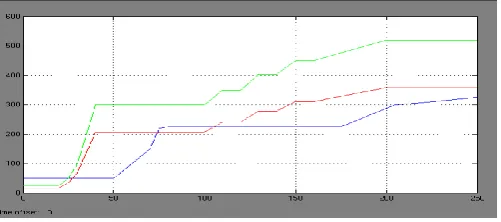
Fig.20. Relations between input Xk and voltage reference The integral of the square of IEDLC1 and IEDLC2 in each case were shown in Fig. 21. In case of the fuzzy control, the integral numbers of the square of IEDLC1 at 250 s was 20.1% lower than the results of the droop control, while the integral numbers of the square of IEDLC2 at 250 s was almost the same.
Droop Control
Fuzzy control
[image:8.595.309.553.301.476.2]© 2015, IRJET ISO 9001:2008 Certified Journal Page 862 It indicates that the loss in case of the fuzzy control is
[image:9.595.38.289.165.276.2]lower than that of the droop control.
Fig. 22. Integral of the square of the current with three controllers (Droop control, Fuzzy control and Model
reference adaptive control)
Integral of the square of the current with three controllers (Droop control, Fuzzy control and Model reference adaptive control) are shown in Fig. 22. From the results the current with MRAS is reduced which contributed to reduce the losses due to the line resistances. This indicates that DC voltage regulation and stored energy balancing control are realized simultaneously.
5. CONCLUSION
This paper presented a new control that combines MRAS, Fuzzy control with gain scheduling to accomplish both power sharing and energy management by using current as feedback parameter. The results show that the DC distribution voltage was within 340 V ±5%, and the ratios of the storage units were approximately equal. This tells that DC voltage regulation and stored energy balancing control are realized simultaneously. Trial and error methods might be adopted to adjust the membership functions in practice, which is a time consuming process. The main advantage of the proposed control is effective to handle variation in process dynamics due to nonlinear actuators, changes in environmental conditions and variation in the character of the disturbances. Our future study is in actual application, if a dc micro-grid is extended and another energy storage system is included, it would require a communication line to obtain state information and detect faults.
REFERENCES
1. Hiroaki Kakigano, Yushi Miura and Toshifumi Ise, “Distribution Voltage Control for DC Microgrids Using Fuzzy Control and Gain-Scheduling Technique” IEEE
transactions on power electronics, vol. 28, no. 5, may 2013.
2. H. Kakigano, Y. Miura, and T. Ise, “Low-voltage bipolar-type DC micro-grid for super high quality distribution,” IEEE Trans. Power Electron., vol. 25, no. 12, pp. 3066–3075, Dec. 2010.
3. H. Kakigano, Y. Miura, T. Ise, T. Momose, and H. Hayakawa, “Fundamental characteristics of DC microgrid for residential houses with cogeneration system in each house,” in Proc. IEEE Power Energy Soc. General Meeting, Jul. 2008, Paper 08GM0500, pp. 1–8. 4. Y. A. I. Mohamed and E. F. El-Saadany, “Adaptive
decentralized droop controller to preserve power sharing stability of paralleled inverters in distributed generation micro-grids,” IEEE Trans. Power Electron., vol. 23, no. 6, pp. 2806–2816, Nov. 2008.
5. Kakigano, H., Nishino, A. & Ise, T. 2011. Distribution voltage control for DC micro-grids using fuzzy control and gain-scheduling technique. IEEE Transactions on Power Electronics, vol. 28, pp. 2246–2258.
6. M. Roslan, K. H. Ahmed, S. J. Finney, and B. W. Williams, “Improved instantaneous average current-sharing control scheme for parallel connected inverter considering line impedance impact in micro-grid networks,” IEEE Trans. Power Electron, vol. 26, no. 3, pp. 702–716, Mar. 2011.
7. N. Papadimitriou and N. A. Vovos, “A fuzzy control scheme for integration of DGs into a microgrid,” in Proc. IEEE Mediterranean Electro technical Conf., Apr. 2010, pp. 872–877.
8. Barklund, E., Pogaku, N., Prodanovic, M., Hernandez-Aramburo, C. & Green T.C. 2008. Energy management in autonomous microgrid using stability constrained droop control of inverters. IEEE Transactions on Power Electronics, vol. 23, pp. 2346–2352.