© 2016, IRJET | Impact Factor value: 4.45 | ISO 9001:2008 Certified Journal
| Page 1939
A STUDY ON IMPLEMENTATION OF TQM FOR SUSTAINABILITY
Ashish Vishwakarma
1, Naman Shrivastava
2, Nitin Vishwakarma
31
M.Tech Scholar
,
Industrial Engineering & Management, Infinity Management & Engineering College, Sagar (M.P.)
2M.Tech Scholar
,
Industrial Engineering & Management, Infinity Management & Engineering College, Sagar (M.P.)
3Asst. Prof, Department of Mechanical Engineering
, Infinity
Management & Engineering College, Sagar, (M.P India
---***---Abstract -
The purpose of this Paper is to study indetail about the fundamentals of Total Quality Management (TQM) and how it helps provide a sustainable performance to any organization. Though many have written about TQM this research will focus on the fundamentals of TQM implementations. The implementation process basics that are influential in making TQM a successful change management program in this dynamic market scenario are the key points in this study. The ever changing market conditions what is called as hyper competition is pushing the manufacturers all over the world to look for better way of doing business. This hypercompetitive environment has given the strength to the customer to demand more from the organizations. Hence it will be interesting to observe how organizations are responding to this challenge.
TQM is a management innovation and has been with the organizations for quite a long time. But there were lot of reports that this innovation is not coming up to the expectation and termed as a failure and fad. At the same many success stories were also reported. India is facing the competitive onslaught and now becoming the favorite destination of all big players in a variety of industries. Hence it is very important to have a look at TQM with Indian Context and study the relevance and provide input for further research and guidance to the practicing managers.
The intent of this study is to review how this new
management innovation provides a sustainable
performance to the organization and the factors that affect the implementation process.
Key Words: TQM, Sustainability, TQM
implementations,Organizationimprovement.
1. INTRODUCTION
Thirteen eventful years have gone in 21st century. The
entry into this 21st century itself was a very big shock and surprise for us. The Y2K bug syndrome loomed largely on our day to day life threatening to damage our regular activities starting from banking and extending into our
Entire life wherever digital era touched.
A worst economic have seen downturn, a global meltdown that has done irreparable damages in the economic situation of the nations, organizations and individuals. The changes happened so far on the economic front of the nations and the improvement associated with the livelihood of the human beings is at the peak of the magnitude. Quality has become a way of life [5]. The nations all over the world are removing the barriers in their domestic markets and thereby opening way for more and more global players to come and start the business creating a borderless global village. India has also opened its economy.
This has put the domestic business organization compete with the international organization for their survival and competition gets heated up for the success. This situation created a very big opportunity for the customers to demand for a better quality product at a competitive price. This has forced the organizations to improve continuously. This has further created the cut throat competition for introducing more and more valuable and innovative products.
On the other side technology is propelling the speed of change in a new direction. The drivers of the technology- Information Technology and Internet- have a very strong impact on the day to day life of the people. They have altered and transformed the way people are thinking. This is a major paradigm change and this new paradigm change calls for a paradigm shift in the thought process of people [7].
International Research Journal of Engineering and Technology (IRJET)
e-ISSN: 2395 -0056 Volume: 03 Issue: 08 | Aug-2016 www.irjet.net p-ISSN: 2395-0072© 2016, IRJET | Impact Factor value: 4.45 | ISO 9001:2008 Certified Journal
| Page 1940
Product is reduced and competition is intensified. Thecurrent environment is termed as hyper competition. Survival has become a distant dream and those who are managing with a new thrust in their knowledge base are
Able to stick their neck out of the troubled water and look forward [9]. This knowledge era forcing the organizations to steer clear their strategic directions in the growth path.
Nowadays knowledge workers define and determine the longevity of the organizations. The market has changed dramatically and will continue to change in a very dynamic way. Customer perception and their needs have changed in a big way. It is becoming highly untenable to treat them as statistical indicators. Individual attention and satisfying their needs are here to stay. Therefore, these are some of the characteristics of the hyper competition and to understand this type of competitive environment, manage organizations in the period of turmoil and lead them towards a sustainable performance [1], organizations should revisit, review and restate their management philosophies and establish a robust management practices to survive.
They much talked much hyped impact of IT has entered into manufacturing. Technology and manufacturing have ingrained into one and it is very difficult to look separately. The knowledge era has given its advantage to manufacturing and new workplace practices and paving way for the new concepts and new management practices to creep into the organizations and old methods with outdated thoughts making their way out.
TQM still has the cutting edge to keep the organizations strong and sustain for a long time [6]. In the interest of the long term survival of the organization we need to understand the concepts in a right attitude and ensure that the obstacles in the implementation process are removed.
2. THE RENEWAL OF TQM
We need to understand these concepts keeping in mind what Hayes said about the intersection of paradigm concept. New work places demand new working practices. It is the basic fundamental differences that are creeping into the successful TQM introduction and the perceived failures. If these aspects are not considered then failure stories will continue to grow and the tag on TQM as a management fad will continue to attach. One of the main contributions of TQM is the reorientation of the managerial thinking from the narrow internal operational control to the customer oriented strategic focus. And the internal operational control now is with the operational team with empowerment to manage and run the day to day activities. Many scholars have defined TQM in many ways but the researcher would like to go with the one provided by Dean
& Bowen. He simply put three fundamental and basic principles for TQM and they are
1. Customer Focus 2. Team work and
3. Continuous Improvement
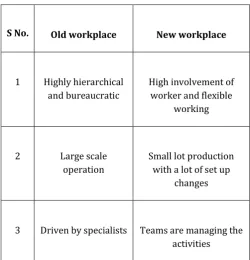
One of the most discussed topics nowadays is flat organizations. The meaning behind this is the new work places are capable of handling new workplace practices. The work task is no longer done by one person and also the division between the thinking and doing is blurring. With the advancement in technology new workplace practices need to be given their thrust and place so that survival is possible. Dividing TQM concepts into hard and soft is gaining momentum among researchers. Soft side of the TQM is the driving force in maintaining and sustaining TQM into future. And team work and customer focus are the key in this. If we look into the new workplace practices these two form the driving forces or the key enablers. We can summaries the basic fundamental differences between the Old and New workplace as follows
S No. Old workplace New workplace
1 Highly hierarchical and bureaucratic
High involvement of worker and flexible
working
2 Large scale operation
Small lot production with a lot of set up
changes
[image:2.595.312.563.376.637.2]3 Driven by specialists Teams are managing the activities
International Research Journal of Engineering and Technology (IRJET)
e-ISSN: 2395 -0056 Volume: 03 Issue: 08 | Aug-2016 www.irjet.net p-ISSN: 2395-0072 [image:3.595.35.292.415.565.2]© 2016, IRJET | Impact Factor value: 4.45 | ISO 9001:2008 Certified Journal
| Page 1941
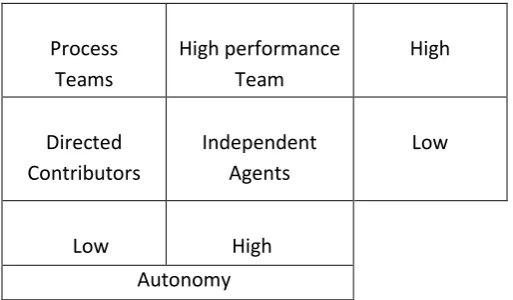
Fig 1 Old and new workplace matrixThese workplace changes give rise to the new work practices. But it will be very difficult to see the pure division of the workplaces mentioned above. We will see the combinations only. And that can be shown below as matrix form.
The ideal one is the portion III new workplace coupled with new working practices. And II and IV are the common failure areas and it is the researcher that the failures attributed to TQM may be at these II and IV areas. From the above further scope of workplace and practices are emerging Process [2] Teams High Performance Teams High Interaction Directed Contributors Independent Agents Low High Autonomy.
3. SAMPLE DESIGN
A sample design is a part of the target population, carefully selected to present that population. The focus is on the small and medium industries in Bhopal with manufacturing as their core operation.
PILOT STUDY
A pilot study was conducted with 40 staff level people to receive the feedback. Based on the feedback on the reliability of the survey instrument the study further progressed for getting the balance respondents.
SELECTION OF SAMPLE
Bhopal is the second largest city in the State of Madhya Pradesh next to Indore. And apart from the textile business Pumps and Motors, Foundries and Auto Components are also playing important role in the economic improvement of Bhopal. Bhopal is an important auto component manufacturing hub in the country. It has its lion share of business in this segment sometime back. Almost 30% of the auto component requirements were met by Bhopal. But things started taking a negative path recently. Many industrial set up are not able to meet the competitive onslaught by the other location players and started losing the market share. This study focusing on the medium and large industries located in Bhopal. There are around 250 such units operations here. These industries are having the basic quality systems in place like ISO 9001. It is estimated that there are around 5000 people occupying the staff level position in these organizations and this study focuses on the staff level only and operator level.
LOOKING FOR THE SOLUTION
This study is an important one carried out in the recent times in Bhopal. The enthusiasm generated for the topic concerned and the response was simply fantastic. It gives the feeling of satisfaction to the researcher that TQM concepts are still popular and rather a new way of doing business. Factor analysis is one of the most often used multivariate techniques of research studies [8]. It is a technique applicable when there is a systematic interdependence among the set of observed or manifest variables and the researcher is interested in finding out something more fundamental or latent which creates this commonality. Factor analysis, seeks to resolve a large set measured variables in terms of relatively low categories, known as factors. Factor analysis and reliability tests were applied to ascertain the important factors and to test the reliability of the data. Factor analysis is a collection of methods used to examine how underlying constructs influence the responses on a number of measured variables [4]. There are basically two types of factor analysis: exploratory and confirmatory. Exploratory factor analysis (EFA) attempts to discover the nature of the constructs influencing a set of responses. Confirmatory factor analysis (CFA) tests whether a specified set of constructs is influencing responses in a predicted way. SPSS 20.0 used to measure the capability to perform
Process
Teams
High performance
Team
High
Directed
Contributors
Independent
Agents
Low
Low
High
Autonomy
0 1 2 3 4 5
OLD NEW
OLD
NEW
Working pratice
International Research Journal of Engineering and Technology (IRJET)
e-ISSN: 2395 -0056 Volume: 03 Issue: 08 | Aug-2016 www.irjet.net p-ISSN: 2395-0072© 2016, IRJET | Impact Factor value: 4.45 | ISO 9001:2008 Certified Journal
| Page 1942
exploratory factor analysis. CFAs require a program withthe ability to perform structural equation modeling. For this purpose AMOS 20.0 was used to examine confirmatory factor analysis.
4.ANALYSIS
OF
TQM
PRACTICES
OF
MANUFACTURING INDUSTRIES IN BHOPAL
Instrument with thirty seven variables framed for the study was reduced into the following mentioned variables by principal component analysis extraction method through Varimax with Kaiser Normalization rotation although factor loadings of 0.30 to 0.40 (Positive or Negative) are minimally acceptable, values 0.50 (Positive or Negative) are generally considered necessary for practical significance (Rules of Thumb 3-5). For this study, Out of the Variables, The above variables having variance of 0.60 and above are considered for further analysis. The nine variables were grouped into two factors [4]. The Cronbach's Alpha reliability test result indicated that 9 variables scored 0.976 and it was more than acceptable range of 0.70. The most important factors for this study are Factor1 (4 variables) with the Eigen value 9.162, factor 2 (5 variables) with the Eigen Value 3.352 and with the reliability of 0.897and 0.864. The Percentage of variance explained to these factors are 24.763 and 9.060 respectively Confirmatory factor analysis (CFA) is used to study the relationships between a set of observed variables and a set of continuous latent variables. When the observed variables are categorical CFA is also referred to as Item Response Theory (IRT) analysis. It provides a more explicit framework for confirming prior notions about the structure of a domain of content. CFA adds the ability to test constraints on the parameters of the factor model to the methodology of EFA. With CFA it is possible to place substantively meaningful constraints on the factor model [3].
5. CONCLUSION
Customer Focus is the key in TQM. Age, Experience in the current organization, Total Experience, Educational Qualifications, Job position and Functional areas contributing a significance in the customer focus. In TQM customer also means Internal Customer. Treating internal customer equal to external customer is very important in the successful implementation. But this study reveals the gap in this. Another major embarrassment to the TQM concept is that the way organizations are treating their internal customer. This factor is also putting the philosophy down. This is being done to assess the mindset of the people. And instead of a NO they prefer to say this answer. This is also high point of concern. Internal customer focus can be enriched by involving all the people in their work area and decision makings can be made at the lowest possible level as far as the regular working s are concerned.
While resolving the internal quality issues it is suggested that the team working like Quality Circle concepts can be followed and this will smoothen the friction between the departments and will drive a commitment to one and all. TQM rests on the strong foundation of serving the customer and satisfying him. Though the overall observation and conclusion from this study say customer focus is good, there are few indicators providing us a caution. Many people still think that their organization is not doing a customer survey. This is a major shock and needs to be addressed by all concerned immediately. Getting the feedback from the customer is the first step in improving the organizational performance and this will be major source of data for all the improvement activity that will focus on delighting the customer
References
[1] S. Schrettle, A Hinz, M Scherrer, T Friedli, 2013,”Turning sustainability into action: Explaining firms sustainability efforts and their importance on firm performance”, International Journal of Production Economics.
[2] Vathsala Wickramasinghe, (2012) "Influence of total quality management on human resource management practices: An exploratory study", International Journal of Quality & Reliability Management, Vol. 29 Iss: 8, pp.836 850.
[3] Katie Burke, Kate Morris & Leona McGarrigle, 2012,"An introductory Guide to implementation: Terms, Concepts, and frameworks," CES Guide.
[4] U.C.Jha, Sunand Kumar & M.N. Qureshi, 2012, "Important factors of Total Quality Management implementation”, Journal of Radix International Educational and Research Consortium, Vol 1, Issue 4.
[5] Fazli Idris (2011) Total Quality Management (TQM) And Sustainable Company Performances: Examining The Relationship In malaYsian Firms International Journal of Business and Society,Vol. 12, No. 1, pp: 31-52.
[6] Harjeev K. Khanna, D.D. Sharma, S.C. Laroiya, (2011) "Identifying and ranking critical success factors for implementation of total quality management in the Indian manufacturing industry using TOPSIS", Asian Journal on Quality, Vol. 12 Iss: 1, pp.124 138.8 Mary Jo Hatch, Monika Kostera & Andrzaj K. Kozminsk, 2006, The three faces of leadership: Manager, Artist, PriestOrganizational Dynamics, Vol 25 no 1, pp 49-68.
© 2016, IRJET | Impact Factor value: 4.45 | ISO 9001:2008 Certified Journal
| Page 1943
[8] Voon-Hsien Lee , Siew-Yong Lam, Keng-Boon Ooi,Mohammad Samaun Safa , 2010, “Structural analysis of TQM and its impact on customer satisfaction and innovation ,”International journal of Modeling in Operation Management, vol 1, No 2, pp 157-179
[9] Charles A. O'Reilly , David F. Caldwell , Jennifer A. Chatman , Margaret Lapiz , William Self , 2010, “How leadership matter: the effeets of leaders’ alignment on strategy implementation”, the leadership Quarterly, vol 21 pp 104-113.