© 2016, IRJET | Impact Factor value: 4.45 | ISO 9001:2008 Certified Journal
| Page 1972
PERFORMANCE EVALUATION OF MODIFIED DESIGN OF A DOUBLE
SLOPE WICK-TYPE SOLAR STILL
Dr. K. Shanmugasundaram,
Head & Assistant Professor, Department of Physics,
Thiruvalluvar University College of Arts & Science, Thiruvennainallur – 607 203
Email: [email protected] and [email protected]
Abstract:
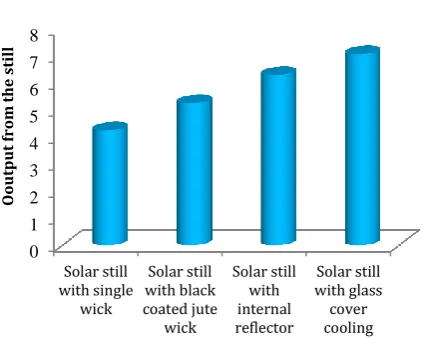
There is an unavoidable need to look at various possible designs that can be implemented to enhance the wick type double slope solar still performance through increasing the production rate of distilled water. Design modifications were introduced to the double slope wick type solar still, involving the installation of black coated jute wick, water flowing over the glass cover and internal reflector. Form the result it is found that the water flowing over the glass cover or regenerative method improved the performance of the still than the other methods. The productivity of the still is found to be, 4.25 L/m2/day for conventional solar still, 5.25 L/m2/day for black coated jute wick solar still, 6.25 L/m2/day for solar still with internal reflector, 7.05 L/m2/day for solar still with glass cover cooling.
Keywords
: Wick-type solar still, Thermal performance, Design modifications, solar energy.1.
INTRODUCTION
The supply of drinking or fresh water is one of the important problems especially in developing countries. Fresh water is a basic human necessity, and without water the life will be impossible. Nowadays the rivers and lakes are polluted by industrial effluents and sewage disposal resulted in scarcity of fresh water in many big cities around the world. Wick type solar stills are one of the solar devices which can be used for fresh water production. They are considered as one of the cheapest solutions for purifying saline/brackish water and suitable for the Middle East and Africa due to their low cost and ease of maintenance. Many experimental and theoretical studies were conducted on single basin solar stills to test the thermal performance of different enhancement parameters. The effectiveness of different absorbing materials in a solar still to increase the productivity of water was studied using a single basin solar still with double slopes [1-4]. Al-Hayek and Badran [1], Phadatare and Verma [5], and Tanaka and Nakatake[6] found that the productivity of fresh water by solar distillation depends mainly on the intensity of solar radiation, the sunshine hours and the type of the still. experimental study of solar still with floating wick showed that, the productivity of this type solar still was higher than the common titled wick type and conventional type solar stills [7]. The fins were integrated at the basin of the still to augment evaporation of the still basin water [8-9].
The objective of the present study was to enlarge the performance of a conventional double slope wick type solar still through three design modifications: addition of black coated jute wick, using regenerative method and internal reflector. These modifications can increase the solar still capability to capture more solar energy and increase the evaporation rates.
2.
MATERIAL AND METHODS
2.1. EXPERIMENTAL SET UP
2.2. Solar still design modifications:
© 2016, IRJET | Impact Factor value: 4.45 | ISO 9001:2008 Certified Journal
| Page 1973
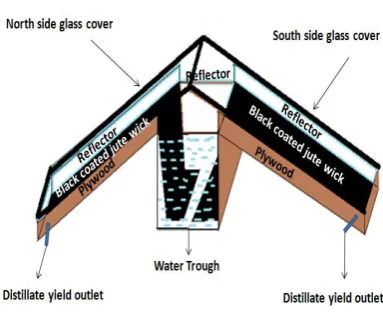
[image:2.595.324.550.100.365.2]The thermo coal insulation of thickness 6 cm is introduced to the sidewalls and bottom side of the tilted portion to minimize the heat losses from the evaporating wick surfaces. The water level in the reservoir is maintained so as not to overflow into the tilted portion and always to be 0.5 cm below the tilted portion. Due to the raised water level in the reservoir, the tilted wick surfaces were always wet. The excess hot water from the tilted surfaces was fed to the reservoir during late and early working hours of the still. The schematic diagram of the modified design of double slope wick type solar still is shown in figure 3 and 4.
Figure 1. Schematic diagram of the double slope wick type solar still
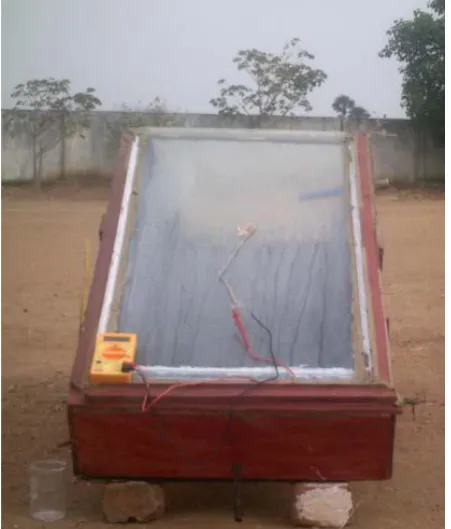
[image:2.595.50.270.293.537.2]Figure 2. Photograph of the experimental system
[image:2.595.319.567.460.680.2]© 2016, IRJET | Impact Factor value: 4.45 | ISO 9001:2008 Certified Journal
| Page 1974
Figure 4. Schematic diagram of the wick type solar still with internal reflector
3.
EXPERIMENTAL PROCEDURE
Experiments done on the fixed conventional design of the wick type solar still were carried out on successive days during the month March 2016, and experiments for the modified still were carried out during the month April 2016. Each experiment started from 8 am in the morning to 6.00 pm in the evening. The experimental works was fully carried out in the solar energy laboratory at the Karpagam University in Coimbatore. The first part of this research work was to test a traditional wick type solar still in a fixed position towards the North-South. Five different thermocouples were installed on the solar still system at different locations. These locations were (a) a wick in the basin to measure the temperature of the wick. (b) Inner surface of the glass (d) outer surface of the glass cover (e) water temperature in the trough, and (f) water vapour. The second part of this research work was to flow water over the glass cover. This modification was introduced to enhance the thermal performance and the distillation productivity.
Results and Discussion
Figure. 5 shows that the change in the energy intensity during the full working day (sunny day). It is clearly shown that the hourly solar radiation was high at noon. Also the power gain was varied from minimum values in the morning (i.e. low ambient temperature and low solar radiation) to the maximum at noon where the solar radiation and the ambient temperature are high.
The maximum solar radiation and ambient temperature are gradually increased from morning and reaches maximum at noon time. The maximum value of solar radiation and ambient air is found to be 1198 W/m2 and 35°C.
Figure 5. Variations of the solar radiation and ambient air for the experimental days
Figure 6. Shown that the variations of total production rate for conventional solar still and modified solar still. The solar still with glass cover cooling has higher production rate during morning than evening. The rate of increase in production rate during morning hours was higher than the rate of decrease in production rate during evening hours. The cumulative production was higher through the entire day for the still with glass cover cooling than the other methods.
The production variations of the modified still with black coated jute wick and conventional still with single jute wick are compared. The production rate of the still with black coated jute wick was higher than the other. The productivity of the still was increased when using black coated jute wick in the still due to the black coated jute absorbed maximum incident solar radiation so that the evaporation rate is increased.
24 25 26 27 28 29 30 31 32 33 34 35 36
400 500 600 700 800 900 1000 1100 1200 1300
8 9 101112131415161718
Ambien
t
Air
(
°
C)
Hs
(W
/m2)
Time of the day (Hrs)
[image:3.595.335.537.189.360.2]© 2016, IRJET | Impact Factor value: 4.45 | ISO 9001:2008 Certified Journal
| Page 1975
Figure 6. Variations of the distillate output for conventional and modified solar still for the experimental days
Figure. 7 show the variations of average efficiency for conventional solar still and modified solar still. From the graphs, it is clear that the efficiency of still with glass cover cooling method was higher than the other methods. It is found that the average efficiency of the conventional solar still and modified solar still is 26.7%, 32.5% for solar still with black coated jute wick, 41.2% for solar still with internal reflector, and 47.7% for solar still with glass cover cooling. From the results, it is suggested that the glass cover cooling method is the best one and gives higher distillate output in this location.
[image:4.595.54.266.100.269.2]The production rate and average efficiency of the conventional and modified stills are compared in the table.1. From the table it is clear that the modified solar still is better than the conventional solar still due to the productivity and average efficiency was higher and the performance of the modified still is seems to be good than the conventional solar still.
Figure 7. Shows the average efficiency of the conventional and modified solar still
Table.1 shows the variations of the production rate and average efficiency for the conventional and modified solar
still
Conclusion
The performance of a double slope single wick type solar still system with three different design modifications was investigated. The experimental results clearly show that the thermal performance of a traditional double slope wick type solar still can be considerably improved through the design modifications. Installing internal reflectors gave high efficiency with an average increase of 14.5% when compared with conventional solar still system. Modifying the still design with glass cover cooling gave a higher average efficiency with an average increase of 21%.
A wick type double slope solar still with glass cover cooling was presented as a potential option for high performance solar distillation. It can be utilized for industrial applications for economical bulk production of distilled water for battery charging, chemical laboratories, educational institutions, and for gas station services.
References
1. Al-Hayek and O.O. Badran, “The effect of using different designs of solar stills on water distillation”, Desslination, 2004, 169, pp.121 – 127.
2. B.A. Akash, M.S. Mohsen and W. Nayfesh,”Experimental study of the basin type solar still under local climate conditions”, Energy Conv, Manage, 2000, 41 (9), pp. 883-890.
0 1 2 3 4 5 6 7 8 Solar still with single wick Solar still with black coated jute wick Solar still with internal reflector Solar still with glass cover cooling O out put fr om the s til l 0 10 20 30 40 50 Solar still with single wick Solar still with black coated jute wick Solar still with internal reflector Solar still with glass cover cooling E ff ic ie n c y o f th e S ti ll
Tested System distilled water Collected
L/m2/day
Effici ency η (%) Conventional solar
still 4.25 26.7
Solar still with black
coated jute wick 5.25 32.5
Solar Still With
Internal Reflector 6.25 41.2
Solar Still With Glass
[image:4.595.313.558.203.341.2] [image:4.595.45.474.584.787.2]© 2016, IRJET | Impact Factor value: 4.45 | ISO 9001:2008 Certified Journal
| Page 1976
3. B.A. Akash, M.S. Mohsen, O.Osta and Y. Elayan, "Experimental evaluation of a single basin solar still using different absorbing materials”, Renewable Energy, 1998, 14(1-4), pp.307 – 310. 4. S. Nijmeh, S. Odeh and B. Akash, “Experimental
and theoretical study of a single – basin solar still in Jordan”, Int Comm. Heat Mass Transfer, 2005, 32, pp.565-572.
5. M.K. Phadatare and S.K. Verma, “Development in solar still: A review”, Renewable Sustainable Energy Reviews, in press.
6. H. Tanaka and Y. Nakatake, “Theoretical analysis of a basin type solar still with internal and external reflectors”, Desalination, 2006,186,pp.280-299.
7. Al-Karaghouli AA,Minasian AN,“A floating – wick type solar still”,Renewable Energy, 1995,6: 77 e9. 8. Velmurugan V, Deenadayalan CK, Vinod H, Srithar K.Desalination of effluent using fin type solar still. Energy 2008, 33:1719e27.
9. Velmurugan V, Gopalakrishnan M, Raghu R, Srithar K. Single basin solar still with fin for enhancing productivity. Energy Conversion and Management 2008, 49:2602e8.
ACKNOWLEDGEMENT
I am extremely thankful to Dr. R. SURESH, Principal,
Thiruvalluvar University College of Arts & Science, Thiruvennainallur, for his motivation, and encouragement of my research work.
BIOGRAPHY
Dr. K. SHANMUGASUNDARAM M.Sc., Ph.D., with JRF
working as Head & Assistant Professor in Department of Physics at Thiruvalluvar University College of Arts and Science, Villupuram. He has published 23 research papers in International and National Journals. His area of research work is solar energy, environmental protection, and thin film and Nano technology.