© 2016, IRJET | Impact Factor value: 4.45 | ISO 9001:2008 Certified Journal
| Page 2128
Unsteady MHD flow through porous media past an impulsively started
vertical plate with constant wall temperature and variable mass
diffusion in the presence of Hall current
U. S. Rajput and Neetu kanaujia
Department of Mathematics and Astronomy, University of Lucknow,U P India.
---***---Abstract -
In the present paper, unsteady MHD flowthrough porous media past an impulsively started vertical plate with constant wall temperature and variable mass diffusion in the presence of Hall current is studied. The fluid considered is an electrically conducting, absorbing-emitting radiation but a non-scattering medium. The Laplace transform technique has been used to find the solutions for the velocity and skin friction. The velocity profile and skin friction have been studied for different parameters like Schmidt number, Hall parameter, magnetic field parameter, mass Grashof number, thermal Grashof number, Prandtl number, permeability of the medium, and time. The effect of parameters is shown graphically, and the values of the skin-friction for different parameters have been tabulated.
Key Words:
MHD, Hall current, porous media, constant wall temperature, variable mass diffusion.
1. INTRODUCTION
The study of MHD flow through porous media are encountered in a wide range of engineering and industrial applications such as in recovery or extraction of crude oil, geothermal systems, thermal insulation, heat exchangers, storage of nuclear wastes, packed bed catalytic reactors, atmospheric and oceanic circulations etc. MHD flow models with Hall effect have been studied by a number of researchers, some of which are mentioned here. Katagiri [14] have studied the effect of Hall current on the magneto hydrodynamic boundary layer flow past a semi-infinite plate. Attia [9] has study velocity and temperature distributions between parallel porous plates with Hall effect and variable properties. Attia et al. [1] have studiedheat transfer between two parallel porous plates for Couette flow under pressure gradient and Hall current. Ram et al. [10] have studied Hall effects on heat and mass transfer flow through porous medium. Pandurangan [2] have studies combined effects of radiation and Hall current on MHD flow past an exponentially accelerated vertical plate in the presence of rotation. Reddy et al. [8] have studied unsteady MHD convective heat and mass transfer flow past a semi-infinite vertical porous plate with variable viscosity and thermal conductivity. Reddy et al. [7] have studied radiation effects on MHD combined convection and mass transfer flow past a vertical porous plate embedded in a porous medium with heat generation. Naramgari et al. [3] have studied radiation, and rotation effects on unsteady hydromagnetic free
convection flow past an impulsively moving vertical plate in a porous medium. Rajput and Sahu [6] have studied combined effects of MHD and radiation on unsteady transient free convection flow between two long vertical parallel plates with constant temperature and mass diffusion. Debnath [13] have studied on unsteady magnetohydrodynamic boundary layers in a rotating flow. Soundalgekar [12] has studied free convection effects on the oscillatory flow past an infinite, vertical porous plate with constant suction. Perdikis have studied [11] flow of a viscous fluid through a porous medium bounded by a vertical surface. Das et al. [5] have studied unsteady hydro-magnetic convective flow past an infinite vertical porous flat plate in a porous medium. Rajput and Kumar [4] have studied radiation effect on MHD flow through porous media past an impulsively started vertical plate with variable heat and mass transfer. We are considering unsteady MHD flow through porous media past an impulsively started vertical plate with constant wall temperature and variable mass diffusion in the presence of Hall current. The effects of Hall current on the velocity have been observed with the help of graphs, and the skin friction has been tabulated.
2. Mathematical formulation
An unsteady viscous incompressible electrically conducting fluid past an impulsively started vertical plate is considered here. The plate is electrically non-conducting. A uniform magnetic field B is assumed to be applied on the flow. Initially, at time
t
0 the temperature of the fluid and the plates are same as T , and the concentration of the fluid is
C . At time t > 0, temperature of the plate is raised to Twand the concentration of the plate is Cw. Using the relation
, 0
B for the magnetic field ͞B
Bx,By,Bz
, we obtainy
B
(sayB0) = constant, i.e.B
0,B0,0
, where B0isexternally applied transverse magnetic field. Due to Hall effect, there will be two components of the momentum equation, which are as under. The usual assumptions have been taken in to consideration. The fluid model is as under:
, u K mw u m B C C g T T g y
u t
u
( )
) 1 ( ) ( )
( 2
2 0 *
2 2
(1)
, w K mu w m B y
w t
w
) ( ) 1
( 2
2 0 2 2
© 2016, IRJET | Impact Factor value: 4.45 | ISO 9001:2008 Certified Journal
| Page 2129
, 2 2 y C D t C (3) . 2 2 y T C k t T P (4) The following boundary conditions have been assumed:
. , 0 , 0 , , 0 , : 0 , , , 0 , 0 : 0 2 0 0 y as T T , C C w u 0, y at t u C C C C T T w u u t y, of values the all for T T C C w u t w w (5)Here u is the velocity of the fluid in x- direction, w - the velocity of the fluid in z - direction, m -the Hall parameter, g - acceleration due to gravity, 𝛽 - volumetric coefficient of thermal expansion, 𝛽* - volumetric coefficient of concentration expansion, t - time, C- the concentration in the fluid far away from the plate, C - species concentration in the fluid , Cw- species concentration at the plate, D - mass diffusion, T- the temperature of the fluid near the plate, Tw
- temperature of the plate, T - the temperature of the fluid , k - the thermal conductivity, υ - the kinematic viscosity, ρ - the fluid density, σ - electrical conductivity, μ - the magnetic permeability, K - permeability of the medium, and CP is specific heat at constant pressure. Here mee with
e-cyclotron frequency of electrons and
e- electron collision time.To write the equations (1) - (4) in dimensionless from, we introduce the following non - dimensional quantities:
. T T T T , C C C C C u C C g Gm u T T g G u tu t Ku K u B M k C D Sc yu y u w w u u u w w w w r P ) ( ) ( , ) ( , ) ( , , , , , Pr , , , , 3 0 3 0 2 0 2 0 2 0 2 0 2 0 0 0 0 (6)
Here the symbols used are:
͞͞
u - dimensionless velocity, ͞w - dimensionless velocity, θ - the dimensionless temperature, C - the dimensionless concentration, Gr - thermal Grashof number, Gm - mass Grashof number,
- the coefficient of viscosity, Pr - the Prandtl number, Sc - the Schmidt number, M - the magnetic parameter.The dimensionless forms of equation (1), (2), (3) and (4) are as follows , 1 ) 1 ( ) ( 2 2 2 u K m w m u M C G G y u t u m
r
(7)
, 1 ) 1 ( ) ( 2 2 2 w K m u m w M y w t w
(8)
͞ 1 ,
2 2 y C Sc t C
(9)
2 2 1 Pr t y
(10)
The corresponding boundary conditions are:
y as w C u 0, y at t C w u t , y of values all for , w C u t . 0 , 0 , 0 , 0 , 1 , 0 , 1 , 0 0 , 0 , 0 , 0 , 0
(11)Dropping the bars and combining the equations (7) and (8), we get , 1 ) 1 ( 1 2 2 2 q K mi m M GmC Gr y q t q
(12)
, 1 2 2 y C Sc t C
(13)
, Pr 1 2 2 y t (14)
where
q
u
iw,
The boundary condition become
. y , ,θ ,C q , y t ,C ,θ , w :q t C q t as 0 0 0 0 at , 1 0 1 0 y, of values all for , 0 , 0 , 0 : 0 (15)
The solution of above equations obtained by Laplace - transform method is an under
)}] 1 ( 1 ) 1 ( 2 { ) 1 ( 2 { 2 1 )} 1 ( 2 { 2 1 )} 1 ( 2 1 ) ( ) 1 ( 1 { 4 1 )} 1 ( ) ( { 2 1 ) ( 2 1 [ 0 1 1 14 4 13 2 14 15 13 Pr 1 Pr 1 12 1 1 3 2 11 15 10 Pr 1 Pr 1 0 0 2 Sc Sc B e y B y Sc t e a t Sc y Sc B y Sc Gm a A A A e A Gr a Sc B e y A e a t e Sc A y Gmy a A A A e A e Gr a A e q y Sc Sc at Sc at t Scy y at at y Sc at Sc at y a y a y at at y a y a , 2 Pr t y Erfc . y Sct e t y Sc Erf Scy t C t Scy 2 4 2 2 2
3. Skin friction
The dimensionless skin friction at the plate y = 0 is computed by z x y i dy
dq
0
Separating real and imaginary parts in
, 0 y dy dq the
© 2016, IRJET | Impact Factor value: 4.45 | ISO 9001:2008 Certified Journal
| Page 2130
0
y x
dy du
and
0
y z
dy dw
can be computed.
4. Results and Discussion
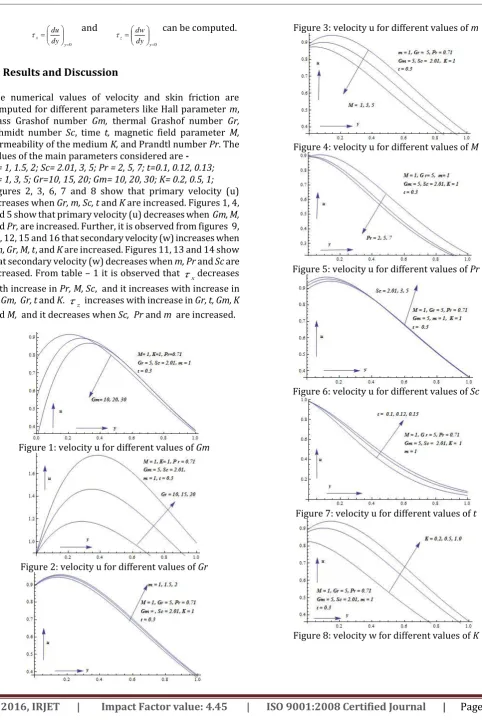
The numerical values of velocity and skin friction are computed for different parameters like Hall parameter m, mass Grashof number Gm, thermal Grashof number Gr, Schmidt number Sc, time t, magnetic field parameter M, permeability of the medium K, and Prandtl number Pr. The values of the main parameters considered are
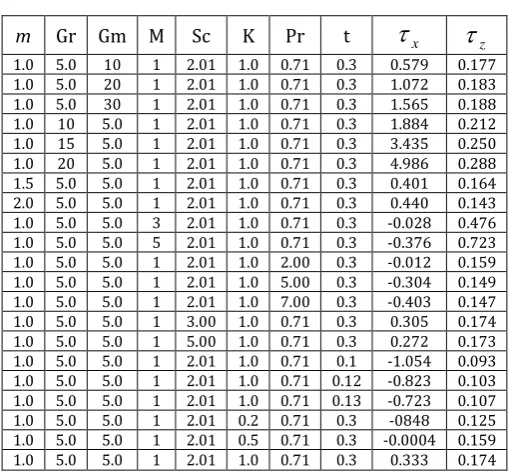
-m= 1, 1.5, 2; Sc= 2.01, 3, 5; Pr = 2, 5, 7; t=0.1, 0.12, 0.13; M= 1, 3, 5; Gr=10, 15, 20; Gm= 10, 20, 30; K= 0.2, 0.5, 1; Figures 2, 3, 6, 7 and 8 show that primary velocity (u) increases when Gr, m, Sc, t and K are increased. Figures 1, 4, and 5 show that primary velocity (u) decreases when Gm, M, and Pr, are increased. Further, it is observed from figures 9, 10, 12, 15 and 16 that secondary velocity (w) increases when Gm, Gr, M, t, and K are increased. Figures 11, 13 and 14 show that secondary velocity (w) decreases when m, Pr and Sc are increased. From table – 1 it is observed that
xdecreases with increase in Pr, M, Sc, and it increases with increase in m, Gm, Gr, t and K.
z increases with increase in Gr, t, Gm, K and M, and it decreases when Sc, Pr and m are increased.Figure 1: velocity u for different values of Gm
[image:3.595.47.530.79.808.2]Figure 2: velocity u for different values of Gr
Figure 3: velocity u for different values of m
Figure 4: velocity u for different values of M
Figure 5: velocity u for different values of Pr
Figure 6: velocity u for different values of Sc
Figure 7: velocity u for different values of t
© 2016, IRJET | Impact Factor value: 4.45 | ISO 9001:2008 Certified Journal
| Page 2131
Figure 9: velocity w for different values of GmFigure 10: velocity w for different values of Gr
Figure 11: velocity w for different values of m
Figure 12: velocity w for different values of M
Figure 13: velocity w for different values of Pr
Figure 14: velocity w for different values of Sc
Figure 15: velocity w for different values of t
[image:4.595.302.557.495.732.2]Figure 16: velocity w for different values of K
Table -1: Skin friction for different Parameters.
m Gr Gm M Sc K Pr t
x
z© 2016, IRJET | Impact Factor value: 4.45 | ISO 9001:2008 Certified Journal
| Page 2132
5. CONCLUSIONS
Some conclusions of the study are as under:
Primary velocity increases with the increase in Hall parameter, thermal Grashof number and time. However, it decreases with the increase in mass Grashof number, magnetic field parameter, Prandtl number and Schmidt number.
Secondary velocity increases with increase in thermal Grashof number, mass Grashof number, time and magnetic field parameter. However, it decreases with the increase in Hall parameter, Prandtl number and Schmidt number.
The value of xdecreases with increase in Prandtl number, magnetic field parameter, Schmidt number, and it increases with increase in Hall parameter, mass Grashof number, thermal Grashof number, time and permeability of medium. The value of
zincreases with increase in thermal Grashof number, time, mass Grashof number, permeability of medium and magnetic field parameter, and it decreases when Schmidt number, Prandtl number and Hall parameter are increased.
Appendix
, 2e A3 A ay
), 1
( 2 2
1
0 A e A
A ay
], 2 2
1 [
1 at y
t Erf
A 2 ],
2 1 [
2 at y
t Erf
A
1 2
,2 1 2
3 e A e A
A ay ay
], 2
Pr 1
Pr 2 [ 10
t y t a Erf A
],
2 Pr 1
Pr 2 [
11
t y t a
Erf A
],
2 Pr [
12
t y Erfc
A
], 2
Pr Pr 1 2 [
13
t y t a Erf A
],
2 Pr Pr 1 2 [
14
t y t a
Erf A
, Pr 1
Pr 2
15
y a
e
A B1B17B11B17B12,B01B17B15B17B16,
], 2 1 2 [
11
t y t Sc aSc Erf B
],
2 1 2 [
12
t y t Sc aSc Erf B
],
2 1 [
13
t y Sc Erf
B
, 2
14
t y Sc Erf
B ],
2 1 2 [
15
t y Sc t Sc a
Erf B
], 2 1 2 [
16
t y Sc t Sc a Erf B
,
1 2
17
y Sc aSc
e
B
. K 1 im m M
a
1
1 2
REFERENCES
[1]
Hazem Attia, Wabbas, A. M. Mostafa Abdeen and A. M. SaidAhmed, “Heat transfer between two parallel porous plates for Couette flow under pressure gradient and Hall current,” Indian Academy of Sciences, Sadhanavol. 40, Feb 2015 Part 1pp. 183– 197.(c).[2] M. Thamizhsudar and J. Pandurangan, “Combined effects of radiation and Hall current on MHD flow
past an exponentially accelerated vertical plate in the presence of rotation,” International Journal of
Innovative Research in Computer and
Communication Engineering vol. 2, Dec 2014, Issue 12.
[3] Sandeep Naramgari, Sugunamma Vangala, And Mohankrishna Penem, “Aligned magnetic field, radiation, and rotation effects on unsteady hydromagnetic free convection flow past an impulsively moving vertical plate in a porous
medium,” Hindawi publishing corporation
international journal of engineering mathematics volume, 2014, article id 565162, 7 pages.
[4]
U. S. Rajput and Surendra Kumar, “Radiation effect on MHD flow through porous media past an impulsively started vertical plate with variable heat and mass transfer,” International Journal of Mathematical Archive-4(10), 2013, 106-114. [5] S. S. Das, M. Maity and J. K. Das, “Unsteadyhydro-magnetic convective flow past an infinite vertical porous flat plate in a porous medium,” Int. J. Energy and Environ, 2012,1: 109–118.
[6] U. S. Rajput and P. K. Sahu, “Combined effects of MHD and radiation on unsteady transient free convection flow between two long vertical parallel plates with constant temperature and mass diffusion,” Gen. Math. Notes (Jordan), Vol. 6, 2011, 25-39.
[7] P. Bala Anki Reddy and N. Bhaskar Reddy, “Radiation effects on MHD combined con-vection and mass transfer flow past a vertical porous plate embedded in a porous medium with heat generation,” Int. J. of Appl. Math and Mech, 2010 6(18), pp 33 – 49.
[8] M. Reddy Gnaneswara and N. Reddy Bhaskar, “Unsteady MHD convective heat and mass transfer past a semi-infinite vertical porous plate with variable viscosity and thermal conductivity,” Int. J. Appl.Math. and Computation, Vol. 1, 2009 no. 2, pp 104-117.
[9] H. A. Attia, “Velocity and temperature distributions between parallel porous plates with Hall effect and variable properties,” Chem. Eng. Comm. 194: 2007, 1355–1373.
[10]
P. C. Ram, C.B. Singh, U. Singh, “Hall effects on heat and mass transfer flow through porous medium,” Astrophysics Space Science, 1984, 10, 45-51. [11] A. Raptis and C. Perdikis, “Flow of a viscous fluidthrough a porous medium bounded by a vertical surface,” Int. J. Eng. Sci. 21, 1983, 1327–1330. [12] V. M. Soundalgekar, “Free convection effects on the
oscillatory flow past an infinite, vertical porous plate with constant suction,” I. Proc. R. Soc., A, 1973, 333, 25 – 36.