© 2016, IRJET | Impact Factor value: 4.45 | ISO 9001:2008 Certified Journal | Page 1812
Formulation of Experimental Data Base Model of Processing Time for
Human Powered Food Grain Crusher
1
M.S. Giripunje, Research Scholar & Assistant Professor, Dept. of Mech. Engg., PCE, Nagpur, Mah., India.
2J.P. Modak, Dean R & D, PCE, Nagpur, Mah., India.
3
M.P. Singh, Principal, PCE, Nagpur, Mah., India.
---***---Abstract –
Powdered food grains are a base of almost allfoods in India. In ancient times, food grains are ground with the help of hand grain crushers. Today the electric motor driven grain crushers are used. But today there is a huge scarcity of electricity almost everywhere in India which results in six to twelve hours load shedding. In rural areas the load shedding is done daily from ten to twelve hours which badly affects their daily needs requiring electricity such as food grain crushing, water supply etc. To overcome this, we can replace the electric motor driven process units by manually driven process units such as food grain crusher driven by human powered flywheel motor [1]* i.e. manually driven food grain crusher. Also we all know that hand muscles are weaker than the leg muscle [24] i.e. we can operate the food grain crusher without fatigue and smoothly for a longer period if we replace hand operated food grain crusher by pedal operated food grain crusher.
Key Words: Process unit, food grain crusher, pedal driven, human powered flywheel motor, ANN
1.INTRODUCTION
The Human powered Flywheel motor comprises of three sub systems namely (i) Energy supply unit(peddling mechanism to supply power or to store energy in flywheel) (ii)Appropriate clutch and transmission and (iii) a process unit.
The complete unit consists of a bicycle mechanism, an appropriate clutch and transmission system and a process unit which could be any process device needing power up to 7 hp. Here it is food grain crusher.
Referring Fig 1.1 The rider sits on the seat and paddles the bicycle mechanism while the clutch is in dis-engaged position. Thus the load on the legs of the rider is only the inertia load of the flywheel. The Flywheel is accelerated to the speed of 800 rpm in minutes time by a young rider of the age group of 20 to 25 physically fit of height about 165 cm. The Flywheel size is 1m rim diameter, 10cm rim width and 2cm rim thickness. Such a Flywheel when energized to the speed of 800 rpm, it stores energy to the extent of 3200 kgf-m. At the end of 1 minute, speed of 800 rpm is reached and so much of energy is stored in a Flywheel. Afterwards the peddling is stopped, clutch is engaged and such a stored energy in the
flywheel is communicated to the process unit through the clutch. Obviously the clutch is subjected to sever shock on account of instantaneous momentum transfer. This is so because as the clutches engaged, the Flywheel is subjected to the process load and the process unit consumes shaft energy of the Flywheel. After the clutch engagement, the energy stored in a Flywheel gets exhausted in 5 to 15 seconds for application tried so far (ref [1] to [7],[10],[21]). The capacity of such a system is in the range of 2.5 to 8.5 Hp. The functional feasibility and economic viability of this system has also been confirmed ([1] to [7],[10],[21]).
Schematic arrangement of the complete unit:
Fig -1: Schematic of Human Powered Flywheel Motor
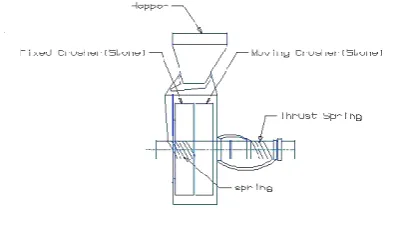
Fig -2: Food Grain Crusher (Process unit)
2. BACKGROUND OF THE PRESENT RESEARCH
[image:1.595.326.536.411.478.2] [image:1.595.336.533.510.626.2]© 2016, IRJET | Impact Factor value: 4.45 | ISO 9001:2008 Certified Journal | Page 1813 compared to wind and hydropower in renewable energy
sources.
Cori Denison [19] patented human powered device with removable flywheel power unit. As per this patent, the flywheel power unit can be inserted in to desired process unit to power the process.
Almost since 1978, Researcher J. P. Modak and his associates are working on Human powered flywheel motor [1 to 14]. The Human powered Flywheel Motor comprises of three sub system namely (i) Energy supply unit (Pedaling mechanism to supply power or to store energy in a Flywheel ), (ii) Appropriate clutch and transmission and (iii) a process unit. ( in this case Food Grain Crusher ). The complete unit comprises a bicycle mechanism, appropriate clutch and transmission and process unit could be any process device needing power up to 7 Hp.
The concept is applied in past so far for keyed bricks, wood turning, algae formation machine, fodder chopper, oilseed presser [7,10,11,12,13]. etc. and can be looked upon models of those systems as design data for designing such systems.
3. OBJECTIVES OF PROPOSED WORK
The energy sources of such systems are considered as one form of non- conventional energy source. The importance of this source is for the remote and interior area for energizing process unit in the range up to 7 Hp. For this range, large number of process machines is required to be energized [14]. For small farmers, it is necessary to adopt this concept for small agricultural implements. Accordingly it has been adopted for several processes such as keyed bricks, wood turning, algae formation machine, fodder chopper, oilseed presser [7,10,11,12,13]. The suggestions from food grain crusher operators, working in villages and remote areas, to develop such a food grain crusher which will be cheap and independent of conventional energy sources, motivate us. If such a Food Grain Crusher is developed it will be of great help to poor people / people in villages [1], firstly because it does not need conventional energy and it may generate work for one of the family member.
A large area around the vicinity of college is a rural area and almost all rural areas in India are affected by load shedding which greatly hampers the daily needs, growth and development of these rural areas. If the institute focuses its research work on replacing the electricity driven process units by human powered flywheel motor driven process units, then it will be of great help to such rural areas for the overall growth and development. Also it can generate fund for the institute for its self-dependence through such research activities.
The basic objective of this work is to generate design data for food grain crusher using human powered flywheel motor by the way of performing extensive experimentation by varying independent variables over widest possible range and gathering the response data generated. Finally the models can be formed as per the data observations obtained from the
classical approach of experimentation put forth by H. Schank Jr [25].
4. EXPERIMENTAL SET UP
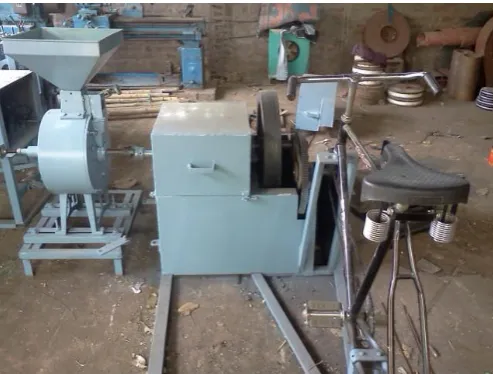
The experimental setup is as shown in Fig -3. In human energized food grain crusher, the objective of the experiment is to collect information with the help of experimentation for the formulation of mathematical model of food grain crusher. After the engagement of the clutch, the processing Time (TP) is measured with the help of an electronic kit.
Fig -3: An Experimental Set Up Photo
5. EXPERIMENTATION METHODOLOGY
Here the classical approach of design of experimentation has been applied for the model formulation as proposed by H. Schank Jr.[26].
5.1 Design of Experimentation
Series of experiments were conducted to study the effect on processing time for human energized food grain crusher. This experimentation has been carried out to investigate the processing time considering various parameters of food grains and processing machine i. e. process unit. During experimentation, wheat and sorghum were used for the data collection and investigation. Also the various geometrical parameters of the process unit are varied during experimentation. This collected data i.e. observations then analyzed and processed for the formulation of the model.
5.2 Experimental Approach
[image:2.595.310.557.224.411.2]© 2016, IRJET | Impact Factor value: 4.45 | ISO 9001:2008 Certified Journal | Page 1814 Experimentation by H. Schenk Jr.[26]. is proposed to be
applied.
Brief Methodology of Theory of Experimentation 1. Identification of variables affecting the phenomenon. 2. Reduction of variables by dimensional analysis
3. Test plan: consist of determination of test envelope, test points, test sequence and plan of experimentation. 4. Experimental set up design
5. Fabrication of experimental set up 6. Selecting appropriate instrumentation 7. Execution of experimental plan
8. Test data checking, rejection of outliers and data purification
9. Formulation of experimental data based models.
The energy sources of such systems are considered as one form of non- conventional energy source. The importance of this source is for the remote and interior area for energizing process unit in the range up to 7 Hp. For this range, large number of process machines is required to be energized.
5.3 Identification of Variables Affecting the
Phenomenon
[image:3.595.300.564.92.287.2]In this the various independent variables affecting the phenomenon have been identified. Processing time is the dependant variable. Those are listed in the table below.
Table -1: Identification of Variables
SN Variables Symbol Dimensions Nature of Variables
1 Average size of food grains a [ M0L1T0 ] Independent
2 Density of food grains ρG [ M1L-3T0 ] Independent
3 Hardness of food grains hG [ M1L-1T-2 ] Independent
4 Mass of input food grains m [ M1L0T0 ] Independent
5 Diameter of stone D [ M0L1T0 ] Independent
6 Hardness of stone hs [ M0L0T0 ] Independent
7
Distance between the rotating and fixed stone
d [ M0L1T0 ] Independent
8 Roughness of stone rF [ M0L1T0 ] Independent
9 Density of stone ρS [ M1L-3T0 ] Independent
10 Moment of Inertia of
rotating stone IS
[ M1L2T0 ] Independent
11 Gear ratio G [ M0L0T0 ] Independent
12 Moment of Inertia of
flywheel IF
[ M1L2T0 ] Independent
13 Acceleration due to gravity g [ M0L1T-2 ] Independent
14 Angular speed of the
flywheel w
[ M0L0T-1 ] Independent
15 Processing time TP [ M0L0T1 ] Dependant
5.4 Dimensional Analysis
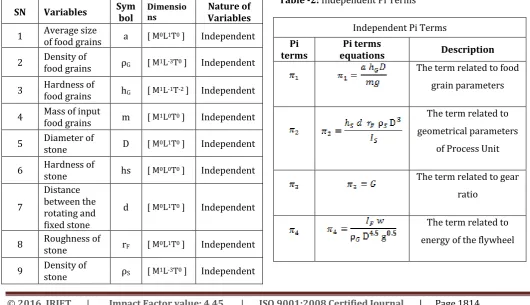
The dimensional equation for a phenomenon reduces the number of independent variables in the experiments. This is done by applying Buckingham’s π theorem. By applying this method eleven Pi terms are formed. Further to reduce the coplexity and to obtain the simplicity in the behaviour of the phenomenon, the Pi terms of independent variables are reduced by reduction of variables method as suggested by Schenk Jr.[26]. The Pi terms related to the independent variables are reduced to form a single new Pi term. In all total four Pi terms are formed, the first Pi term is the term related to food grain parameters, the second Pi term is the term related to Process Unit parameters, the third Pi term is the term related to gear ratio, and the fourth Pi term is the term related to energy of the flywheel.
Table -2: Independent Pi Terms
Independent Pi Terms
Pi
terms equations Pi terms Description
The term related to food grain parameters
The term related to geometrical parameters
of Process Unit
The term related to gear ratio
[image:3.595.29.560.485.790.2]© 2016, IRJET | Impact Factor value: 4.45 | ISO 9001:2008 Certified Journal | Page 1815
Table -3: Dependent Pi Terms
Dependent Pi Term
Pi
terms equations Pi terms Description
Π D1 Pi Term related to
Processing Time
5.5 Test Planning
It comprises of deciding the test envelope, test points, test sequence and experimentation plan for the deduced set of dimensional equation.
5.6 Model Formulation
It is necessary to correlate the various independent and dependent terms involved in this very complex phenomenon. This correlation is nothing but a mathematical model for the processing time TP. The mathematical model for processing time is as given below:
=
For wheat,
ΠD1 = =
4.04762 X 10⁻²³ ( ) 6.1886( ) 0.1012( ) -0.8788
( ) 1.0788
For sorghum,
ΠD1 = =
9.58517 X 10⁻¹⁸ ( ) 6.7016( ) 0.1097( ) -0.9213
( ) 1.1864
6. MODEL VALIDATION
The observed data from the experimentation is separated into two parts viz. causes i.e. input data or the data of independent pi terms and the effects i.e. output data or the data of dependent pi terms. The input data and output data is imported to the software respectively.
This network is then trained using the training data. The computation errors in the actual and target data are computed and then the network is simulated.
After simulating the ANN, it is found that experimentally observed values are very close and in good agreement with the ANN predicted values validating the model formed.
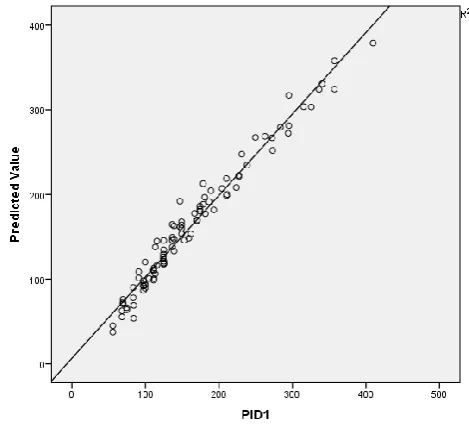
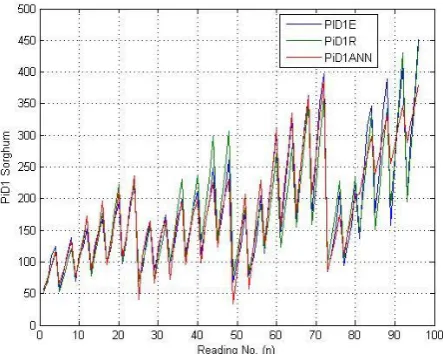
The ANN result validates the mathematical model formed from the experimentation results as the percentage error is very less. Here the higher value of R2 for wheat is 0.968 while the value of R2 for sorghum is 0.985 as indicated in the graph of PiD1 Vs. Predicted value with ANN for wheat and sorghum both. Also the sum of squares error and relative error for both wheat and sorghum is very less as given in Table 4 and 5 respe. Thus promising the best results from ANN.
[image:4.595.325.560.232.444.2]Fig -4: Graph of PiD1 Vs Predicted value with ANN for wheat
Table -4: Model Summary of PiD1 ANN for wheat
Model Summary
Training
Sum of Squares Error 1.083
Relative Error .034
Stopping Rule Used
1 consecutive step(s) with no decrease in errora
Training Time 0:00:00.11
Testing Sum of Squares Error .289
Relative Error .026
Dependent Variable: PiD1
[image:4.595.37.285.393.645.2]© 2016, IRJET | Impact Factor value: 4.45 | ISO 9001:2008 Certified Journal | Page 1816
Fig -5: Comparison graph of Experimental, Regression and ANN for PiD1 of Wheat
Fig -6: Graph of PiD1 Vs Predicted value with ANN for sorghum
Table -5: Model Summary of PiD1 ANN for sorghum
Model Summary
Training
Sum of Squares Error .373
Relative Error .013
Stopping Rule Used
1 consecutive step(s) with no decrease in errora
Training Time 0:00:00.05
Testing Sum of Squares Error .312
Relative Error .018
Dependent Variable: PiD1
a. Error computations are based on the testing sample.
Fig -7: Comparison graph of Experimental, Regression and ANN for PiD1 of sorghum
6. CONCLUSION
1. The newly designed food grain crusher will work on non-conventional energy source.
2. In countries like India where ample human power is available, such human powered man machine systems will help in a great extend to improve the economic condition and employability of such countries in backward or remote areas . 3. Apart from use of such human powered man machine systems, those systems can be used for preparing poultry farm food which makes poultry farms in rural areas independent and such cheap poultry farm food will increase their profit margin.
4. Those models will work as a design data for such type of man machine systems.
REFERENCES
[1] Modak, J. P. et all, “Manufacturing of Lime-flyash-sand bricks using manually driven brick making machine”, a project sponsored by Maharashtra Housing & Area Development Authority, (MHADA), Bombay, India. [2] Modak, J. P. and Bapat, A. R., “Formulation of
Generalized Experimental Model for a Manually Driven Flywheel Motor and its Optimization”, Applied Ergonomics, U.K., Vol. 25, No. 2, pp 119-122, 1994. [3] Modak J. P. and Bapat A. R. “Various efficiency of a
Human Power Flywheel motor” Human Power, USA International Human Power Vehicle Association No. 54, pp 21-23 Spring 2003.
[4] Modak J. P. “Design and development of manualluy energized process machines having relevance to village / agriculture and other productive operations” Human Power, USA International Human Power Vehicle Association no 58 pp 16-22, Fall 2004
[image:5.595.322.544.109.286.2] [image:5.595.48.270.109.257.2] [image:5.595.43.292.305.492.2]© 2016, IRJET | Impact Factor value: 4.45 | ISO 9001:2008 Certified Journal | Page 1817 electrical energy for rural applications, and computer
aided analysis of battery charging process.”, Human Power, USA International Human Power Vehicle Association no 58 pp 10-16Summer 2009.
[6] Askhedkar R. D. and Modak J. P. “Hypothesis for the Extru-sion of Lime-Fly-ash-Sand Bricks Using Manually Driven Brick Making Machine” Building Research & Information U.K. Vol. 22,N1, pp 47-54 1994.
[7] Sohoni V.V., H. P. Aware and Modak J. P “Manually Powered Manu-facture of Keyed Bricks” Building Research & Information, U.K. Vol. 25, N6, Pp 354-364, 1997
[8] Moghe S. D. and Modak J. P. “Development of an efficient cranking mechanism for bicycle and related devices” Human Power, USA International Human Power Vehicle Association, In Press
[9] Pattiwar J. T. and Modak J. P. “Design, Development & Analysis of Torsionally Flexible Clutches for on load Starting of a Manually Energized Machine” In Press [10] Modak, J. P. and Bapat, A. R, “Manually driven flywheel
motor operates wood turning process” Contemporary Ergonomics, Proc. Ergonomics Society Annual Convention 13-16 April, Edinburgh, Scotland, pp 352-357, 1993
[11] Modak, J. P. and Katpatal A.A., “Design of Manually Energized Centrifugal Drum Type Algae Formation Unit”Proceedings International AMSE Conference on System, Analysis, Control and Design, Layon (France), Vol. 3, 4-6 July 1994, pp 227-232.
[12] Zakiuddin K. S. and Modak, J. P., “Application of pedal operated flywheel motor as an energy source for fodder chopper” International Journal of Agricultural Engineering, Vol. 3 Issue 2 pp 251-256, Oct. 2010 [13] Dhale A. and Modak, J. P., “Formulation of the
approximate generalized data based model for oilseed presser using human powered flywheel motor as an energy source” International Journal of Agricultural Engineering,
[14] Modak, J. P., et all, “Influence of development and human powered process machine and its impact on energy management of rural and interior sector”, Proceeding of National Conference on Energy Management in Changing Business Scenario, (EMCBS 2005), 8-9 October 2005, BITS Pilani.
[15] Bapat A. R. Ph. D., Thesis on “Formulation of Generalized Experimental Model for a Manually Driven Flywheel Motor” 1995
[16] Pattiwar J. T. Ph. D., Thesis on “Advancement in the Development of Finger Type Torsionally Flexible Clutch for Low Capacity Manually Energized Chemical Unit Operation Device “ 2004
[17] Deshpande S. B. Ph. D., Thesis on “Application of Manually Energized Fly Wheel Motor to Generation of Electricity “ 2008
[18] Sohoni V. V. Ph. D., Thesis on “Ph. D. (Formulation of Generalized Experimental Model for Manual Keyed Brick-making Machine and to Deduced Hypothesis for Extrusion” 2002
[19] Askhedkar R. D., Ph. D., Thesis on “Experimental Model for Brick Making Machine” 1992.
[20] Moghe S. D. Ph. D., Thesis on “Optimization of cranking Mechanism for Bicycle & Related Devices “ 2010.
[21] Zakiuddin K. S. Ph. D., Thesis on “Formulation of Generalized Experimental data base Model for Agricultural implements” 2010
[22] Deshmukh R. and Modak J. P., M.E. by Research Thesis on “Dynamics of Torsionally Flexible Clutch “
[23] Aware H. V., M.E. by Research Thesis on “Establishing Functional Feasibility & Economic Viability of Manufacture of Keyed Bricks ‘” 1999
[24] K.H.F. Murrell, “Ergonomics : Man In His Working Environment” Chapman and Hall, London
[25] H. Schenk Jr., “Test Sequence and Experimental Plans”, Theories of Engineering Experimentation, Mc Graw Hill Book Co., New York, pp 6.
[26] Dariusz Dziki,Janusz Laskowski ”Influence of wheat grain mechanical properties on grinding energy requirements”,TEKA Kom. Mot. Energ. Roln., 2006,6A,56-64
[27] Dariusz Dziki, Janusz Laskowski ,“Infuence of selected factors on wheat grinding energy requirements”TEKA Kom. Mot. Energ. Roln., 2005,56-64
[28] Dariusz Dziki, Janusz Laskowski ,”The energy consuming indexes of wheat Kernel Grinding process.”
[29] E.Beshada, M. Bux, T. Waldenmaier ”Design and Optimisation of a Photovoltai powered Grain Mill”,Agricultural Engineering International:the CIGR Ejournal
[30] B. D. Shiwalkar “Design of Machine Elements” Denett & Co., India.
[31] B. D. Shiwalkar “Design Data For Machine Elements” Denett & Co., India.