© 2016, IRJET | Impact Factor value: 4.45 | ISO 9001:2008 Certified Journal
| Page 2604
Proposed Methods for Spoofed IP Detection and Prevention for Cloud
Computing
Kunal V. Raipurkar
1, Prof. Anil V. Deorankar
21
Dept. of Computer Science and Engg. Government College of Engineering, Amravati, Maharastra ,India
2
Professor, Dept. of Computer Science and Engg. Government College of Engg, Amravati, Maharastra ,India
---***---Abstract
- Denial of Service do violence to has beenacknowledged as the prevalent security intimidation to service accessibility in Cloud Computing. It thwart justifiable Cloud users from right of entry pool of resources make available by cloud Providers by inundation and overwhelming network bandwidth to weaken servers and computing resources. A most important characteristic of DoS assault is spoofing of IP address that put out of sight the distinctiveness of the assailant. Imitation crimes are appropriate all the time more complicated and have additional ruthless trade and industry impacts. Each assailant goal can be alienated into four main classes: intermission, interception, amendment and falsehood. Based on the assailant goals there are essentially two types of molest, active attack and passive attack. Active attacks are those in which assailant can transform information, intermission services and endeavor to gain unofficial access to the arrangement systems. During unreceptive attack, the aggressors simply monitor the diffusion flanked by the two parties and incarcerate information that is propelled and accept. For this many time-honored network devices such as Intrusion Detection System, firewalls and safekeeping scanners are obtainable. However these methods will not be competent to become aware of the IP spoofing attacks. And also the spoofing assault is man-in-the-middle attack. Hence there should be some appliance by which such attacks can be detected. Through this paper we endeavor to formulate study on various mechanisms by which IP spoofing assault can be detected and stipulate the singular obtainable techniques to thwart the IP spoofing show violent behavior. The system anticipated in a fortification Method in opposition to unconstitutional Access and Address Spoofing for unfasten Network Access Systems is more efficient. This paper thrash out unusual methods for become aware of spoofed IP packet in Cloud Computing and proposes Host-Based Operating System fingerprinting that uses both unreceptive and active technique to competition the Operating System of homeward bound packet from its database. Furthermore, how the projected performance can be put into operation was established in Cloud computing upbringing.
Key Words: Denial of service, Cloud computing, Security,
Finger printing, unconstitutional, operating system
1. INTRODUCTION
Computer safety measures have been a sombre question since the preparatory of internet. As the knowledge enlarge
the charge of this safety measures issues also increased. There are singular ways to make certain safety measures in internet. Most of these procedures are restrained to securing the arrangement from a meticulous type of infringement. Hence as new-fangled systems are urbanized to save from destruction in opposition to an unambiguous attack, interloper comes up with a new-fangled interruption method. A quantity of the interloper methods take account of spamming, spoofing, Phishing, cookies. Spamming refers to the garbage mails propel to the email. More often than not spasms are not treacherous. Spoofing is imaginary to be an important person else. Phishing is a procedure that is second-hand to get hold of username or password through an unconstitutional technique. Cookies are credentials which accumulate the recitation of browsing. Actuality cookies furnish out to be ready to lend a hand a large amount of the times; on the other hand this manuscript can be stolen by an impostor to expand admittance to unauthorized data. Also these assaults are finished by a third party organization. Hence each and every one these assail can be pigeonhole into man-in-the-middle attack. The perception of IP spoofing was foremost come interested in representation in the 1980's. In the April 1989 article unconstrained: safety measures tribulations in the TCP/IP Protocol matching set, the foremost to make out IP Spoofing as an authentic jeopardy to computer networks [1]. Word connotation of Spoofing is pretending to be incredible you are not. Hence in terms of interloper in internet, spoofing refers to by means of an important individual else IP address as foundation address before distribution of a packet. When the packet is conventional at the destination, the beneficiary accept as true with the intention of the packet was send by a trusted solitary and hence will act in response to the packet. This take places for the reason that most of the protocols internet relies on the source address for substantiation. Also spoofing the source IP address is not a dangerous task. Therefore a gatecrasher can without problems cause an IP spoofing assault.
2. BACKGROUND
© 2016, IRJET | Impact Factor value: 4.45 | ISO 9001:2008 Certified Journal
| Page 2605
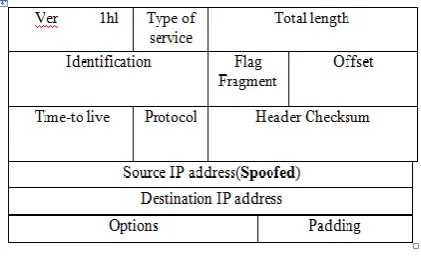
than not a self-confidence IP address. This packet on [image:2.595.61.272.188.316.2]accomplishment the objective, it ensures for the source IP address. In view of the fact that the source IP address is seen to be an expectation one it agree to the packet, flush though it was propel by un-trusted party. In fig 1. It shows the IP header fields along with the source IP address field where spoofing occurs mostly.
Figure 1: IP header design
For illustration for the IP spoofing is individual as underneath. Presume that an interloper whose IP address is 192.168.30.111necessities to send a packet to a website with IP address 192.168.30.44.If the interloper knows an IP take in hand which is a buoyancy one to 192.168.30.44 say 192.168.31.20 then 192.168.30.111 foregoing to sending the packet will amend IP header paddock in such a performance that the source IP address at this split second is 192.168.31.2 instead of 192.168.0.12.This beneficiary on considering the source IP address 192.168.31.2,it identifies that the packet is oblige from a trusted solitary. There is an assortment of researches going on to become aware of the IP spoofing assault. Some of the techniques take account of dissemination test, using hop count, using packet filters etc. Here in this paper and we aim to measure up to these dissimilar techniques used for detecting IP spoofing assault.
The two fundamental detecting mechanisms of IP spoofing based assault is packet filtering and packet mark out back at the nodule altitude. Numerous techniques have been wished-for by an assortment of researchers based on the greater than point out two mechanisms. The fractional path of the packet is inspecting in regulate to come across the accurate starting point of the show violent behavior of the packet. This task of pronouncement the true source of the malicious packet is called trace back mechanism. The first stride towards the indispensable legal achievement to dishearten such show aggression in future is to categorize the source address in the approved manner. Savage et al. wished-for to let routers smudge packets probabilistically, so that the sufferer can bring together the discernible packets and modernize the show aggression path. One superior proposal of probabilistic packet scratching has been anticipated by Song et al. to decrease the counterfeit positive tempo for reconstructing the show aggression path. An additional superior method of probabilistic small package marking has
been wished-for to diminish the computational visual projection.
As a down to business solution to such attacks, quite a lot of filtering schemes, which must complete on IP routers, encompass been wished-for to put a stop to spoofed IP packets from accomplishment intended victims. The access filtering blocks spoofed packets by the side of edge routers, where take in hand possession is moderately instantly recognizable, and traffic consignment is near to the ground. However, the accomplishment of access filtering turning point on its spacious consumption in IP routers.
Park and Lee wished-for the route-based container filters as a outward appearance of International Journal of catalog Presumption and Application extenuating IP spoofing, which assumes with the intention of in attendance is solitary single path stuck between one foundation node and one destination node, so whichever packet with the source take in hand and the destination address that come into sight in a router that is not in the path, should be unnecessary. Consequently, a new technique which is Hop-Count Filtering (HCF) wished-for an additional work of fiction cut down system to recognize packets whose source IP addresses is spoofed. The information on the subject of a source IP take in hand and it’s responding bound on or after servers is recorded in a counter at the member of staff serving at table surface when in attendance are attacks without charge. On one occasion an assault alarm is raised, the fatality will give something the once-over the homeward bound packets’ source IP addresses and their responding hops to make a distinction the spoofed packets.
To make lawful that an IP packet carries the spot on source address, accumulate, a source address authority enforcement protocol, builds a table of homeward bound source IP addresses at every one router that acquaintances each of its homeward bound interfaces with a position of compelling incoming set of connections addresses. Accumulate runs on every one IP router and verifies whether an IP packet arrives at its anticipated crossing point. By corresponding homeward bound IP addresses in the midst of their predictable in receipt of interfaces, situate of IP source addresses that whichever aggressor be capable of spoof is to the highest degree concentrated.
During show aggression situations somewhere a bulky add up to of contaminated hosts are utilized, the information commencing a outsized numeral of set of connections campaign should be collective to induce a having an important consequence decision.
2.1 DDos Attack in Cloud
© 2016, IRJET | Impact Factor value: 4.45 | ISO 9001:2008 Certified Journal
| Page 2606
figure 1, DDoS carries out enlargement which can moreoverbe a unswerving or manifestation assault.
2.2 IP Spoofing in DDos Attack
DDoS assault is over and over again characterized by spoofing of source IP address to camouflage its distinctiveness to outlaw straightforward sketch back or mislead the Cloud Provider to take pleasure in certain examination accrued to a trusted host. The methods worn to become aware of spoofed IP can be in the main classified as moreover passive or active.
Figure2. DDoS assault in Cloud
2.3 Spoofed IP Packet Detection Methods
Hop-Count Filtering (HCF) is a technique wished-for by [3] and was worn to strain flooding traffic for the duration of a DDoS assault by using the Time-to-Live (TTL) worth of the foundation packet header. The hop count up estimation is compared with the worth obtained from the erect IP2HC mapping table. Packets will be established if the principles counterpart while a difference will be termed spoofed and redundant. The major disadvantage of this modus operandi is that each and every one the OS developers do not encompass the identical preliminary TTL value; consequently difference can without difficulty take place during the development of obtaining the preliminary TTL from the concluding value. Path fingerprint technique called ANTID (Anti-DDoS) was wished-for by [4] for detecting and filtering spoofed packets in DDoS attack. Here, each packet has an embedded only one of its kind path fingerprint which identifies the direction an IP packet traverses from source to destination. It distinguishes stuck between the dissimilar IP paths in use by dissimilar IP packets. The member of staff plateful at table has a map for every one of the communicating client and maps the clients IP address to the equivalent path fingerprint. This technique is some degree of in its occupation as it cannot become aware of packets in the midst of spoofed IP take in hand that does not continue
living on its mapping. Trace method is a widespread set of connections tool with the intention of is far and wide second-hand for influential the path at which a packet negotiated. When worn to become aware of a spoofed packet, it determination put in the picture add up to of hops to the accurate source of the packet. In the middle of the most imperative disadvantage of this modus operandi is that it is awfully unhurried and if the accurate source is sheltered by a firewall, the questioning packet wills homecoming the numeral of hops to the firewall [5] which will not reproduce the hop count up of the accurate source. TCP interactive technique was wished-for due to TCP organism a association slanting protocol that ensures trustworthy liberation of packets by distribution ACK communication for each delivered packet stuck between source and destination. On implementing this modus operandi, in attendance will be announcement stuck between in collaboration sides. This enables recognition of spoofed packets as its foundation will not act in rejoinder to any investigate from the objective if it does not continue living [5]. Supplementary TCP attributes that can be second-hand includes casement size countryside and the progression integer sports ground of the ACK packet. The most important demerit of this modus operandi is that aggressor can forecast the SYN numeral value and act in response to the objective.
3. IP SPOOFING ANTICIPATION METHODS
3.1 Compression
Fundamentally compression confidential captivated to two types-
3.1.1 Lossy Compression
© 2016, IRJET | Impact Factor value: 4.45 | ISO 9001:2008 Certified Journal
| Page 2607
of red dot, red dot, etc red dot. The innovative contains aconfident amount of in sequence; in attendance is a subordinate perimeter to the size of file that can bring all the in sequence. For example, most populace is on familiar terms with that WinRar fabricate the packed together ZIP file is less important than the imaginative file; but over and over another time compressing the dossier will not diminish the size to not anything, and strength of character in fact more often than not augment the size. Lossy compression formats go through from production loss: over and over again compressing and decompressing the file strength of character grounds it to more and more be unable to find superiority. This is in dissimilarity with lossless data compression. Information hypothetical practicalities for lossy data compression are provided by tempo deformation speculation. A large amount approximating the bring into play of possibility in most advantageous coding theory, velocity misrepresentation theory a great deal draws on Bayesian inference and pronouncement presumption in categorize to reproduction perceptual misrepresentation and even visual conclusion.
3.1.2 Lossless Compression
Lossless data firmness is a category of data compression algorithms with the intention of tolerates the faithful innovative data to be fetched from the compressed ZIP data. The expression lossless is in dissimilarity to lossy data compression, which no more than allows a rough calculation of the imaginative data to be alive fetched, in swap over for enhanced compression tariff Lossless data compression is worn in a lot of applications. For example, it is worn in the admired ZIP file arrangement and in the most important ingredient unix implement gzip. It is in adding together over and over again worn as a constituent controlled by lossy data compression knowledge.
3.2 Cryptography
Cryptography has been worn as an approach to throw secret communication sandwiched between warring populations, stuck between users, stuck between associations etc; as such, it became an imperative concern in countrywide safety measures and laws. With the escalating necessitate for safe and sound connections for data traversing computer networks for health check, economic, and other dangerous applications, cryptography is now attractive a inevitability for nongovernmental, nonmilitary applications. All more than the sphere, the laws and set of laws with reference to cryptography are undergoing a immeasurable adjust. Officially authorized limitations on the introduction and sell to other countries of cryptographic products are being deliberated and tailored.
Cryptography has some major issues:
Key length: The amalgamation of the algorithm and the
key measurement lengthwise are aspects of cryptographic potency. The algorithm is more often than not well acknowledged. The longer key is the stronger the cryptographic potency of a prearranged algorithm.
A number of countries have sell to other countries laws that perimeter the key measurement lengthwise of a prearranged cryptographic algorithm.
Key recuperation: In current existence, sell to other
countries laws have been adapted if the cryptographic algorithm includes the competence of incorporating key recuperation methods. These modified laws smooth the progress of governments to wire-tap for encrypted electronic data if they estimate it necessary to do consequently.
Cryptography bring into play: Dissimilarity is every now
and then completed on the subject of whether cryptography is used for substantiation and truthfulness purposes or for discretion rationale. When used for discretion, the sell to other countries laws are characteristically much supplementary rigorous. In this chapter, cryptography uses to augment the safety measures in IP compression modus operandi.
The most important purpose of IP compression is to stay away from the above your head, which provides the bandwidth consumption. The IP description compression employment initiated ten years ago excluding still in attendance is a quantity of disadvantage and difficulty persists. For behavior the packet conversion in successful approach we are heartrending to IPv6 but the description size will augment in IPv6. To augment the bandwidth utilizations, keep away from the set of connections traffic, blocking, fender-bender, we go for compression modus operandi.
Fundamentally compression used for curtail the size of dossier into partially. For example if the innovative file size is 100mb subsequent to compression it will concentrated into 50mb. While decompress your file we encompass to acquire original in sequence devoid of unfastened no matter which. Indispensable suggestion in the rear in this is do away with the unnecessary data’s or information’s.
In our effort we integrate the compression modus operandi into TCP/IP packets. At the same time as data reassign two end systems will formulate the announcement stuck between these two conclusions points the gathering will billed for the short idiom. Both arrangements has an only one of its kind IP address for identifying the classification in set of connections, using this IP address only communiqué will well-known.
4. IMPLICATIONS
IP spoofing assault is a successful modus operandi used by interloper in which they make use of the only one of its kind IP address substitute modus operandi to increase right of entry to a system in an not permitted approach. For this explanation IP spoofing can be well thought-out as a modus operandi of fooling a party and consequently expand the agreement. Above we include seen three dissimilar practices by which to become aware of IP spoofed packets.
© 2016, IRJET | Impact Factor value: 4.45 | ISO 9001:2008 Certified Journal
| Page 2608
Technique 1:
One of the most important reasons why the spoofing show violent behavior occurs is for the motivation that the confirmation is finished immediately based on the source IP address. In attendance should be a quantity of modus operandi in which IP speak to is not the no more than criterion by which substantiation are to be completed.
Technique 2
:
In the primary manuscript it was seen that spoofing knows how to acquire position outstanding to the intend flaws of UDP. On the other hand TCP provides a more effective mechanism .This is because TCP establishes a connection stuck between sender and beneficiary from beginning to end three ways handshake machinery. This three way handshaking mechanism can avoid spoofing because if the starting place take in hand was spoofed the beneficiary on conveyance the acknowledgement to the correspondent the trusted host whose IP address was used for spoofing will act in response with an blunder memorandum.
Technique 3:
Render inoperative the ping instructions. Flush though ping information’s are worn on the odd juncture it can be used to elicit a DOS show aggression by flooding the injured party with ICMP packets.
5. CONCLUSIONS
Safety measures are a very important constituent of each set of connections design. When planning, developing and deploying a set of connections one should comprehend the consequence of a strong security policy. A safety measures guiding principle defines what community be capable of and can't do with set of connections apparatus and possessions. In attendance are dissimilar types of show aggression on internet, unreceptive attack, vigorous attack, disseminated attack, Insider Attack, Phishing Attack, spoofing show aggression etc. Each and every one these attack has their have possession of distinctiveness and for this reason the tester be supposed to be very on your guard about the aggressor. Smooth despite the fact that IDS and firewall are exceptionally triumphant scheme that ensure set of connections safety measures it does not bring into being superior results in confident cases. From beginning to end this paper we can investigate dissimilar modus operandi from beginning to end which to become aware of ma-in-the-middle assault and spoofing assault.
REFERENCES
[1] M. T Khorshed, A. Ali and S. A. Wasimi, “A survey on
gaps, threat remediation challenges and some thoughts
for proactive attack detection in cloud computing,” FGCS, 28(6), pp. 833-851, 2012.
[2] W.T Tsai, X. Sun and J. Balasooriya, “Service-Oriented
CloudComputing Architecture,” In IEEE Seventh International Conference onInformation Technology: New Generations (ITNG), Las Vegas, USA, pp.684-689., 2010.
[3] J. Cheng, H. Wang and K.G, “Hop-count filtering: an
effective defenseagainst spoofed DDoS traffic,” In Proceedings of the 10th ACM conference on Computer and communications security, USA, pp.30-41. October 2003
[4] F. Y. Lee and S. Shieh, “Defending against spoofed DDoS
attacks withpath fingerprint,” Computers & Security, 24(7), pp.571-586, 2005.
[5] S. J. Templeton and K. E. Levitt, “Detecting spoofed
packets,” In IEEE DARPA Information Survivability Conference and Exposition Proceedings Vol. 1, pp. 164-175, 2003.
[6] J. M Allen OS and Application Fingerprinting
Techniques, SANS institute InfoSec Reading Room, 2007.
[7] Bechtsoudis and N. Sklavos,” Aiming at Higher Network
Security Through Extensive Penetration Tests”, IEEE Latin America Transactions, Vol. 10, No. 3, April 2012.