Technology (IJRASET)
Implementation of a High-Speed RSD Based ECC
Processor with Vedic Multipliers
Chitra A1, Sangeethalakshmi K2, Prabhakar K3
1,2
Department of Electronics and Communication Engineering, First-Two RMK College of Engineering and Technology,
3
L&T Limited
Abstract- In this paper, an exportable application-specific instruction-set elliptic curve cryptography processor based on redundant signed digit representation is proposed. The processor employs extensive pipelining techniques for Karatsuba–Ofman method to achieve high throughput multiplication. Furthermore, an efficient modular adder without comparison and a high throughput addition/subtraction, which results in a short data path for maximized frequency, are implemented. We have proposed a novel recursive decomposition algorithm for addition to obtain high-throughput digit-serial implementation. The synthesis results for field programmable gate array (FPGA) and application specific integrated circuit (ASIC) realization of the proposed designs and competing existing designs are compared.
Keywords: Elliptic curve cryptography, Vedic multipliers, Redundant signed digits, Application specific integrated circuit.
I. INTRODUCTION
In this paper, we proposed an 8-bit multiplier using a Vedic Mathematics (Urdhva Tiryakbhyam sutra) for generating the partial products. The partial product addition in Vedic multiplier is realized using carry-skip technique. An 8-bit multiplier is realized using a 4-bit multiplier and modified ripple carry adders. In the design we have reduced the number of logic levels, thus reducing the logic
delay. Simulation of the architecture is carried out using Xilinx ISIM and synthesized using Xilinx XST [1]. Architecture to
perform high speed multiplication using ancient Vedic math’s technique is proposed. To increase the speed of multiplier the half adder and full adder of the Vedic mathematics multiplier is replaced with compressor. In this 4:2 compressors are used for adding more than 3-bits at a time. Upon comparison, the compressor based multiplier introduced in this paper, is almost two times faster than the popular methods of multiplication [2].
In this paper, multiplier based on ancient Vedic mathematics technique has been proposed which employs 4:3 compressor, 5:3 compressor, 6:3 compressor and 7:3 compressors for addition of partial products. Combining the Vedic Sutra- Urdhwa Tiryakbhyam and efficient compressors, a robust area and power efficient multiplier architecture has been achieved. The designs were synthesized and analyzed in Cadence RTL compiler in 180 nm technology. In this higher order compressor for used to design an 8*8 multiplier. It can be used in low area and power critical applications [3].
In this symbol CMOS 4:2 compressor using pass logic is develop. This circuit is design using an X-OR and X-NOR combination gates it eliminates the use of inverters. The total power dissipation has been cut down to a minimum while providing the full output voltage swing at all nodes in the circuit. The total circuit consists of 28 transistors [4].
As mentioned earlier, Vedic Mathematics can be divided into 16 different sutras to perform mathematical calculations. Among these the Urdhwa Tiryakbhyam Sutra is one of the most highly preferred algorithms for performing multiplication. The algorithm is competent enough to be employed for the multiplication of integers as well as binary numbers. The term "Urdhwa Tiryakbhyam” originated from 2 Sanskrit words Urdhwa and Tiryakbhyam which mean “vertically” and “crosswise” respectively. The main advantage of utilizing this algorithm in comparison with the existing multiplication techniques, is the fact that it utilizes only logical “AND” operations, half adders and full adders to complete the multiplication operation. Also, the partial products required for multiplication are generated in parallel and apriority to the actual addition thus saving a lot of processing time.
The formulas of urdhwa tiryakbhyam sutra for multiplication of two eight bit numbers is given below, P0= A0*B0
C1P1 = (A1*B0) + (A0*B1)
C3C2P2 = (A2*B0) + (A1*B1) + (A0*B2) + C1 C5C4P3 = (A3*B0) + (A2*B1) + (A1*B2) + (A0*B3) +C2
C7C6P4 = (A4*B0) + (A3*B1) + (A2*B2) + (A1*B3) + (A0*B4) + C3 + C4 C10C9C8P5 = (A5*B0) + (A4*B1) + (A3*B2) + (A2*B3) + (A1*B4) +
(A0*B5) + C5 + C6
C13C12C11P6 = (A6*B0) + (A5*B1) + (A4*B2) + (A3*B3) + (A2*B4) + (A1*B5) + (A0*B6) +C7 + C8
C16C15C14P7 = (A7*B0) + (A6*B1) + (A5*B2) + (A4*B3) + (A3*B4) + (A2*B5) + (A1*B6) +(A0*B7) +
C9 + C11
C19C18C17P8 = (A7*B1) + (A6*B2) + (A5*B3) + (A4*B4) + (A3*B5) + (A2*B6) +(A1*B7) + C10 +
C12 + C14
C22C21C20P9 = (A7*B2) + (A6*B3) + (A5*B4) +(A4*B5) + (A3*B6) + (A2*B7) +C13+ C15 + C17
C25C24C 23P10 = (A7*B3) + (A6*B4) + (A5*B5) + (A4*B6) + (A3*B7) + C16 +C18 + C20
C27C26P11 = (A7*B4) + (A6*B5) + (A5*B6) +(A4*B7) + C19 + C21 + C23 C29C28P12 = (A7*B5) + (A6*B6) + (A5*B7) + C22 +C24 + C26
C31C30P13 = (A7*B6) + (A7*B6) + C25 +C27 + C28 C32P14 = (A7*B7) + C29 + C30
P15 = C31 + C32
Technology (IJRASET)
Fig 1-Architecture of Compressor based Urdhwa multiplier
Graphically illustrates the step by step method of multiplying two 8 bit numbers using the Urdhwa Tiryakbyam Sutra. The black circles indicate the bits of the multiplier and multiplicand, and the two-way arrows indicate the bits to be multiplied in order to arrive at the individual bits of the final product. As mentioned earlier, the partial products obtained are added with the help of full adders and half adders. It can be seen, from equation (1) to (16) that in few equations there is a necessity of adding more than 3 bits at a time. This leads to additional hardware and additional stages, since the full adder is capable of adding only 3 bits at a time. In the next section three different types of compressor architectures are explored which assist in adding more that 3 bits at a time, with reduced architecture and increased efficiency in terms of speed.
III. SOFTWAREDESIGN
Multipliers play an important role in today’s digital signal processing and various other applications. With advances in technology, many researchers have tried and are trying to design multipliers which offer either of the following design targets – high speed, low power consumption, regularity of layout and hence less area or even combination of them in one multiplier thus making them suitable for various high speed, low power and compact VLSI implementation.Common multiplication method is “add and shift” algorithm. In parallel multipliers number of partial products to be added is the main parameter that determines the performance of the multiplier. To reduce the number of partial products to be added, Modified Booth algorithm is one of the most popular algorithms. To achieve speed improvements Wallace Tree algorithm can be used to reduce the number of sequential adding stages. Further by combining both Modified Booth algorithm and Wallace Tree technique we can see advantage of both algorithms in one multiplier. However with increasing parallelism, the amount of shifts between the partial products and intermediate sums to be added will increase which may result in reduced speed, increase in silicon area due to irregularity of structure and also increased power consumption due to increase in interconnect resulting from complex routing. On the other hand “serial-parallel” multipliers compromise speed to achieve better performance for area and power consumption. The selection of a parallel or serial multiplier actually depends on the nature of application. In this lecture we introduce the multiplication algorithms and architecture and compare them in terms of speed, area, power and combination of these metrics. AND gates are used to generate the Partial Products, PP, If the multiplicand is N-bits and the Multiplier is M-bits then there is N* M partial product. The way that the partial products are generated or summed up is the difference between the different architectures of various multipliers. Multiplication of binary numbers can be decomposed into additions. Consider the multiplication of two 8-bit numbers A and B to generate the 16 bit product P.
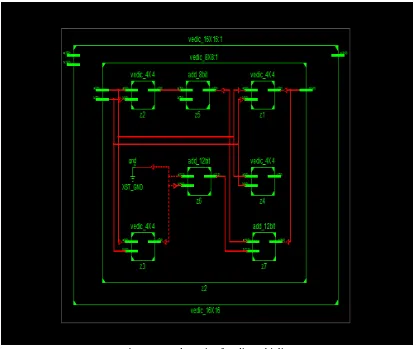
Fig 2. RTL Schematic of Vedic multiplier
V. SIMULATIONRESULT
Technology (IJRASET)
products. This in turn leads to a large propagation delay due to the reasons explained in the previous section. As part of our novel approach, we combined the compressor architectures explained earlier and utilized the same in the Urdhwa based architecture which was formerly shown below. The architecture for the multiplier given below.
[image:6.612.138.475.180.433.2]That the compressor based Urdhwa multiplier requires only 12 parallel stages as opposed to 15 which was in the case of the conventional Urdhwa Tiryakbhyam multiplier. This is a major improvement with respect to high-speed multiplier design. Also, it can be seen that, many of the stages have now been reduced to logical XOR operation, with an initiative to reduce area. An analysis on the area occupied by the new design and also the improvement in speed in comparison with other popular methods of multiplication has been presented in this section
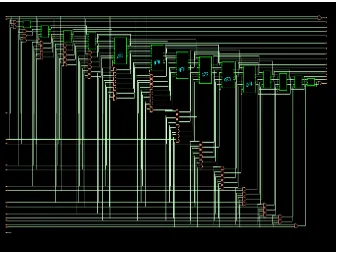
Fig 3. Output schematic of multiplier
VI. CONCLUSION
This multiplier provides high-speed performance for the elliptical curve cryptography for encryption of binary bits. The delay time of this Vedic multiplier is very much less when compared to the existing model. The pipelining in the Vedic multipliers are faster and highly robust when compared to the normal multipliers. This reduces the time consumption for the encryption and decryption process in ECC process. Equally, new demands arising from unconventional applications have stimulated new solutions, combining proven technologies in novel and innovative ways.
REFERENCES
[1] Cristophe bhode ‘Introduction to reconfigurable ECC PROCESSOR’ architectures algorithms and applications springer.
[2] Diffie W and HellmanM. E. (1976) ‘New directions in ECC cryptography,’ IEEETrans. Inf. Theory, vol. IT-22, no. 6, pp. 644–654.