Face Detection and Features Extraction
Pritpal Singh
Research scholar in Ycoe,Punjabi Uni Patiala
Abstract: In this we are used features extraction method is used for identify object form group of objects. And calculate location and size of human face In which we are detect Eye, nose, mouth. In which we are work on detection of human face in front. In our research we are use Viola Jones algo for detection of facial features Template machining technique basically create a template and identify object with the help of techniques IN which object is compare with classifiers and matched sucessfully.It contains feature points which used for describe objects. Working of template machining as follows.
1) In which features of source image is competes.
2) IN which features of image is compare with database images Keywords— Face Recognition, feature detection, viola Jones.
I. INTRODUCTION
Face Detection is the process of identify object from images. We are classify diff objects which are easily visible. Some objects are completely visible and some are partially hidden from another object objects are available in diff positions[1]. Identification of these objects are easy for humans because they have knowledge about object and lean based on experiences but It is difficult task for detect a object from machine. Duo to this problem solving diff algorithms are used. Using these Viola jones algorithms machine can easily detect objects in diif pose, lightning conditions, camera parameters, appearance etc. [2] In which use square-shaped filters to detect interested points object. [3].
[image:2.612.215.387.367.646.2]
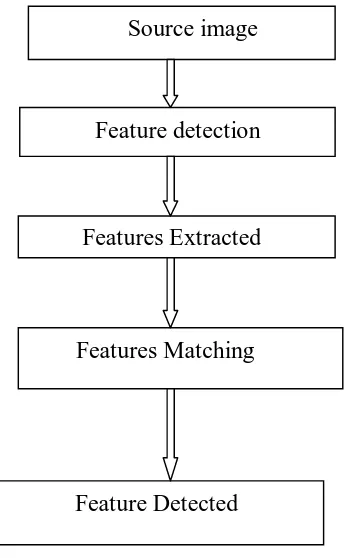
Fig 1 Represents control flow diagram
Source image
Feature detection
Features Extracted
Features Matching
C. We are handle various difficulties during face detection .These problems are work like as
D. hamper during Face detection.[5].
E. 1.There is a bigger problem arise during detection is view point or lighting position.
F. 2.Some image face are rotated then they are not properly detected.
G. 3.Some face are in diff poses and diff appearances.
H. 4.Difficult to detect face in binary images .
II.
BACKPROPAGATION
This algorithm is work on supervising learning method.In which require a output from a input for
calculation loss gradient.In which use as sigmoid function as like as gradient function for its activation.[6]
Algoritm is divided into two pars
1)
Phase 1:Propagation :
2)
Forward propagation: Input is given to network for generate propagation output activation
3)
Backward Propagation: In which giving the output as like as input for order to generate the diffirence
between actual and target output.
4)
Phase2.Weight update:
5)
Gradient of weight is used to produce of diffidence of output and input activation.
6)
Ration of learning is affect the speed and quality of learning. When the ration of neurons are trained
quickly then accuracy is not increases. Due to updating increases positive side then error size increase.
III.
FACE DETECTION ALGORITM
It is proposed by poul violva and Michael Jones.It is useful for detecting faces but other kind of objects. Due
to robust nature and used in practically is mostly used .In which we are used four stages for detection of faces
[7]
1)
Haar feature selection: It is used for detect sophisticated features in rectangular box[8]
2)
Cascade: In which classify features in different stages[9]
IV.
VISION CASCADE OBJECT DETECTOR
Cascade object detector is used viola-johnes algoritm to detect people face ,nose ,mouth, eye [10]
A.
Neural Network
Multiple interconnected layers are inspire neural structure of brain. Arrow represents the connection from the
output of neuron of another. The nodes of neural networks are exchange data within nodes. Every nodes are
assign nodes. It is based on supervision learning[11]
B. Proposed methodology
1)
Detection of faces in images.
2)
Detection of features in face.
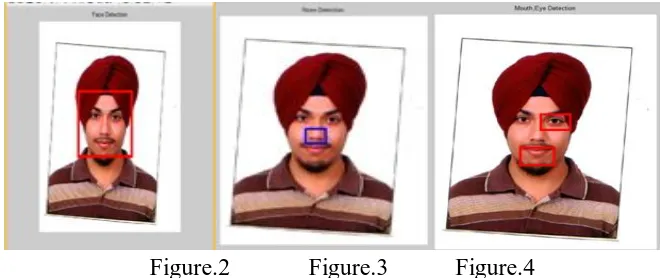
Figure.2 Figure.3 Figure.4
In figure2 we are detection of face using haar cascade ,detection in rectangle . In figure3.we are detetection of nose n face .
[image:4.612.58.553.270.438.2]In figure4.we are detecting eye and mouth simultaneously at a single time
Fig. 5. Histogram of grey level image Fig 6.Histogram of colour image
V. CONCLUSIONS
Detecting face and features are recognize using neural networks .We are used different multiple faces for face recognization is continue as same. First we are read the image and detecting features and then convert into greyscale images for detection of feature .In that require a lots of training seasons for enhances the performance of network and reduce least mean square error. Viola-jones algorithm is high sensitive to the color information in the image and will not work for a gray scale image. It is difficult to detect face and features in binary and grey image.
REFERENCES
[1] Tikoo, Smriti, and Nitin Malik. "Detection, Segmentation and Recognition of Face and its Features Using Neural Network." arXiv preprint arXiv:1701.08259 (2017)
[2] Kaur, Amanpreet, and Er Priyanka Jarial. "Object Recognition using Template matching with the help of Features extractionmethod." (2015).
[3] ] Nagi, Jawad, Syed Khaleel Ahmed, and Farrukh Nagi. "A MATLAB based face recognition system using image processing and neural networks." 4th International Colloquium on Signal Processing and its Applications. Vol. 2. 2008.
[4] Wilson, Phillip Ian, and John Fernandez. "Facial feature detection using Haar classifiers." Journal of Computing Sciences in Colleges 21.4 (2006): 127-13 [5] Hemalatha, G., and C. P. Sumathi. "A study of techniques for facial detection and expression classification." InternationalJournal of Computer Science and
Engineering Survey 5.2 (2014): 27
on. IEEE, 2016.