Technology (IJRASET)
Contingency Analysis of 30 Bus Power System
Using PSAT
Sushil Kumar1, Harmeet Singh2
1,2
Department of Electrical Engineering
Guru Nanak Dev Engineering College Ludhiana, Jalandhar, India
Abstract: Load Flow Study (LFS) is the most important part of system-planning studies and also the starting point for transient and dynamic stability studies. The load flow problem models the nonlinear relationships among bus power injections, power demands, and bus voltages and angles, with the network constants providing the circuit parameters. This paper provides formulations of the load LFSs in unforeseen contingency environments’. Load Flow are necessary for planning, operation, economic scheduling and exchange of power between utilities. The principal information of LFS is to find the magnitude and phase angle of voltage at each bus and the real and reactive Load flowing in each transmission lines. LFS is a significant tool involving numerical studies applied to a power system. In this article, iterative techniques are solved via power system analysis tool. To finish this studies there are methods of mathematical calculations which consist plenty of step depend on the size of system. This process is difficult and takes a lot of times to perform by hand. LFS software package develops by the author use Power System Analyses Toolbox (PSAT).
Keywords: Load flow, Newton Rap son method, Fast Decoupled method.
I. INTRODUCTION
LFS [1], [2] are performed to ensure that stable, reliable and economical way of power transfer from generators to end user. Usually load flow problem are solved by iteration [3], [4], by using NR, GS or Fast Decoupled method. Day by day with the increase in number of buses in power system LFS becomes mandatory. Many research works are carrying out to make programs for LFSs. However, programs perhaps meet with convergence problem when a radial distribution system (RDS) with a large number of buses is to be solved therefore, development of a special program for RDS studies becomes mandatory [5]. In this paper GS and fast decoupled method are deeply analyzed with solution procedures and formulations can be precise and approximate, intended for either on-line or off-line application. In the parlance, with large interconnected system, it becomes necessary to reduce running cost of power transfer due to soaring price rise and improving the efficiency of whole power system [6], [7]. A small decline in percentage of operation reflect huge cost saving of power transfer from generator to load centre or in other words decrease in fuel cost for the same power transfer capacity. The general difficulty is the economic load dispatch to achieve minimum cost of operation. Now these days Environmentalist creates many environment protection norms and standards, therefore it becomes essential to minimize pollutants and conserve various forms of fuel [8]. In addition to above, it is a need to expand the limited economic optimization problem to incorporate constraints on system operation to ensure the security of the system, thereby preventing the collapse of the system due to unforeseen conditions [9]. However closely associated with this economic dispatch problem is the problem of the proper commitment of any array of units out of a total array of units to serve the expected load demands in an optimal manner [10]. For the purpose of optimum economic operation of this large scale system, modern system theory and optimization techniques are being applied with the expectation of considerable cost savings. LFS gives voltage magnitudes and angles at each bus in the steady state. One of the most important studies of load flow is that the magnitudes of the bus voltages are required to be held within a specified limit or in other words there is no violation of bus voltage. Once the bus voltage magnitudes and their angles are computed using the load flow, the real and reactive power flow through each line can be easily computed [11], [12]. We can easily find the losses by subtracting power flow at the sending and receiving ends.
II. RETAED WORK
Technology (IJRASET)
positive sequence etpower flow. With the order of Jacobian matrix reduced from 3n times 3n to n times n, the complexity and computational cost are reduced significantly. The load flow analysis of a real 28-node distribution system confirms the validity of the proposed algorithm. Hasan, K.N. ; Rao, K.S.R. ; Mokhtar, Z. [23]This paper presents the analysis of load flow and short circuit studies of an offshore platform using ERACS software and analyses its performance by comparing with the existing EDSA software results. The EDSA software is commonly used in industries because of its accuracy and reliability while ERACS offers a user friendly with a powerful graphical user interface.Abdel-Akher, et.al.. [24].This paper presents the development of three phase load flow software by reusing an existing single phase load flow software component. The single phase load flow component was developed using object oriented and component based development methodologies. The object oriented power system model of the single phase load flow component was established separately from the mathematical solution. The proposed three phase load flow is formulated based on symmetrical components theory, which involves a positive sequence load flow solutionRabih A. Jabr et.al [16]proposed algorithm is implemented in the MOSEK software package. This article shows that the load flow equations in a meshed network can be also placed in conic quadratic format provided that the voltage angle difference on power lines is accounted for by separate constraints. This research shows that 1) the load flow equations of meshed power networks can be placed in conic quadratic programming format, and 2) the proposed power flow format can be accounted for using interior point based conic quadratic programming methods. This is advantageous because conic quadratic problems can be solved by polynomial time interior-point methods at basically the same computational complexity as linear programming problems ofsimilar size. Aleksandra Dimitrovskiet. al [1]. shows new concept for finding accurate boundary load flow solutions given fuzzy/interval numbers is presented [1]. Extending an idea from probabilistic load flow, an optimization procedure for implicitly defined functions is introduced. Test systems are used for performance evaluation and comparison between the new method and extant methods that give approximate solutions. The need for a different approach to the load flow problem, which would incorporate uncertainty into the systems. Khalid Mohamed, et al [11]In this paper describes the implementation of reusability aspects in producing load-flow analysis software application. The reusability in the algorithm and codes are obtained by applying matrix partitioning approach for Newton method and sequential approach for Fast Decoupled method. The software is built by using component-based development and object oriented programming methodologies.
III. PROBLEM FORMULATION
The load flow calculation is a network solution problem. The voltages and currents are
Related by the following equation: [I] = [V] [Y]
Where
[I] is the vector of total positive sequence currents flowing into the network nodes (buses)
[V] is the vector of positive sequence voltages at the network nodes (buses)
[Y] is the network admittance matrix
Equation is a linear algebraic equation with complex coefficients. If either [I] or [V]were known, the solution for the unknown quantities could be obtained by application ofwidely used numerical solution techniques for linear equations.
Partly because of tradition and partly because of the physical characteristics of generation. And load, the terminal conditions at each bus are normally described in terms of active and reactive power (P and Q). The bus current at bus is related to these quantities as follows:
A. Newton-Rap Son Iterative Techniques
Technology (IJRASET)
the three-bus example, the bus Powers are expressed as nonlinear functions of the bus voltageIn the load flow problem, IV1is specified; that is, (V1= 0. Also, since ∆P1does not enter the computations explicitly, Equation may
be reduced to
B. Fast Decoupled Power Flow
A derivation of any decoupled power flow always starts with the decoupling of the Linearized power flow equations. In order to obtain this decoupling, two conditions are assumed to have been satisfied, first, the resistances of the branches are small with respect to their respective reactances and, second the angle differences are small. On the decoupled power flow matrices, more approximations have to be made. The Fast Decoupled Power Flow (FDPF) was originally proposed in [Stott and Alsac 1974] and has been further developed and generalized in several variations. PSAT used the XB and BX methods presented in [van Amerogen 1989.] The power flow Jacobian matrix JLFV can be decomposed in four sub-matrices
QV Q PV P LFVJ
J
J
J
J
where
J
P =
gp,
J
PV
Vgp,
J
Q
gQ,and
J
P
VgQ.
The basic assumptions of FDPF methods are''
0
0
'B
J
B
J
J
J
QV P Q PV
Where B’ and B” can be thought as admittance matrices with the following simplifications: -Line charging, shunts and transformer tap ratios are neglected when computing B’; Phase shifters are neglected and line charging and shunts are doubled when computing B”. The XB and BX variations differ only in further simplification of the B’ and B” matrices respectively
IV.SIMULATION MODEL OF 30 BUS SYSTEMS
A. Simulation Tool Box
Technology (IJRASET)
Fig 1. Simulation model of 30 bus system
B. N-1 Contingency Analysis
A system contingency is defined as a disturbance that can occur in the network and can result in possible loss of parts of the network like buses, lines, transformers, or power units in any of the network areas. Load flow analysis is an adequate means for studying the effect of a possible contingency on a given operating point of the network. It is often the case that experienced engineers, involved in operation of a given system, can guess effectively contingency without the support of numerical computations. The results of this type of analysis allow systems to be operated defensively.
[image:5.612.187.416.540.685.2]C. Result Of N-1 Cotingency To 30 Bus System
Fig 2. Voltage magnitude profile after N-1 Contingency
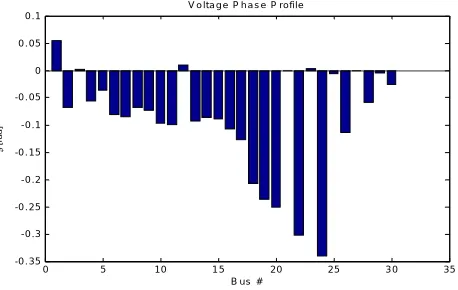
Fig 3. Voltage phase profile after N-1 Contingency
B u s 9
B u s 8
B u s 7 B u s 6
B u s 5
B u s 4
B u s 3 0 B u s 3
B u s 2 9
B u s 2 8
B u s 2 7 B u s 2 6
B u s 2 5
B u s 2 4 B u s 2 3
B u s 2 2 B u s 2 1
B u s 2 0 B u s 2
B u s 1 9 B u s 1 8 B u s 1 7
B u s 1 6
B u s 1 5 B u s 1 4 B u s 1 3
B u s 1 2
B u s 1 1
B u s 1 0 B u s 1
0 5 1 0 1 5 2 0 2 5 3 0 3 5
0 0 . 2 0 . 4 0 . 6 0 . 8 1 1 . 2 1 . 4
V
[
p
.u
.]
V o l t a g e M a g n it u d e P r o fil e
B u s #
0 5 1 0 1 5 2 0 2 5 3 0 3 5
-0 . 3 5 -0 .3 -0 . 2 5 -0 .2 -0 . 1 5 -0 .1 -0 . 0 5 0 0 . 0 5 0 .1 [ ra d ]
V o lta g e P h a s e P ro file
Technology (IJRASET)
[image:6.612.186.414.279.451.2]Fig 4. Real power profile after N-1 Contingency
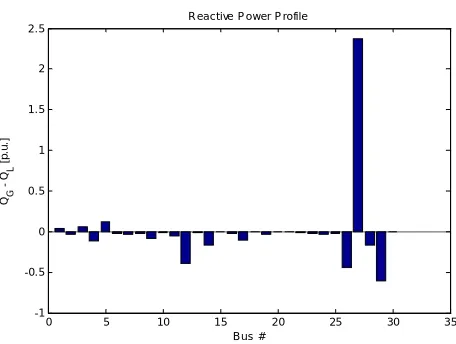
Fig 5. Reactive power profile after N-1 Contingency
V. CONCLUSION AND FUTURE SCOPES
IEEE30 BUS system data constitutes a power system which is optimal secure as well as robust, as system prevent itself from N-1 contingency as clear from figure 2 to 6, at each bus of power system load is flowing with specific value. Amongst deterministic security criteria, the most generally used is certainly the “N-1” criterion. Indeed it corresponds to possible events. This criterion stipulates amongst other things that in its state ‘N”, that is to say when all elements of the system are in operation, operating conditions are in accordance with rules. Generally this is tested for different conventional states: at least for peak and off-peak load of the system, etc. It implies further that for all types of incidents leading to the disconnection of only one element (generator, circuit, line, transformer, etc.), the system operating point stays within the requested area. The operating point and the system is then declared “N-1” secure. This approach is often “generalized” considering, at least for some devices, the loss of more than one element, turning the criterion from “N-1” to “N-2”, to “N-x”. In these cases, the system operating area is generally enlarged, considering some overload capabilities of system elements.
REFERENCES
[1] AleksandarDimitrovski, and Kevin Tomsovic, ―Boundary Load Flow Solutions,ǁ IEEE Transactions on Power Systems, Vol. 19, No. 1, February 2004. [2] Antonio Gomez Exposito, Jose Luis Martinez Ramos, and Jesus Riquelme Santos, ― Slack Bus Selection to Minimize the System Power Imbalance in
Load-Flow Studies,ǁ IEEE Transactions on Power Systems, Vol. 19, No. 2, May 2004.
[3] ArfitaYuana Dewi1, SasongkoPramonoHadi, and Soedjatmiko, ―Contingency Analysis of Power System Electrical Operation,ǁ Proceedings of the International Conference on Electrical Engineering and Informatics Institute Teknologi Bandung, Indonesia June 17-19, 2007.
[4] Dharamjit, and D.K.Tanti, ―Load Flow Analysis on IEEE 30 bus System,ǁ International Journal of Scientific and Research Publications, Volume 2, Issue
0 5 10 15 20 25 30 35
-1.5 -1 -0.5 0 0.5 1 1.5 2 2.5 3
PG
P
L
[
p
.u
.]
Real P ower P rofile
Bus #
0 5 10 15 20 25 30 35
-1 -0.5 0 0.5 1 1.5 2 2.5
QG
Q
L
[
p
.u
.]
Reactive Power Profile
Technology (IJRASET)
11, November 2012.[5] Eduard Janecek and Daniel Georgiev, ―Probabilistic Extension of the Backward/Forward Load Flow Analysis Method,ǁ IEEE transactions on power systems, vol. 27, no. 2, may 2012.
[6] G. W. Chang, S. Y. Chu, and H. L. Wang, ―An Improved Backward/Forward Sweep Load Flow Algorithm for Radial Distribution Systems,ǁ IEEE
Transactions on Power Systems, Vol. 22, No. 2, May 2007.
[7] Jaime A. Peralta, Francisco de León, and Jean Mahseredjian, Member, IEEE, ―Unbalanced Multiphase Load-Flow Using a Positive-Sequence Load-Flow Program,ǁ IEEE Transactions on Power Systems, Vol. 23, No. 2, May 2008.
[8] Jen-Hao, ―A Direct Approach for Distribution System Load Flow Solutions,ǁ IEEE transactions on Power Delivery, Vol. 18, No. 3, July 2003.
[9] Jen-HaoTeng, ―A Novel and Fast Three-Phase Load Flow for Unbalanced Radial Distribution Systems,ǁ IEEE Transactions on Power Systems, Vol. 17,
No. 4, November 2002.
[10] Katia C. Almeida and Roberto Salgado, ―Optimal Power Flow Solutions under Variable Load Conditions,ǁ IEEE Transactions on Power Systems, Vol. 15, No. 4, November 2000.
[11] Khalid Mohamed Nor, HazlieMokhlis, and Taufiq Abdul Gani, ―Reusability Techniques in
Load-Flow Analysis Computer Program,ǁ IEEE Transactions on Power Systems, Vol. 19, No. 4, November 2004. [12] Luciana M. C. Braz, Carlos A. Castro, and Carlos A. E Murari, ―A Critical Evaluation of
Step Size Optimization Based Load Flow Methods,ǁ IEEE Transactions on Power System. Vol. I, No. 1, February 2000.
[13] M. Angeles Moreno, and Julio Usaola, ―A New Balanced Harmonic Load Flow Including
Nonlinear Loads Modeled With RBF Networks,ǁ IEEE Transactions on Power Delivery, Vol. 19, No. 2, April 2004.
[14] Peter W. Sauer Karl, E. Reinhard Thomas, and J. Overbye, ―Extended Factors for Linear Contingency Analysis,ǁ Proceedings of the 34th Hawaii
International Conference on System Sciences,2001.
[15] Morad Mohamed AbdelmageedAbdelaziz, ―A Novel and Generalized Three-Phase Power Flow Algorithm for Islanded Microgrids using a Newton Trust Region Method,ǁ IEEE Transactions on Power Systems,
[16] Rabih A. Jabr, ―A Conic Quadratic Format for The Load Flow Equations of Meshed Networks,ǁ IEEE Transactions on Power Systems, Vol. 22, no. 4, November 2007.
[17] Salah EldeenGasim Mohamed, AbdelazizYousif Mohamed and Yousif Hassan Abdelrahim,
―Power System Contingency Analysis to detect Network Weaknesses,ǁ Zaytoonah University, International Engineering Conference on Design and Innovation in Infrastructure Amman, Jordan, Jun 18-20, 2012.
[18] Subramani C., SubhransuSekhar Dash, Vivek Kumar and Harish Kiran, ―Implementation of Line Stability Index for Contingency Analysis and Screening
in Power Systems,ǁ Journal of Computer Science 8 (4): 585-590, Science Publications 2012.
[19] VeenavatiJagadishprasad Mishra &Manisha D. Khardenvis, ―Contingency Analysis of Power System International Conference on Emerging Frontiers in Technology for Rural Area (EFITRA) 2012.
[20] Wood, A. J.; Wallenberg, B. F., ―Power Generation, Operation and Controlǁ, 2nd ed., New York/USA: John Wiley& Sons, 1996.
[21] TianyuLuo ; Dolan, M.J. et al Technique for Power Flow Management in DistributionAssessment of a New Constraint Satisfaction-Based Hybrid Distributed Control Networks with Generation and Demand Response volume 7. June2015
[22] Murty, V.V.S.N. ; Teja, B.R. ; Kumar, A. ‘’A contribution to load flow in radial distribution system and comparison of different load flow methods ‘’ volume13.NOV 2014
[23] Hasan, K.N. ; Rao, K.S.R. ; Mokhtar, Z. ‘’Analysis of load flow and short circuit studies of an offshore platform using ERACS software’’ volume 1\ [24] Abdel-Akher, et.al.’’ Development of three phase load flow by reusing object oriented single phase load flow’’2004 IEEE Transactions on Power Systems.