http://dx.doi.org/10.4236/jss.2015.31013
Does Power Corrupt? The Evidence from
Event-Related Potentials
Yaozhong Liu, Junjie Huang
School of Management, Jinan University, Guangzhou, China Email: [email protected]
Received 30 December 2014; accepted 18 January 2015; published 23 January 2015
Copyright © 2015 by authors and Scientific Research Publishing Inc.
This work is licensed under the Creative Commons Attribution International License (CC BY). http://creativecommons.org/licenses/by/4.0/
Abstract
The approach/inhibition theory of power suggested that power conduced to more reward-related behavior, while powerless individual had more inhibited behavior. In this study, participants were told to take part in the dictator game and the ultimatum game, which respectively made them feel powerful or powerless. In the meanwhile, ERPs (Event-Related Potentials) was also adopted in the experiment. After comparing the behavioral and potential differences between those two power conditions, the study found that people felt more powerful and allocated less interests to the counterparts when they played the dictator game than that in the ultimatum game. Four types of ERP component were found in this study: P2, N2, P3 and LNC. In the power condition, participants probed larger N2 than in the powerlessness condition. Particularly, the P2 of left cerebral hemis-phere was larger than that on the right. However, N2, P3 and LNC probed in powerlessness condi-tion were larger. The results implied that powerful individual put more cognitive resource at the early stage of decision-making while powerless individual allocated more cognitive recourse in the later stage. Besides, more conflict processing might be performed when people had less power. The study found a new neural evident to support the approach/inhibition theory of power.
Keywords
Power, Dictator Game, Ultimatum Game, P2, N2, P3, LNC
1. Introduction
con-trol [6] could affect the balance between self-interests and the interests of others, which seems that power plays an important role in social decision-making, as power is close related to status, information symmetry and sense of control.
Power is defined as the ability to control resources, own and others’, without social interference [7]. Some re-searches focused on how power affect individual’s behavior, which suggested that power can lead to corrupt [8]. Because power could make people pay more attention to their own interests while put the interests of others’ aside [9].
The approach/inhibition theory of power is one of the most representative theory in terms of power effect [10]. The theory explains the approach/inhibition effect of power on individual’s emotion, attention, social cognition and behavior. The theory suggests that sense of power is related to individual’s behavior approach system (BAS), which can enhance the positive emotion expression and pay more attention to reward and self-goal achieving through the neural path of catechin polyphenols amine and dopamine [11]. BAS is also associated to individu-al’s disinhibited social behavior. However powerlessness is related to individuindividu-al’s behavior inhibition system (BIS), which would enhance the expression of negative emotion, leading to more concerned about information of punishment and threat. A study has found that BIS consist of the hippocampal system [12]. Contract to BAS, BIS is associated to individual’s inhibited social behavior. Maarten (2012) measured EEG (Electroencephalo-graph) activity while participants engaged in a task priming either high or low social power, which turned out that high social power is indeed associated with greater left-frontal brain activity compared to low social power, providing the first neural evidence for the theory that high power is associated with approach-related motivation [13]. However, results fail to further illustrate how power affect individual’s social behavior.
Studies have shown that brain potential component like P2, N2, P3 and LNC could reflect the power effect. P2 is a positive deflection at approximately 150 - 250 ms [14]. Researches have proved that some advanced cognitive process elicited enlarged frontal, parietal, and occipital P2 [15]. Some scholars found that larger P2 would be elicited in common interests condition than in conflicting interests conditions [16], showing that con-flicting interests elicit more inhibition and conflict resolving process, while common interests are more motiva-tionally significant to human [17]. N2 is a negative deflection after P2, studies show that N2 is the index of con-flicting as N2 is elicited when occur target conflict and reaction conflict [15]. P3 is a positive deflection at ap-proximately 300 ms, which is closely related to advanced cognitive process. And some advance cognitive process elicited enlarge temporal, parietal and occipital P3 [18]. Research of inhibition process shows that target conflict elicited enlarge LNC (late negative component) [19]. Then LNC can also be the index of measuring in-dividual’s mental conflict in conflicting interests situation.
In order to find the neural evidences for the approach/inhibition theory of power, this study observed partici-pants’ social decision-making in different power conditions which are manipulated by dictator game (DG, power condition) and ultimatum game (UG, powerlessness condition). As in the dictator game, subjects can distribute the money without any limitation, so they are supposed to be more powerful in this task. However, in the ulti-matum game, the subjects had to distribute the money with consideration, as the responder may reject the dis-tribution if he/she thought it was not fair, and then both of them may get 0 [20]. Therefore, subjects in this task should feel less powerful. Subjects’ EEG was also be detected while they were making decision in DG and UG. This study not only discussed how power affects individuals’ social decision-making and its neural activities process, but also helped predict the action trend of powerful individual and powerless individual in organiza-tions, which makes this study have both theoretical and practical significance. Based on the researches and stu-dies mentioned above, this study supposed that power will activated individuals’ BAS, leading to more self-in- terest oriented behavior and allocating more cognitive resource to reward information, while powerlessness ac-tivated one’s BIS, leading to inhibited social behavior, paying more cognitive resource to deal with the conflict between self-interests and others’ interests.
2. Methods
2.1. Participants
2.2. Materials and Procedure
All of the participants were asked to complete DG and UG, to manipulate participants’ sense of power. Espe-cially, DG referred to the power condition, while UG was the powerlessness condition. The main dependent va-riables were the amount of money they divided to others and the reaction tome in DG and UG. The EEG while they made the decision was also detected in this study. Participants sat in a comfortable position in an armchair in front of a computer screen. All stimulus was presented by E-prime2.0. All participants had to finish 4 blocks of games (2 were DG and 2 were UG). Each block had 60 trails and presented in accordance with ABBA se-quence. Participants were asked to fill up a questionnaire to record their sense of entitlement as soon as they fi-nished one block of the experiment.
2.2.1. Dictator Game and Ultimatum Game
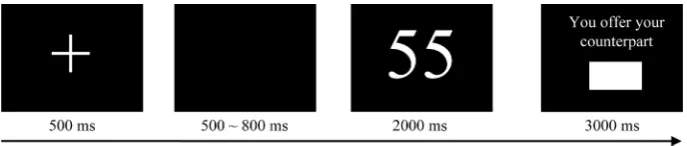
Participants were told to complete a money dividing task with another student (in fact there was only one subject in one experiment, the other subject was the assistant for this study), and their reward depend on how much money they get in the experiment. In DG, every trail began with a “+” as an fixation for 500 ms; then a number (55, 65, 75, 85, 95) was presented in the screen, which was the total amount of interests. What the participants needed to do was to decide how much he/she wanted to divided to his/her counterpart by inputting a certain number (see Figure 1). The task of UG was nearly the same. However, the subject was told that in UG, if the counterpart (respondent) rejected the project, he/she would get 0 in the trail.
2.2.2. Scale of Self-Reported Entitlement
The measure of perceptions of the relative power was collected as soon as they finished one block of the expe-riment. Participants were asked to rate on a scale from 0 to 100, “What is your power in this task?” On the scale, 0 was labeled “my counterpart has all the power;” 50 was labeled “equal power;” and 100 was labeled “I have all the power.” [21].
2.3. ERP Recording and Pre-Processing
The EEG was recorded continuously with electrodes mounted on an elastic cap from 64 standard locations ac-cording to the 10 - 20 electrode system. Two electrodes were placed on the right and left mastoids. An electrode placed in front of Fz served as the ground. Eye movements were monitored by deriving bipolar recordings from electrodes placed to the right eye (HEOG); blinks were monitored by deriving bipolar recordings from elec-trodes placed to the left eye (VEOG). The EEG and EOG signals were amplified with a low-pass filter 200 Hz by Brain Products amplifier and digitized at a sampling rate of 1000 Hz.
Data were re-referenced to the average of the two mastoids and re-filtered digitally with a low-pass of 40 Hz. Target-related epochs started 200 ms before and ended 1000 ms after stimulus presentation. All amplitude val-ues were referred to the 200 ms pre-cue baseline. Trials were automatically eliminated if the voltage exceeded ±50 μV at either the vertical or horizontal EOG channels, or if it exceeded ±70 μV at any other channel. Sepa-rate averages were computed for each type of target based on the task (DG or UG). Topographical analysis and the previous literature were used to determine the time windows and electrodes for analysis.
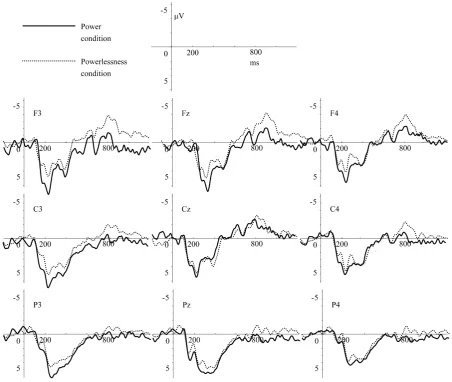
[image:3.595.142.486.628.701.2]Target P2 was analyzed between 200 and 240 ms post-stimulus at F3/4, Fz, C3/4, Cz, P3/4, Pz. Target N2 was analyzed between 250 and 290 ms post stimulus at F3/4, Fz, C3/4, Cz, P3/4. Target P3 followed a centroparietal distribution and was analyzed between 300 and 500 ms at Cz. Target LNC followed a frontal distribution and was analyzed between 700 and 900 ms at F3/4, Fz (see Figure 2). The averaged amplitudes of the ERP compo-nents were subjected to ANOVA. A repeated-measures ANOVA was performed to look at the effect of the late-
Figure 2. ERPs from −200 to 1000 ms to the target stumili in the four tasks blocks from the individual elctrodes.
ralization (left—F3, C3, P3, right—F4, C4, P4) and topography (frontal—F3/F4, central—C3/C4, parietal— P3/P4) for different ERPs’ components in both groups. Greenhouse-Geisser corrections are reported. The dif-ferences within and between factors/groups were considered statistically significant at p < 0.05. The significant main effects and interactions were further analyzed with post-hoc Tukey multiple-range tests (alpha 0.05).
3. Results
3.1. Behavioral Results
The score of participants’ report in scale of self-reported entitlement after each task were subjected to the single factor repeated ANOVA, in order to check whether different types of task (DG and UG) could manipulate the entitlement of participants. The result showed that participants in DG felt much power (M = 78.93 ± 17.58) than in UG (M = 40.33 ± 13.18), F(1, 14) = 42.61, p < 0.001, η2 = 0.68.
3.2. ERP Results
3.2.1. P2The amplitudes of P2 were subjected to a 2(condition: power/powerlessness) × 3(lateralization: F3/C3/P3, Fz/ Cz/Pz, F4/C4/P4) × 3(topography: F3/Fz/F4, C3/Cz/C4, P3/P4/P4) repeated ANOVA analysis. Results showed a significant main effect of power condition, F(1, 14) = 5.36, p = 0.04, η2 = 0.27. Power condition elicited larger P2 than those in powerlessness condition. Besides, the main effect of lateralization was also significant, as the P2 of the left were significantly larger than those elicited from the center and right, F(2, 28) = 7.72, p = 0.01, η2 = 0.36. The results of interaction effect showed that an interaction of power condition and lateralization, F(2, 28) = 4.87, p = 0.04,η2 = 0.26. The following simple effect analysis showed that in powerlessness condition, no sig-nificant difference of P2 was found, F(2, 13) = 2.89, p = 0.09, η2 = 0.31. However in power condition, P2 of the left (M = 7.09 ± 1.02 μV), center (M = 6.01 ± 0.80 μV) and the right (M = 4.53 ± 0.60 μV) were significantly different, F(2, 13) = 5.92, p = 0.02, η2 = 0.48. The simple effect analysis also showed that the P2 of the left was significantly different between power condition and powerlessness condition, F(1, 14) = 8.14, p = 0.01, η2 = 0.29, suggesting that in power condition, the left brain region elicited larger P2 than those in powerlessness con-dition. However, the effect of condition was not significant in neither the center (F(1, 14) = 3.27, p = 0.09, η2 = 0.19) nor the right (F(1, 14) = 2.93, p = 0.11, η2 = 0.17).
3.2.2. N2
The amplitudes of P2 were subjected to a 2(condition: power/powerlessness) × 3(lateralization: F3/C3/P3, Fz/ Cz/Pz, F4/C4/P4) × 3(topography: F3/Fz/F4, C3/Cz/C4, P3/P4/P4) repeated ANOVA analysis. Results showed a main effect of condition, F(1, 14) = 17.21, p = 0.001, η2 = 0.55. Larger N2 was elicited in powerlessness condi-tion than that in power condicondi-tion. A main effect of lateralizacondi-tion was also found, showing that the N2 elicited in the center was significantly larger than those in the left and the right. F = (2, 28) = 6.50, p = 0.005, η2 = 0.317.
3.2.3. P3
The P3 at Cz was subjected to ANOVA, and the results showed a main effect of condition, F = (1, 14) = 4.89, p = 0.04, η2 = 0.259. Powerlessness condition elicited larger P3 at Cz (M = 4.67 ± 3.15 μV) than power condition (M = 5.59 ± 3.78 μV).
3.2.4. LNC
The amplitudes of LNC were subjected to a 2(condition: power/powerlessness) × 3(lateralization: F3/Fz/F4) re-peated ANOVA analysis. The results showed that the main effect of condition was significant, F = (1, 14) = 4.39, p = 0.05, η2 = 0.239. Powerlessness condition elicited larger LNC than power condition. While the main effect of lateralization (F = (1, 14) = 0.86, p = 0.43, η2 = 0.06) nor the interaction effect (F = (1, 14) = 0.47, p = 0.61, η2 = 0.03) were not found.
4. Discussion
This study proved that power influence how individual balance self-interests and the others’ in social-decision making, using DG and UG to manipulate participants sense of entitlement. And results showed that participants feel more powerful in DG as they could divide the interests without any limitation. However, participants in UG felt less powerful as their interests division was decided by their counterparts and themselves. The results of quantum and RT supported the approach/inhibition theory of power. On one hand, the theory suggested that power individual performs more approach behavior like self-goal achieving as power activate BAS. While indi-vidual with less power performs more inhibition behavior as powerlessness activates BIS [10]. In this study, participants divided less interests to his/her counterpart when he/she had more power, but dividing more inter-ests to his/her counterparts when he/she was powerless. On the other hand, RT in power condition was shorter than that in powerlessness condition, which is consistent with the theory which suggested that individual with less power pay too more attention about other information (like limitation and punishment) to make a quick de-cision [22]. Besides, previous researches also suggested that power individual tends to perform social-dede-cision making with intuition, leading to more self-interested behavior, however, powerless individuals focus on other factors not only self-interest in social decision-making, leading to behaving equally instead [8].
ing, especially, power individuals allocate more cognitive resource in the early stage of social decision-making while powerless individuals pay more cognitive resource in the later stage of social decision making. Previous researches have proved that P2 is related to one’s advanced cognitive processing [14]. A study also suggested that P2 reflects the integrated processing of motivational information and cognitive information [23]. In this study, larger P2 was elicited in power condition than in powerlessness condition, implying that in power condi-tion, individuals tend to allocate more cognitive resource at the early stage of social decision-making than in powerlessness condition. As power activates individuals’ BAS, which made them tend to pay more attention to the information about reward and self-goal. And the larger P2 in power condition than in powerlessness condi-tion may also prove this situacondi-tion. Besides, as the results showed that in power condicondi-tion, the P2 of left cerebral hemisphere is larger than that on the right and the center, this study also found the evidence to support the hy-pothesis that BAS is in the left brain region [13]. Then it would be obvious that power individuals allocate more cognitive to the reward information as their BAS is activated, leading to more attention to the target in this study and larger P2 was elicited in power condition.
However, the larger P3 elicited in powerlessness condition implying that participants in powerless condition allocated more cognitive resource in the later stage of social decision-making compared with power condition, As P3 is related to advanced cognitive processing and can measure the effectiveness of information process [18], P3 can reflect the situation of cognitive resource consuming in social decision-making. According to the ap-proach/inhibition theory of power, BIS would be activated when individuals feel powerless, leading them focus on the information about limitation and punishment, making them behave less self-interest. It may because po-werless individuals pay more attention to equal or others approve instead of reward or self-goal. And making an equal decision needs more cognitive resource in the late stage of social decision-making, turning out that lager P3 was elicited in powerlessness condition in this study. In a word, power can affect individuals’ allocation of cognitive resource, depending of BAS or BIS is activated.
The ERPs results also showed that the motivational conflict happened to participants in powerlessness condi-tion, as a larger N2 was found in powerlessness condition. According to previous study, N2 is an index of men-tal conflict [24]. Therefore, a larger N2 should be elicited if individual feel more conflicts to the decision. Par-ticularly, as powerlessness condition activated participants BIS, leading them pay more attention to the informa-tion about punishment, loss, and interpersonal relainforma-tionship, it is easy to understand that powerless participants should feel the conflict between the motive of getting more self-interests and the motive of getting approve from the counterparts. While participants in power condition would not have this conflict as they have the power to control both self-interests and the interests of his/her counterparts.
Another evidence that participants in powerlessness condition have more motivational conflict is that larger LNC is elicited in powerlessness condition. LNC is a late negative component, which is usually elicited while the participants are “making a decision”. Previous study also suggested that LNC plays an important role in dealing with mental conflict [19]. As powerlessness activates individuals’ BIS, making them become more re-strictive by other information like punishment rather than reward, while individuals with power can focus on the information of reward and self-goal as power activates their BAS. In this study, the larger LNC in powerlessness condition than in power condition may infer that powerless participants felt the pressure from the sense of fair-ness and their conscience. The conflict between self-interests and others’ interests led to larger LNC in this study.
There are an increasing number of researches suggesting that power can not only make people “corrupt”, but also make them “enable”. As power also help people think more comprehensively and strength the interpersonal sensitivity [25] [26]. Katherine et al. (2012) also found the mediation effect of moral identity in the effect of power to self-interest behavior [27]. Some scholars have started to apply fMRI to research of power effect. In further studying, other factors should be considered to make a clear knowledge of how power effect self-inter- ested behavior and its neuromechanism.
5. Conclusion
making them behave more equally in social decision-making.
References
[1] Rilling, J.K. and Sanfey, A.G. (2011) The Neuroscience of Social Decision-Making. Annual Review of Psychology, 62, 23-48. http://dx.doi.org/10.1146/annurev.psych.121208.131647
[2] Fehr, E. andCamerer, C.F. (2007) Social Neuroeconomics: The Neural Circuitry of Social Preferences. Trends in Cog- nitive Sciences, 11,419-427. http://dx.doi.org/10.1016/j.tics.2007.09.002
[3] Su, Y.J., Zhang, H. and Zhang, K. (2012) Social Decision-Making: The Equilibrium between Self-Interest and the In- terests of Others. Journal of Psychological Science, 35, 1423-1428.
[4] Piff, P.K., Stancato, D.M., Côté, S., Denton, R.M. and Keltner, D. (2012) Higher Social Class Predicts Increased Un- ethical Behavior. Psychological and Cognitive Sciences, 109,4086-4091.
[5] Vuolevi, J.H.K. and Van Lange, P.A.M. (2010) Beyond the Information Given: The Power of a Belief in Self-Interest. European Journal of Social Psychology, 40,26-34.
[6] Moore, D.A. and Loewenstein, G. (2004) Self-Interest, Automaticity, and the Psychology of Conflict of Interest. Social Justice Research, 17,189-202. http://dx.doi.org/10.1023/B:SORE.0000027409.88372.b4
[7] Galinsky, A.D., Gruenfeld, D.H. and Magee, J.C. (2003) From Power to Action. Journal of Personality and Social Psychology, 85,453-466. http://dx.doi.org/10.1037/0022-3514.85.3.453
[8] Galinsky, A.D., Magee, J.C., Inesi, M.E. and Gruenfeld, D.H. (2006) Power and Perspectives Not Taken. Psychologi- cal Science, 17,1068-1074. http://dx.doi.org/10.1111/j.1467-9280.2006.01824.x
[9] DeCelles, K.A., DeRue, D.S., Margolis, J.D. and Ceranic, T.L. (2012) Does Power Corrupt or Enable? When and Why Power Facilitates Self-Interested Behavior. Journal of Applied Psychology, 97,681-689.
http://dx.doi.org/10.1037/a0026811
[10] Keltner, D., Gruenfeld, D.H. and Anderson, C. (2003) Power, Approach, and Inhibition. Psychological Review, 110, 265-284. http://dx.doi.org/10.1037/a0026811
[11] Stellar, J.R. and Stellar, E. (1985) The Neurobiology of Motivation and Reward.Springe Verlag, New York, 87-92.
http://dx.doi.org/10.1007/978-1-4615-8032-4
[12] Gray, J.A. (1990) Brain Systems That Mediate Both Emotion and Cognition. Cognition and Emotion, 4, 269-288.
http://dx.doi.org/10.1080/02699939008410799
[13] Boksem, M.A.S., Smolders, R. and De Cremer, D. (2012) Social Power and Approach-Related Neural Activity. Social Cognitive and Affective Neuroscience, 7, 516-520. http://dx.doi.org/10.1093/scan/nsp006
[14] Crowley, K.E. and Colrain, I.M. (2004) A Review of the Evidence for P2 Being an Independent Component Process: Age, Sleep and Modality. Clinical Neurophysiology, 115, 732-744. http://dx.doi.org/10.1016/j.clinph.2003.11.021
[15] Luck, S.J. and Hillyard, S.A. (1994) Electrophysiological Correlates of Feature Analysis during Visual Search. Psycho- physiology, 31, 291-308. http://dx.doi.org/10.1111/j.1469-8986.1994.tb02218.x
[16] Boudreau, C., McCubbins, M.D. and Coulson, S. (2009) Knowing When to Trust Others: An ERP Study of Decision Making after Receiving Information from Unknown People. Social, Cognitive, and Affective Neuroscience, 4, 23-34.
http://dx.doi.org/10.1093/scan/nsn034
[17] Wu, Y. and Zhou, X.L. (2012) The Context-Dependency of Fairness Processing: Evidence from ERP Study. Acta Psy- chologica Sinica, 44, 797-806. http://dx.doi.org/10.3724/SP.J.1041.2012.00797
[18] Hansenne, M. (2000) The P300 Cognitive Event-Related Potential: I. Theoretical and Psychobiologic Perspectives. Clinical Neurophysiology, 30, 191-210. http://dx.doi.org/10.1016/S0987-7053(00)00223-9
[19] Leslie, A.M., Friedman, O. and German, T.P. (2004) Core Mechanisms in “Theory of Mind”. Trends Cognition Sci- ence, 8, 528-533. http://dx.doi.org/10.1016/j.tics.2004.10.001
[20] Güth, W., Schmittberger, R. and Schwarze, B. (1982) An Experiment Analysis of Ultimatum Bargaining. Journal of Economic Behavior & Organization, 3, 367-388. http://dx.doi.org/10.1016/0167-2681(82)90011-7
[21] Wolfe, R.J. and McGinn, K.L. (2005) Perceived Relative Power and Its Influence on Negotiations. Group Decision and Negotiation, 14, 3-20. http://dx.doi.org/10.1007/s10726-005-3873-8
[22] Overbeck, J.R. and Park, B. (2006) Powerful Perceivers, Powerless Objects: Flexibility of Power Holders’ Social At- tention. Organizational Behavior and Human Decision Processes, 99, 227-243.
http://dx.doi.org/10.1016/j.obhdp.2005.10.003
[23] Potts, G.F. (2004) An ERP Index of Task Relevance Evaluation of Visual Stimuli. Brain & Cognition, 56, 5-13.
[24] Ernst, L.H., Ehlis, A., Dresler, T., Tupak, S.V., Weidner, A. and Fallgatter, A.J. (2013) N1 and N2 ERPs Reflect the Regulation of Automatic Approach Tendencies to Positive Stimuli. Neuroscience Research, 75, 239-249.
http://dx.doi.org/10.1016/j.neures.2012.12.005
[25] Hall, J.A., Andrzejewski, S.A. and Yopchick, J.E. (2009) Psychological Correlates of Interpersonal Sensitivity: A Meta- Analysis. Journal of Nonverbal Behavior, 33, 149-180. http://dx.doi.org/10.1007/s10919-009-0070-5
[26] Schmid Mast, M., Jonas, K. and Hall, J.A. (2009) Give a Person Power and He or She Will Show Interpersonal Sensi- tivity: The Phenomenon and Its Why and When. Journal of Personality and Social Psychology, 97, 835-850.
http://dx.doi.org/10.1037/a0016234
[27] De Celles, K.A., De Rue, D.S., Margolis, J.D. and Ceranic, T.L. (2012) Does Power Corrupt or Enable? When and Why Power Facilitates Self-Interested Behavior. Journal of Applied Psychology, 97,681-689.