© 2018, IRJET | Impact Factor value: 6.171 | ISO 9001:2008 Certified Journal | Page 4287
A STUDY ON REFRIGERANTS
Sumit Kumar Bandey
M. Tech. Thermal Engineering, SSGI, C.G.
---***---Abstract -
The working agent in a refrigerating systemthat absorbs carries or releases heat from the place to be cooled or refrigerated can be termed as a refrigerant. This heat transfer generally takes place through a phase change of the refrigerant. In this paper, we shall study about the different refrigerants used in various refrigeration systems. At present, we have a large number of refrigerants available to us depending on the requirements of the particular refrigerating system. This paper is intended to serve as an introductory guide to the study of refrigerants.
Key Words: Refrigerants, ODP, GWP
1. INTRODUCTION
Refrigeration may be defined as the process of achieving and maintaining a temperature below that of the surroundings, the aim being to cool some product or space to the required temperature. One of the most important applications of refrigeration has been the preservation of perishable food products by storing them at low temperatures. Refrigeration systems are also used extensively for providing thermal comfort to human beings by means of air conditioning. Air Conditioning refers to the treatment of air so as to simultaneously control its temperature, moisture content, cleanliness, odor and circulation, as required by occupants, a process, or products in the space. The subject of refrigeration and air conditioning has evolved out of human need for food and comfort, and its history dates back to centuries.
“Refrigerant is the fluid used for heat transfer in a refrigerating system that absorbs heat during evaporation from the region of low temperature and pressure, and releases heat during condensation at a region of higher temperature and pressure.”
Refrigerants are the working medium used in refrigerating systems which evaporates by taking the heat from the space that is to be cooled, thus producing the cooling effect. Refrigerant development throughout the history, took place due to different reasons, such as safety, stability, durability, economic or environmental issues, thus giving rise to new research and equipment improvement in terms of safety and efficiency. The refrigerants can be classified into different generations which are discussed below.
HISTORY:
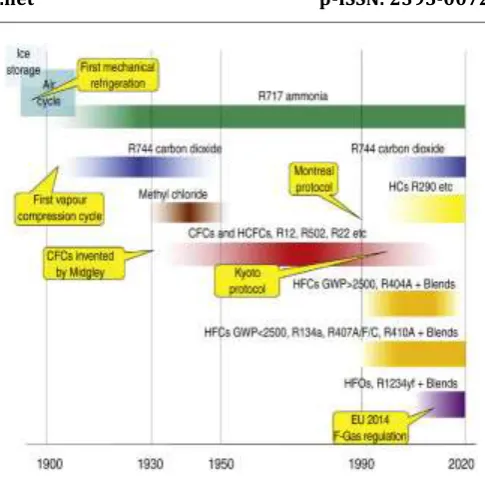
Beginnings of mechanical refrigeration, starting from early 19th century are characterized by use of natural refrigerants. Water and air were the first refrigerants considered for use in mechanical refrigeration systems. In 1834 Perkins proposed ethyl ether as the working fluid in his patent of the vapour compression refrigeration system. Perkins system was a closed circuit comprising all the modern vapour compression system components: the compressor, the condenser, the expansion device and the evaporator. By that time ammonia, sulphur dioxide and carbon dioxide had been isolated and were available for use as well. The first one who use dim ethyl ether, which operated at higher pressure and thus reduced the risk of drawing air into the system and forming an explosive mixture within the machine, was Tiller in 1863. First ammonia compressor for refrigerating purposes was designed and constructed by Boyle in 1872, and 4 years later Linde designed the first machine working with ammonia. In 1862 Lowe developed a carbon-dioxide refrigerating system. Carbon dioxide has very low toxicity but required high-pressure machinery and was difficult to use because of its low critical temperature (31,6°C) which does not allow for condensation in many situations. Methyl chloride was used for the first time as a refrigerant in 1878.
Chlorofluorocarbons CFCs) replaced classic refrigerants in early 20th century. Midgely and his associates, in their
© 2018, IRJET | Impact Factor value: 6.171 | ISO 9001:2008 Certified Journal | Page 4288 In 1974 researchers Roland and Molina predicted that
[image:2.595.313.556.60.299.2]emissions of HFCs could damage Earth’s atmosphere by the catalytic destruction of ozone in the stratosphere. The hypothesis has been proven in 1985 by measurements which have shown the destruction of the ozone layer over Antarctica. In 1987, the Montreal Protocol limits the production and consumption of CFCs. Between 1990 and the present emissions have decreased substantially as a result of the Montreal Protocol and its subsequent amendments and adjustments coming into force. By 2008, stratospheric chlorine abundances in the stratosphere were 10% lower than their peak values reached in the late 1990s and were continuing to decrease. January 2010 marked the end of global production of CFCs under the Protocol. In 2009 the Montreal Protocol was universally ratified by 196 nations.
Table-1: Developments of Refrigerants
Generation Year Refrigerants Comment
1st
1830-1930-
744, R-717, R-764,
610, R-170, R-40
Refrigeration was introduced for industrial and domestic use.
2nd
1931-1990
R-11, R-12, R114, R-113
Introduced as a commercial refrigerant. Developed to use as an aerosol
p r o p s ’ Patented by Carrier Corporation.
1936 R-22, R-15,
R502
1943 Mixture of
R11, R-12
1949 R-500
1975 Mixture of
R12, R-13
3rd
1990-2010
R-32,
R134A,R- 404A,407C, R-410A, R-507
R-508A
Ozone protected where in tensed global warming is the major
problem where recognised
varieties of refrigerants were came into action.
4th 2010
onwar ds
R-1270, R1261,R- 1252,R- 1243,R-1234YF, 1225, R-1216, R-1234
Zero/low ozone depletion
potential very low global
warming potential, high
efficiency
[image:2.595.29.294.323.696.2]
Fig -1: Developments of Refrigerants
3. TYPES OF REFRIGERANT:
1. Primary refrigerants: Primary refrigerants are those fluids, which are used directly as working fluids, for example in vapour compression and vapour absorption refrigeration systems. When used in compression or absorption systems, these fluids provide refrigeration by undergoing a phase change process in the evaporator.
2. Secondary refrigerants: Secondary refrigerants are those liquids, which are used for transporting thermal energy from one location to other. Secondary refrigerants are also known under the name brines or antifreezes.
3.1. CLASSIFICATION OF REFRIGERANTS
:
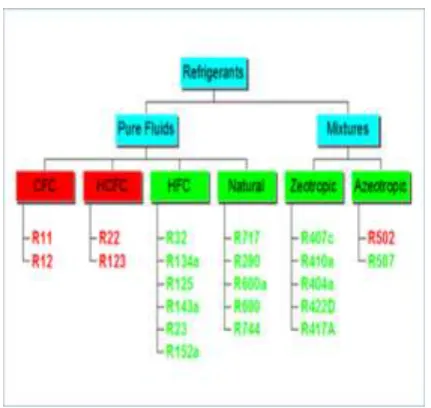
1. Fluorinated refrigerants: Fluorinated refrigerants are largely responsible for the destruction of the ozone layer and contribute to the increase of the greenhouse effect. The interactions between the two phenomena are real but highly complex. We distinguish several types:
i. CFCs (chlorofluorocarbons): They are molecules composed of carbon, chlorine and fluorine. They are stable, allowing them to reach the stratosphere without too many problems. At this stage, by transforming it contributes to the destruction of the ozone layer.
© 2018, IRJET | Impact Factor value: 6.171 | ISO 9001:2008 Certified Journal | Page 4289 iii. HFC (hydrofluorocarbons): They are molecules
composed of carbon, fluorine and hydrogen. They do not contain chlorine and therefore do not participate in the destruction of the ozone layer. This is known as substitution substance.
iv. HFO (hydro-fluoro-olefin): hydro-fluoro-olefin (HFO) based refrigerant replacement for 404A/507, R-407A/F and R-22. R449A is designed for use in positive displacement direct expansion low and medium temperature commercial and industrial applications
2. Mixture of refrigerants: They can be classified according to the type of fluorinated components they contain. They are also distinguished by the fact that some mixtures are:
i. Zeotropic: In a state change (condensation, evaporation), the temperature varies.
ii. Azeotropes: they behave like pure, with no change in temperature during the change of state.
[image:3.595.308.557.101.626.2]
Fig -2: Classifications of Refrigerants
[image:3.595.54.270.370.574.2]
Table-2: Classifications of Refrigerants
4. DESIRABLE PROPERTIES OF REFRIGERANTS
:
The properties can be divided into favorable thermodynamic, chemical and physical properties:1. Thermodynamic Properties
© 2018, IRJET | Impact Factor value: 6.171 | ISO 9001:2008 Certified Journal | Page 4290 transfer at a constant temperature. If this is
not taken care of, then we will have excessive power consumption by the refrigeration system.
ii. Specific Heat: The specific heat of the liquid should be as small as possible. This ensures that the irreversibility associated with throttling are small and there is greater sub cooling of the liquid. On the other hand, the specific heat of vapour should be high to have less superheating of the vapour.
iii. Enthalpy of Vaporization: This should be as large as possible to minimize the area under superheat and the area reduction due to throttling. Also, the higher value of enthalpy of vaporization lowers the required flow rate per ton of refrigeration
iv. Conductivity: The conductivity of the refrigerant should be as high as possible so that the size of the evaporator and condenser is manageable. From this viewpoint, ammonia has a better conductivity than that of R12 or R22 and is more suitable than the latter. But, ammonia is toxic and this does not allow its use in home refrigeration systems.
v. Evaporator and Condenser Pressure: Both the evaporator and condenser pressures need to be above atmospheric pressure otherwise there is a possibility of air leaking into the system. Presence of air drastically reduces the capacity of the refrigeration system. Also, due to presence of moisture in air, acids or other corrosive compounds may form and this may affect the tubing of the refrigeration system. vi. Compression Ratio: The compression ratio
needs to be as small as possible otherwise the leakage of refrigerant occurs across the piston. Also, the volumetric efficiency is affected.
vii. Freezing Point: It should be as low as possible or else there will be a possibility of blockage of passages during flow of fluid through evaporator.
viii. Volume of Refrigerant Handled per Ton of Refrigeration: This should be as small as possible in order to have a small size of the compressor. The type of compressor is decided by this value. For refrigerants like R12, R500, R22 etc., a reciprocating compressor is suitable. For others like R11
and water, a centrifugal compressor is required to handle the large volume.
ix. Coefficient of Performance: The Coefficient of performance or COP has a direct bearing on the running cost of the refrigeration system. Higher the magnitude of COP, lower will be the running cost. Since, the COP of any refrigeration system is limited by the Carnot COP, for large operating pressures a multi-stage refrigeration system should be employed. CO2 has a very low COP. Hence, it is not suitable for use as a refrigerant.
x. Density: The density of the refrigerant should be as large as possible. In reciprocating compressors, the pressure rise is accomplished by squeezing the entrapped fluid inside the piston-cylinder assembly. Hence, density decides the size of the cylinder. Again in centrifugal compressors pressure rise is related to the density of the vapour. A high value of density results in high pressure rise.
xi. Compression Temperature: Whenever a refrigerant gets compressed, there is a rise in the temperature of the refrigerant resulting in the heating of the cylinder walls of the compressor. This necessitates external cooling of the cylinder walls to prevent volumetric and material losses. Refrigerants having lowest compression temperatures are thus better than others.
2. Chemical Properties:
i. Chemical Stability and Inertness: It should be chemically stable for the operating ranges of temperature. Also, it should not react with the materials of the refrigeration system or with which it comes into contact. Further, it should be chemically inert and must not undergo polymerization reactions at either the lower or higher ranges of temperatures.
© 2018, IRJET | Impact Factor value: 6.171 | ISO 9001:2008 Certified Journal | Page 4291 system or loss of functioning of the
compressor.
iii. Flammability: The refrigerant should be inert and not catch fire when subjected to high temperatures. From this viewpoint CO2 is the most suitable as it is not only non-flammable, but also acts as a fire-extinguisher. Ethane, butane, isobutene are highly undesirable as they catch fire quickly.
iv. Effect on Oil: The refrigerant should not react with the lubricating oil else, there is a possibility of loss of lubricating action due to either thickening or thinning of the oil. It should not be soluble in the oil else there will be reduction in the viscosity of the lubricating oil.
v. Effect on Commodity: If the refrigerant is directly used for chilling, then it should not affect the commodity kept in the conditioned space. Also, in case where direct cooling is not employed, the refrigerant should still not affect the commodity if there is any leakage. vi. Toxicity: The refrigerant used in air
conditioning, food preservation etc. should not be toxic as they will come into contact with human beings.
3. Physical Properties:
i. Leakage and Detection: Since pressures higher than atmospheric are usually employed in refrigeration systems, there is a possibility of leakage of refrigerants after long period of operation. It is desirable to detect this leak early else the system would operate under reduced capacity or stop functioning altogether. Hence, it is desirable that the refrigerant has a pungent smell so that its leakage can be detected immediately.
ii. Miscibility with Oil: The refrigerant should not be miscible with the oil else the lubricating strength will be reduced.
iii. Viscosity: It should be as small as possible to ensure that the pressure drop in the system is as small as possible. A low viscosity refrigerant will require less energy for its circulation through the refrigeration system.
5. ENVIRONMENT AND SAFETY PROPERTIES:
The environmental and safety properties are very important. In fact, at present the environment friendliness of the refrigerant is a major factor in deciding the usefulness of a particular refrigerant. The important environmental and safety properties are:
a) Ozone Depletion Potential (ODP): According to the Montreal protocol, the ODP of refrigerants should be zero, i.e., they should be non-ozone depleting substances. Refrigerants having non-zero ODP have either already been phased-out (e.g. R 11, R 12) or will be phased-out in near-future (e.g. R22). Since ODP depends mainly on the presence of chlorine or bromine in the molecules, refrigerants having either chlorine (i.e., CFCs and HCFCs) or bromine cannot be used under the new regulations.
b) Global Warming Potential (GWP): Refrigerants should have as low a GWP value as possible to minimize the problem of global warming. Refrigerants with zero ODP but a high value of GWP (e.g. R134a) are likely to be regulated in future.
c) Total Equivalent Warming Index (TEWI): The factor TEWI considers both direct (due to release into atmosphere) and indirect (through energy consumption) contributions of refrigerants to global warming. Naturally, refrigerants with as a low a value of TEWI are preferable from global warming point of view.
d) Miscibility with lubricating oils: Oil separators have to be used if the refrigerant is not miscible with lubricating oil (e.g. ammonia). Refrigerants that are completely miscible with oils are easier to handle (e.g. R12). However, for refrigerants with limited solubility (e.g. R 22) special precautions should be taken while designing the system to ensure oil return to the compressor
e) Dielectric strength: This is an important property for systems using hermetic compressors. For these systems the refrigerants should have as high a dielectric strength as possible
© 2018, IRJET | Impact Factor value: 6.171 | ISO 9001:2008 Certified Journal | Page 4292
6. HEALTH AND SAFETY:
When dealing with any refrigerant, safety of self and that of others are vitally important. People working for service and maintenance need to be familiar with safety procedures and what to do in the event of an emergency. Health and safety information is available from manufacturers of all refrigerants. Local legislation is country dependent.
HFC refrigerants are non-toxic in the traditional sense, but nevertheless great care must be taken to ensure adequate ventilation in areas where heavier than air gases may accumulate. Carbon dioxide is not a simple asphyxiant. Exposure to more than 30% carbon dioxide will rapidly result in death.
Standard EN378 (2008) is the main refrigeration safety standard in Europe and refrigerants are classified by toxicity and flammability hazard categories. Safety codes are available from the IOR for Group A1 (low toxicity, non-flammable), Groups A2/A3 (non-toxic and non-flammable), ammonia, and carbon dioxide. The next revision of EN378 will cover low flammability refrigerants Group A2L.
In the United Kingdom and most of Europe, it is illegal to dispose of refrigerant in any other way than through an authorized waste disposal company. The UK legislation expects that anyone handling refrigerants is competent to do so and has the correct equipment and containers. Disposal must be through an approved contractor and must be fully documented. Severe penalties may be imposed for failure to implement these laws.
7. DISPOSAL
Under Section 608 of the United States' Clean Air Act it is illegal to knowingly release refrigerants into the atmosphere. When refrigerants are removed they should be recycled to clean out any contaminants and return them to a usable condition. Refrigerants should never be mixed together outside of facilities licensed to do so for the purpose of producing blends. Some refrigerants must be managed as hazardous waste even if recycled, and special precautions are required for their transport, depending on the legislation of the country's government. Various refrigerant reclamation methods are in use to recover refrigerants for reuse.
8. REFRIGERANTS AND EFFICIENCY
The Refrigeration Cycle, the efficiency shortfall of the vapour compression when compared to an ideal cycle was examined. The effect of the shortfall is dependent on the thermodynamic properties of the refrigerant, and so an ideal COP comparison between an existing refrigerant and its replacement can be informative. The HFCs tend to have slightly poorer thermodynamic properties than the chlorine containing substances they are intended to replace. But a simple ideal COP comparison does not give a true indication of the performance in an actual system. The main additional factors are compressor discharge temperature, governed by the index of compression and the effect of system pressure drops and heat transfer properties. High discharge temperatures tend to increase heat transfer losses and the effect of pressure drop tends to be less with higher pressure refrigerants because, although the loss in absolute terms may be the same, it is less proportionate to the total system pressure difference. System design plays an important role and efficiency can always be improved by increase of heat transfer surface and use of larger pipe diameters, but with cost penalties.
9. CURRENT APPLICATIONS OF REFRIGERANTS
© 2018, IRJET | Impact Factor value: 6.171 | ISO 9001:2008 Certified Journal | Page 4293 environments before being sold. Refrigeration also helps
keep fruits and vegetables edible longer.
SUMMARY
Here, in this paper we have undertaken a brief study of the various refrigerants used in the home air-conditioning and refrigeration systems as well as those used in industrial refrigeration systems. We have studied the thermal, physical and chemical characteristics which an ideal refrigerant should possess.
The field of refrigeration and air-conditioning has undergone tremendous changes in the last century. More and more new refrigerants having improved properties are being produced globally. Research in this field is now directed towards producing better environment friendly refrigerants and in replacing old refrigeration systems using halogenated refrigerants with the newer ones. We can be sure that in the future, refrigerants will be produced which will not only match the performance characteristics of the present day refrigerants, but also surpass them. And all this will be done without causing any destructive effect upon the environment.
REFERENCES
1. BranimirPavkovic, “Past, Present And Future Perspectives Of Refrigerants In Air-Conditioning Applications” REHVA Journal – December 2013
2. Dr.Shivprakash Prashant P.Pandav, B Barve, N. R. Anekar, S. S. Hatwalane, “Eco-Friendly Refrigerants”, International Conference On Renewable Energy And Sustainable Development 2014
3. MadhuSruthiEmani, Ranendra Roy And Bijan Kumar Mandal, “Development Of Refrigerants: A Brief Review”, Indian J.Sci.Res.14 175-181, 2017 ISSN: 2250-0138
4. M. A. Sattar, R. Saidur, and H. H. Masjuki, “Performance Investigation of Domestic Refrigerator Using Pure Hydrocarbons and Blends of Hydrocarbons as Refrigerants” World Academy of Science, Engineering and Technology 5 2007.
5. Poonam Dhankhar, “A Study on Refrigeration”, International Journal of Science and Research (IJSR) ISSN (Online): 2319-7064
6. Prashant P.Pandav, B.Lokhande,
ShivprakashB.Barve, “Ecofriendly Refrigerants” Applied Mechanics and Materials Vol. 612 (2014) pp 181-185.