© 2017, IRJET | Impact Factor value: 6.171 | ISO 9001:2008 Certified Journal | Page 617
Design of pressure vessel using ASME codes and a comparative
Analysis using FEA
Arun kumar.M
1, H.S.Manjunath
2, Amith kumar.S.N
31
Department of Mechanical Engineering, Dr. Ambedkar Institute of Technology Bengaluru, Karnataka, India
2
Professor Department of Mechanical Engineering, Dr. Ambedkar Institute of Technology
Bengaluru, Karnataka India
3
Assistant Professor Department of Mechanical Engineering, Dr. Ambedkar Institute of Technology
Bengaluru, Karnataka India
---***---Abstract
-
Pressure vessels are the most used storage equipment in the industrial engineering. They also find wide usage in the process and other mechanical manufacturing industry. The pressure vessels are subjected to varied type of loads and need to be checked for structural safety to prevent any possible failure. Present technology has the advantage of checking the structural safety by virtual simulation with out going for costlier destructive experimental techniques.Key Words
:
Engineering components, Computational
fluid dynamic, Impact velocity and pressure, burst
pressure, Inertia of solid section, Shell elements, Transient analysis
1. INTRODUCTION
A container mainly designed for storage of fluids or gas or called pressure vessels. Pressure vessels are generally designed with difference of pressure i.e. inside and out side of the vessel. Normally pressure inside is more then outside of the pressure vessel excepting for few cases like submarines. The substance inside the pressure vessel may undergo change of phase like water to vapour etc. In the chemical reactors, the substance may mix with some other chemical substance forming a chemical reaction. These type of conditions require the safety of the vessel to prevent possible bursting or cracking spoiling the entire manufacturing process operations. Pressure vessels find wide applications in
Power generation industries Nuclear industries
Petrochemical industry Domestic applications Medical industry Automobile Industry Aerospace Industry
1.1.Typical Pressure Vessel
The figure shows typical pressure vessel components. Main components of pressure vessel include shell , head, nozzle openings, support structures etc. The dome is connected to main shell by welding. Due to number of openings for either inlet or outlet, stress concentration is more on the structure. The stress concentration will also vary due to the size of hole, location of hole and shape of hole. Generally circular holes create a stress concentration effect of 3 and other variations generally create less then 3. Further the overhung structures create bending stress on the pressure vessel. Since the joint is made by weld, thermal effects create residual stress in the pressure vessel.
1.2 Applications of Pressure Vessel
© 2017, IRJET | Impact Factor value: 6.171 | ISO 9001:2008 Certified Journal | Page 618
Fig:1.2 Pressure Vessel for Non-firing
Applications
2. LITERATURE SURVEY
Since pressure vessels are very common and found large usage, much literature is available on usage, design and manufacture. Few of the studies related to pressure vessels are represented as follows. AlberKaufman[1] has done lot of research on stresses and strain development in the pressure vessels. He also done research on pressure vessels with reinforcements. He extended his research on the problems in plastic range also to find cracking time. He has used ultimate strength of the material to find the final bursting pressure of the pressure vessels. Also he has done research on estimating the progressive process of elasto-plastic deformation of the system under increased loading’CalladineC.R[2] has research on the pressure vessel openings to find stress concentration using thin spherical pressure vessels.
Chart -1: Name of the chart
3. PROBLEM DEFINITION AND FINITE ELEMENT
MODEL DEVELOPMENT
3.1 Problem Definition:
Design of pressure vessel major dimensions for the given pressure load and design optimization of the weld region is the main definition of the problem. The main objectives are
Thickness calculation by ASME codes Geometrical built up of the problem Finite element optimization
3.2 Methodology:
Geometrical specification of the pressure vessel Thickness calculation from ASME codes
Finite element verification of the code
Design optimization using finite element analysis Results representation
3.3 Design Requirements
Inner diameter of the pressure vessel d=3500mm Design Pressure: 3.5Mpa
Hemispherical dome Allowable stress: 170Mpa Specification of the Material: Name of the material : SA516 Elastic Modulus: 200Gpa Poison’s ratio=0.3 Density=7800kg/m3.
Yield Strength =335Mpa
3.4 Calculations
AS per UG27: (Validation for the Drawing) P:internal Design pressure:3.5 N/mm2.
R: inside radius of the shell:1750mm S: maximum allowable stress:170N/mm2
T:minimum thickness required E:Joint Efficiency:0.82
Thickness Calculations as per UG27 :
Formulae for shell thickness as per UG27
T=PR/(SE-0.6P)
T=3.5*1750/(170*0.82-0.6*3.5) T=44.6 ~45mm.
Hemi spherical Thickness calculation based on UG27
Td=PL/(2=1.65SE-0.2P)
© 2017, IRJET | Impact Factor value: 6.171 | ISO 9001:2008 Certified Journal | Page 619 Td= 26.7 mm
Standard size of 27mm is considered for dome thickness.
Fig3.1: Geometrical model of the problem
The figure3.1 shows geometrical configuration of the pressure vessel system. Inner diameter of the pressure vessel is 3500mm and outer diameter is 3590mm with thickness equal to 45mm. Total height of the system is around 22037mm. The pressure vessel is having spherical dome with thickness of 27mm. The geometry is built using Solid Edge software Version 19.
3.5 Stress calculations from theoretical formulas:
Di/t = 3500/45=77.7
Here Di= inner diameter of the pressure Vessel t= thickness of the pressure vessel
Hoop Stress
σh=pd/2t=3.5*3500/(2*45)=136.11N/mm2.
This value is far away from the allowable stress value of 170Mpa for the given pressure vessel.
So the design is safe from theoretical calculations.
Dished end thickness calculations:
Thickness required at the dished end td =Pd/4σh
td=3.5*3500/(4*170) = 18.01 in the calculation
hoop stress σh is taken as allowable limit of the
material 170Mpa
The theoretical thickness value of 18.01mm is less then the ASME code specification. So the dished end thickness is safe for structural loading conditions.
3.6 Element Types used:
Plane42 element is used for analysis.
Fig3.2: Plane 42 Element
Plane42 is a liner element defined with 4 nodes. It has two degrees of freedom in ‘X’ and ‘Y’ directions. This element considers 4 nodes in the map meshed conditions and it may be degenerated to 3 nodes in case of free meshing. This element can be used for plane stress, plane strain and axisymmetric problems. Thickness can be specified for plane stress problems. Even orthotrophic material properties can be specified for the geometry.
3.7 Assumptions:
The material is assumed to be isotropic and homogenous
No voids and cracks are assumed in the problem Analysis is carried out with in the yield point of
the material
Connections are assumed to be complete and load transfer is proper
4 noded plane element is used for analysis
Sub problem approximation technique is used for design optimization
4.FINITE ELEMNET RESULT ANALYSIS AND
DISCUSSION
Analysis is carried out using finite element
modeling and analysis. The following cases of analysis is carried out using finite element analysis Case1: Axisymmetric analysis with complete connection of dome and the shell
© 2017, IRJET | Impact Factor value: 6.171 | ISO 9001:2008 Certified Journal | Page 620 Case 3: Design Optimiasation and Final Results
Representation
Case 4: Analysis of weld connection of PN2 and LP column Junction
Case 5: Finite element modification of weld geometry and Analysis
Since pressure vessels are suitable for two dimensional analysis compared to three dimensional analysis due to its loading as well as geometrical symmetry. Since no nozzle’s are considered, usage of axisymmetry is the best option for analysis. It has the advantage of reduction of three dimensional modeling to two dimensional modeling. Also degree of freedom for analysis will also reduce from minimum three to minimum two. Even accuracy of the two dimensional analysis is more compared to the three dimensional analysis due to truncation of curved geometries or replacement of curved geometry with straight geometry.
4.1 Axisymmetric analysis with complete
connection of dome and shell :-
Fig4.1: Boundary Conditions for the problem
The figure4.1 shows applied boundary conditions on the problem. Due to axisymmetry of the problem, two dimensional model is generated using Ansys Classic version 14.5. The geometry is built using Ansys top down approach. Due to symmetry of the problem, only half geometry is built with symmetrical boundary conditions. Plane42 element with axi-symmetry is used for solving the problem. Even plane82 or plane183 elements can be used for solving the problem with more accuracy. But there is problem of load transfer to the mid nodes which reduces the accuracy of the problem. Sizing is done for good quality mesh of the problem. Map me
sh is used for
quality mesh.
Fig4.2: Hoop Stress plot of the pressure vessel
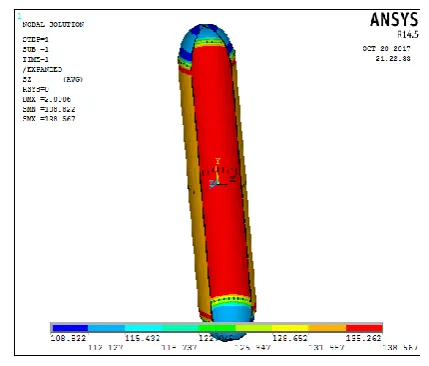
The figure4.2 shows hoop stress in the pressure vessel equal to 138.567Mpa and shown with red color region.
[image:4.595.347.562.84.267.2]The minimum stress of 108.822 Mpa can be observed at the top of the dome and the complete region is subjected to 138.567Mpa stress. Slight variation of stress can be observed between inner surface and outer surface. Hoop stress is also called as circumferential stress and is the main cause of failure of pressure vessel.
Fig 4.3: Radial Stress in the Pressure Vessel
© 2017, IRJET | Impact Factor value: 6.171 | ISO 9001:2008 Certified Journal | Page 621 Fig4.4: Vonmises Stress in the Pressure Vessel System
The figure4.4shows vonmises stress in the pressure vessel system. The maximum stress of 128.284 Mpa can be observed at the joint region of shell with hemispherical region. Vonmises is the most critical stress in finding the structural safety of the structural members. Vonmises stress is also represented as ‘SEQV’ in the title bar or it is called as equivalent stress. The stress is calculated from all the stress components(Sxx,Syy,Szz,Sxy,Syz,Szx) at a given point. As per the literature ductile material failure is mainly predicted by vonmises criteria. Almost 90% of failures are matching with this criteria for pressure vessels. Vonmises stress can also be calculated using principal stresses. Even principal stresses are helpful in finding the compression and tension sides of the pressure vessels under the given loading conditions.
Fig4.6: Vonmises Stress in the Shell Region(Maximum Stress: 123.071Mpa)
Fig4.7: Deformation plot in the Pressure Vessel
The figure4.7 shows maximum deformation of 2mm in the structure for the given loading conditions. This deformation is with in the allowable limits as specified by the structural standards(3500/750=4.66mm). Here structural standards says for every 750mm , 1 mm deflection is allowed for the pressure vessels. Since the structure has inside diameter of 3500mm, the allowable deflection is 4.66m. The deformation also represents rigidity of the structure. Higher the rigidity , the structures are more rigid and its load carrying capacity will increase. Also its dynamic capabilities increases as the deflection is having inverse relation with the natural frequency. Higher fundamental natural frequency can be obtained with lower deformation in the structure. Further analysis is carried out with dished end modeling.
4.2 Analysis with Dish end height specified by
ASME
Dished end modeling : (pg 115 of ASME code book)
Th=27 Ts=45
Y=(Ts-Th)/2 = (45-27)/2=9mm
Height of connection should be greater then 27mm
Considering 30mm as the height of connection.
© 2017, IRJET | Impact Factor value: 6.171 | ISO 9001:2008 Certified Journal | Page 622 The geometry is built between shell and the hemispherical
dome is built as per the ASME codes as specified in the pg 115. The connections are important to prepare the assemblies of pressure vessel system. After building the geometry for the required specifications, further meshing is done for problem. Analysis is carried out after meshing and application of boundary conditions.
Fig4.9: Vonmises Stress Plot(Maximum Vonmises Stress: 127.588Mpa
Fig4.10: Vonmises Stress in the Dished End
The figure4.11 shows vonmises stress of 132.708 Mpa on the dished end. The figure also represents stress concentration at the outer end. So there is possibility for reduction of stress by suitable fillet conditions. The stress values for vonmises, hoop and dished end stresses are less compared to the allowable stress of 170Mpa. The structure designed based on ASME has almost factor of safety of 2 when compared to the yield stress of the member and much less then the allowable stress of 170Mpa. So Design can be optimized by application of finite element analysis.
4.3 Design Optimisation and Optimized set
Results
Design Optimisation through Ansys:
Ansys has a module through which design optimization can be carried out. The steps in the design optimization is as follows.
Scalar representation of design parameters Geometrical built up using scalar parameters Meshing and analysis
Post processing the results for design variables Preparation of a file representing all the steps
Fig4.11: Change of Shell and Dome Thickness Vs iterations
The figure 4.25 shows axisymmetric built up of the model using Ansys. The weld is show by red color arrow region. Initially the geometry is built using rectangles and a scaled cylinder to the required elliptical head. Later Boolean operations are used to create the weld region. The region is split in 4 sided geometries for map meshing. Map mesh helps in representation of graphical plots along with better accuracy compared to the freemesh. The structure is represented with Plane42 element with axisymmetry option. The plane 42 element can be applied plane stress problems, plane strain problems and axisymmetric problems. The geometry should be built with reference to ‘Y’ axis for cyclic expansion.
© 2017, IRJET | Impact Factor value: 6.171 | ISO 9001:2008 Certified Journal | Page 623 The figure4.26shows representation of weld with 10mm
height specification.
Fig4.13: axisymmetric Model
The figure4.28 shows expanded plot of the axisymmetric model. Ansys has the option to shown in three dimensional space of the problem using plot controls>style>symmetry expansion>axisymmetry which gives virtual three dimensional representation. The weld region is shown by red colored arrow mark. The bottom of the pressure vessel is constrained in ‘y’ direction and pressure load of 20 bar or 2Mpa is applied on the inner boundary of the system. The problem is executed using the default solver ansys(Frontal solver). The results for structural safety are captured for interpretation.
Fig4.14: vonmises Stress in the problem(Maximum Vonmises Stress: 180.05Mpa)
Fig4.15: Stress Concentration in the Weld Region
Maximum stress can be observed at the interface of PN2 pressure with weld region. This can be attributed to minimum cross sectional resistance for the given loading.
Fig4.16: Stress values in the Weld region
The figure4.32 shows stress values in the region of weld which helps in finding the distribution of stresses at different regions.
4.4 Finite Element Modification Of Weld
Geometry And Analysis:-
Fig4.17: Fillet Weld in the Region
The weld region is modified to check the improvement in the region. So a fillet type of weld is provided with a radius of 25mm to prevent the stress concentration with PN2 pressure vessel junction. After meshing analysis is carried out to check the structural condition of the problem. The results are again captured for vonmises and hoop stresses which are maximum to find the failure of the structural memebers. Theoritical the stress values should be as per thin cylinder concept is
For PN2 pressure vessel :-
Hoop Stress :
PD/2t = 2*700/(2*6)=116.7Mpa
© 2017, IRJET | Impact Factor value: 6.171 | ISO 9001:2008 Certified Journal | Page 624 ‘D’ diameter of PN2 pressure vessel=700mm
‘t’ is the thickness of PN2 shell=6mm
Similarly for LP Column the hoop stress calculations are as follows:-
Hoop Stress in LP column =
P1D1/2t1=2*950/(2*8)=118.75Mpa
Here P
1= Pressure inside the LP column=2Mpa
D
1=Diameter of LP column=950mm
T
1=Thickness of LP column =8mm
Fig4.18: Stress with improved Fillet
The figure4.36 shows maximum stress development in the pressure vessel system is reduced to 152.907Mpa from 180 Mpa with ASME specified weld. Now the structure is with in the safe working limits as the allowable stress of the construction material is 170Mpa. Now the stress concentration is spread to certain region in stead of localization with initial design. Both inner and outer geometries are subjected to stress concentration unlike the initial design as specified by ASME code.
Fig4.19: Hoop Stress in the Problem(Maximum Hoop Stress : 153.578Mpa)
In the overall structure stress is reduced from 180 Mpa with the initial design to a final safe design of 152.907Mpa with modification in the weld region.
Fig4
.20: Stress concentration region in the weld
Fig4.21: Stress variation along the thickness of the weld
The figure4.40 shows slight variation of stress can be observed in the shell thickness between inner and outer geometries. Minimum stress is observed at the central regions. The inner boundary is subjected to a stress of 138 Mpa and the outer region is subjected to 152.9Mpa and minimum stress is around 103 Mpa.
5. CONCLUSIONS
© 2017, IRJET | Impact Factor value: 6.171 | ISO 9001:2008 Certified Journal | Page 625 5.2 FURTHER SCOPE
Analysis can be continued with change of material for optimization
Spectrum loading can be considered for the problem Effect of defects in the welds can be considered to find the strength
Possible thermal effects can be considered
Fluid turbulence effect inside the pressure vessel can be considered.
REFERENCES
1] Abler Kaufman, “ Investigation of the Elasto-Plastic
Stress State around reinforced
Openign in a Spherical Shell”, NASA publications, Washington, Feb 1965.
[2] Calladine C.R. “ On the Design of Reinforcement for
Openings and Nozzles in Thin
Spherical Pressure Vessels”, Journal of Mech. Eng. Science, Vol8, P1-14, 1966.
[3] R. Kitching,” Limit Pressures for Cylindrical Shells with Unreinforced Openigns of Various Shapes”, Journal of Mech. Eng. Science, Vol 12, P 313-330, 1970