© 2017, IRJET | Impact Factor value: 5.181 | ISO 9001:2008 Certified Journal
| Page 2726
Cost Analysis of Road Construction Project by
Earned Value Analysis using Primavera P6
Maheshwar S Maregoudru
1, Monish Kumar K
2, Ashwija K C
3, Sparsha B P
41, 2
PG Student, Dept. of Civil Engineering, KVGCE, Sullia, Karnataka, India
3 ,4Asst Professor, Dept. of Civil Engineering, KVGCE, Sullia, Karnataka, India
---***---Abstract -
Transportation is one of biggest basic need forthe society. The construction of road gives the better transportation facility around the country. For better development of the country in the construction assertive, the project management is necessary. Time and Cost are the two basic parameters to control work in the execution of the road construction. Flow of cost and its usage is very important aspect for beneficial point of view. It is necessary to develop the planning software to easy the works and risks arises in the projects. For the cost analysis of the road works, EVA technique is used to overcome the problems raised during execution. To understand the cost values in the road construction projects, an industrial road work is considered as a case study. Earned value analysis of any construction industry which gives the warning messages to the planning process as well as during the execution of the project whether the project is going on time and it is under budget or over budget. Primavera P6 software gives the accurate Earned value results.
Key Words: Earned Value Analysis, Primavera P6,
Project Management, Road Work, Cost, Time, EVA Parameters, Resources, Scheduling.
1.
INTRODUCTION
Transportation is one of biggest basic need for the society. The construction of road gives the better transportation facility around the country. For better development of the country in the construction assertive, the project management is necessary. Time and Cost are the two basic parameters to control work in the execution of the road construction. Flow of cost and its usage is very important aspect for beneficial point of view. It is necessary to develop the planning software to easy the works and risks arises in the projects. For the cost analysis of the road works, EVA technique is used to overcome the problems raised during execution.
In olden days, the project budgeted total cost is determined by the difference, between the actual cost, and planned cost. That means the project managers’ focus was on only for planned cost and expenditure cost as actual cost. Now in the modern days many schedule properties and cost parameters are considered. Because it is very important in every
Construction project, losses are due to inadequate construction management and cost performances done by the contracts in the road construction projects. So it is necessary to develop the planning software to easy the works and risks arises in the projects. The mainly used software is MSP, Primavera P6 and some developed software. This software gives better scheduling methods and cost performances affectively.
1.1 Road Construction
Construction of roadway has the many scopes in the developing countries like India. The better quality of road work needs good quality of construction methods and better usage of the resources available near the working place. A good construction management gives the better quality of work.
1.2 Concept of EVA- Earned Value Analysis
Earned Value is a program management technique that uses “work in progress” to indicate what will happen to work in the future. EVA uses cost as the common measure of project cost and schedule performance. It allows the measurement of cost in currency, hours, worker-days, or any other similar quantity that can be used as a common measurement of the values associated with project work. EVA uses the following project parameters to evaluate project performance [1]
Planned Value
Earned Value
Actual Value
1. Planned Value (PV): It is cost of the construction project as per the schedule of the project. It is also called as BCWS (Budgeted cost of work scheduled).
2. Earned Value (EV): It is budgeted cost, of the work performed till, the current date. It is cumulative budgeted cost occurred in activities that will complete on the due date.
© 2017, IRJET | Impact Factor value: 5.181 | ISO 9001:2008 Certified Journal
| Page 2727
Other earned value parameters like Cost variance and costperformance index, schedule variance, and schedule performance index, estimate to complete the project and its Variances are considered in this project work. The variances are used to check the deflection or deviation of the project from the path of original schedule. It is also used to analyse the extent and cause for the delays of works or tasks of the project. Following re two variances:
Cost Variances (CV): It is used to check the difference between the proposed planned project and present project on the specific date. It shows the variation of project in form of cost. The formula used for calculating cost variances is [7] Cost Variance = Earned Value – Actual Cost
Schedule Variance (SV):It is used to examine the deflection of present project in from the planned project. If considerable change appears than the project objectives must be revised. The formula for calculating the schedule variance is [7]
Schedule Variance = Earned Value – Planned Value
Schedule Performance Index (SPI): SPI can be used to estimate the projected time to complete the project. It is calculated as follows,
SPI = Earned Value / Planned Value SPI = 1 means Project is on Schedule SPI < 1 means Project is behind Schedule SPI > 1 means Project is ahead of Schedule [7]
Cost Performance Index (CPI): CPI can be used estimate the project cost to complete the project based on performance to date. It is calculated as follows,
CPI = Earned Value / Actual Cost
CPI = 1 means Planned and Actual cost are same CPI < 1 means Project is under Budget
CPI > 1 means Project is over Budget
Estimate at Completion (EAC):The Estimate at Completion is the actual cost to date plus an objective estimate of costs for remaining authorized work. The most common is EAC = Actual cost + Estimate to Complete [7].
1.3 Objectives of Study
The objectives of the studies are
To determine the actual project cost of the road
work.
To determine the practical durations that are
required to complete the activities.
To determine the difference in estimated cost
and actual cost of the project.
To find out the various cost parameters and
their values by software Primavera P6 and by
formulae.
Fig-1: Standard Earned Value Analysis Graph
2. LITERATURE REVIEW
Sagar and Gayatri (2012) has discussed “Cost controlling using EVA in construction Industries” is about controlling the cost in the projects by using EVA. If the cost of the project is over run, then the construction project management team adds the good engineering program or techniques to overcome the problems. Cost reduction involves reduce of scope & quality in few parts of the work. And also it can be reduced by giving the extra money to the existed works for the further work with cash flow. Similarly, if the time is less for the execution work, the program is made like fast tracking or crashing the durations. The paper includes better improvements and utilization of earned values to achieve the estimation @ completion, based on economical techniques and traditional indices of earned values. The author has taken a residential building as a case study. The total building area of the project is 120 sqm. The study included the parameters to calculate the cost values using developed software. Therefore the author has taken two more software MS project and Primavera to compare with the developed Software. The result shown a strong relation between each software and gave 99.5% accuracy. So the author concluded that there is no much difference between each software and all project planning software can be used in the construction industry [1].
© 2017, IRJET | Impact Factor value: 5.181 | ISO 9001:2008 Certified Journal
| Page 2728
objective of the study is to understand the importance ofmonitoring and controlling of the project in the execution progressive within the time. It is proved that, the progress and specific problems are raised in the process of work can be reduces by the proper attention. They concluded that the drawbacks of management and need of effective project planning software like primavera P6 [2].
Mohammad and Devanand (2014) Made “analysis on resource planning, cost estimation and tracking of project by earned value management” by taking a duplex apartment as a case study. The focus was on planned expenditures and actual cost. The duration of the project was 160 working days. So four set of tracking were done at different intervals. Earned value concept revealed the future opportunities and it also examines actual accomplishment. So the key point here that EVA that enable us to spot a potential problem early in the project and rectified the situation that rose in the project [3].
Sandeep and Attarde (2015) have discussed about “the time and cost planning and during the execution of the construction projects”. Author found the causes of delays in the project and given guidelines for proper planning for the saving of time and cost. The main factor that delayed the project was the material management due to contractual agreements or delay in the settling running account bills, management problems delayed the project completion. Those delays affected on the cost of the projects that lead into over budget. So they concluded that, the delays can be avoid or minimize only when the causes are identified in the construction project [5].
Subramani and Sekar (2015) has discussed about “the preplanning and scheduling of road construction by using project portfolio management” in primavera P6 module R .1 software. Author discussed about the advantages of preplanning in the road construction project in detail and maintained a baseline to compare how the project is running v/s the original plan v/s the last update cycle v/s six months ago, etc. This study has given brief explanation for preplanning project management. The study concludes that the Primavera P6 software offers the flexibility when determining who is responsible for the activity during the execution of project in every stages of the work. CPM scheduling provided CPM scheduling, which used the activity durations, relationship between activities and calendars to estimate the activities that affects the completion date for the project or an intermediate deadline [4].
Unmesh and Rohith (2015) has explained about the proper “planning, scheduling and tracking of a residential project using primavera software”. They defined project monitoring is like a warning mechanism which includes watching the project with respect to time and scheduling performance and resources used during the execution of the project. As a case study, the author has taken a residential building which is
located in Bhugoan, owner of this project was kalashree developers. The author has made research on the project and found defects in the planning, Scheduling procedure done by the organization. The results revealed that the contractors and subcontractors plays vital role in the completion of the project. The study conclude that the organization has found that monitoring and tracking the project using software is very useful, So the organization has changed their planning and scheduling methods by weekly targets given to the contractors instead of monthly. Training was given to the project managers and engineers to use the software during the project planning and monitoring [6].
Abuzar and Geetha (2016) has discussed about the “Time and Cost management using project planner software”. For time and cost analysis it is important to do project monitoring. Project monitoring acts like a warning mechanism, it is the process of recording project performance that the Project manager and others wants to know. The author has taken a case study of residential apartment under the Shanti Builders. If, time is the main consideration, then cost will be more and vice-versa. The Study concluded that the time and cost analysis is very important factors in the project planning and project planner software are very helpful to all construction industries. In this paper the results were obtained from the software were very useful to the apartment constructions and the construction finished under the budget[8].
Suhas and Vijay (2016) had discussed about the “base line fixing and EVA in construction industries using primavera”. They have taken residential apartment as a case study for the cost controlling and optimization of EVA. The project details are taken from the Drushti constructions. The activities entered including from excavation to building handling over. They maintained various baselines to compare the each stages of the work with time and cost. Setting a base line is very helpful to concentrate on the usage of resources and the cost controlling throughout the execution of the work. The study conclude in this paper as by setting baselines for a project gives more accuracy in the cost management and optimization in the usage of resources with suitable durations [7].
3. METHODOLOGY
© 2017, IRJET | Impact Factor value: 5.181 | ISO 9001:2008 Certified Journal
| Page 2729
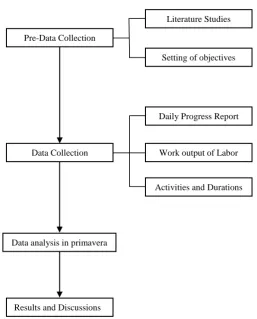
Chart -1 : Research Methodology3.1 Site Details
The working site details are tabulated in the table 3.1
Table-1 Site Details
Name of the Project KIADB Road Work Owner of the Project PWD, Karnataka Contractor Er. Venkatesh H Daroji Project manager Er. Santosh Hulsoore Location Industrial Area, Gokak. Total length of road 750 m
Project Start date January 29, 2017 Project Duration 82 Days
Planned Project Cost Rs. 1,30,00,000
3.2 Pre-Data Collection: In this stage, pre data collections are made which are required to study on the concept of earned value analysis and adopting this analysis for the future purposes in the road construction projects. It consists of study of literature reviews which includes the concept of planning, scheduling and earned value Analysis and the discussions made are studied thoroughly. After the literature reviews, objective of studies are made to clear understanding of the project.
3.3 Data Collection
In the data collection part, the data required for the study of planning, scheduling and earned value analysis are collected. These data collections are made in three parts and are as follows.
DPR (Daily progress report).
Work, output of the Labor.
Activities with, planned duration.
3.4 Data Analysis in Primavera P6
[image:4.595.32.290.102.422.2]The activities of the road construction are collected and entered in the primavera P6 software for the further calculations. The sequence of construction activities are found out on site and by field training. Linking of activities with the Predecessors and successors is made. After that resources required for each activity are assigned. After the results generated form the primavera are collected and EVA is calculated by the formulae.
Table-2 Procedure in primavera Software
1 Create Project
2 Define WBS
3 Creating Calendars 4 Define Activities
5 Appoint Activity Durations 6 Allocating resources/budgeting 7 Tracking, updating
8 Run Reports
9 Generating Earned Value Reports
4. ANALYSIS AND CALCULATIONS
[image:4.595.307.564.584.724.2]In this analysis part, the detailed procedure is explained starting from the entering of the activities to the generating the report of resources sheets and earned value reports.
Figure 2 Activity details with durations and budget cost
Pre-Data Collection
Data Collection
Data analysis in primavera
Results and Discussions
Literature Studies
Setting of objectives
Daily Progress Report
Work output of Labor
© 2017, IRJET | Impact Factor value: 5.181 | ISO 9001:2008 Certified Journal
| Page 2730
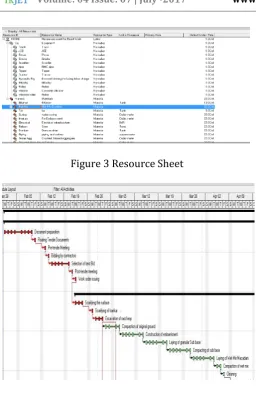
Figure 3 Resource Sheet
Figure 4 Critical Path
Various Earned value parameter results are obtained from the primavera software which is generated by the analysis process and earned value = Rs. 2,08,83,846 actual cost = Rs.1,13,09,392 planned value = Rs. 1,25,58,350 are obtained by primavera. By using formulae, the various parameter values are obtained as follows.
1) Cost variance = EV- AC = 20880846 – 11309392 CV = Rs. 9,51,454/-
2) Schedule Variance = EV-PV = 20883846-12558350 SV = Rs. 1,96,25,496/- 3) Cost Performance Index = EV/AC
=20883846/11309392 CPi = 1.184
4) Schedule Performance Index = EV/PV
= 20883846/12558350 SPi = 1.6
5) Estimate to Complete (ETC): This project is completed in May 24 as per the schedule and under the budget given by the govt. So, estimate cost to complete that road work project is same as the cost of actual project cost.
6) Variance at Completion (VAC): Variance at completion values of the project is under the budget, therefore there is no over budget of the project.
5. RESULTS AND DISCUSSIONS
[image:5.595.34.291.72.467.2]The results are obtained from the software as well as by formulae are accurate to nearer values. The cost parameter results obtained from the analysis in primavera has given positive results and that will help to the company in future projects. Following earned value results are obtained from the software.
Table 5.1 Results Obtained From the Calculations
Project Budgeted Cost Rs. 1,23,56,750 Total Duration of the Project 82 Days
Actual Cost Rs. 1,13,09,392
Planned value Rs. 1,25,58,350 Earned Value Rs. 2,08,83,846 Cost variance Rs. 9,51,454 Schedule Variance Rs. 1,96,85,496 Cost Performance Index 1.18
Schedule Performance index 1.6
6. CONCLUSIONS
Obtained values from the primavera P6 given the satisfactory results which are very helpful for the project managers and the site engineers. Earned value management system given very helpful guidelines to work.
Cost*variance*(CV) is Rs. 9,51,454 has the positive value, it indicates that the project*is under*budget.
Schedule*variance*(SV) is Rs. 1,96,25,496 has positive*value,it indicates*that the project*is*ahead of the schedule.
Cost*Performance*Index (CPi) is 1.18, so the value obtained is more than*1 that indicates*the performance*of the project is good.
Schedule*Performance Index*(SPi) has the value of 1.6 which is*greater than one, it indicates*the project*schedule performance is good.
Estimate*At*Completion*(EAC) is the same as the*actual cost obtained*from the*total project cost*of the work.
Variance*At*Completion (VAT) of the project is 1,20,000, because*there is only maintenance cost for the road work if the road become repair.
The project is under planned durations, therefore the overall project is within the schedule and under the budget,
REFERENCES
© 2017, IRJET | Impact Factor value: 5.181 | ISO 9001:2008 Certified Journal
| Page 2731
technology(IJEIT), ISSN 2277-3754, Vol 1, Issue 4,pp324-332.
[2] Andrew F T, Sachin Paul (2013) “Project monitoring and controlling in primavera” International journal of innovative research in science, engineering and technology. ISSN 2319-8753, Vol 2 Issue 3, pp762-771.
[3] Shaik Md M, Devandand.R, Harsha H.N (2014) “An Analysis on resource planning, Cost estimation and tracking of project by Earned Value Management”. International Journal of Engineering and Innovative Technology. ISSN 2277-3754, Vol 4 Issue 4.pp42-47.
[4] Subramni.T, Sekar.M (2015) “Preplanning and scheduling of road construction by using PPM” International Journal of application or Innovation in Engineering and Management (IJAIEM), ISSN 2319- 4847, vol.4 Issue 5, pp234-244. [5] Sandip P, Attarde P.M (2015) “Time And Cost planning in Construction project” International journal of engineering and innovative technology, ISSN 2277- 3754, vol 4 issue 4,pp45-48.
[6] Unmesh P, Rohith R (2015) “Planning, Scheduling and Tracking of a residential project Using Primavera Software”. International Journal of Advance Research in Computer Science and Management Studies. ISSN 2321-7782, Vol.3 Issue5, pp227-235.
[7] Suhas K B, Vijay K (2016) “Baseline Fixing and Earned Value analysis in construction industry using primavera”. International Journal of Engineering Research and Technology. ISSN2278-0181, Vol.5 Issue 8, pp78-82. [8] Abuzar A, Geetha.K, Ramya R (2016) “Time and Cost analysis using project planner Software”. International Journal of Recent Advances in Engineering & Technology. ISSN2347-2812, vol.4 Issue 4, pp15-18.
ACKNOWLEDGEMENT
I thank Dr. Chandrashekhar A., HOD Dept of Civil Engineering KVGCE, Sullia for his guidance and encouragement.
I thank to Er. Santosh Hulsoore for his support in carrying out the dissertation work.
I thank to Er. Venkatesh H Daroji, MD of Swastik Associates for their support.
BIOGRAPHIES
Maheshwar S Maregoudru BE in Civil Engineering(2015) [M tech in CT(2017)]
Monish Kumar K
BE in Civil Engineering(2013) [M tech in CT(2017)]
Ashwija K C Assistant Professor Dept of Civil Engineering KVGCE Sullia