Journal of Chemical and Pharmaceutical Research, 2014, 6(7):594-602
Research Article
CODEN(USA) : JCPRC5
ISSN : 0975-7384
Coal mine emergency rescue drill system based on virtual reality technology
Baiwei Lei*, Bing Wu and Yao Zhou
China University of Mining and Technology, Beijing, China
______________________________________________________________________________
ABSTRACT
The rescue effort of rescue crew in coal mines is mostly responsible for preventing an accident from becoming worse. An emergency virtual drill training system based on Unity 3D technology is introduced in order to enhance the tactical capacity of rescue team, make members understand the rescue theories and standardize their behaviors. The system can simulate and present the whole process of underground rescue, train rescue team virtually and strengthen investigation ability of rescue players through a man/machine interaction and computer-scored system. Currently, the system has been successfully applied to China Kailuan Group’s emergency rescue base. The results show that the system not only enhances the rescue capacity of players, but also guarantees the safety of training process.
Key words: Coal mine explosion; Rescue training; Virtual reality; Accident simulation
______________________________________________________________________________
INTRODUCTION
Prompt and correct emergency rescue is the fundamental means to mitigate the accident and reduce casualties when coal mine disaster occurs. Mine rescue crew is the main part that fulfills the emergency rescue mission during a mine disaster, and the capability of rescue crew is crucial for rescuing.
In China, disaster relief training on rescue crew of coal mine is primarily based on the traditional theory, assisted by some practical training. Most of these trainings focus on fitness-related exercise rather than disaster relief theory. In face of complex mine disaster scenario, mine rescue crew members should not only have a strong physique, but the ability of predicting and judging mine environment to respond to uncertainties. These skills need both study of relief theory and constant practice so as to consolidate theoretical understanding and behavior standardization of rescue crew members.
In recent years, with China's economic growth, the training methods of rescue crew members have also improved, such as simulation of a variety of conditions in underground disaster site. However, for safety reasons, these facilities and equipment can hardly reflect the status of the mine disaster site.
Rapid development of computer technology provides a possibility for solving the above problems. By applying sophisticated virtual reality technology, and combining software with hardware, we can construct the disaster scene under different conditions, so that rescue crew members can have a better understanding and analysis of various complex relief environments, and be more accurate to assess the risk characteristics and the degree of risk under various scenarios in relief procession, thereby significantly improving the response capacity of the rescue crew[1-2].
whole handling process of coal mine explosion accident in a simulated real-world scenarios. It significantly improves the training effect of crew members.
DOMESTIC AND OVERSEAS RESEARCHES
By building a three-dimensional scene software system and multi-channel virtual scene display platform, virtual reality technology gives users a sense of reality as if they are immersed in the scene. This can effectively solve some problems of traditional training, for example, training facilities are not readily available, the training environment has special restrictions or safety concerns. This technology allows trainees to master the basic knowledge and operating procedures of equipment quickly, reducing people or equipment damage caused by improper operation during the training course.
Using virtual reality technology for training education is a new direction at home and abroad[3-5]. Nathaniel [6]put forward a flexible, low-cost virtual training to guide the legs-disabled persons to regulate the operation of electric wheelchairs. Francisco[7] used VR technology in medicine training, coaching operation staff to clean hands in strict accordance with the correct procedure before entering the operating room. University of Nottingham[8-10] came first to apply virtual reality technology in mining enterprise safety training programs, and to develop a virtual reality training software, which was mainly used in open-pit car driver training, training and testing of new miners. Etienne[11] built an virtual training systems based on VR technologies to achieve safety training for miners. China has also made great progress in the research on Virtual Training in the field of coal. Qi Yixin[12] established a fire virtual reality system in large space, by which the user can interact with other operating equipment and systems by mouse and data gloves, also control the virtual human in the scene to roam and to simulate extinguishing process. Chen Xuexi[13] conducted simulation study on mine gas explosion based on virtual reality, achieving gas explosion, burning and smoke effects. Yang Jichun[14] studied on overall design of a virtual mine safety training system. Zhang Hongyan[15] analyzed the training effect of a virtual reality training system for training Muduchaideng miners.
At present, there is few virtual reality training system specifically developed for mine rescue crew members in China. By using virtual reality technology we can easily set up a virtual disaster environment and obtain operating consequences feedback, so the development of an emergency virtual drill training platform for the mine rescue crew members can enhance their theoretical level and standardizing their disaster relief acts.
OVERVIEW OF SYSTEM CONSTRUCTION A. System Development Goals
In consideration of the studies on mine rescue team training methods and actual coal mine disaster rescue, the mine disaster relief virtual drill system should be developed to meet the following requirements:
(1) A three-dimensional model is established in a typical mine to realize the whole process of coal mine disaster rescue. In terms of actual mining roadway layout, the system includes shafts, parking lots, roadways (haulage, belting), fully mechanized mining face, heading face, underground main chamber (pumping stations, refuge chamber, substation, etc.), mining area return air, the total return air shaft. At the same time, other mine facilities, equipment models (including conveyors, local fans, etc.) are also included.
(2) A flexible and advanced system control platform is formed. The system should involve the rescue tool function selection, interactive window, information tips, capture action points, Hawkeye, directly to the key point and so on.
(3) Drill script design is standardized. The drill system is developed according to the detailed design script based on the relevant rules and regulations. Coal mine disaster relief drill scripts include some targeted mission design in the relief process such as fire and explosions. The design for relief consist of main tasks design, parameters design for each task status, design of the main point and the design of the scene requirements according to the characteristics of each type of accident.
(4) The system should have random variation of environmental conditions and disaster point setting function to ensure the exercise effect. When the assessment and training goes, we need to arbitrarily change the location of disaster place, victims, on-site disposal (such as fuel combustion, roadway through treatment, etc.) in addition to underground environmental parameters (such as gas concentration in the atmosphere, concentration of CO, O2, temperature, etc.) in the process of disaster relief mission, so as to achieve the purpose of training and assessment.
the operating points based on operating conditions, automatically give test scores and assessment and recommendations, allowing users to understand their own weaknesses and learnable points.
B. System Composition
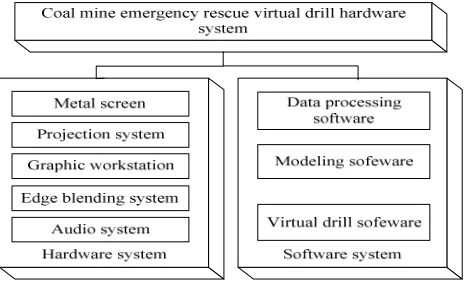
Research and development of the virtual system for coal mine emergency rescue mainly includes three aspects: coal mine emergency rescue virtual drill hardware system, three-dimensional modeling of coal mine disaster relief virtual drills, coal mine emergency rescue virtual drill software system.
(1) Coal mine emergency rescue virtual drill hardware system
Build coal mine emergency rescue virtual drill hardware support system by multi-channel annulus system, etc.
(2) Three-dimensional modeling of coal mine disaster relief virtual drills
Find a coal mine which holds a most representative roadway layout in Chinese style. And then, digitally model the chosen mine and exaggerate it on lights and animations through three-dimensional modeling development tools.
(3) Coal mine emergency rescue virtual drill software system development
Virtual reality software development tools software is used for coal mine emergency rescue virtual drill software system function development.
[image:3.595.189.422.301.447.2]System components are shown in Figure 1:
Fig. 1: System composition structure
C. System Development Process
By collecting the specific relief case information of coal mine rescue crew and the video of rescue drills and rescue equipment operations of rescue crew, we obtain large amounts of data to conduct base development. After a detailed analysis of data, to overcome the lack of practical application of the theory in mine emergency rescue training of disaster rescue crew, we carry out the design and development of mine emergency rescue virtual drill training system. Figure 2 shows the development flowchart of this system.
D. System Drill Method Design
In order to guarantee the training effect, the system uses the combination mode of the virtual reality display and live-action video demonstration of standard operation. Through virtual reality scene, learners can learn real standard operation by video play in a true feeling of scene, so that we can solve the problems that complex norms and standards of the specific operation are difficult to achieve or implement in virtual reality technology, such as resuscitator operations, personnel life sign check, artificial respiration operations. If virtual reality technique is adopted to realize the training goal, it will be very complex and the workload heavy. But by using the high-definition video, through real operation, we can show the operation specification well. Therefore, the use of virtual scene with the insertion of high-definition video for emergency rescue drills is conducted. The system records videos on the main operations of the relief process and inserts them into the position of the virtual reality scene, then sets up the call function. Thus, we can watch the video in the corresponding scenario and learn real specification operation in such a disaster situation. In order to achieve a better learning effect, we integrate the virtual three-dimensional dangerous environment, specification and accurate operation method.
THE SCRIPT DESIGN OF COAL MINE EMERGENCE VIRTUAL DRILL SYSTEM A. System Rescue Process Design
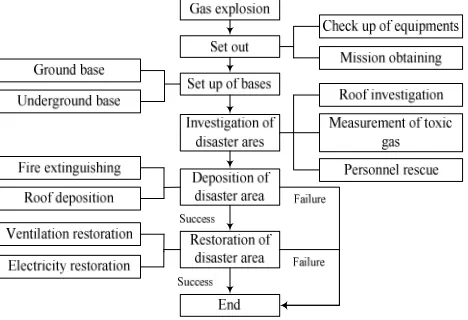
[image:4.595.191.425.396.556.2]In order to realize all-crew attendance and enhance skills for each player, the whole process of underground standardized rescue is designed according to “Coal Mine Rescue Regulations”, which includes set out, establishment of underground rescue base, investigation and deposition of disaster area and restoration of disaster area. The virtual training flow chart of coal mine emergency is shown in Figure 3.
Fig. 3: The design flowchart of virtual coal mine emergency rescue drill
B. Accident Simulation Design
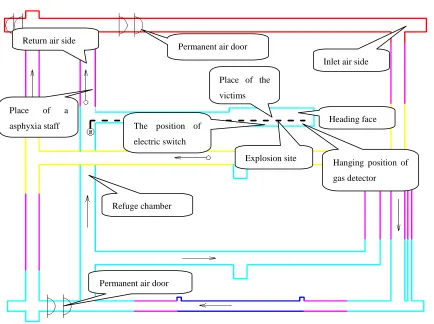
In order to increase the effect of rescue training exercises, the simulation setups of coal mine gas explosion should enable trainees to be involved. System selection based on a typical mine, including primary and secondary shaft, shaft station, roadway, district rise, working face, heading face, return air rise, main return airway and so on. In Figure 4, an entire mine is selected, and a simplified model is employed combined with occurrence region of gas explosion, which shows the whole process of gas explosion, the personnel flee and roadway damage.
Fig. 4: The scene layout schematic of coal mine gas explosion accident
C. Key Training Content Design of Emergency Rescue Drills (1)Responses
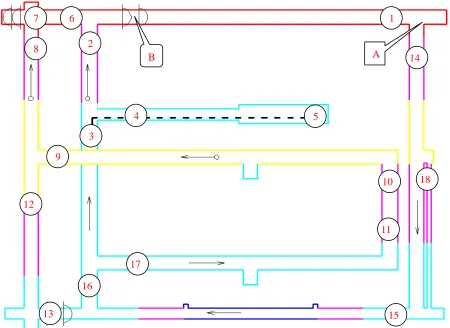
After answering the alarm call, the on-duty man of rescue crew sends a gas explosion emergency alarm. Before proceeding to the accident site, two teams of rescue crew need to make careful preparations emphasizing on check oxygen pressure of respirator and equipment carried. Rescue captain comes, accepts the task and then explains the overview of the mine ventilation system (shown in Figure 3) and disaster situations to rescue crew members for tactical discussions. The serial number of Figure 4 identifies the rescue crew members for the order to check and walking, also the location that needs to check whether hazards of gas and roadway is normal or not.
(2)Underground field base settings
Two teams carry the least technical equipment wherever explosion has been and choose the air inlet A (shown in Figure 4) as a mine rescue base. After the base is set up, the middle team leader serves as the base headquarters and arranges a team member to stay in the base to take charge of the safety monitoring, such as discovery of abnormal situation as well as contact with relief workers and ground command. The focus of assessment to the rescue crew members is the location selection and construction of the underground field base, which ensures safe and reliable mine field base and necessary equipment.
(3) Disaster area investigation
Middle team leader sends two team members to reach the main return airway and check gas, carbon monoxide concentrations, and then sends a team starting from the base into the disaster area according to air flow test results of the main return airway. Set the mark number 1-13 in Figure 4 as return air side which have a priority for investigation, and the mark number14-18 in Figure 5 as the airway investigation area. The key investigation content is roadway, inspection records of the roadway collapse situation, explosion influence scope, burst point, disaster gas concentration distribution, flame inspection, and first aid of the victims.
Firstly, we conduct the investigation of the return air side. Middle team leader sends a team starting from the base into the disaster area to carry out relief work. While they are walking, they lay a telephone line for the disaster area. Every gas and underground roadway inspection result must be reported immediately to rescue base, so that base members mark the reported information on the drawings. If a person in distress is found in the course of the investigation, we should carry out check immediately; if the person is confirmed dead, we should record his miner's lamp number or self-rescuer number and mark on the drawings; if there are signs of life, rescue measures should be
Return air side
Place of a
asphyxia staff
Permanent air door
Inlet air side
Heading face
Hanging position of
gas detector Explosion site
Place of the
victims
The position of
electric switch
Refuge chamber
immediately taken and then he is transported to mine rescue base. Then continue investigation until the investigation is completed. In addition to the inspection of the situation outside, we also focus on whether the rescue crew members have checked the pressure of respirators in the appraisal process of the investigation. If find the pressure drop too fast, all of the rescue crew members should immediately turn back and continue investigation at the scheduled routes after replacing respirator.
Fig. 5: The scene layout schematic of coal mine gas explosion accident
After the return air investigation is completed, the investigation team conducts an investigation into the inlet side. While they are walking, they lay a telephone line. If the team finds a respirator pressure drops too fast when traveling to a certain distance, the whole team all return to base. After replacing the respirator, the investigation continues according to the scheduled route. Once a person in distress is found, the investigation team checks and deals with them. Then ship them to the underground base, and continue investigation until the investigation is completed.
(4) Disaster handling
Mine rescue crew members should take reasonable firefighting measures when discovering sporadic small-scale fire in the investigation process, such as use of fire extinguishers. When the roof falls in the road and we cannot move forward, firstly, we should use the life detector to detect whether there is a life or not, after confirming no vital signs exists, conduct cave-treatment; if we find a person in distress who is buried, we should check his vital signs at first; if he is dead, record his miner's lamp or self-rescuer number and mark in the drawings.
(5) Disaster recovery
After receiving the command of ground headquarters, underground base should send a team to reenter the mine to recover ventilation, restore power, remove the poisonous disaster and sprinkle water to cooling and dust.
1) Recover ventilation and restore power supply: At first, we gradually close the damper B in Figure 5 and check the gas concentration at No. 6 in order to ensure the gradual exclusion of gas inside the mine. And then restore mine power supply when the damper B is closed and the gas concentration of No. 6 declines to 0.4%.
2) Recover the ventilation of heading face: After power is restored, we should start the local fans of heading face for
7 6
8 2
B
1
A 14
5 4
3
9
18 10
11
15 17
16
gas emissions in the heading face. When the gas concentration of No. 4 declines to 0.4%, we can enter the roadway to sprinkle water to cooling and dust, and then the rescue crew can withdraw from the mine.
IMPLEMENTATION OF VIRTUAL DRILL SYSTEM A. System Rescue Process Design
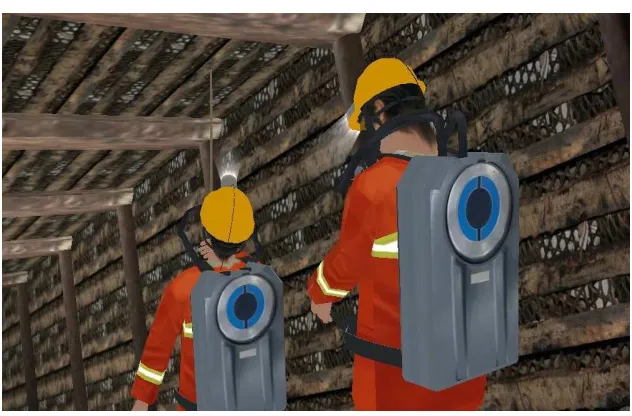
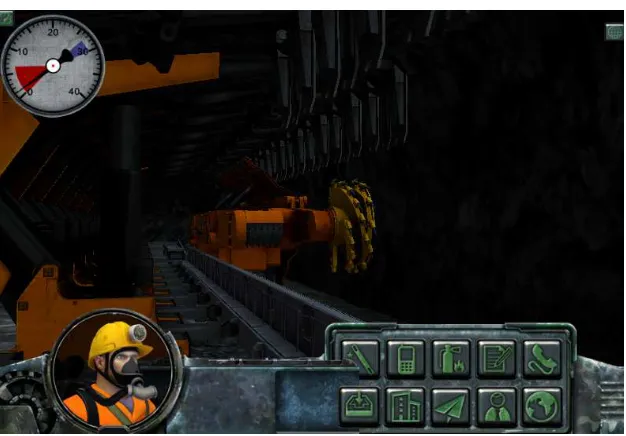
[image:7.595.150.464.233.421.2]According to the content design of mine emergency virtual drills, in the concrete development, we use CAD floor plan and the collected mine laneway data to determine the coal mine roadway arrangement at first, and then use three-dimensional modeling software such as 3DMax to build shearers, hydraulic support, belt conveyor, tunnel boring machine and other structures model. Convert it to. fbx format and import into Unity3D, then paste it in Unity3D, and add lighting effects. After completion of scenarios construction, we begin conducting simulation system interaction design, including walking and roaming interaction, menu interface interaction, performance testing after completion of the system, the resulting executable file and network files. Virtual drill scene effect is shown in Figure 6 to Figure 9.
Fig. 6: The scene diagram of coal mine gas explosion
[image:7.595.148.464.443.651.2]Fig. 8: The scene diagram of wounded person rescuing
Fig. 9: The scene diagram of coal mining face
CONCLUSION
Through the content design of the virtual coal mine emergency drills, by using 3DMax modeling software as a tool, a coal mine rescue drill training system in the conditions of gas explosion and fire is developed.
Currently, most of the similar training systems in China are designed for the exercise in a local roadway or single-face, which cannot fully reflect the whole process of the coal mine disaster rescue. Besides, the disaster drill point and the state of the environment of the most systems are fixed, which is not conducive to achieve training effect. This system adopts a whole mine as a model, achieving the display and drills for both the whole mine and the entire rescue process.
REFERENCES
[1] Zhang Ruixin; Ren Tingxiang; D Schofield; B Denby; T Walsha, Journal of China coal society,1999, 27(3), 70-73.
[2] Lin Lin; Liu Xianmei, Computer technology and development, 2012,22(10), 205-208. [3] Yuli Chen, Journal of Computer, 2014, 9(1), 34-43.
[4] S. Jeschke; H. Scheel; T. Richter; C. Thomsen, Journal of Software, 2007,2(6), 76-85. [5] Dayan Shangguan; Xinyuan Huang, Journal of Computers, 2014, 9(3), 781-786.
[6] Nathaniel Rossol;Irene Cheng; Walter F. Bischof, etc., International Conference on Computer Graphics and
Interactive Techniques, New York, USA, 2011,343-346.
[7] Francesco Corato; Maria Frucci; Gabriella Sanniti Di Baja, Virtual Training of Surgery Staff for Hand Washing Procedure,Proceedings of the Working Conference on Advanced Visual Interfaces, Capri Island, Italy, 2012, 274-277.
[8] Schofield,D. ; Denby, B. ;McClarnon, D. , Mining Magazine, 1994,171(5), 284-286.
[9] Schofield, D., Denby, B. and Hollands, R., Mine Safety in the Twenty-First Century, Mine Health and Safety Management ,Littleton, Colorado,USA,2001, 153-174.
[10] Noond, J.;Schofield, D.; March, J. ; Evison, M., Journal of The Forensic Science Society, 2002,42(2), 89-95. [11] Van Wyk, Etienne; De Villiers, Ruth ,Virtual Reality Training Applications for the Mining Industry, 6th
International Conference on Computer Graphics, Virtual Reality, Visualisation and Interaction in Africa, Pretoria, South africa, 2009,53-63,
[12] Qin Yixin;Xia Zhengyi;Wang Jian,etal, China Safety Science Journal,1999,9(6),49-53.
[13] Chen Xuexi;Han Yuchun;Zou Hengyi,etal, Journal of North China Institute of Science and Technology, 2004,1(2), 1-6.