CFD SIMULATION OF THE DYNAMIC FLOW BEHAVIOR IN A BUBBLE COLUMN REACTOR
SAZALI BIN MD HASAN
A project report submitted in partial fulfillment of the requirement for the award of the
Degree of Master of Mechanical Engineering
Faculty of Mechanical and Manufacturing Engineering Universiti Tun Hussein Onn Malaysia
ABSTRACT
ABSTRAK
Kaedah pemodelan bubble column menggunakan Eulerian two-phase Computational Fluid Dynamics (CFD) model yang di tunjukkan dalam laporan ini berupaya mengesan bubbly flow parameter seperti“gas holdup”, “contact surface area”, “air
volume fraction”, pressure drop”, dan “velocity magnitude” bagi memahami tingkah laku aliran hidrodinamik. Dalam simulasi ini, tiga jenis pembahagi gas di uji terhadap“bubble column cylinder” yang berketinggian 1.5 m dengan diameter 0.15 m. Untuk menghasilkan pelbagai corak aliran di dalam“bubble column”, lima halaju gas yang berbeza digunakan keatas setiap rekabentuk pembahagi gas. ANSYS Fluent Workbench 15.0 digunakan sebagai kaedah penyelesaian berangka bagi membuat analisis simulasi terhadap“bubble column”. Bagi menghasilkan gelembung udara yang naik di sepanjang silinder, gas (udara) di sesarkan melalui pembahagi gas kedalam cecair (air). Bagi mengesahkan keputusan yang diperolehi, satu perbandingan keputusan “gas holdup” dan “velocity magnitude” dalam bentuk graf telah dilakukan terhadap keputusan simulasi penyelidik terdahulu dan persetujuan yang agak baik dicapai. Daripada pemerhatian didapati, dengan meningkatnya
“superficial gas velocity”, “gas holdup” juga meningkat dan “velocity magnitude” akan berkurangan apabila menghampiri dinding silinder. Daripada keputusan yang diperolehi, didapati bahawa pembahagi gas rekabentuk “c” dengan diameter lubang dan nisbah kawasan terbuka paling besar selalunya memberikan nilai “gas holdup”,
CONTENTS TITLE DECLARATION DEDICATION ACKNOWLEDGEMENT ABSTRACT ABSTRAK CONTENTS LIST OF TABLES LIST OF FIGURES
LIST OF SYMBOLS AND ABBREVIATIONS LIST OF APPENDICES
i ii iii iv v vi vii x xi xv xvi
CHAPTER 1 INTRODUCTION
1.1 Research background 1.2 Problem statement 1.3 Objective
1.4 Scope of study 1.5 Significant of study
1 1 3 4 4 5
CHAPTER 2 LITERATURE REVIEW
2.1 Introduction
2.2 Application of bubble column
2.3 Hydrodynamic and operation of bubble column
2.3.1 Gas holdup
2.3.1.1 Effect of superficial gas velocity to gas holdup
2.3.2 Axial liquid velocity 2.3.3 Turbulent kinetic energy
2.4 Flow pattern
2.5 Hydrodynamic regime
2.6 The bubble column geometry and parameter
2.7 Sparger design
2.8.1 Effect of sparger geometry on the distribution of gas holdup
2.8.2 Effect of sparger type on gas holdup 2.8 CFD analysis
13 14 17 18 20 23 24
CHAPTER 3 METHODOLOGY
3.1 Flow chart
3.2 Bubble column reactor modeling process 3.2.1 Bubble column cylinder
3.2.2 Bubble column perforated plate sparger
3.3 Properties material used 3.4 Parameter used
3.5 Geometry
3.5.1 Boundary condition 3.6 Meshing
3.7 Solution setup
3.8.1 Boundary conditions 3.8 Solution method
25 26 27 28 29 30 31 31 31 32 35 35 37
CHAPTER 4 RESULT AND DISCUSSION
4.1 Validations 4.2 Gas Holdup
4.2.1 Effect of sparger holes diameter on gas holdup
4.2.2 Effect of superficial velocity toward gas holdup
4.3 Contact Surface Area
4.4 Design “c” as the selected sparger design based on the previous result
4.4.1 Pressure drop
4.4.2 Volume fraction (air) 4.4.3 Velocity magnitude
50 51 53
CHAPTER 5 CONCLUSION AND RECOMMENDATION
5.1 Conclusion 5.2 Recommendation
56 56 57
LIST OF TABLES
2.1
2.2 2.3 3.1 3.2
3.3 3.4 3.5
3.6 3.7
Some of the typical application of bubble column
The bubble column geometry and parameter The bubble column geometry and parameter Bubble Column Cylinder geometry data Bubble Column Perforated Plate Sparger geometry data
Properties of air and water
Parameter used in the simulation analysis The number of nodes and elements after meshing
Meshing Parameter
Detailed of the boundary conditions parameter setup
7
17 18 28 29
30 31 33
LIST OF FIGURES 2.1 2.2 2.3 2.4 2.5 2.6 2.7 2.8 2.9
Effect of superficial gas velocity on gas holdup Overall gas holdup (εg) versus superficial gas velocity (Usg)
Gas Holdup versus air velocity for constant liquid velocity
Comparison between the simulated and
experimental profiles of axial liquid velocity at different axial positions in a 150mm i.d. bubble column with a single point sparger at VG = 20 mm/s: (a) H/D = 0.5; (b) H/D = 2.5; (c) H/D = 3.4; and (d) H/D = 4.6
Comparison between the simulated and
experimental profiles of turbulent kinetic energy at different axial positions in a 150mm i.d. bubble column with multi-point sparger at VG = 20 mm/s: (a) H/D = 0.2; (b) H/D = 1.4; (c) H/D = 2.6; (d) H/D = 3.9; (e) H/D = 5.0; and (f) H/D = 6.2
Liquid circulation patterns in bubble columns, a) large-scale overall circulation; b) donut-model of Joshi and Sharma (1979); c) circulation cells The flow regime observed in gas-liquid bubble column reactors: bubbly flow or homogeneous regime (left); heterogeneous regime (middle) and slug flow regime (right)
Flow regime map for bubble columns Definition sketch of flow regimes in bubble column. Full line: Ho-homogeneous regime;
2.10 2.11 2.12 2.13 2.14 2.15 3.1 3.2 3.3 3.4 3.5 3.6 3.7 3.8 3.9 4.1 4.2
transition regime; He-heterogeneous regime; qs-stable plate operation regime, beginning of homogeneous regime; qc-critical point, end of homogeneous
Gas distributor plates: (a) A=0.57%, (b) A=0.99%, and (c) A=2.14%
Gas holdup and flow regime transition using different aeration plates in an air-water system Experimental Setup
Effect of sparger geometry on the cross sectional image of gas hold-up
Two sparger type are used in the experimental setup
Effect of sparger types on gas hold up CFD modeling overview
Flow Chart of Methodology Bubble column cylinder
Perforated plate sparger with 3 different holes diameter (a) Ø = 1 mm, (b) Ø = 2 mm and (c) Ø = 3 mm
The bubble column boundary condition The illustration of bubble column mesh The illustrated of three design of sparger after mesh, (a) Ø holes = 1 mm, (b) Øholes = 2 mm and (c) Øholes = 3 mm
The different cell zones of air (red) and water (blue) after patch process
Plot of scaled residual progress in calculate the solution
Simulation result from the study about gas holdup versus gas velocity
Simulation result from the study about velocity magnitude versus cross sectional of the bubble
4.3 4.4 4.5 4.6 4.7 4.8 4.9 4.10 4.11 4.12 4.13 4.14 4.15 4.16 column diameter
Simulation result from previous study about gas holdup versus air velocity
Simulation result from previous study about velocity magnitude versus cross sectional of the bubble column diameter
Gas holdup transition using different open area ratio for 1 m/s superficial gas velocity
Gas holdup transition using different open area ratio for 2.5 m/s superficial gas velocity
Gas holdup transition using different open area ratio for 5 m/s velocity
Gas holdup transition using different open area ratio for 7 m/s velocity
Gas holdup transition using different open area ratio for 9 m/s velocity
Percentage of gas holdup using different superficial gas velocity for design “a” Percentage of gas holdup using different superficial gas velocity for design “b” Percentage of gas holdup using different superficial gas velocity for design “c”
Effect of gas distributor holes size on contact surface area by using superficial gas velocity 1 m/s
Pressure drop in the bubble column for gas distributor holes 3 mm diameter at superficial gas velocity 9 m/s
Illustration of air volume fraction along 0.3 m of bubble column height at superficial gas velocity 9 m/s
Contour of air volume fraction for gas
distributor (3 mm holes diameter) at superficial
4.17
4.18
4.19
gas velocity of 9 m/s
Velocity magnitude for gas distributor ( 3 mm holes diameter) at superficial gas velocity 9 m/s Contour of velocity magnitude for gas
distributor ( 3 mm holes diameter) at superficial gas velocity 9 m/s
Velocity vectors by velocity magnitude for gas distributor ( 3mm holes diameter) at superficial gas velocity 9 m/s
54
55
LIST OF SYMBOLS AND ABBREVIATIONS Ø 3D A CFD ERT H/D HFA k-ε LDA PIV Usg Ut V VG VOF – – – – – – – – – – – – – – – – Diameter Three Dimensional Open Area Ratio
Computational Fluid Dynamics Gas Hold up
Electrical Resistance Tomography Height/Diameter k-epsilon
Hot Film Anemometer second K-epsilon
Laser Doppler Anemometer Particle Image Velocimeter Superficial Gas Velocity Transition Velocity Velocity
LIST OF APPENDICES
APPENDIX
A
B
C
D
E
F G
TITLE
Gas holdup data for bubble column design a (A= 0.084%)
Gas holdup data for bubble column design b (A= 0.338%)
Gas holdup data for bubble column design c (A= 0.760%)
Contact surface area data for bubble column design a (A= 0.084%)
Contact surface area data for bubble column design b (A= 0.338%)
Contact surface area data for bubble column design c (A= 0.760%)
Gantt Chart
PAGE
61
64
66
69
71
74
CHAPTER 1
INTRODUCTION
Bubble column are important devices as gas liquid contactor in multiple industry processes. In the bubble columns, gases are representing in the form of bubbles, and come in contact with liquid. The purpose may be simply to mix the liquid phase and finally to produce fuel. A bubble column reactor is basically a cylindrical vessel with a gas distributor at the bottom. According to Kantarci et al., (2005) the gas is sparged in the form of bubbles into either a liquid phase or a liquid–solid suspension.
Bubble column reactors owe their wide application area to a number of advantages they provide both in design and operation as compared to other reactors (Shahimie, 2010). First, they have excellent heat and mass transfer characteristics, meaning high heat and mass transfer coefficients (Kantarci et al., 2005). Little maintenance and low operating cost because of the less parts moving and uncomplicated design. The durability of the component or other packing material is high.
1.1 Research Background
Bubble column reactors are widely used in chemical, petrochemical and biochemical processes (Zhang et al., 2006 and Kantarci et al., 2005). It is also widely used for conducting gas–liquid reactions in a variety of practical applications in industry such as absorption, fermentations, bio-reactions, coal liquefaction and waste water treatment (Mouza et al., 2004).
Gas-liquid bubble columns can be operated in a number of different regimes. The flow regime encountered in the column depends on one hand on the superficial gas velocity and the physical properties of the phases, and on the other hand, on the aspect ratio of the column (Delnoij et al., 1997). Broadly, the regimes of operation in a bubble column are homogeneous, heterogeneous and the transition regime.
Bubble column reactor have a different behavior in homogeneous and heterogeneous regime, thus, the dependencies of rates of mass, heat and momentum transfer on the design and operating parameters (such as reactor geometry, gas and liquid flow rates and properties of the contacting phases) are also very different (Miguel et al., 2005).
Flow pattern in a bubble column reactor is a result of multitude of factors arising out of the motion of individual phases associated with pertinent viscous and the turbulent effects, which render it fully three dimensional at various levels of complexities in different directions. At low gas velocities, the rise velocity of bubbles and hence the downward flow of liquid is not very dominant to generate an appreciable flow pattern in the column (Kulkarni et al., 2007).
During the last 10 years, vigorous attempts have been made for experimental measurements of flow pattern using some of the advanced flow visualization techniques viz. laser Doppler anemometer (LDA), particle image velocimeter (PIV), hot film anemometer (HFA) and tomography.
for the design, scale-up, and optimum operation of bubble column reactors. The simulation of bubbly flows is still not fully mastered mainly due to its complexity and the manifold interacting phenomena. The bubble column hydrodynamics are dominated by the movement of the bubble plume and the 3-D vortical flow structures in the liquid phase that continuously change sizes and positions.
It is generally accepted that only dynamic 3D flow models are able to simulate the essential features encountered in bubble columns to a reasonable extent. The results of CFD analysis are relevant engineering data used in conceptual studies of new designs, detailed product development, troubleshooting, and redesign and therefore CFD is gaining importance in general process applications (Anil et al., 2007).
The simulation method (CFD) will give more advantages compare to the others method. It is a very compelling, non-intrusive, virtual modeling technique with powerful visualization capabilities and can represent data in a various forms with chippers cost and time. Furthermore, CFD can predict a gas hold-up with different superficial gas velocity and a time-averaged flow structure. All the modelling in this study is done with the Eulerian-Eulerian approach, as this is considered as being the most suitable method for modelling the dynamic flow to understand the hydrodynamic behavior in a bubble column reactor.
1.2 Problem Statement
1.3 Objective
1. To understand the hydrodynamic behaviour of a concurrent gas-liquid up-flow bubble column by CFD analysis.
2. To predict a gas hold-up and magnitude velocity with different sparger distributor geometry and superficial gas velocity.
3. To predict a surface contact area, pressure drop and volume fraction in order to describe bubble characteristic and dynamic behaviours.
1.4 Scope of the Study
These studies are conducted with the limitations below to ensure that, it’s did not exceed the required purpose:-
1. The system used in the study is a cylindrical column of 15cm diameter and 1.5 m height.
2. A single gas distributors with different geometry are employed: a perforated plate (19 holes of ϕ1 mm, opening area: 0.084%), (19 holes of ϕ2 mm, opening area: 0.338%) and (19 holes of ϕ3 mm, opening area: 0.760%).
3. The plate sparger aerates the whole cross-section of the bubble column and three different gas distributors has a diameter of 1 mm, 2 mm and 3 mm and five different superficial gas velocities 1 m/s, 2.5 m/s, 5 m/s, 7 m/s and 9 m/s were use to produces fully turbulent flow in the sparger zone.
4. The eulerian-eulerian approach will be used for modeling the volume of fluid multiphase model flow.
5. The standard k-ε mixture turbulence, implicit model and transient time will be used to account the effect of turbulence.
1.5 Significant of the Study
CHAPTER 2
LITERATURE REVIEW
The current development on CFD modelling of hydrodynamics bubble column is presented in this chapter. The CFD simulation on bubble column emphasis on parameters such as superficial gas velocity, gas hold-up profile contact surface area and air volume fraction that probably affects the hydrodynamic behavior of a concurrent gas-liquid up-flow bubble column is the main interest in this study. Besides that, a brief summary about the experimental measurement technique to predict the gas hold-up and the time-average flow structure was also discussed.
2.1 Introduction
A bubble column reactor is an apparatus that widely used in industry application for
gas-liquid reactions. This apparatus are presented in most simple form basically in vertically
square and cylindrical. A simple construction and lack of mechanical part are synonym
with the reactor characteristic. Because of the reasonable cost and can be built in large
size, a bubble column can be category as an adaptable reactor compare to the ability of
the operationally.
In their operation, the gas normally are aerated through the sparger distributor
locate at the bottom of column reactor. With the certain velocity, it wills dispersed by the
distributor into bubble to the continuous liquid phase to produce the dynamic turbulent
stream that cause the optimum gas exchange. Normally, the liquid flow rate is very low when it’s passing through a bubble column. Otherwise, the gas hold up flow may vary
2.2 Application of Bubble Column
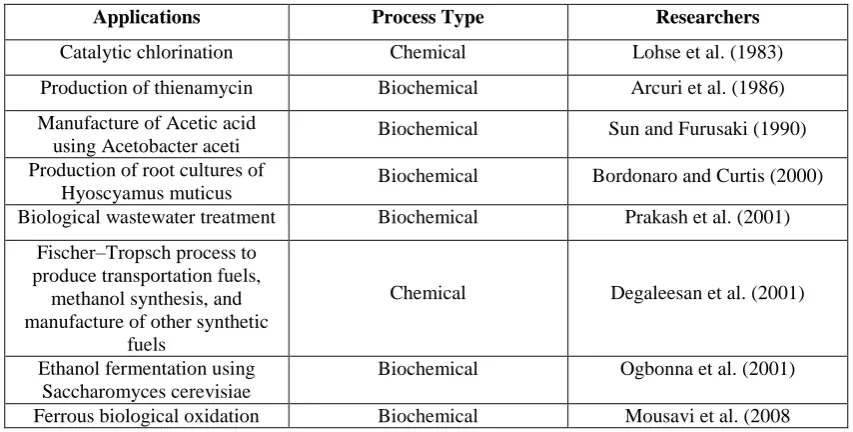
[image:20.595.106.533.418.634.2]In the industrial application based on manufacture of synthetic fuels by gas conversion processes and in biochemical processes such as fermentation and biological wastewater treatment and in chemical processes involving reactions such as oxidation, chlorination, alkylation, polymerization and hydrogenation, normally bubble column is the most appropriate equipment used (Prakash et al., 2001). Some very well-known chemical applications are the famous Fischer-Tropsch process which is the indirect coal liquefaction process to produce transportation fuels, methanol synthesis, and manufacture of other synthetic fuels which are environmentally much more advantages over petroleum derived fuels (Mahajan, 2010). The most important industrial application of bubble column in biochemical is the utilization of microorganism to produce products such as enzymes, proteins, antibiotics, etc (Kantarci et al., 2005).
Table 2.1:Some of the typical application of bubble column (Mahajan, 2010).
Applications Process Type Researchers
Catalytic chlorination Chemical Lohse et al. (1983) Production of thienamycin Biochemical Arcuri et al. (1986) Manufacture of Acetic acid
using Acetobacter aceti Biochemical Sun and Furusaki (1990) Production of root cultures of
Hyoscyamus muticus Biochemical Bordonaro and Curtis (2000) Biological wastewater treatment Biochemical Prakash et al. (2001)
Fischer–Tropsch process to produce transportation fuels, methanol synthesis, and manufacture of other synthetic
fuels
Chemical Degaleesan et al. (2001)
Ethanol fermentation using Saccharomyces cerevisiae
Biochemical Ogbonna et al. (2001)
2.3 Hydrodynamics and Operation of Bubble Column
2.3.1 Gas Hold-Up (Ɛg)
Gas hold-up plays an important role in the hydrodynamic parameters such as design, development, scale-up and troubleshooting of multiphase system. Gas hold-up is dimensionless key parameter for phenomena purposes of bubble column systems (Nader, 2008). Usually, it is known as the volume fraction of gas phase occupied by the gas bubbles (Shahimie, 2010). All studies examine gas holdup because it plays an important role in design and analysis of bubble columns. In the bubble column reactor, overall gas hold-up is used to characterize the hydrodynamics behaviour. It depends mainly on the gas velocity, physical properties of the liquid and type of gas sparger (Pirdashti & Kompany, 2009).
The variation in gas hold-up is the important thing in the gas-liquid phase, one of them is gas hold-up profile gives rise to pressure variation and thus liquid recirculation (Nader, 2008). Liquid recirculation is an important on mixing and heat and mass transfer predictions of radial gas hold up, it’s would lead to better understanding of this phenomenon to scale-up the bubble column (Nader, 2008).
2.3.1.1 Effect of Superficial Gas Velocity to Gas Hold-up
According to Moshtari et al., (2009), the homogeneous and regime occurs at low gas flow, while the heterogeneous regime at high gas flows. Based on their experimental result, the bubble size is small and uniform and bubble travel upwards in a helical path without any major collision or coalescence at superficial velocity. At 9 cm/s superficial gas velocity, all the bubble will large. The transition from homogeneous to heterogeneous regime is observed at a superficial gas velocity between 0.9 to 0.11 m/s (Moshtari et al., 2009). The measurement result of gas hold up at different superficial gas velocity, with differential pressure method is shown in the figure 2.1.
Figure 2.1: Effect of superficial gas velocity on gas holdup in air-water system (Moshtari et al., 2009)
Figure 2.2: Overall gas holdup (εg) versus superficial gas velocity (Usg) (Pirdashti & Kompany, 2009).
[image:23.595.203.437.478.705.2]Figure 2.3 show the result of gas holdup increases study by (Mahajan, 2010). The result indicated the gas holdup increases monotonically by increases the gas (air) velocity.
2.3.2 Axial Liquid Velocity
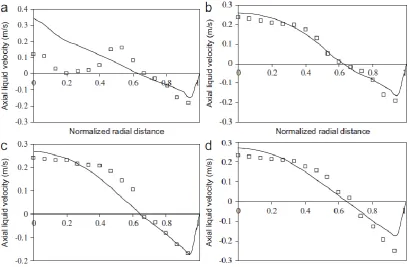
[image:24.595.121.532.255.522.2]The liquid flow and mixing behavior in bubble columns is partially described by means of global liquid recirculation velocity profile (Shahimie, 2010). According to Kulkarni et al., (2007), in the near sparger region, the mean axial liquid velocity profiles for the positive maximum velocities are seen only in the region and away from centre, where the fractional gas hold-up was also higher as shown in the figure 2.4.
Figure 2.4:Comparison between the simulated and experimental profiles of axial liquid velocity at different axial positions in a 150mm i.d. bubble column with a single point sparger at VG = 20 mm/s: (a) H/D = 0.5; (b) H/D = 2.5; (c) H/D = 3.4;
and (d) H/D = 4.6 (Kulkarni et al., 2007)
bubbles obtained by measurement liquid and bubble velocities in a bubble column (Shahimie, 2010). For the example, with increasing the superficial gas velocity, the axial liquid velocity becomes higher, and the correlation predicts the point of zero velocity well. To prediction the axial liquid velocity profile over arrange of conditions, the simulation technique can be used which help the process engineers should assess convective liquid mixing in bubble column rapidly.
2.3.3 Turbulent Kinetic Energy
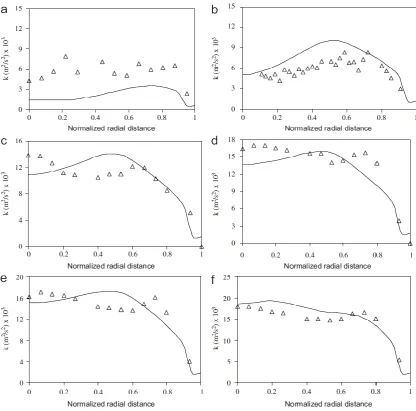
The energy exchange in the bubble column can occur from gas to liquid or vice versa. Understanding the energy transfer from phase to phase as well as internal energy within the phase is very important because the liquid circulation in the column depends on the energy balance (Shahimie, 2010). The potential energy is maximum when the bubble reaches the top of the liquid. The kinetic energy remains the same when the bubble rises at its constant slip velocity. The energy associated with a bubble decreases and the same amount is dissipated in friction (drag/inertia) between bubble and liquid during the rising process (Shahimie, 2010). Velocity rise and drag force increase will causing higher amount of energy released to the liquid at each stage as a result of increase in bubble volume. Turbulent kinetic energy can be estimated from the velocity–time series data with measurement the average of eddy energy values (Kulkarni et al., 2007).
Figure 2.5:Comparison between the simulated and experimental profiles of turbulent kinetic energy at different axial positions in a 150mm i.d. bubble column with multi-point sparger at VG = 20 mm/s: (a) H/D = 0.2; (b) H/D = 1.4; (c) H/D = 2.6; (d) H/D
= 3.9; (e) H/D = 5.0; and (f) H/D = 6.2 (Kulkarni et al., 2007).
2.4 Flow Pattern
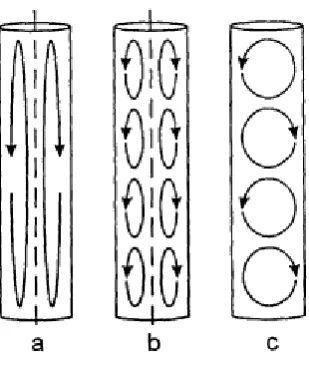
Figure 2.6: Liquid circulation patterns in bubble columns, a) large-scale overall circulation; b) donut-model of Joshi and Sharma (1979); c) circulation cells
according to Zehner (1986).
2.5 Hydrodynamics Regime
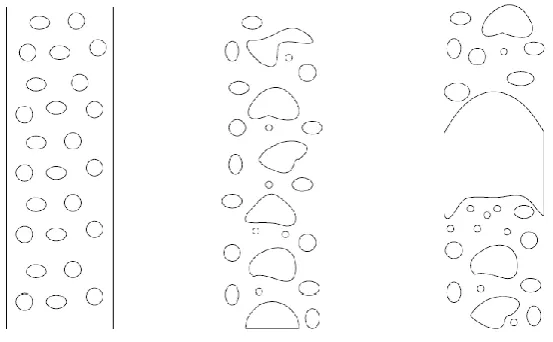
Basically, there have three types of flow regimes in the bubble column which are the homogeneous (bubbly flow) regime; the heterogeneous (churn-turbulent) regime and slug flow regime (Kantarci et al., 2005). These regimes largely depend on the superficial velocity, physicochemical properties of the gas–liquid system, sparger design (mainly the hole diameter), column diameter and also the column inclination (Kulkarni et al., 2007). The homogeneous regime is characterized by a narrow bubble size distribution and radially uniform void fraction distribution. The bubbles interaction is minor and liquid recirculation takes place in between the bubbles. If the gas flow rate is increased, the void fraction increases and the flow become unstable. Instead, the bubble size distribution widens and the radial void fraction distribution is not homogeneous anymore. The void fraction near the center of the bubble column is larger than the average void fraction, and large vortical structures appear with a size comparable to the column diameter. These large scale structures contribute to the large scale circulation in the bubble column with up flow in the center and down flow near the wall.
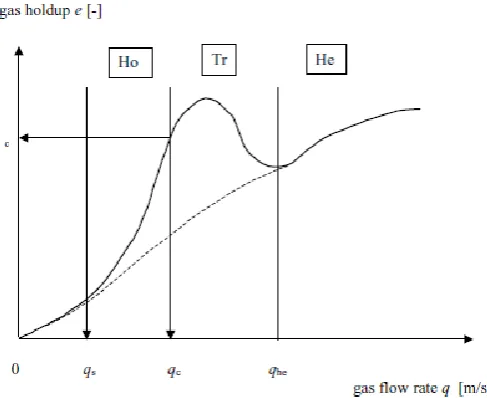
gas velocity. This regime of operation in a bubble column is called the homogeneous bubbly flow regime. The regime of operating for superficial gas velocity exceeding Utransition is commonly referred to as heterogeneous or churn turbulent regime (Moshtari et al., 2009). Homogeneous flow regime is obtained at low superficial gas velocities, approximately less than 5 cm/s in semi batch columns. This flow regime is characterized by bubbles of relatively uniform small sizes and rise velocities (Kantarci et al., 2005). The heterogeneous (churn-turbulent) regime exists for even higher gas throughput, when coalescence and breakup reach equilibrium. It is marked by a wide bubble size distribution. The bubble diameter can vary an order of magnitude. The degree of mixing in the flow is very strong (Harteveld, 2005). A slug flow regime has been only observed in small diameter laboratory columns at high gas flow rates. A slug flow means the formation of bubble slugs when larger bubbles are stabilized by the column wall (Kantarci et al., 2005). Figure 2.7 shows the three types of flow regime that has been observe by (Mahajan, 2010).
Figure 2.7: The flow regime observed in gas-liquid bubble column reactors: bubbly flow or homogeneous regime (left); heterogeneous regime (middle) and slug flow regime
(right) (Mahajan, 2010).
be observed clearly. The slug regime is highly unstable. It can be found when the superficial gas velocity is increased further. Based on Figure 2.9, the study by (Naji, 2010) also stated that another regime occur called as transition regime where gas holdup may go through a maximums.
Figure 2.8: Flow regime map for bubble columns (Kantarci et al., 2005)
Figure 2.9: Definition sketch of flow regimes in bubble column. Full line: Ho-homogeneous regime; Tr-transition regime; He-heterogeneous regime; qs-stable plate operation regime, beginning of homogeneous regime; qc-critical point, end of
[image:29.595.198.442.453.652.2]2.6 The Bubble Column Geometry and Parameter
The bubble columns geometry is important part that should not be careless in prediction of hydrodynamics and its influence on transport characteristics. In industrial applications, bubble columns usually designed with a length-to-diameter ratio (H/D) of at least 5. In biochemical applications this value usually varies between 2 and 5 (Kantarci et al., 2005). Even more, the use of large diameter reactors is desired because large gas throughputs are involved. Generally, the design and scale-up of bubble column reactors depend on the quantification of three main phenomena:
i. Heat and mass transfer characteristics ii. Mixing characteristics
iii. Chemical kinetics of the reacting system
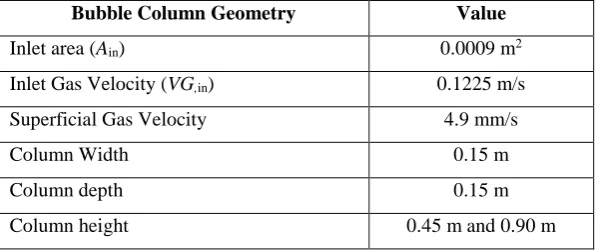
[image:30.595.171.469.545.670.2](Zhang et al., 2006), in their study on numerical simulation of the dynamic flow behavior in a bubble column, a water and air was used as a continuous liquid phase and dispersed gas phase. The gas-liquid flow is assumed to be homogeneous bubbly flow. They propose the bubble column geometry as follows.
Table 2.2: The bubble column geometry and parameter propose by (Zhang et al., 2006)
Bubble Column Geometry Value
Inlet area (Ain) 0.0009 m2
Inlet Gas Velocity (VG,in) 0.1225 m/s
Superficial Gas Velocity 4.9 mm/s
Column Width 0.15 m
Column depth 0.15 m
Column height 0.45 m and 0.90 m
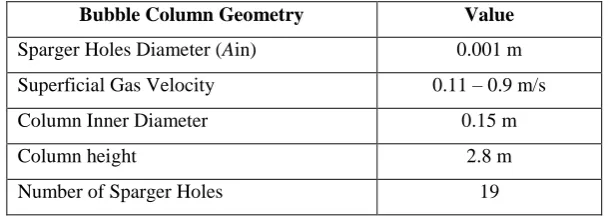
Table 2.3: The bubble column geometry and parameter propose by (Moshtari et al., 2009)
Bubble Column Geometry Value
Sparger Holes Diameter (Ain) 0.001 m Superficial Gas Velocity 0.11 – 0.9 m/s
Column Inner Diameter 0.15 m
Column height 2.8 m
Number of Sparger Holes 19
2.7 Sparger Design
Gas Sparger is important parameters to indicate the characteristic of bubble and indirectly affects gas hold up value. The sparger used to determines the bubble sizes observed in bubble columns. Basically, small orifices of diameter plate enable the formation of small bubble sizes. The common used gas sparger types in recent study are perforated plate, ring type, and porous plate. Regarding to the literature study by (Kantarci et al., 2005), stated that the smaller the bubbles, the greater of the gas hold up values. It can be concluded that with small gas distributors their gas hold up values were higher. Literature study of (Kantarci et al., 2005) also stated that gas holdup was found to be strongly affected by the type of gas distributor and another conclusion about the type of spargers was that the contributions of both small and large bubbles to gas velocity were lower with ring sparger as compared to the perforated plate.
However, Su & Heindel (2005) also stated that further increasing open area beyond a critical value by increasing the number of holes with a constant hole diameter enhances bubble coalescence near the aeration plate because of a reduced hole spacing; this leads to a reduction in gas holdup.
Figure 2.10: Gas distributor plates: (a) A=0.57%, (b) A=0.99%, and (c) A=2.14% (Su & Heindel, 2005)
[image:32.595.164.479.401.642.2]2.7.1 Effect of Sparger Geometry on the Distribution of Gas Holdup
The sparger geometry affects less the distribution of hold-ups when the superficial velocity rises (Haibo et al., 2006). According to (Su & Heindel, 2005) gas holdup increases with increasing plate open area or by increasing the number of holes. The ERT is a very powerful tool that used to diagnose the “inside” flow behavior, meanwhile in their study, the distribution of gas hold-up in the sparger region is mainly depend on the sparger design. Based on the previous study by (Su & Heindel, 2005), hole spacing play an important role at the inlet and directly influences the interfacial area and transport rate in bubble column reactor.
Figure 2.12 show the experimental equipment that has been setup by (JIN Haibo et al., 2006). They used the ERT sensors to diagnose the inside flow behavior. The sensors are place at 37 mm and 57 mm from air distributor.
(a) 37 mm from air distributor
[image:35.595.196.443.72.318.2](b) 57 mm from air distributor
2.7.2 Effect of Sparger Type on Gas Hold-up.
[image:36.595.161.480.190.386.2]According to B. Moshtari, E. Babakhani & J. Moghaddas (2009), in their experimental setup, they used perforated plate and porous plate with 0.1% porosity as shown in the figure 2.14.
Figure 2.14: Two sparger type are used in the experimental setup (Moshtari et al., 2009)
Figure 2.15: Effect of sparger types on gas hold up (Moshtari et al., 2009)
2.8 CFD Analysis
REFERENCES
Anil, M., Agarwal, V. K., Siraj Alam, M., & Wasewar, K. L. (2007). CFD modeling of three-phase bubble column: 1. study of flow pattern. Chemical and biochemical engineering quarterly, 21(3), 197-205.
Delnoij, E., Lammers, F. A., Kuipers, J. A. M., & Van Swaaij, W. P. M. (1997). Dynamic simulation of dispersed gas-liquid two-phase flow using a discrete bubble model. Chemical Engineering Science, 52(9), 1429-1458.
Harteveld, W. (n.d.).(2005). Bubble columns-structures or stability, 90-64642-26-5
Haibo, J. I. N., Wang, M., & Williams, R. A. (2006). The effect of sparger geometry on gas bubble flow behaviors using electrical resistance tomography. Chinese Journal of Chemical Engineering, 14(1), 127-131..
Kantarci, N., Borak, F., & Ulgen, K. O. (2005). Bubble column reactors. Process Biochemistry, 40(7), 2263-2283..
Kulkarni, A. A., Ekambara, K., & Joshi, J. B. (2007). On the development of flow pattern in a bubble column reactor: experiments and CFD. Chemical engineering science, 62(4), 1049-1072.
Mena, P. M. P. N. C. (2005). Mass transfer and hydrodynamics in multiphase systems (Doctoral dissertation, Universidade do Porto).
Shahimie, S. (2010). Modelling of hydrodynamics in heterogeneous. (Bachelor of chemical engineering, University Malaysia Pahang)
Moshtari, B., Babakhani, E. G., & Moghaddas, J. S. (2009). Experimental study of gas hold-up and bubble behavior in gas-liquid bubble column. Petroleum & Coal, 51(1), 27-32.
Nader, A. A. (2008). Simulation of Gas-to-Liquid ( GTL ) Process in Slurry Bubble Column Reactor (Master of science in chemical engineering, University of Technology)
Pirdashti, M., & Kompany, R. (2009). Effects of Height to Diameter Ratio and Aeration rate on Liquid Mixing and Hydrodynamic Properties in a Bubble Column. Iranian Journal of Chemical Engineering, 6(3), 47.
Su, X., & Heindel, T. J. (2005). Effect of perforated plate open area on gas holdup in rayon fiber suspensions. Journal of fluids engineering, 127(4), 816-823.
Xue, J., Al‐Dahhan, M., Dudukovic, M. P., & Mudde, R. F. (2008). Bubble velocity, size, and interfacial area measurements in a bubble column by four‐point optical probe. AIChE journal, 54(2), 350-363.
Yoshimura, H., Matsumura, H., Niwa, K., Nakamura, T., & Itoigawa, F. (2004). Study on Eco-Friendly Oil on Water Drop Metalworking Fluid (No. 2004-01-0789). SAE Technical Paper.
Zhang, D., Deen, N. G., & Kuipers, J. A. M. (2006). Numerical simulation of the dynamic flow behavior in a bubble column: a study of closures for turbulence and interface forces. Chemical Engineering Science, 61(23), 7593-7608.
Shaikh, A., & Al-Dahhan, M. H. (2007). A review on flow regime transition in bubble columns. International Journal of Chemical Reactor Engineering, 5(1).
Mahajan, V. (2010). CFD analysis of hydrodynamics and mass transfer of a gas-liquid bubble column (Doctoral dissertation, NATIONAL INSTITUTE OF TECHNOLOGY, ROURKELA).
Irani, M., & Khodagholi, M. A. (2011). Investigation of bubble column hydrodynamics using cfd simulation (2d and 3d) and experimental validation. Petroleum & coal, 53(2), 146-158.