International Journal of Emerging Technology and Advanced Engineering
Website: www.ijetae.com (ISSN 2250-2459,ISO 9001:2008 Certified Journal, Volume 3, Issue 4, April 2013)
364
A Fast Encryption Algorithm for Color Extended Visual
Cryptography
Anuprita Mande1, Manish Tibdewal2
1
Student, M.E. (4th Semester), Shri Sant Gajanan Maharaj College of Engineering, Shegaon
2
Associate Professor, Shri Sant Gajanan Maharaj College of Engineering, Shegaon
Abstract— Color visual cryptography (VC) encrypts a color secret image into n halftone image shares. The secret image can be recovered simply by stacking these shares together without any complex computations involved. The shares are very safe because separately they reveal nothing about the secret image. This paper introduces a faster and easier color visual cryptography encryption method that produces meaningful color shares via error diffusion halftoning. An error diffusion technique for halftoning produces shares which are more pleasant to human eyes. The algorithm proposed by this scheme reduces a considerable time for encryption and decryption in a much easier way. Comparisons with previous approaches show the superior performance of the new method.
Keywords—Color meaningful shares, digital halftoning, error diffusion, secret sharing, visual cryptography (VC).
I. INTRODUCTION
“Visual cryptography” was first proposed by Naor and Shamir which is also called as the “k-out-of-n visual secret sharing scheme” [1]. The major feature of this scheme is that the secret image can be decrypted simply by the human visual system without any complex computations. This scheme can hide the secret image in n distinct images called shares. The secret image can be revealed by simply stacking together as many as k of the shares. Each of the shares looks like a collection of random pixels and of course appears meaningless by itself. Any single share before being stacked up with the others, reveals nothing about the secret image. This way, the security level of the secret image can be effectively lifted up. VC scheme has been applied to many applications which include general access structures [2], copyright protection [3], watermarking [4], [5], visual authentication and identification [6], print and scan applications [7], etc.
To illustrate the basic principles of VC scheme, consider a simple (2, 2)-VC scheme in Fig. 1. Each pixel from a secret binary image is encoded into black and white subpixels in each share. If p is a white (black) pixel, one of the six columns is selected randomly with equal probability, to replace p.
Regardless of the value of the pixel p, it is replaced by a set of four subpixels, two of them are black and two white. Thus, the subpixel set gives no clue of the original value of
p. When two subpixels originating from two white p are superimposed, the decrypted subpixels have two white and two black pixels. On the other hand, a decrypted subpixel having four black pixels indicates that the subpixel came from two black p pixels.[1]
Fig. 2 shows an example of a simple (2, 2)-VC scheme with a set of subpixels shown in Fig. 1. Fig. 2(a) shows a secret binary message, Fig. 2(b) and (c) depicts encrypted shares for two participants. Superimposing these two shares leads to the output secret message as shown in Fig. 2(d). The decoded image is clearly identified, although some contrast loss is observed.
International Journal of Emerging Technology and Advanced Engineering
Website: www.ijetae.com (ISSN 2250-2459,ISO 9001:2008 Certified Journal, Volume 3, Issue 4, April 2013)
365 Visual secret sharing for color images was introduced by Naor and Shamir [16] based upon cover semigroups. Hou [12] in 2003 proposed schemes for color shares by applying halftone methods and color decomposition. Hou decomposed the secret color image into three (yellow, magenta and cyan) halftone images. All of the previously mentioned methods discuss color schemes for 2-out-of-2 or
2-out-of-n secret sharing where the reconstructed colors are interpreted by some mixing rules of colors.
Ching-Nung Yand and Tse-Shih Chen proposed a VC scheme for color images based upon an additive color mixing method [17]. In this scheme, each pixel is expanded by a factor of three. We found that this scheme suffers from the problem of pixel expansion in the size of encrypted shares. In order to reduce the size of encrypted shares a new VC scheme was proposed by Gonzalo R. Arce [18] for color visual cryptography which introduces Visual Information Pixel (VIP) synchronization to generate high quality shares. This paper has also introduced an error diffusion technique for generating halftone shares which are more pleasant to human eyes. However, the algorithm proposed by this scheme takes a long time for encryption and decryption.
In order to reduce the time required for encryption and decryption, a new VC scheme for color visual cryptography is proposed in this paper which provides a faster algorithm to generate the meaningful shares. This paper also uses error diffusion halftoning to generate the shares that are much pleasant to human eyes.
The paper is organized as follows: Section II provides preliminaries about standard VC, extended VC scheme, and the fundamentals of halftone techniques for easy understanding of the proposed VC method. Section III describes the proposed encryption algorithm to generate final shares. Section IV shows simulation results of the new scheme and we conclude this paper in Section V.
II. PRELIMINARIES
This section gives a brief description of VC, extended VC and an error diffusion halftoning.
A. Fundamentals of VC
Generally, a (k, n) VC scheme encrypts a secret message into n distinct shares. Each share shows noise-like random black and white patterns and does not reveal any information of the secret image by itself. In a k-out-of-n
scheme, access to more than k shares allows one to recover the secret image by stacking them together, but access to less than k shares is not sufficient for decryption. [1]
B. Extended VC
Generally, a (k, n)-Extended VC scheme takes a secret image and n original images as input and produces n
encrypted shares with approximation of original images that satisfy the following three conditions:
• Any k out of n shares can recover the secret image; • Any less than k shares cannot obtain any information of the secret image;
• All the shares are meaningful images; encrypted shares and the recovered secret image are colored. [13]
C. Error Diffusion
Error diffusion is a simple but efficient way to halftone a grayscale image. There are various error diffusion algorithms that are applied to halftone an image. This includes Floyd-Steinberg algorithm [19], Jarvis algorithm [20], Stucki algorithm [21], etc.
Fig.1. Construction of (2, 2) VC scheme
(a) (b)
(c) (d)
Fig.2. (a) Binary secret image (b) Encrypted share 1. (c) Encrypted share 2. (d) Decrypted secret message.
International Journal of Emerging Technology and Advanced Engineering
Website: www.ijetae.com (ISSN 2250-2459,ISO 9001:2008 Certified Journal, Volume 3, Issue 4, April 2013)
366 III. COLOR ENCRYPTION AND DECRYPTION
In this section, we describe the encryption method for color meaningful shares with the proposed scheme. First, we describe the process of halftoning with error diffusion method. We need to halftone the secret image as well as the share images ahead of the encryption stage. We then introduce the proposed encryption as well as decryption process.
A. Halftoning with error diffusion method
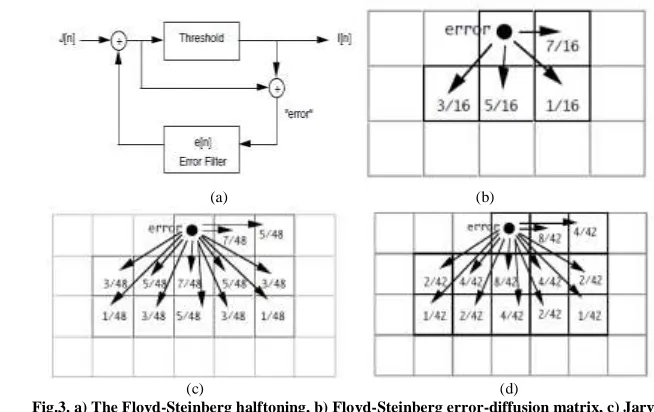
In this method of halftoning, the quantization error at each pixel is filtered and fed into a set of future inputs. Fig. 3(a) shows a binary error diffusion diagram where f(m,n)
represents the pixel at (m,n) position of the input image.
d(m,n) is the sum of the input pixel value and the diffused errors, g(m,n) is the output quantized pixel value. Error diffusion consists of two main components.
The first component is the thresholding block where the output g (m,n) is given by
𝑔 𝑚, 𝑛 = 1, 𝑖𝑓 𝑑 𝑚, 𝑛 ≥ 𝑡(𝑚, 𝑛)
0, 𝑜𝑡𝑒𝑟𝑤𝑖𝑠𝑒 (1)
The threshold t (m,n) can be position dependant. The second component is the error filter h (k,l) where the input e (m,n) is the difference between d (m,n) and g (m,n). Finally, we compute d (m,n) as
𝑑 𝑚, 𝑛 = 𝑓 𝑚, 𝑛 − 𝑘,𝑙 𝑘, 𝑙 𝑒(𝑚 − 𝑘, 𝑛 − 𝑙) (2)
Where 𝑘, 𝑙 ∈ 𝐻 and H is a 2-D error filter. A widely used filter is the error weight originally proposed by Floyd and Steinberg. [19]
(𝑘, 𝑙) = 1
16×
∎ 7
3 5 1 (3)
Where is the current processing pixel. The error filter is designed in such a way that the low frequency difference between the input and output image is minimized. The error that is diffused away by the error filter is high frequency or “blue noise” [14]. These features of error diffusion produce halftone images that are pleasant to human eyes with high visual quality. [18]
The process of error diffusion halftoning can be explained with an example of Floyd-Steinberg algorithm. Consider an n by m grayscale image. The boundary conditions are ignored. It is convenient to compute the output pixels in scan line order from upper left to lower right.
At every step, the algorithm compares the grayscale value of the current pixel J (i, j) which is represented by an integer between 0 and 255, to some threshold value (typically 128). If the grayscale value is greater than the threshold, the output pixel I (i, j) is considered black (value 0), else it is considered white (value 1). The difference between the pixel's original grayscale value and the threshold is considered as an error. Because we don't want to alter the already computed pixels, we spread this error intensity only to the pixels on the right, the right diagonal, the left diagonal and the bottom. The amount of error which is spread to each neighbor may be varied, but sending 3/8 of the error to the right and lower pixels and 1/8 to the two diagonal neighbors gives good results. Algorithm 1 given below illustrates the Floyd-Steinberg algorithm. The matrix shown graphically in Fig. 3(b) is an error-diffusion matrix proposed by Floyd and Steinberg [19].
Algorithm 1:
1. Procedure HALFTONING AN IMAGE 2. for i = 1,……,n do
3. for j = 1,…..,m do
4. if J(i, j) < 128 is found then J(i, j) = 0 5. else J(i, j) = 1
6. error = J[i, j] - I[i, j]*255
7. Distribute (3/8) error to the right pixel 8. Distribute (1/8) error to right diagonal pixel 9. Distribute (1/8) error to the bottom pixel 10. Distribute (3/8) error to the left diagonal pixel 11. end for
12. end for
International Journal of Emerging Technology and Advanced Engineering
Website: www.ijetae.com (ISSN 2250-2459,ISO 9001:2008 Certified Journal, Volume 3, Issue 4, April 2013)
367 Table 1 shows the comparison of all these algorithms with respect to perceived error and peak signal to noise ratio (PSNR). At this stage of the scheme, halftoning of the secret image as well as the share images is performed.
B. Declaration of shares
Two random shares S0 and S1 of size 256 × 256 are to be declared prior to the encryption. These shares are used for the encryption process.
C. Encryption process
The proposed encryption process starts with segmentation of the halftoned secret image. The halftoned secret image is partitioned into four segments. These segments also called as „message images‟ are to be interpolated to match with the size of halftoned share images. After interpolation, every pixel of the message image is verified for two values, „0‟ or „1‟. If the message pixel is „0‟, it is EX-ORed with share S0 otherwise EX-ORed with share S1 and the resultant pixel is stored.
D. Decryption Process
The decryption process is exactly reverse to that of the encryption process. The decrypted images are to be decimated to obtain the original message images. The four message images retrieved so are concatenated to obtain the secret image.
The complete algorithm of the proposed encryption method is given in algorithm 2.
Algorithm 2:
1. Procedure PROPOSED ENCRYPTION SCHEME 2. Read secret image
3. Perform halftoning of the secret image 4. Read share images
5. Perform halftoning of the share images
6. Perform partition of the secret image into four segments
7. Each segment is called as message image
8. Perform interpolation of each message image to match with the size of the share images
9. Declare two random shares S0 and S1 equal to the size 256 × 256
10. Do for Message image 1 of dimension n × m 11. for i = 1,……,n do
12. for j = 1,…..,m do
13. if M (i, j) = 0 is found then EX-OR M (i, j) with S (i, j) of share S0
14. else EX-OR M (i, j) with S (i, j) of share S1 15. End if
16. End for
17. Repeat step 11 to 16 for message images 2,3 and 4 18. Retrieve the message images from encrypted shares by
performing decryption
19. Decimate the decrypted message images to obtain the original message images
20. Concatenate the decimated message images to obtain the complete secret image
IV. SIMULATION RESULTS
In this section we will discuss the simulation results of the proposed encryption scheme. Fig. 5(a) shows the secret message of size 128×128 pixels which shows letters “U,” “D,” “E,” and “L” in red, green, blue and yellow, respectively. Fig. 5(b) to (e) shows “Lena,” “Baboon,” “Pepper,” and “Flower” of size 256×256 in natural colors for share generation. Fig. 6(a) shows the halftoned secret message of size 128×128 pixels. Fig. 6(b) to (e) shows halftoned share images “Lena,” “Baboon,” “Pepper,” and “Flower” of size 256×256. Fig. 7(a) to (d) shows the encrypted share images of size 256×256 by the proposed scheme. Fig. 7(e) shows the retrieved secret image.
We use two different metrics for visual quality comparison between the original images and the encrypted shares. First, we use the peak signal-to-noise ratio (PSNR) distortion measure. Second, we measure the visual quality of the encrypted shares using the perceived error method between the original images and the encrypted shares. The perceived error is the difference between perceived continuous-tone images and perceived halftone images calculated by employing an approximated human visual system (HVS) model [24]. Let f (m,n) be the continuous-tone image and f (x,y) be the continuous-tone image by an ideal printer. An ideal printer is one that can reproduce an ideal square pixel equal to that of the continuous-tone pixel. Likewise, let g [m,n] = 0 or 1 represent the halftone image. Then, the perceived halftone image 𝑔 (𝑥, 𝑦) is written as
𝑔 𝑥, 𝑦 = 𝑔 𝑚, 𝑛 𝑝
𝑚,𝑛
(𝑥 − 𝑚𝑋, 𝑦 − 𝑛𝑌)
and the perceived continuous-tone image is written as
𝑓 𝑥, 𝑦 = 𝑓(𝑥, 𝑦) ∗∗ (𝑥, 𝑦)
𝑓 𝑥, 𝑦 = 𝑓 𝑚, 𝑛 𝑝
𝑚,𝑛
(𝑥 − 𝑚𝑋, 𝑦 − 𝑛𝑌)
International Journal of Emerging Technology and Advanced Engineering
Website: www.ijetae.com (ISSN 2250-2459,ISO 9001:2008 Certified Journal, Volume 3, Issue 4, April 2013)
368 𝑝 𝑥, 𝑦 = 𝑟𝑒𝑐𝑡 𝑥|𝑋, 𝑦 𝑌
Above equation is the dot rendering function of an ideal printer. [18]
The perceived error between the continuous-tone image and the halftone image is given by
𝑒 𝑥, 𝑦 = 𝑔 𝑥, 𝑦 − 𝑓 𝑥, 𝑦
Table 2 gives the comparison of Perceived error of the secret image as well as the share images using the proposed encryption algorithm for (2, 2), (4, 4) and (8, 8) shares. Table 3 gives the comparison of PSNR of the secret image as well as the share images using the proposed encryption algorithm for (2, 2), (4, 4) and (8, 8) shares.
(a) (b)
(c) (d)
[image:5.612.123.450.249.455.2]Fig.3. a) The Floyd-Steinberg halftoning, b) Floyd-Steinberg error-diffusion matrix, c) Jarvis error-diffusion matrix, d) Stucki error-diffusion matrix,
Fig.4 Flowchart of Error diffusion halftoning
Fig. 4. Flowchart of Error Diffusion halftoning
(a) (b) (c) (d) (e)
[image:5.612.124.500.488.580.2]International Journal of Emerging Technology and Advanced Engineering
Website: www.ijetae.com (ISSN 2250-2459,ISO 9001:2008 Certified Journal, Volume 3, Issue 4, April 2013)
369 V. CONCLUSION
[image:6.612.97.537.154.253.2]This paper develops a faster and easier encryption method to construct a color VC scheme with error diffusion halftoning. An error diffusion halftoning is used to construct the shares such that the noise introduced by the preset pixels is diffused away to the neighbors. This improves the visual quality of the encrypted shares as well as the decrypted secret image. From Table 1 we can observe that Stucki algorithm gives maximum PSNR and minimum perceived error. Hence, we can conclude that Stucki algorithm is best suited for the proposed VC scheme. The proposed encryption method provides easy way of encryption as well as decryption by simple EX-OR operations. It also takes less time i.e. only 7.552531 seconds to perform encryption and decryption. This time is very much less as compared to the previous methods. From Table 2 we can conclude that, if we increase the number of shares to hide the secret image, the amount of perceived error decreases. It is minimum i.e. 2175759 for (8, 8) VC scheme. However, it is observed from Table 3 that, PSNR also decreases with the increase in the number of shares, which is not desirable.
(a) (b) (c) (d) (e)
Fig.6. (a) Halftoned secret image of size 128 × 128, (b) to (e) Halftoned shares using error diffusion with the Floyd and Steinberg error filter; Lena, Baboon, Pepper and Flower respectively of size 256 × 256
[image:6.612.104.538.298.399.2](a) (b) (c) (d) (e)
Fig.7. Experimental results of (4, 4)-proposed CEVC scheme. (a) to (d) Encrypted Shares of proposed VC scheme. (e) Decrypted message from shares (a) and (d) of (4, 4)-proposed VC scheme
TABLE 1
PERCEIVED ERROR AND PSNR FOR ALL THE HALFTONING ALGORITHMS
Type of halftoning Algorithm Perceived
Error
PSNR
Original Floyd-Steinberg algorithm 4213223 18.2995
Modified Floyd-Steinberg algorithm
4.2132e+006 18.2995
Jarvis algorithm 4206273 18.2975 Stucki algorithm 4.2019e+006 18.3104
TABLE 2
PERCEIVED ERROR FOR PROPOSED ENCRYPTION ALGORITHM
Image(s) Perceived Error
2 Shares 4 Shares 8 Shares Secret Image 545799 5.4527e+005 2175759 Lena 8.3063e+006 8306336 8.3063e+006 Baboon 8.2697e+006 8.2697e+006 8.2697e+006
Pepper 7.2407e+006 7.2404e+006
Flower 5.4748e+006 5.4740e+006
Sunset 5.4837e+006
Mixed Fruit 6.8041e+006
Apple 1.1116e+007
International Journal of Emerging Technology and Advanced Engineering
Website: www.ijetae.com (ISSN 2250-2459,ISO 9001:2008 Certified Journal, Volume 3, Issue 4, April 2013)
370 REFERENCE
[1] M. Naor And A. Shamir, “Visual Cryptography,” In Proc. Eurocrypt, 1994, Pp. 1–12.
[2] G. Ateniese, C. Blundo, A. D. Santis, And D. R. Stinson, “Visual Cryptography For General Access Structures,” Inf. Comput., Vol. 129, No. 2, Pp. 86–106, 1996.
[3] A. Houmansadr And S. Ghaemmaghami, “A Novel Video Watermarking Method Using Visual Cryptography,” In Proc. Ieee Int. Conf. Eng. Intell. Syst., 2006, Pp. 1–5.
[4] M. S. Fu And O. C. Au, “Joint Visual Cryptography And Watermarking,” In Proc. Ieee Int. Conf. Multimedia Expo, 2004, Pp. 975–978.
[5] C. S. Hsu And Y. C. Hou, “Copyright Protection Scheme For Digital Images Using Visual Cryptography And Sampling Methods,” Opt. Eng., Vol. 44, P. 077003, 2005.
[6] M. Naor And B. Pinkas, “Visual Authentication And Identification,” Adv. Cryptol., Vol. 1294, Pp. 322–336, 1997.
[7] W. Q. Y, J. Duo, And M. Kankanhalli, “Visual Cryptography For Print And Scan Applications,” In Proc. Ieee Int. Symp. Circuits Syst., 2004, Pp. 572–575.
[8] L. A. Macpherson, “Gray Level Visual Cryptography For General Access Structrue,” M. Eng. Thesis, Univ. Waterloo, Ontario, Canada, 2000.
[9] C. Blundo, A. D. Santis, And M. Naor, “Visual Cryptography For Grey Level Images,” Inf. Process. Lett, Vol. 75, No. 6, Pp. 255–259, 2000.
[10] Y. T. Hsu And L. W. Chang, “A New Construction Algorithm Of Visual Crytography For Gray Level Images,” In Proc. Ieee Int. Symp. Circuits Syst., 2006, Pp. 1430–1433.
[11] C. C. Lin And W. H. Tsai, “Visual Cryptography For Gray-Level Images By Dithering Techniques,” Pattern Recognit. Lett., Vol. 24, Pp. 349–358, 2003.
[12] Y. C. Hou, “Visual Cryptography For Color Images,” Pattern Recognit., Vol. 36, Pp. 1619–1629, 2003.
[13] G. Ateniese, C. Blundo, A. Santis, And D. R. Stinson, “Extended Capabilities For Visual Cryptography,” Acm Theor. Comput. Sci., Vol. 250, Pp. 143–161, 2001.
[14] Z. Zhou, G. R. Arce, And G. D. Crescenzo, “Halftone Visual Cryptography,” Ieee Trans. Image Process., Vol. 18, No. 8, Pp. 2441–2453, Aug. 2006.
[15] Z. M. Wang, G. R. Arce, and G. Di Crescenzo, “Halftone visual cryptography via error diffusion,” IEEE Trans. Inf. Forensics Security, vol. 4, no. 3, pp. 383–396, Sep. 2009.
[16] M. Naor And A. Shamir, “Visual Cryptography Ii: Improving The Contrast Via The Cover Base,” Lect. Notes Comput. Sci., Vol. 1189, Pp. 197–202, 1997.
[17] C. N. Yang and T. S. Chen, “Visual cryptography scheme based on additive color mixing,” Pattern Recognit., vol. 41, pp. 3114–3129, 2008.
[18] Gonzalo R. Arce, Color Extended Visual Cryptography Using Error Diffusion Ieee Transactions On Image Processing, Vol. 20, No. 1, January 2011
[19] Robert W. Floyd And Louis Steinberg, An Adaptive Algorithm For Spatial Grayscale. Proceedings Of The Society For Information Display 17 (2) 75-77, 1976
[20] J. F. Jarvis, C. N. Judice And W. H. Ninke, A Survey Of Techniques For The Display Of Continuous Tone Pictures On Bi-Level Displays. Computer Graphics And Image Processing, 5 13-40, 1976
[21] P. Stucki, Mecca - A Multiple Error Correcting Computation Algorithm For Bi-Level Image Hard Copy Reproduction. Research Report Rz1060, Ibm Research Laboratory, Zurich, Switzerland, 1981.
[22] Panagiotis Takis Metaxas- Parallel Digital Halftoning By Error-Diffusion
[23] Haibo Zhang, Xiaofei Wang, Wanhua Cao and Youpeng Huang, “Visual Cryptography for General Access Structure Using Pixel-block Aware Encoding”, Journal Of Computers, Vol. 3, No. 12, December 2008
[24] S. H. Kim and J. P. Allebach, “Impact of hvs models on model-based halftoning,” IEEE Trans. Image Process., vol. 11, no. 3, pp. 258–269, Mar. 2002.
Anuprita U. Mande received the B.E. degree in Electronics & Telecomm. Engineering in 2002. Now, she is a student of 4th Semester M.E. in Shri Sant Gajanan Maharaj College of Engineering, Shegaon, Maharashtra, India.
Manish N. Tibdewal received the B.E. Industrial Electronics Engg. degree in 1990 and M.E. Electronics Engineering degree, from Amravati University,Amravati, Maharashtra, India, in 2001. Presently, he is working as an Associate Professor with Electronics and Telecommunication Engineering Department in Shri Sant Gajanan Maharaj College of Engineering, SHEGAON, Maharashtra, India.
He is currently working toward the Ph.D. degree in Biomedical Neuro-Signal and Image Analysis and processing in School of Medical Science and Technology, Indian Institute of Technology, Kharagpur,W.B., India. He is a student member of IEEE and life member of ISTE and IETE. He is co-opted as an executive member of IETE Centre Amravati, Maharashtra,India.
TABLE 3
PSNR FOR PROPOSED ENCRYPTION ALGORITHM
Image(s) PSNR
2 Shares 4 Shares 8 Shares Secret Image 23.2554 23.2747 22.7850
Lena 12.0650 12.0651 12.0640 Baboon 12.5358 12.5359 12.5349
Pepper 13.7787 13.7778
Flower 15.7006 15.6995
Sunset 16.8809
Mixed Fruit 14.0239
Apple 5.7146
International Journal of Emerging Technology and Advanced Engineering
Website: www.ijetae.com (ISSN 2250-2459,ISO 9001:2008 Certified Journal, Volume 3, Issue 4, April 2013)
371