Understanding mediumsized cities
Hildreth, PA
Title
Understanding mediumsized cities
Authors
Hildreth, PA
Type
Article
URL
This version is available at: http://usir.salford.ac.uk/17574/
Published Date
2007
USIR is a digital collection of the research output of the University of Salford. Where copyright
permits, full text material held in the repository is made freely available online and can be read,
downloaded and copied for noncommercial private study or research purposes. Please check the
manuscript for any further copyright restrictions.
This article addresses two questions.1How can differences in the economic role and performance of English medium-sized cities be explained? And does understanding these differences offer insight into the reasons for disparities in economic performance between the English regions?2
Why medium-sized cities are important In England, medium-sized cites have received far less urban policy attention than London and the eight ‘core cities’.3This has been a product of the
recognition that large cities, as centres for advanced information and producer services, offer developed countries their best opportunity to keep ahead in an increasingly competitive global economy.
However, medium-sized cities are important to both regional and national economies. They are where a significant proportion of England’s population live and work. They also offer a distinctive insight into the state of regional economies in ways that the larger cities do not.
Unlike the treatment of capital and high-profile large cities,4medium-sized cities cannot be approached as stand-alone places. They do not operate like islands surrounded by open sea. They sit within a wider regional and national urban hierarchy. Their success in attracting and retaining firms and workers, and generating jobs, relates to the inter-dependencies that exist between them and the economies of other cities and areas around them.
This is why the functional city– defined by the ways people live their lives and how the economy operates between a city and the towns and area surrounding it – is the best way of understanding
medium-sized cities. It is a dynamic concept expressed in terms of connections and flows between cities and the towns and areas that surround them – from home to work, from home to shop and (in housing moves) from home to home – and also concerning the way businesses relate to their customers and suppliers.5
Medium-sized cities do not perform as a single type. Unlike large cities they do not usually offer urbanisation economies (i.e. economic advantages from larger market size and labour markets and knowledge exchange across the whole urban area). Medium-sized cities offer more localised economies within the industries in which they specialise. Consequently, while large cities will tend to develop sectoral strengths in advanced producer services, medium-sized cities tend to be more diverse in their specialist sectoral composition.
As a result, medium-sized cities perform different roles within the urban hierarchy, and these roles may change over time. They do not operate on a level playing field in their access to labour, firms and other key assets of the modern knowledge economy. They also vary significantly in their economic roles and performance.
The questions with which this article opened are therefore highly pertinent to the debate around the significance of ‘cities’ within the current HM Treasury driven sub-national economic development policy review. A growing interest in ‘functional cities’ is reflected in recent Government publications. For example, the HM Treasury led Devolved Decision Making 36acknowledges cities as drivers of regional economies; and the Local Government White Paper
understanding
medium-sized
cities
Paul Hildreth
applies a typology of key characteristics to examine
Hull, Grimsby emphasised ‘place-shaping’ across, as well as within, local authority boundaries.
Developing a typology for medium-sized cities
The cities chosen to explore the research questions were those studied in the State of the English Cities report (from which the data on these cities were also taken).7This report covered 56 ‘Primary Urban
Areas’8with populations over 125,000. Having
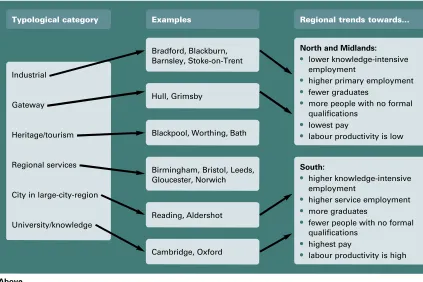
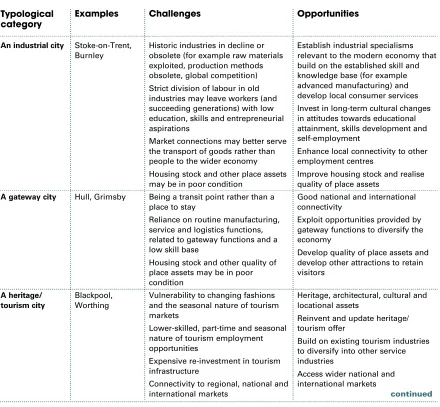
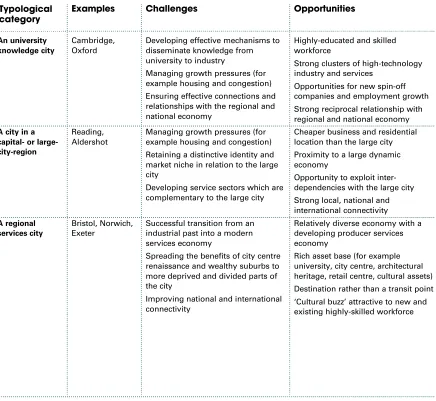
excluded London and the eight core cities (as large cities), the typology was tested on the remaining 47 Primary Urban Areas in two ways. First, the 47 cities were allocated to a typological category and tested in relation to key economic variables. The outcomes are illustrated in Fig. 1. Second, this analysis was followed up with interviews with city local authorities to further test the findings. The results of the interviews and data analysis are brought together in Table 1.
A typology invariably involves simplification. The allocation of cities to categories was based on their perceived dominant characteristics. However, this approach has limitations in that many medium-sized cities have characteristics of two or more categories, so some of the allocations might be subject to debate. And while a typology can improve the understanding of a city’s current position and possible future strategy, it cannot explain all the unique variations among cities.
The typological categories were:
• an industrial city– a city that historically developed around one or more dominant industrial sectors as a consequence of physical geographic advantages or proximity to raw materials;
• a gateway city– a city that provides connections for goods and/or people to the international economy (for example the location of a port or airport);
• a heritage/tourism city– a city that attracts national and/or international visitors owing to its
advantageous position (a coastal location, for example), its natural assets or its historical, cultural and architectural heritage;
• a university knowledge city– a city that contains a leading university with expertise in science and technology and the capacity to promote innovation and clusters of spin-off companies in the local economy;
• a city in a capital- or large-city-region– a city that benefits from its physical connection to a capital- or large-city-region, by specialising in complementary knowledge-intensive industries that give the larger city its comparative advantage in the national or global economy; and
• a regional services city– a city that historically has grown through supplying employment
opportunities and retail and other services to its wider region.
Industrial
Gateway
Heritage/tourism
Regional services
City in large-city-region
University/knowledge
Bradford, Blackburn, Barnsley, Stoke-on-Trent
Blackpool, Worthing, Bath
Birmingham, Bristol, Leeds, Gloucester, Norwich
Reading, Aldershot
Cambridge, Oxford
North and Midlands:
• lower knowledge-intensive employment
• higher primary employment • fewer graduates
• more people with no formal qualifications
• lowest pay
• labour productivity is low
South:
• higher knowledge-intensive employment
• higher service employment • more graduates
• fewer people with no formal qualifications
• highest pay
• labour productivity is high
[image:3.499.31.454.354.636.2]Examples of key economic challenges and opportunities identified within each of these typologies is summarised in Table 1. Overall, these reveal marked structural differences in the economic role and performance of English medium-sized cities, as shown in Fig. 1. These in turn reflect regional economic differences.
‘While medium-sized cities in
the South East and London
operate as an inter-dependent
network, no such mechanism
operates in the North. As a
result, many of the northern
industrial cities are not deriving
as much direct benefit from
the revival of the northern
core cities as they might’
For example, industrial and gateway cities were heavily concentrated in the North and the Midlands and consistently had characteristics of weaker economies. These included higher secondary employment, more people with no formal qualifications and lower skills, lower proportions of graduates, lower knowledge-intensive employment and lower labour productivity. By comparison, university knowledge cities and cities in large-city-regions had mirror-opposite
characteristics of stronger economies: higher service employment, fewer people with no formal
qualifications, more graduates, higher knowledge-intensive employment and higher labour productivity.
Why there are differences in economic performance and roles
There are a number of factors that work in an inter-related way to underline differences in the economic role and performance of English medium-sized cities:
• History matters: A city’s economic purpose and industrial structure was shaped by the interaction of locational advantages and economic and social forces. Its future development is ‘path dependent’ in that its current assets will influence future possibilities. For some cities, such as Blackpool, this leaves little option but to re-invent their present specialism. For others, such as most industrial cities, it limits their range of future options. The risk for industrial and gateway cities is that the
performance gap may widen compared with cities that are better positioned to adapt within the knowledge economy. University knowledge cities and cities within a large dynamic city-region (such as the London mega-city-region) are best placed, given their stronger knowledge assets and strong
inter-dependent supportive relationships with other cities.
• Industrial sectors and specialisation:Different cities have different industrial specialisations. In the current economic context the UK has competitive knowledge advantages in three broad areas: advanced producer services, advanced
manufacturing, and consumer services. Advanced producer services are the main drivers of post-industrial Western economies,9but, as already
indicated, they are most likely to be found in large cities and in the smaller cities with which they have strong inter-dependent relationships (i.e. university knowledge, regional services cities and cities in a large dynamic city-region). Other cities (industrial, gateway and specialist heritage/tourism cities) will need to take a different path, building specialisms more appropriately suited to their historical and locational strengths in advanced manufacturing or consumer services.
• Connectivity: Being well-connected regionally, nationally and internationally matters in the modern global economy. Being well-placed for connections between people is more important than being centrally located for the transport of physical goods. Improvements in technology have made face-to-face contact more, not less important.10
Internationally, improved capacity to communicate electronically (for example by e-mail, conference calls or video conferencing) has actually created increased demand for business meetings and travel. And while technology has revolutionised the speed of travel, cost reductions have been more than offset by increases in opportunity costs (through rising real wages) of time spent travelling.
• Knowledge assets:Cities that are a key location for knowledge-based industries and services are at a considerable advantage in the modern economy. The most successful cities combine being a centre for innovation, a highly-educated workforce, advantageous locations for face-to-face contact and networks for imparting ‘tacit knowledge’, as well as excellent connectivity into the global economy.
• Functionality of place:A high-quality built
environment is a significant asset for medium-sized cities. Various forces influence the physical layout of cities, including the decision of firms, individuals and civic authorities. Ideas and fashions in
factor in explaining the city’s weaker economic performance.
• City networks and inter-dependence: City economies are inter-dependent. As a result, most medium-sized cities are not viable as independent economic development units. It makes sense for them to seek to collaborate with other places within their functional economy, rather than narrowly focus within restrictive administrative boundaries.
Key conclusions
The application of a city typology has illustrated a
and medium-sized cities in the Greater South East.
Given the increasing importance of the knowledge-based economy, it is likely that markets will reinforce differences in performance rather than narrow them over time. While medium-sized cities in the South East and London operate as an inter-dependent network, helping to spread economic benefits across the region, no such mechanism operates in the North. As a result, many of the northern industrial cities are not deriving as much direct benefit from the revival of the northern core cities as they might. Co-operation between cities in the North needs to foster
Examples Challenges Opportunities
An industrial city
A gateway city
A heritage/ tourism city
Stoke-on-Trent, Burnley
Hull, Grimsby
Blackpool, Worthing
Historic industries in decline or obsolete (for example raw materials exploited, production methods obsolete, global competition) Strict division of labour in old industries may leave workers (and succeeding generations) with low education, skills and entrepreneurial aspirations
Market connections may better serve the transport of goods rather than people to the wider economy Housing stock and other place assets may be in poor condition
Being a transit point rather than a place to stay
Reliance on routine manufacturing, service and logistics functions, related to gateway functions and a low skill base
Housing stock and other quality of place assets may be in poor condition
Vulnerability to changing fashions and the seasonal nature of tourism markets
Lower-skilled, part-time and seasonal nature of tourism employment opportunities
Expensive re-investment in tourism infrastructure
Connectivity to regional, national and international markets
Establish industrial specialisms relevant to the modern economy that build on the established skill and knowledge base (for example advanced manufacturing) and develop local consumer services Invest in long-term cultural changes in attitudes towards educational attainment, skills development and self-employment
Enhance local connectivity to other employment centres
Improve housing stock and realise quality of place assets
Good national and international connectivity
Exploit opportunities provided by gateway functions to diversify the economy
Develop quality of place assets and develop other attractions to retain visitors
Heritage, architectural, cultural and locational assets
Reinvent and update heritage/ tourism offer
Build on existing tourism industries to diversify into other service industries
Access wider national and international markets
continued
[image:5.499.28.468.65.472.2]Typological category
Table 1
take into account more fully than it does at present the significant structural differences that exist among cities and regions in the English economy.
• Paul Hildrethis Visiting Policy Fellow at the Centre for Sustainable Urban and Regional Futures (SURF), Salford University, and an Advisor on Cities and Regional Economic Policy to the Department for Communities and Local Government. The views expressed in this article are the personal views of the author alone.
Notes
1 This article is based on a longer paper by the author which is available at www.surf.salford.ac.uk
2 The idea of answering these questions arose from a research project commissioned by the OECD and the Regional School of Public Administration of Galicia, Spain 3 Birmingham, Bristol, Leeds, Liverpool, Manchester,
Newcastle upon Tyne, Nottingham and Sheffield
4 For example, see M. Parkinson et al.: Competitive European Cities: Where Do the Core Cities Stand? ODPM, 2004 5 A. Harding, S. Marvin and B. Robson: A Framework for
City-Regions. ODPM, 2006. Available at www.communities.gov.uk
6 Devolving Decision Making: 3 – Meeting the Regional Economic Challenge: The Importance of Cities to Regional Growth. HM Treasury, DTI, ODPM, 2006
7 M. Parkinson et al.: State of the English Cities. ODPM, 2006 8 ‘Primary Urban Areas’ were the primary unit of analysis of
the State of the English Citiesreport. PUA boundaries seldom align with political or administrative boundaries. They are normally bigger than local authority areas and frequently contain several of them. PUAs are closest to the metropolitan city definition described in this article (i.e. the ‘functional city’) 9 P. Hall: ‘A new geography of Britain?’. Town & Country
Planning, 2006, Vol. 75, Nov., pp.304-8
10 P. Hall and K. Pain (Eds): The Polycentric Metropolis: Learning from Mega-City Regions in Europe. Earthscan Publications, 2006
Examples Opportunities
An university knowledge city
A city in a capital- or large-city-region
A regional services city
Cambridge, Oxford
Reading, Aldershot
Bristol, Norwich, Exeter
[image:6.499.37.473.70.471.2]Typological category
Table 1 continued
A typology of medium-sized cities
Developing effective mechanisms to disseminate knowledge from university to industry
Managing growth pressures (for example housing and congestion) Ensuring effective connections and relationships with the regional and national economy
Managing growth pressures (for example housing and congestion) Retaining a distinctive identity and market niche in relation to the large city
Developing service sectors which are complementary to the large city
Successful transition from an industrial past into a modern services economy
Spreading the benefits of city centre renaissance and wealthy suburbs to more deprived and divided parts of the city
Improving national and international connectivity
Highly-educated and skilled workforce
Strong clusters of high-technology industry and services
Opportunities for new spin-off companies and employment growth Strong reciprocal relationship with regional and national economy Cheaper business and residential location than the large city Proximity to a large dynamic economy
Opportunity to exploit inter-dependencies with the large city Strong local, national and international connectivity
Relatively diverse economy with a developing producer services economy
Rich asset base (for example university, city centre, architectural heritage, retail centre, cultural assets) Destination rather than a transit point ‘Cultural buzz’ attractive to new and existing highly-skilled workforce