Research Article
CODEN(USA) : JCPRC5
ISSN : 0975-7384
235
The Utilization of Black Nightshade (Solanum nigrum L.) Fruit in Fermented
Beverage
Yuniwaty Halim
1*, Nadia Catherine Prima Onasie
1and CC Nurwitri
21Department of Food Technology, Universitas Pelita Harapan, Jl. M. H. Thamrin Boulevard, Indonesia 2Department of Food Science and Technology, Bogor Agricultural University, Bogor, Indonesia
_____________________________________________________________________________
ABSTRACT
The black nightshade (Solanum nigrumL.), which is commonly known as leunca in Indonesia, has been acclaimed for its medicinal effects. Due to its limited use, a processing method to utilize black nightshade into a product that has better functional properties must be studied. This research was aimed to utilize the black nightshade (Solanum nigrumL.) juice in the making of fermented beverage. The black nightshade juice was made with two different pretreatments (no blanching, water blanching at 80ºC for 3.3 minutes) and three different ratios of fruit and water (1:1, 1:2, 1:3). Ranking test was conducted by 80 untrained panelists to determine the most preferred juice. The juice with blanching pretreatment and 1:2 ratio of fruit and water was chosen as the most preferred juice. The black nightshade fermented beverage was made with three different sugar concentrations (10%, 12.5%, 15%) and observed twice a week for 21 days. The black nightshade fermented beverage was analyzed for its antioxidant activity, alcohol content, total titratable acidity, and total dissolved solids. The highest antioxidant activity was obtained from black nightshade fermented beverage which was added with 10% sugar concentration after 14 days of fermentation, i.e. 304.1918 ± 0.5026 mg/L .
Keywords: Antioxidant; Black nightshade; Fermentation; Black nightshade fermented beverage
_____________________________________________________________________________
INTRODUCTION
The black nightshade (Solanum nigrum L.) is a plant that belongs to Solanaceaefamily. In Indonesia, it is commonly known as “leunca”. In some parts of the world, including Europe and North America, the black nightshades are considered as weeds in agriculture. It is different with other countries, including Australia, Uganda, Ethiopia, Nigeria, and Indonesia, where the black nightshades are sometimes used as leafy herbs, vegetables, and fruits [1,2]. The black nightshade has been acclaimed for its medicinal effects. It has antioxidant activity [1] anticancer activity [3], antitumor activity [1,4], and anti-convulsion activity [1,4]. However, the utilization of the black nightshade is still rare due to less information about the presence of the plant and the bitter taste produced. In Indonesia, there are only some people who consume the fruits either raw (lalapan) or being added to chili paste or oncom (fermented food from soybean). Fermentation has been known and applied since prehistoric times even when the scientific principles have not been understood yet. Fermentation is one of the oldest methods of food processing [5]. A variety of fermented foods gain their popularity among the consumers due to their attractive flavor and nutritional value. The safety of the fermented food can be increased because fermentation can remove food’s natural toxic components or prevent the growth of disease-causing microbes.
236
EXPERIMENTAL SECTION
Materials
Materials used for producing the black nightshade fermented beverage were black nightshade fruits (Solanum nigrum L.) obtained from Pasar Anyar (Tangerang, Indonesia), water, sucrose, citric acid and “Fermipan” instant yeast. Equipment used for producing and analyzing the black nightshade fermented beverage were glasswares, thermometer, blender, filtered cloth, pH meter, glass bottle, autoclave, “Memmert” water bath, plastic pipe, clay dough, “Minolta CR-400” chroma meter, disposable Petri dish, “Barnstead Turner” UV-Vis spectrophotometer, pycnometer, “Buchi” distillation unit, and “ATAGO” hand-held refractometer.
Research Methods
The research method used was experimental methods with blanching method (no blanching, water blanching at 80ºC for 3.3 minutes) and ratio of fruit and water (1:1, 1:2, 1:3) as treatments on the preliminary research. On the main research, fermentation time (0, 3, 7, 10, 14, 17 and 21 days) and sugar concentration (10%, 12.5% and 15%) were used as the treatments.
Preparation of Black Nightshade Juice
Black nightshade juice was prepared by first sorting and washing the fruits with clean water. There were two different pretreatments applied to the cleaned fruits. The first treatment was the cleaned fruits were blanched using water at 80°C for 3.3 minutes [6]. While the second treatment was the cleaned fruits went directly to the next step, which was addition of water. There were three kinds of ratio of fruit and water (amount of fruit : amount of water), which were 1:1, 1:2 and 1:3. The fruits and the water added were mixed using blender, and then the mixture was filtrated using filter cloth. The filtrate obtained was called the black nightshade juice. The juice obtained was analyzed organoleptically using ranking test method which was conducted by 80 untrained panelists based on the preference of the samples(1=most acceptable, 6=least acceptable) [7,8]. The total juice samples were six, with different pretreatment (no blanching, water blanching at 80ºC for 3.3 minutes) and ratio of fruit and water (1:1, 1:2, 1:3).
Preparation of Black Nightshade Fermented Beverage
Based on the ranking test performed before, the most preferred black nightshade juice was the black nightshade juice with the blanching method as the pretreatment and 1:2 ratio of fruit and water. Therefore, this result was then used as the method to prepare the black nightshade juice before it was fermented. The procedure to make the black nightshade fermented beverage started with the addition of three different concentrations of sugar, which were 10%, 12.5%, and 15%, to the black nightshade juice. The mixture was mixed and adjusted to reach pH 4 with the addition of citric acid. Then, the mixture was transferred into several sterilized bottles in an aseptic condition and the mixture was then Pasteurized at 65ºC for 15 minutes. After that, the “Fermipan” instant yeast was added into the mixture in an aseptic condition.4 mL of 0.12 g/mL instant yeast was added to provide 107 cells/mL. This is because the suitable amount of yeast for alcoholic fermentation was 107 cells/mL [5]. The fermentation was done anaerobicallyat room temperature for 21 days. Observation was done twice a week with the range of 3-4 days. After the fermentation was done, the mixturewas filtered using filter cloth in an aseptic condition and pasteurized at 65ºC for 15 minutes. Then, the Pasteurized mixture was called black nightshade fermented beverage. The black nightshade fermented beverage was analyzed for its antioxidant activity based on DPPH Radical Scavenging Assay [9], alcohol content [10], total titratable acidity [10] and total dissolved solids [10]. The selected black nightshade fermented beverage was chosen based on its antioxidant activity.Then, the selected black nightshade fermented beverage formula was determined for its proximate, i.e., moisture content using oven method [10], ash content using dry ashing method [10], fat content using Weibull-Stoldt method [11], protein content using Kjeldahl method [10], and carbohydrate content using by difference method [10].
Antioxidant Activity - DPPH Radical Scavenging Assay [9]
237
as the blank solution. The control solution was also subjected to the same method. The control solution consisted of one mL methanol and 0.8 mL of 0.2 mM DPPH (2,2-diphenyl-2-picrylhydrazyl) solution in a test tube.
The absorbance value was used to calculate the radical scavenging activity (RSA) using the formula:
The antioxidant activity was expressed as IC50, which indicated the amount of sample needed to inhibit 50% of free
radical of DPPH. A linear equation was made to explain the relationship between sample concentration and %RSA. IC50 value was calculated with the formula (y = a + bx) with y (50% inhibition) value was 50 and x was the IC50 of
the sample. The higher the IC50 value indicated the lower antioxidant activity in the sample.
Statistical Analysis
The experimental design used was complete randomized two factorial designs with two replications. The results were then analyzed by means of Two-way-ANOVA using SPSS (Statistical Program for Social Sciences) software version 17.0.
RESULTS AND DISCUSSION
Determination of Selected Black Nightshade Juice
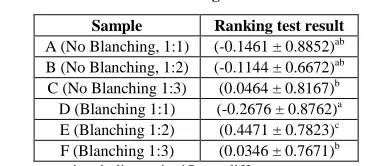
[image:3.612.208.400.354.437.2]The black nightshade juice that was used for the fermentation was selected based on ranking test results on 80 untrained panelists. The aim was to determine the preference of the panelists related to the pretreatment applied and ratio of fruit and water used in the preparation of black nightshade juice. There were two different pretreatments (no blanching, water blanching at 80ºC for 3.3 minutes) and three different ratios of fruit and water (1:1, 1:2, 1:3). The ranking test result (converted using Fisher and Yates method) is shown on Table 1.
Table 1: Ranking test result
Sample Ranking test result
A (No Blanching, 1:1) (-0.1461 ± 0.8852)ab
B (No Blanching, 1:2) (-0.1144 ± 0.6672)ab
C (No Blanching 1:3) (0.0464 ± 0.8167)b
D (Blanching 1:1) (-0.2676 ± 0.8762)a
E (Blanching 1:2) (0.4471 ± 0.7823)c
F (Blanching 1:3) (0.0346 ± 0.7671)b
Note: Different superscripts indicate significant differenceamong treatments at α=0.05
Based on Table 1, sample E had the highest value followed by sample C, F, B, A, and D. The higher the value indicatedthat the sample was more preferred by the panelist. It also showed that the black nightshade juice which applied blanching as the pretreatment had a higher value rather than the juice without blanching pretreatment. This result corresponded with previous research that bitter leaf that undergone water blanching had a higher acceptance value in the taste and overall acceptability of the bitter leaf soup [12]. Moreover, previous research also reported that blanching pretreatment did not affect the nutrient contents in black nightshade leaves and could increase the shelf life [13]. Therefore, the most preferred black nightshade juice was the black nightshade juice with the blanching method as the pretreatment and 1:2 ratio of fruit and water.The chosen pretreatment and ratio of fruit and water were then applied in the making of the black nightshade fermented beverage.
Antioxidant Activity (IC50)
238
fermentation period and sugar concentration added. The IC50 value of the black nightshade fermented beverage
towards the fermentation period and sugar concentration is shown in Figure 1.
[image:4.612.135.478.94.275.2]Note: Different superscripts indicate significant difference among treatments at α = 0.05
Figure 1: IC50 value of black nightshade fermented beverage with different fermentation period and sugar concentration
Based on Figure 1, IC50 value decreased during the fermentation process for each sugar concentration. The lower
IC50 value meant that the fermented beverage had a higher antioxidant [15]. Therefore, fermentation process could
increase the antioxidant activity in the fermented beverage. According to previous research, the IC50 value of the
black nightshade fermented beverages indicated that the fermented beverages had high antioxidant activity [16]. These results also corresponded with preivous research that stated the fermented alcoholic fruits have a higher antioxidant activity rather than the raw fruits due to the presence of alcohol, which could enhance antioxidant activity of phenolic phytochemicals [17,18]. Previous research also reported that fermentation using Saccharomyces cerevisiae could increase the antioxidant activity of kiwifruit wine [19]. The similar result is also reported by previous research, that fermentation process has also been reported to increase the antioxidant activity in chayote-based fermented beverage [20].
Alcohol Content
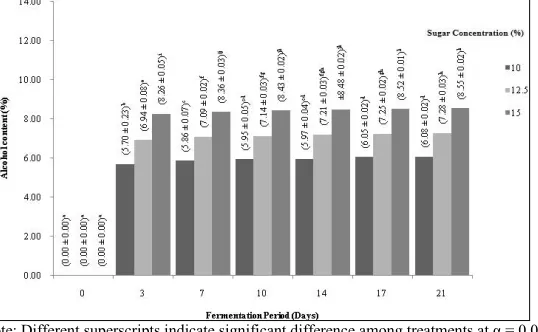
Alcohol is one of the main components resulting from fermentation process. Sugar is converted into alcohol during the exponential and stationary growth phase of the yeast during the fermentation process [14]. Yeast can convert sucrose to be fermented into alcohol [21]. Statistical analysis had showed thatthere was a significant effect between the fermentation period and sugar concentration added on the alcohol content of the black nightshade fermented beverage. The alcohol content was also affected with the interaction between the fermentation period and sugar concentration added. The alcohol content of the black nightshade fermented beverage towards the fermentation period and sugar concentration is shown in Figure 2.
[image:4.612.174.443.520.686.2]Note: Different superscripts indicate significant difference among treatments at α = 0.05
239
Based on Figure 2, the alcohol content in the black nightshade fermented beverage increased as the fermentation period and sugar concentration added increased. The fermented beverage with the addition of 10% sugar concentration yielded the lowest alcohol content, while the fermented beverage with the addition of 15% sugar concentration yielded the highest alcohol content. These results corresponded with previous research that stated the initial sugar concentration contributed to the final concentration of ethanol formed [14]. The increase of sugar concentration would increase the production of ethanol due to the more substrate that would be used by the yeast to be converted into alcohol [22]. The alcohol content resulted during 21 days of fermentation in this experiment was in the range from 5.7% to 8.55% (v/v).
Total Titratable Acidity
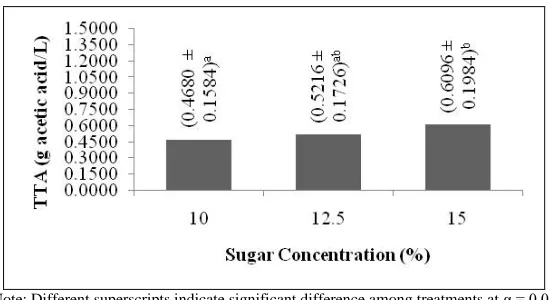
Statistical analysis had showed that both fermentation period and sugar concentration did not have a significant interaction that affected the total titratable acidity. Meanwhile, both fermentation period and sugar concentration gave a significant effect towards the total titratable acidity. The total titrable acidity of the black nightshade fermented beverage on each fermentation period and sugar concentration are shown in Figures 3 and 4.
[image:5.612.169.443.237.403.2]Note: Different superscripts indicate significant difference among treatments at α = 0.05
Figure 3: Total titratable acidity of black nightshade fermented beverage with different fermentation period
Note: Different superscripts indicate significant difference among treatments at α = 0.05
Figure 4: Total titratable acidity of black nightshade fermented beverage with different sugar concentration
Based on Figure 3, the total titratable acidity in gram acetic acid per Liter unit increased as the fermentation period increased. This is because acetic acid could be produced by yeast as an intermediate in the pyruvate dehydrogenase pathway [14]. Acetic acid is the main volatile acid in alcoholic beverage and the accumulation of acetic acid is controlled by the rate of pyruvate decarboxylase activity [23]. If there was formation of acetic acid, it meant that the total titratable acidity in terms of acetic acid would increase during the fermentation process.
[image:5.612.169.444.423.573.2]240
comparable to previous research, in which the total titratable acidity obtained from apple wine was about 0.930 g/L [24].
Total Dissolved Solids
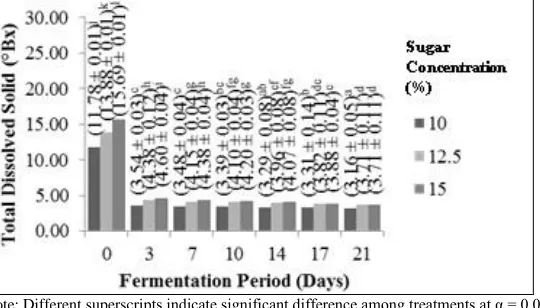
Statistical analysis had showed that there was a significant effect between the fermentation period and sugar concentration added towards the total dissolved solid of the black nightshade fermented beverage. The total dissolved solid was also affected with the interaction between the fermentation period and sugar concentration added. The total dissolved solid of the black nightshade fermented beverage towards the fermentation period and sugar concentration is shown in Figure 5.
[image:6.612.173.443.178.332.2]Note: Different superscripts indicate significant difference among treatments at α = 0.05
Figure 5: Total dissolved solid of black nightshade fermented beverage with different fermentation period and sugar concentration
Based on Figure 5, the total dissolved solid of the black nightshade fermented beverage decreased as the fermentation period increased for each sugar concentration. These results are because sugar would be converted into alcohol during the fermentation process [14,18]. The decrease of dissolved solids in the fermentation was a measure of sugar conversion to alcohol [25]. If the sugar was converted into alcohol, it meant that the total dissolved solid,which majority represented the sugar content in the beverage, would decrease during the fermentation process.
Selected Black Nightshade Fermented Beverage
The selected black nightshade fermented beverage was chosen based on its antioxidant activity. Therefore, the black nightshade fermented beverage with 14 days of fermentation period and 10% of sugar concentration was selected. This fermented beverage was categorized to have high antioxidant activity, which its IC50 was 304.1918 ± 0.5026
mg/L, that was not significantly different with the highest antioxidant activity from sample with 21 days fermentation period and 10% of sugar concentration.
Proximate Analysis
Proximate analysis was done for the black nightshade fruit and the selected black nightshade fermented beverage. Based on proximate analysis results, the black nightshade fermented beverage had higher moisture content (98.53%) rather than the black nightshade fruit (89.51%). The ash, fat, and protein content in the black nightshade fermented beverage, which were 0.40%, 0.59%, and 0.15% respectively, was lower than in the black nightshade fruit, which were 7.76%, 0.68%, and 1.73% respectively. The carbohydrate of the black nightshade fruit, which was 0.32%, was lower than in the black nightshade fermented beverage, which was 0.33%. Therefore, the energy produced from the black nightshade fermented beverage yielded lower value (7.35 kcal/100 mL) rather than the black nightshade fruit (14.36 kcal/100 g).
CONCLUSION
241
concentration and fermentation period. The antioxidant activity in terms of the IC50 value, and total dissolved solid
decreased with the increase of fermentation period for each sugar concentration.
Both of sugar concentration and fermentation period affected the total titratable acidity of the fermented beverage, in which the total titratable acidity increased with the increase of sugar concentration and fermentation period. Due to the antioxidant activity (304.1918 ± 0.5026 mg/L) the black nightshade fermented beverage with 10% sugar concentration and 14 days of fermentation period was selected to be the formulation of the black nightshade fermented beverage. The energy produced from the black nightshade fermented beverage was lower (7.35 kcal/100 mL) compared to the black nightshade fruit (14.36 kcal/100 g).
REFERENCES
[1] JM Edmonds, JA Chweya. Black nightshades - Solanum nigrum L. and related species. International Plant Genetic Resources Institute, Rome, 1997.
[2] IE Akubugwo; AN Obasi; SC Ginika. Pakistan J Nutr. 2007, 6(4), 323-326.
[3] YO Son; J Kim; JC Lim; Y Chung; GH Chung, JC Lee. Food Chem Toxicol. 2003, 41(10), 1421-1428. [4] JZK Khattak; Z Anwar; S Aftab; M Afzal; M Islam; A Khan. Br J Pharmacol. 2012, 3, 185-189. [5] MR Adams, MJR Nout. Fermentation and Food Safety. Aspen Publishers, Maryland, 2001.
[6] V Hartinah. Determination of optimum blanching temperature and time on the antioxidant activity of black nightshade fruit (Solanum nigrum L.) using RSM. Thesis, Universitas Pelita Harapan, Tangerang, Indonesia, 2012.
[7] BM Watts, GL Ylimaki, LE Jeffery, LG Elias. Basic sensory methods for food evaluation. International Development Research Centre, Ottawa, 1989.
[8] M Rothe. Handbook of Aroma Research. Akademie-Verlag Berlin, Netherlands, 1988. [9] I Amin; WY Lee. Sci Food Agric. 2005, 31, 913-917.
[10] AOAC. Official Methods of Analysis of the AOAC International. AOAC International, Maryland, 2005. [11] P Walstra; H Mulder. Neth Milk Dairy J. 1963, 83, 347-351.
[12] MI Yusufu; JE Obiegbuna. Agric Sci Res J. 2015, 5, 105-110.
[13] OM Makanjuola; HA Sanni; A Ajayi. J Global Biosci. 2013, 2(4), 85-89. [14] AJ Buglass. Handbook of Alcoholic Beverages. John Wiley & Sons, UK, 2011. [15] P Molyneux. Songklanakarin J SciTechnol. 2004, 26, 211-219.
[16] P Surinrut; S Kaewsutthi; R Surakarnkul. Proc WOCMAP III. 2005, 5, 201-203. [17] Y Zhang; I Han; P Dawson. Food Nutr Sci. 2015,6, 18-28.
[18] MR Perez-Gregori; J Regueiro; E Alonso-Gonzalez; LM Pastrana-Castro; J Simal-Gandara. LWT - Food Sci Technol. 2011, 44, 1793-1801.
[19] L Xingchen; X Yage; C Lin; X Qinglian; L Shaohua; W Ranran; J Zijing; C Zhenming; L Hongbin. Biomed Res Int. 2017.
[20] SM Pebrijusna. Study of heating pretreatment and fermentation time on antioxidant activity of chayote (Sechiumedule (Jacq.) Swartz) - based fermented beverage. Thesis, Universitas Pelita Harapan, Tangerang, Indonesia, 2015.
[21] EMT El-Mansi, CFA Bryce, B Dahhou, S Sanchez, AL Demain, AR Allman. Fermentation microbiology and biotechnology, 3rdedtion. Taylor & Francis Group, Boca Raton, 2012.
[22] T Supriyanto, Wahyudi. Proses produksi etanol oleh Saccharomyces cerevisiae dengan operasi kontinyu pada kondisi vakum. Thesis, Universitas Diponegoro, Semarang, Indonesia, 2010.
[23] GC Whiting. J Inst Brew. 1976, 82, 84-92.
[24] B Peng; N Ge; L Cui; H Zhao. LWT - Food Sci Technol. 2016, 66, 86-92.