Schemata in Creative Thinking to Solve Mathematical
Problems about Geometry
Wahyudi1,*, Sb. Waluya2, Hardi Suyitno2, Isnarto2, Santa M. Pramusita1
1Faculty of Teacher Training and Education, Universitas Kristen Satya Wacana, Indonesia 2Mathematics Education, Graduate Program, Universitas Negeri Semarang, Indonesia
Received August 20, 2019; Revised September 16, 2019; Accepted September 26, 2019
Copyright©2019 by authors, all rights reserved. Authors agree that this article remains permanently open access under the terms of the Creative Commons Attribution License 4.0 International License
Abstract
The purpose of this study is to describe schemata and students creativity in solving mathematical problem about a Geometry. This study is qualitative research. The data of this research were collected by the method of think out loud and task analysis, by giving test questions and conducting interview according to students’ responses. Miles and Huberman’s analysis technique are used to analyze the data. The result showed that there is variety of student’s schemata based on their creativity in solving mathematical problems. Students with high creative thinking skills had complete and systematic schemata structures, while students with less creative category had incomplete schemata. The process of students with high creative thinking skills was arranged in coherent and systematic ways and diverse answers. The incomplete schemata made them not be able to find the relationship between concepts. Students with less creative category have unfavorable schemata and cannot provide a solution to the problem.Keywords
Schemata, Creative Thinking, Solve Mathematical Problems, Geometry1. Introduction
The purpose of learning mathematics is to improve creative thinking skills in solving problems [1]. Creative thinking skills allow learners to create variety of solutions in amount and way used. There are several factors that may influence creative thinking, and one of them is concept scheme built based on the student’s experience or we can call it the prerequisite capabilities or background knowledge previously owned [2]. These schemes will build a system called schemata [3].
Schemata are collection of concept schemes
representing a generic concept stored in memory, or it is also a plural form [4]. Schemata are mental representation of some aspects that serve to compare someone’s knowledge with new information, and goes into their memory [5]. Schemata develop based on one’s experience [2] [4-6]. Schemata are what help someone process new information until it solves the problem given to him. Schemata have important position of student’s knowledge at the time of study, so teacher’s role is really important to notice how the schemata are formed and stored in the student’s memory. Teachers tend to focus to complete the material and prioritize things related to cognitive ability. Therefore, the main problem in learning is commonly neglected by teachers. Mathematics learning has not provided the opportunity for students to improve reasoning and thinking skills in solving problems [10-11]. Math learning is becoming a lesson that students don't prefer. This leads to the student's low creativity in solving the problem.
Creative thinking is the ability to process information, which is the part of a person’s biological development and knowledge, including Metacognition [7]. A person will use his or her metacognitive skill when he or she is able to organize and compile information using his or her experience. Schemata are really close to the improvement of creative thinking and have an important role in the development of one’s thinking logic in which the logic of thinking will help someone in solving the problem encountered, including in solving problem of mathematic [8].
2. Methods
2.1. Design of the Study
This research was a qualitative research. The research design uses qualitative triangulation where the validity of data, the ability of creative thinking, and thinking schemata are acquired from the result of test and interview. The scope of this research included the descriptions of the ability of mathematical creative thinking and thinking schemata.
2.2. Participant
This qualitative research has 30 participants. They are students of pre-service primary school teacher. The technique used is a non-probability sampling technique to select the participant, which is each member of population, where each member does not have the same opportunity to be the subject research. The type of non-probability sampling used is purposive sampling, which is the taking of subject used if the research has certain considerations with certain objectives.
2.3. Technique and Data Collection Instrument
The method of think out loud [12] and task analysis [13] are used to collect the data in the form of creative thinking processes and thinking schemata, by giving test questions and conducting interview, according to students responses and viewed from the components of thinking system. Cognitive activity that occurs in a person’s mental or mind, is not visible, but can be inferred from visible behavior is called thinking [14-16]. The type of schemata in this research used opinion by Shuying An [1] and Dixon and Zhao [17] which has been modified based on the research needs, namely about mathematics, creative thinking, and geometry material of plane.
2.4. Data Analysis Technique
The data analysis conducted through qualitative which includes several steps of data reduction, display and
drawing conclusion [18-20].
3. Results & Discussion
3.1. Mathematical Creative Thinking Initial Level Creative thinking skills are measured by tests that have been faltered by 5 experts in the field of mathematics. The mean of test results are 60.47 with the standard deviation of 9.10 with the standard of precast error 1.66 of the participants have creative thinking skills with medium and low categories of 93.33% (28 participants).
3.2. Schemata in Creative Thinking
The schemata in creative thinking can be seen from students’ answers and interviews which include formal schemata, content schemata and linguistic schemata. To give a description of creative thinking schemes then selected 3 subjects with the ability to think creatively in the creative category, quite creative, and less creative. Here are the questions given to the 3 selected subjects.
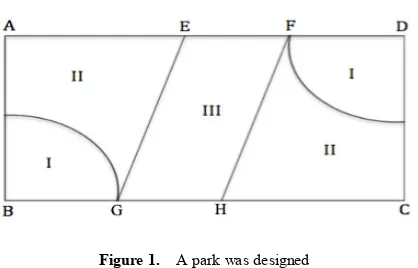
A park was designed as the picture below (Figure 1).
Figure 1. A park was designed
The park is 11 meters long and 8 meters wide. At the two ends of the park there are each fish pond with a radius of 3.5 meters which EF is 2 meters.
I = Fish Pond ; II= Grass; III= Pathway
Determine all possible ways to determine the area of land planted with grass!
a. Subject 1 (Creative category)
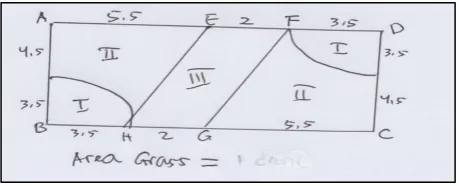
[image:2.595.319.528.361.495.2] [image:2.595.140.455.610.730.2]As per the answer to the subject 1 (creative), the next step taken was an interview. The interview results for subject 1 (creative) can be seen from the recap of the following interview. In accordance with the answers in the interview, then the subject 1 can be identified as thinking creatively according to the answer.
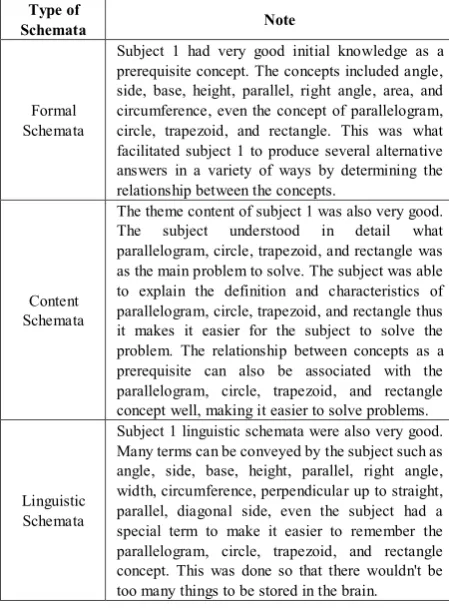
Table 1. Type and descriptions of the schematic in thinking subject 1 (creative)
Type of
Schemata Note
Formal Schemata
Subject 1 had very good initial knowledge as a prerequisite concept. The concepts included angle, side, base, height, parallel, right angle, area, and circumference, even the concept of parallelogram, circle, trapezoid, and rectangle. This was what facilitated subject 1 to produce several alternative answers in a variety of ways by determining the relationship between the concepts.
Content Schemata
The theme content of subject 1 was also very good. The subject understood in detail what parallelogram, circle, trapezoid, and rectangle was as the main problem to solve. The subject was able to explain the definition and characteristics of parallelogram, circle, trapezoid, and rectangle thus it makes it easier for the subject to solve the problem. The relationship between concepts as a prerequisite can also be associated with the parallelogram, circle, trapezoid, and rectangle concept well, making it easier to solve problems.
Linguistic Schemata
Subject 1 linguistic schemata were also very good. Many terms can be conveyed by the subject such as angle, side, base, height, parallel, right angle, width, circumference, perpendicular up to straight, parallel, diagonal side, even the subject had a special term to make it easier to remember the parallelogram, circle, trapezoid, and rectangle concept. This was done so that there wouldn't be too many things to be stored in the brain.
These results indicate that subjects with creative categories have excellent and complete schemata in formal, content and linguistic schemata. This is what makes the assimilation process work well. The good process of adaptation is what allows the formation of interrelated concept schemes that are schemata in the memory of students [4]. This schema will be the capital of the student can solve the problem given to him. This will make the adaptation process run well so that knowledge will continue to build up according to the good experience received by each student [2]. It is in line with the opinions, that a person's schematic will grow in line with his experience [2] [4-6] [21]. Existing concepts are well organized and can be used to solve problems. Based on these results it can be concluded that the subject has a good and complete scheme, the ability to think creatively is also good (creative). It is in accordance with the study of Corcoran [8], where schemata are very close to the improvement of creative thinking and has an important role in the development of one's thinking logic.
The logic of thinking is what will help someone in solving the problems encountered including in solving
mathematical problems [8].
[image:3.595.60.285.183.489.2]b. Subject 2 (Quite Creative Category)
Figure 3. Example of answers to subjects with creative enough category
Table 2. Type and descriptions of the schematic in thinking subject 2 (quite creative)
Formal Schemata
Subject 2 had initial knowledge not yet complete as a prerequisite concept. The concepts possessed include area, base, height, parallelogram, circle, and rectangle. This concept helped subject 2 to produce several alternative answers.
Content Schemata
The theme of subject 2 content about parallelogram, circle, and rectangle was only limited as a stand-alone rectangular building. Subject 2 only memorized the wide parallelogram, circle, and rectangle. The relationship between concepts as a prerequisite was only related to parallelogram, circle, and rectangle.
Linguistic Schemata
Subject 2 linguistic schemata were limited to area, base, height, parallelogram, circle, and rectangle. This also limited Subject 2 to produce other problem solving alternatives.
As per the answer to the subject 2 (quite creative) there is 1 correct answer. In accordance with the answers in the interview, then the subject 2 can be identified as thinking creatively according to the answer to question number 1.
These results indicate that subject 2 with a quite creative category has incomplete schemata, only focusing on 2 concepts namely parallelogram, circle, and rectangle. Nevertheless, the assimilation process went well, especially those related to parallelogram, circle, and rectangle thus it was able to provide one solutions to the problem. Subject 2 has not seen other concepts such as trapezoid, this causes subject 2 to only produce 1 solution. What is interesting from the results of interviews is that the learning patterns of plane was done partially, without paying attention to the relationship between plane building, so when asked about the relationship and classification, the subject experiences confusion and cannot describe the relationship. These results indicate that the schema which the subject has affects the ability of creative thinking in generating solution problems. It is in accordance with the study of Corcoran [8], where the schema is very close to the improvement of creative thinking.
c. Subject 3 (Less Creative Category)
creative according to the answer to question number 1.
Figure 4. Example of answers to subject with less creative category
Table 3. Type and descriptions of the schematic in thinking subject 3 (less creative)
Formal Schemata
Subject 3 did not have good initial knowledge as a prerequisite concept. Only rectangular concepts in general, and forgot the concepts that existed in the problem given. The subject also experienced confusion in building a rectangle that was the problem.
Content Schemata
The content schemata of subject 3 on parallelogram, circle, trapezoid, and rectangle was very weak, even having difficulty identifying that the problems presented are related to parallelogram, circle, trapezoid, and rectangle.
Linguistic Schemata
The subject's linguistic schemes were only limited to rectangular flat, rectangular, wide, but many forgotten names.
These results indicate that subject 3 in the less creative category has unfavorable schemata. This caused subject 3 cannot provide a solution to the problem. The assimilation process did not go well, many forgotten concepts even some were unknown to them. What's interesting about the results of the interview is that subject 3 did not like learning mathematics. Subject 3 did not feel comfortable and happy while studying mathematics, even tended to be afraid. This is the cause of not many mathematical concepts stored in the subject's memory 3.
It is not in line with the current mathematical learning paradigm, where mathematics is close to humans, mathematics is part of human culture [22-24] and is part of social reality [22-25]. Learning must be made to a real, challenging and engaging problem so that students are interested in learning. This fun situation will make the mathematical concept can be remembered as a beautiful memory in the students' memories so that the formal schemata and content schemata will be well formed.
4. Conclusions
The results showed that student’s schemata varied according to their creativity in solving mathematical problems. Students with high creative thinking skills had complete and systematic schemata (formal, content, and linguistic) structures. The process of problem solving was arranged in coherent and systematic ways with diverse answers. New schemata were well formed and produced balanced new knowledge. Students with a creative enough
category have incomplete schemata. Their formal schemata are incomplete so as to not be able to find relationships between concepts. Students with less creative category have unfavorable schemata. They cannot provide a solution to the problem. They did not like learning mathematics. They did not feel comfortable and happy while studying mathematics, even tended to be afraid.
REFERENCES
Nadjafikhah, M., Yaftian, N., & Bakhshalizadeh, S.. [1]
Mathematical creativity: some definitions and characteristics. Procedia-Social and Behavioral Sciences, 31, 285-291, 2012.
Piaget, J.. The psychogenesis of knowledge and its [2]
epistemological significance, 1980.
An, S.. Schema Theory in Reading. Theory and Practice in [3]
Language Studies, 3(1), 130-134, 2013.
Rumelhart, D. E., Norman, D. A., Aitkenbcad, A. M., & [4]
Slack, J. M.. Issues in cognitive modeling. 'Representation of Knowledge', 1985.
Cook & Guy. Discourse. Oxford: Oxford University Press, [5]
1989.
Neumann, K. L., & Kopcha, T. J. The Use of Schema [6]
Theory in Learning, Design, and Technology. TechTrends, 62(5), 429-431, 2018.
Flavell, J. H. Theory-of-Mind Development: Retrospect and [7]
Prospect. Merrill-Palmer Quarterly, 50(3), 274–290. https://doi.org/10.1353/mpq.2004.0018, 2004
Corcoran, J. Schemata: the concept of schema in the history [8]
of logic. Bulletin of Symbolic Logic, 12(2), 219-240, 2006.
Wahyudi, Waluya, S. B., Rochmad, & Suyitno, H. [9]
Assimilation and Accommodation Processes in Improving Mathematical Creative Thinking with Scaffolding According to Learning Style. In Journal of Physics: Conference Series(Vol. 1097). Institute of Physics Publishing. https://doi.org/10.1088/1742-6596/1097/1/012 156, 2018.
Cracolice, M. S., Deming, J. C., & Ehlert, B. Concept [10]
learning versus problem solving: a cognitive difference. Journal of Chemical Education, 85(6), 873, 2008. Vyas, D., Ottis, E. J., & Caligiuri, F. J. Teaching clinical [11]
reasoning and problem-solving skills using human patient simulation. American journal of pharmaceutical education, 75(9), 189, 2011.
Charters, E. The use of think-aloud methods in qualitative [12]
research an introduction to think-aloud methods. Brock Education: A Journal of Educational Research and Practice, 12(2), 2003.
Someren, M. W., Barnard, Y. F., & Sandberg, J. A. C. The [13]
[image:4.595.60.290.99.192.2]Mayer, R. E. Rote versus meaningful learning. Theory into [14]
practice, 41(4), 226-232, 2002.
Mayer, R. E. Incorporating motivation into multimedia [15]
learning. Learning and Instruction, 29, 171-173, 2013. MacLin, M. K., & Solso, R. L. Experimental psychology: a [16]
case approach. Pearson/Allyn & Bacon, 2008.
Dixon, L. Q., Zhao, J., Shin, J.-Y., Wu, S., Su, J.-H., [17]
Burgess-Brigham, R., Snow, C. (2012). What We Know About Second Language Acquisition: A Synthesis From Four Perspectives. Review of Educational Research, 82(1), 5–60. https://doi.org/10.3102/0034654311433587
Miles, M. B., Huberman, A. M., Huberman, M. A., & [18]
Huberman, M. Qualitative data analysis: An expanded sourcebook. Sage, 1994.
Creswell, J. W. Educational research: planning. Conducting, [19]
and Evaluating, 2012.
Bazeley, P., & Jackson, K. (Eds.). Qualitative data analysis [20]
with NVivo. Sage Publications Limited, 2013.
Longo, G., & Perret, N. Rhythms, Retention and Protention: [21]
Philosophical Reflections on Geometrical Schemata for Biological Time. In Building Theories (pp. 245-259). Springer, Cham, 2018.
Hersh, Reuben. What is Mathematics, Really?. London: [22]
Jonathan Cape.A Dyer, J., Gregersen, H., & Christensen, C. M. (2011). The innovator's DNA: Mastering the five skills of disruptive innovators. Harvard Business Press, 1997. Greer, B. Modelling reality in mathematics classrooms: The [23]
case of word problems. Learning and instruction, 7(4), 293-307, 1997.
Rosa, M., & Orey, D. Ethnomathematics: the cultural [24]
aspects of mathematics. Revista Latinoamericana de Etnomatemática: Perspectivas Socioculturales de La Educación Matemática, 4(2), 32-54, 2011.
Zevenbergen, R., Dole, S., & Wright, R. J. Teaching [25]
mathematics in primary schools. Crows Nest: Allen & Unwin, 2004.
Gardner, H. Creating minds. New York: Basic Books, [26]