DOI: https://doi.org/10.30880/ijie.xx.xx.xxxx.xx.xxxx
*Corresponding author: [email protected]
2011 UTHM Publisher. All right reserved.
penerbit.uthm.edu.my/ojs/index.php/ijie
72
Optimization of Batch Conditions for COD and Ammonia
Nitrogen Removal Using cockle shells Through Response
Surface Methodology
Zawawi Daud
1*, Mahmoud Hijab Abubakar
2, Halizah Awang
3, Zainab Belel
Ahmed
2, Mohd Arif Rosli
1, Mohd Baharudin Ridzuan
1, Ruwaida Aliyu
4, Husnul
Azan Tajarudin
51Centre of Advanced Research for Integrated Solid Waste Management (CARISMA). Faculty of Civil and
Environment Engineering, Universiti Tun Hussein Onn Malaysia
2Civil Engineering Department, Modibbo Adama University of Technology Yola, Nigeria. 3
Faculty of Technical and Vocational Education, Universiti Tun Hussein Onn Malaysia
4College of Engineering Technology, Adamawa state Polytechnic Yola, Nigeria.
5Bioprocess Technology Division, School of Industrial Technology, Universiti Sains Malaysia
Received 15 July 2018; accepted 11 December 2018, available online 31 December 2018
1.
Introduction
Water deficiency and contamination currently rank evenly with climate change as the most pressing environmental perturbation [1-8]. Due to increasing globalization and urbanization, which intensify ecological damage and severely endanger human health and the environment, adsorption, especially for the use of activated carbons and zeolites has been the focus of numerous studies and it is extensively applied to wastewater management [9-11]. And with the cost of conventional media reaching as high as S$602 per metric ton in the global market and the demand increasing constantly to an unprecedented degree (800,000 tons per year), the search for an economical and environmentally friendly substitute adsorbent is inevitable [1]. Agricultural waste biomass is currently a topic of interest that has been receiving considerable attention in the past few decades [12]. In recent years, different native and low-cost materials, such as peat soil, feldspar, cockle shell (CS), seaweed, rice husk, wood sawdust, banana
frond, and limestone, have been considered successful alternatives for wastewater treatment [13]. Several operational parameters, such as pH, dosage, and shaking speed, mainly influence the minimization of chemical oxygen demand (COD) and ammonia nitrogen (NH3–N).
RSM is a compilation of statistical and mathematical procedures critical to the realization, enhancement, and optimization of systems. It also helps in evaluating the influence of independent variables and gives rise to mathematical models related to chemical or biochemical systems. The primary advantage of RSM is the minimal amount of experimentation required to assess multiple parameters and their interactions [14-15]. Therefore, RSM is less strenuous compared with other approaches, such as “one factor at a time,” which is lengthy and disregards the interaction between variables [16-17]. The present study aims to optimize the operating reaction conditions for the removal of COD (YCOD) and that of
NH3–N (YNH3–N) by using response surface methodology
(RSM) via central composite design (CCD). RSM Abstract: The optimal conditions for the reduction of COD and NH3-N using cockle shells (CS) from a stabilised
landfill effluent were analyzed. The influence of two variables (adsorbent dosage and pH) were analysed through the application of response surface methodology (RSM) and central composite design (CCD). Quadratic models were developed for the removals of COD and NH3-N parameters. The optimum conditions for removal of 65.6%
and 53.6% for COD and NH3-N respectively was achieved at pH 6.34, adsorbent dosage of 20.21 g having 0.888
desirability value. The model F-value obtained for NH3-N removal Prob. > F value of 0.0001 with F-value of
104.21 was obtained. Similarly the Prob. > F value of < 0.0001 for COD with F-value of 82.74 was obtained, these P-values confirmed the significance of the model. The predicted response versus the experimental response depicted that the experimental data were relatively close to the predicted data. Thus, the generated models significantly enclosed the correlation between the process variables and the response.
73
performs several assays to determine the optimum experimental conditions. YCOD and YNH3–N were
monitored throughout the experiments. Accordingly, the statistical design focused on two independent factors (i.e., media dosage and pH) and the dependent variables or responses (i.e., COD and NH3–N).
2.
Materials and method
2.1
Leachate sampling
The leachate sample was procured from Simpang Renggam municipal landfill located at N10 53 41.64 latitude and E1030 22 34.68 longitude in Kluang District of Johor. Sterilized 20-L high-density polyethylene bottles was utilised to manually collect the leachate at site in accordance to the method outlined by [14]. Moreover, the leachate was characterized within 24 h according to the standard methods for the examination of water and wastewater [18].
2.2
Preparation of Adsorbent media
Cockle shells (CS) were obtained from commercial restaurants in Batu pahat area of Johor. The preparation is carried out according to the procedure outlined by [19,20] and crushed sorted, sieved to obtain particle between sizes of 0.6 -1.18 mm [3].
2.3
Adsorption experiments
Adsorption experiments were carried out by shaking the media in 250 mL conical flask containing 100mL sample of raw leachate solution of desired pH in an orbital shaker at 150 rpm. The experiments were carried out varying cockle shell dosage and pH. The samples were taken from the flasks at predetermined time intervals and analyzed for COD and NH3-N content [21,22]. The
COD and NH3-N were assessed by the closed reflux and
Nessler Method respectively using atomic adsorption spectrophotometer (Model HACH DR6000). The effect of pH was studied by adjusting the pH of the leachate solutions using HCl and NaOH [23,24]. Experimental results were calculated as percentage removal of COD and NH3-N according to equation (1).
(1)
Where and are the initial and final COD(mg/L) and NH3-N(mg/L) concentration respectively.
2.4
CCD-based experimental design.
Design Expert (Version 7.0; Stat-Ease, Inc., Minneapolis, MN 55413, USA) software was employed to design the experiments and analyze the data. CCD and RSM were used to optimize two independent variables, namely, pH and dosage. The ranges for variable selection were 4–56 g/L for dosage and 4–8 for pH. To attain the optimum dosage and pH, two dependent variables were investigated as responses, namely, COD and NH3–N. The
quadratic equation model for predicting the optimum conditions can be expressed according to Equation (2):
where i represents the linear coefficient, j the quadratic coefficient, as the coefficient of regression, k is for the quantity of factors investigated and optimized by the experiment while e stands for the random error [25]. Analysis of variance (ANOVA) was incorporated in graphical analyses of the obtained data to determine the interactions between the system variables and their responses. The coefficient of determination R2 determined
the nature and suitability of the derived polynomial model, and its significance was measured by F-test within the program [26]. Model reliability was assessed by using a P-value with a 95% confidence limit [27]. Three-dimensional (3D) graphs and their contour graphs were created to illustrate the interactions on the basis of the effects of dosage and pH. The optimum zone was also established on the basis of the paramount variables from the graphs.
3.
Results and Discussion
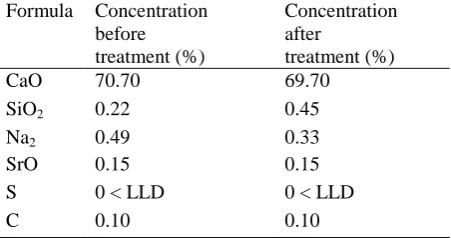
Table 1 presents the physicochemical quality of the CS adsorbent obtained using an XRF machine (Bruker S4 pioneer model) before and after treatment. The shells contained high amount of CaO and which makes it suitable for application in wastewater treatments. The results also indicate that several changes occurred in the percentage composition of several compounds for the pretreatment and post-treatment media composition, which is probably due to redox reaction that occurred due to adsorbent – adsorbate interaction..
Table 1 Chemical composition of CS before and after treatment.
Formula Concentration before treatment (%)
Concentration after
treatment (%)
CaO 70.70 69.70
SiO2 0.22 0.45
Na2 0.49 0.33
SrO 0.15 0.15
S 0 < LLD 0 < LLD
C 0.10 0.10
3.1
CCD
In this study, two salient factors, namely adsorbent dose (A) and pH (B), were selected as independent variables. The software with the application of multiple regression analysis technique proposed a quadratic model; YCOD and YNH3–N for COD and NH3-N
[image:2.595.302.528.522.641.2]74
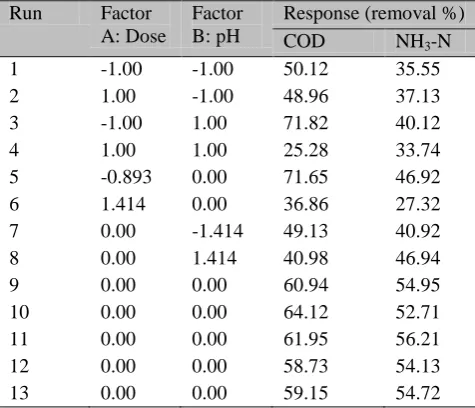
steady condition were selected as the dependent variables(response). Tables 2 and 3 show the empirical design array derived and the percentage removals, respectively. The percentage removals ranged from 36.86% to 71.82% and 27.32% to 54.95% for COD and NH3–N,
respectively. The quadratic model for YCOD and YNH3–N is
expressed as follows:
YCOD = 61.23 - 12.38*A - 1.69*B - 11.34*A* B -
3.44*A2 - 8.31*B2 (3)
YNH3-N = 54.66 -1.48*A + 1.21* B - 1.99*A* B -
12.52*A2 - 5.41* B2 (4)
The positive or negative symbol before the expression determines the positive or negative effect of the individual or multiple coefficient factor interaction on YCOD and YNH3–N [15]. Positivity and negativity imply
favorable and unfavorable interactions, respectively, in the remediation [17]. The occurrence of a single factor signifies a singular effect, the presence of two variables is indicative of a paired effect, and the occurrence of a second-order expression symbolizes quadratic influence [25].
Table 2 Variables and levels studied for percentage of removal of COD and NH3-N
Factor Name Units Low Level High Level
A dose g 4 56
[image:3.595.52.282.381.426.2]B pH - 4 8
Table 3 CCD of two variables and their responses. Run Factor
A: Dose
Factor B: pH
Response (removal %) COD NH3-N
1 -1.00 -1.00 50.12 35.55
2 1.00 -1.00 48.96 37.13
3 -1.00 1.00 71.82 40.12
4 1.00 1.00 25.28 33.74
5 -0.893 0.00 71.65 46.92
6 1.414 0.00 36.86 27.32
7 0.00 -1.414 49.13 40.92
8 0.00 1.414 40.98 46.94
9 0.00 0.00 60.94 54.95
10 0.00 0.00 64.12 52.71
11 0.00 0.00 61.95 56.21
12 0.00 0.00 58.73 54.13
13 0.00 0.00 59.15 54.72
3.2
Statistical analysis
3.2.1
ANOVA
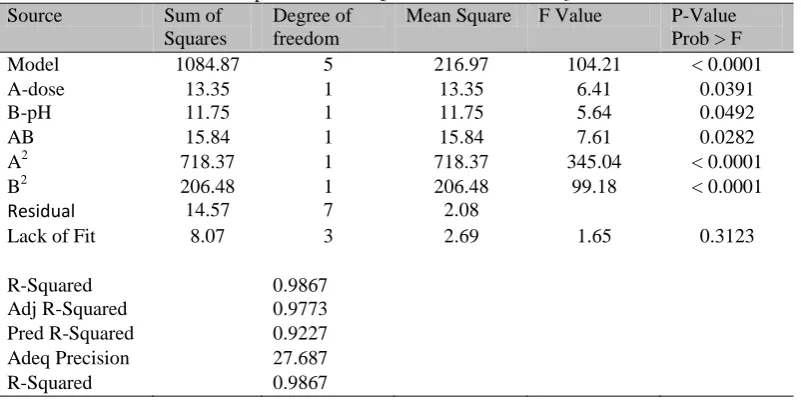
Tables 4 and 5 present the outcomes of the surface quadratic model for YCOD and YNH3–N obtained through
ANOVA, respectively. ANOVA is necessary to substantiate the significance and adequacy of the models.
The model’s F-value of the ANOVA implies the ratio of insignificance. Tables 4 and 5 show the ANOVA of YCOD
and YNH3–N, respectively. With reference to YCOD
percentage (Table 4), the obtained F-value of the model was 82.74 with the Prob. > F-value of < 0.0001, which confirms the model’s significance. Model terms A, AB, A2, and B2 were significant to the response in contrast with B, which was insignificant. The lack-of-fit F-value of 1.26 indicates that the lack of fit is insignificant. Lack of fit was insignificant relative to the pure error. A lack-of-fit F-value this large could occur at a probability of 40.08% due to noise.
An insignificant lack of fit is desirable. As shown in Table 5, a Prob. > F-value of 0.0001 and an F-value of 104.21 were also obtained for NH3–N, which indicates
the model’s significance. At this point, the terms A, B, AB, A2, and B2 were all significant. Correspondingly, a lack-of-fit F-value of 1.65 implies that the lack of fit is insignificant relative to the pure error. A lack-of-fit F-value this large could occur at a probability of 31.23% due to noise [26]. The results of statistical analyses reveal that the models are appropriate with respect to the prediction of YCOD and YNH3–N within the extent of the
considered variables.
The merit of the models derived was determined on the basis of the coefficient of determination R2
. The R2 values for COD and NH3–N were 0.9834 and 0.9867,
respectively (Tables 4 and 5, respectively). The “Pred R-Squared” value for COD (0.9181) was consistent with the “Adj R-Squared” value (0.9715), which implies that the model can describe a 97.15% YCOD. “Adeq Precision”
quantifies the signal-to-noise ratio [16]. An Adeq Precision value of more than 4 is preferable. A 30.249 ratio in this case indicates an adequate signal. The Pred R-Squared value for YNH3–N was 0.9227 and is in
[image:3.595.53.291.460.664.2]75
Table 4 ANOVA for Response Surface Quadratic Model of COD
Source Sum of
Squares
Degree of freedom
Mean Square F Value P-Value Prob > F
Model 2206.32 5 441.26 82.74 < 0.0001
A-dose 935.51 1 935.51 175.41 < 0.0001
B-pH 22.8 1 22.8 4.28 0.0775
AB 514.84 1 514.84 96.53 < 0.0001
A2 54.33 1 54.33 10.19 0.0152
B2 487.02 1 487.02 91.32 < 0.0001
Residual 37.33 7 5.33
Lack of Fit 18.12 3 6.04 1.26 0.4008
R-Squared 0.9834
Adj R-Squared 0.9715
Pred R-Squared 0.9181
Adeq Precision 30.249
R-Squared 0.9834
Table 5 ANOVA for Response Surface Quadratic Model of NH3-N
Source Sum of
Squares
Degree of freedom
Mean Square F Value P-Value Prob > F
Model 1084.87 5 216.97 104.21 < 0.0001
A-dose 13.35 1 13.35 6.41 0.0391
B-pH 11.75 1 11.75 5.64 0.0492
AB 15.84 1 15.84 7.61 0.0282
A2 718.37 1 718.37 345.04 < 0.0001
B2 206.48 1 206.48 99.18 < 0.0001
Residual 14.57 7 2.08
Lack of Fit 8.07 3 2.69 1.65 0.3123
R-Squared 0.9867
Adj R-Squared 0.9773
Pred R-Squared 0.9227
Adeq Precision 27.687
R-Squared 0.9867
This model can be used to navigate the design space. Furthermore, Figs. 1 shows the predicted versus the experimental values representing YCOD and YNH3–N,
respectively. The values indicate that the experimental
[image:4.595.85.316.583.744.2]76
Fig.1 Predicted vs. Experimental values plot for (a) COD and (b) NH3-N removal
Figs. 2 Response surface plots for the COD and NH3–N parameters removal
Figs. 2 presents the 3D response surface plots for the YCOD and YNH3–N parameters, respectively. The plots
illustrate the effect of pH–dosage interaction in the removal. The two figures show that the YCOD was better
than the YNH3–N. Daud [19] and Moideen [14] had
observed similar behavior in their study.
3.2.2
Optimization
The COD and NH3–N decontamination by CS were
optimized by using Design Expert software. Graphical optimization presents the region of ideal response values of the factor scope with the area that suits the optimization criteria that have been identified at the peak. The ANOVA evaluation emphasizes the models significance for the removal (%) of COD and ammonia nitrogen with Prob > F values of < 0.0001 Table 4 and 5. Furthermore, the Prob > F of greater than 0.10 signifies the statistical inadequacy of the correlation among the process responses and variables [28-38]. Notwithstanding, some of the models’ terms are have limited influence on the removal of COD and ammonia based on the F values. Through the optimization, the baseline for the two response values was set to maximum values. The ideal adsorption values obtained were pH 6.34 and dosage of 20.21 g. These configurations yield approximately 65.6% COD, 53.6% NH3–N, and a desirability value of 0.888.
Table 6 Numerical optimization solution Number Dose
(g)
pH COD (%)
NH3-N
(%)
Desirability
1 20.21 6.34 65.605 53.615 0.888
Conclusion
Two adsorption criteria (adsorbent dosage and pH) were optimized by using CCD for the minimization of COD and NH3–N by CS. The optimized removal
proportions were 65.6% and 53.6% for the COD and
NH3-N respectively. The maximum removal proportion
of the adsorbate was achieved at the optimum adsorbent dosage of 20.21g, pH 6.34, and desirability value of 0.888. Based on the evaluated adsorbent performance, the CS prove to be suitable for application in wastewater industries.
References
[1] Foo, K. Y., & Hameed, B. H. Utilization of rice husk ash as novel adsorbent: a judicious recycling of the colloidal agricultural waste. Advances in Colloid and Interface Science, volume 152(1), (2009), pp. 39-47. [2] Daud, Z., Abubakar, M.H., Abdul Latiff, A.A., Awang, H., Ahmad, Z., Ridzuan, M.B., Cod and ammonia removal from landfill leachate using mixed granular adsorbent media. Jurnal Teknologi, 80 (4), (2018), pp. 81-86.
[3] Daud, Z., Hatta, M.Z.M., Ridzuan, M.B., Awang, H., Adnan, S.,Studies on physical and mechanical properties by soda-AQ pulping of Napier grass.
Defect and Diffusion Forum, 382 DDF, (2018), pp. 318-321.
[4] Daud, Z., Suhani, N., Mohamed, R.M.S.R., Awang, H., Feasibility of banana (Musa sapientum) trunk biofibres for treating kitchen wastewater. Nature Environment and Pollution Technology, Volume 16 (4), (2017), pp. 1205-1210.
[5] Daud, Z., Hatta, M.Z.M., Kassim, A.S.M., Aripin, A.M., Awang, H., Analysis of Napier grass (Pennisetum purpureum) as a potential alternative fibre in paper industry. Materials Research Innovations, 18, (2014), pp. S6-18-S6-20.
77
[7] Daud, Z., Awang, H., Kassim, A.S.M., Hatta, M.Z.M., Aripin, A.M., Comparison of pineapple leaf and cassava peel by chemical properties and morphology
characterization. Advanced Materials Research.
Volume 974, (2014), pp. 384-388.
[8] Daud, Z., Aziz, H.A., Adlan, M.N., Hung, Y.-T., Application of combined filtration and coagulation for semi-aerobic leachate treatment. International Journal of Environment and Waste Management, Volume 4 (3-4), (2009), pp. 457-469.
[9] Daud, Z., Hatta, M.Z.M., Kassim, A.S.M., Awang, H., Aripin, A.M., Exploring of agro waste (pineapple leaf, corn stalk, and napier grass) by chemical composition and morphological study. BioResources, Volume 9 (1), (2014), pp. 872-880.
[10]Adeleke, A. R. O., Abdul Latiff, A. A., Daud, Z., Ridzuan, B., and Mat Daud, N. F., Remediation of Raw Wastewater of Palm Oil Mill Using Activated Cow Bone Powder through Batch Adsorption. Key Engineering Materials, 705, (2016), pp. 380-384. [11]Adeleke, A.O., Latiff, A.A.A., Al-Gheethi, A.A.,
Daud, Z., Optimization of operating parameters of novel composite adsorbent for organic pollutants removal from POME using response surface methodology. Chemosphere, Volume 174, (2017), pp. 232-242.
[12]Habeeb, S.A., Latiff, A.A.A., Daud, Z., Ahmad, Z. The start-up of hybrid, anaerobic up-flow sludge blanket (HUASB) under a range of mesophiclic and thermophilic temperatures. EnvironmentAsia, Volume 4 (2), (2011), pp. 63-68.
[13]Daud, Z., Rosli, M.A., Latiff, A.A.A., Ridzuan, M.B., Awang, H., Halim, A.A., Micro-peat as a potential low-cost adsorbent material for COD and NH3-N removal. Defect and Diffusion Forum, 382 DDF, (2018), pp. 297-301.
[14]Siti Nur Fatihah Moideen, Fadhil, M., Rezania, S., Ponraj, M., Rahman, A. A., Wen, L., Zulhilmi, I., Shazwin, M., Yu-you, L., Komori, D. Dual phase role of composite adsorbents made from cockleshell and natural zeolite in treating river water. Journal of King Saud University - Science, (2017), pp. 6–11. [15]Garba, Z. N., Bello, I., Galadima, A., & Lawal, A. Y.
Optimization of adsorption conditions using central composite design for the removal of copper ( II ) and lead ( II ) by defatted9 papaya seed. Karbala International Journal of Modern Science, volume 2(1), (2016), pp. 20–28.
[16]Rahimi, A., Bayati, B., & Khamforoush, M. Synthesis and Application of Cu-X zeolite for Removal of Antibiotic from Aqueous Solution: Process Optimization Using Response Surface Methodology. Arabian Journal for Science and Engineering, (2018), pp. 1-17.
[17]Sadhukhan, B., Mondal, N. K., & Chattoraj, S. Optimisation using central composite design ( CCD ) and the desirability function for sorption of methylene blue from aqueous solution onto Lemna major. Karbala International Journal of Modern Science, volume 2(3), (2016), pp. 145–155.
[18]Standard methods for the examination of water and wastewater. 2012. Washington, DC: American Public Health Association (APHA).
[19]Daud, Z., Abubakar, M.H., Kadir, A.A., Latiff, A.A.A., Awang, H., Halim, A.A., Marto, A.,Adsorption studies of leachate on cockle shells.
International Journal of GEOMATE, Volume 12 (29), (2017), pp. 2186-2990.
[20]Daud, Z., Abubakar, M.H., Kadir, A.A., Latiff, A.A., Awang, H., Halim, A.A., Marto, A., Optimization of leachate treatment with granular biomedia: Feldspar and Zeolite. Indian Journal of Science and Technology, Volume 9(37), (2016), 91845.
[21]Daud, Z., Nasir, N., Kadir, A.A., Latiff, A.A.A., Ridzuan, M.B., Awang, H., Halim, A.A., Potential of agro waste-derived adsorbent material for colour removal. Defect and Diffusion Forum, 382 DDF, (2018), pp. 292-296.
[22]Latiff, A. A. A., Adeleke Abdul Rahman, O., Daud, Z., Ridzuan, M. B., & Mat Daud, N. F., Batch Adsorption of Manganese from Palm Oil Mill Effluent Onto Activated Cow Bone Powder. ARPN Journal of Engineering and Applied Sciences, Volume 11(4), (2016), pp. 2627-2631.
[23]Daud, Z., Nasir, N., Aziz Abdul Latiff, A., Ridzuan, M. B., & Awang, H., Treatment of Biodiesel Wastewater by Coagulation-flocculation Process Using Polyaluminium Chloride (PAC) and Polyelectrolyte Anionic. ARPN Journal of Engineering and Applied Sciences, Volume 11(20), (2016), pp. 11855-11859.
[24]Al-Gheethi, A., Noman, E., Mohamed, R. M. S. R., Ismail, N., Abdullah, A. H. B., & Kassim, A. H. M. Optimizing of Pharmaceutical Active Compounds Biodegradability in Secondary Effluents by β-lactamase from Bacillus subtilis using Central Composite Design. Journal of hazardous materials. (2018).
[25]Daud, Z., Bakar, M.H.A., Rosli, M.A., Ridzuan, M.B., Aliyu, R. Application of Response Surface Methodology (RSM) to Optimize COD and ammoniacal nitrogen removal from leachate using moringa and zeolite mixtures. International Journal of Integrated Engineering, Volume 10 (1), (2018), pp. 142-149.
[26]Tan, Y. H., Abdullah, M. O., Nolasco-hipolito, C., Syuhada, N., & Zauzi, A. Application of RSM and Taguchi methods for optimizing the transesteri fi cation of waste cooking oil catalyzed by solid ostrich and chicken-eggshell derived CaO. Renewable Energy, volume 114, (2017), pp. 437–447.
[27]Abba, H.A., Sani, L., Hijab, A.M., Daud, Z. Novel admixture for improvement of foundations on tropical expansive soils. International Journal of Integrated Engineering, Volume 9 (1), (2017), pp. 44-49.
78
Hydrate-Bearing Formation. Arabian Journal forScience and Engineering, volume 1-14, (2018). [29]Nasir, N., and Daud, Z., Performance of Aluminium
Sulphate and Polyaluminium Choloride In Biodiesel Wastewater. Journal of Mechanical Engineering and Sciences, Volume 7(1), (2014), pp. 1189-1195. [30]Abdulrahman, A., Latiff, A.A.A., Daud, Z., Ridzuan,
M.B., Jagaba, A.H., Preparation and Characterization of Activated Cow Bone Powder for the Adsorption of Cadmium from Palm Oil Mill Effluent. IOP Conference Series: Materials Science and Engineering, Volume 136 (1), (2016), 012045. [31]Ridzuan, M.B., Daud, Z., Ahmad, Z., Abd Latiff,
A.A., Awang, H. Leachate treatment using up-flow anaerobic sludge blanket system. International Journal of Integrated Engineering, Volume 10 (1), (2018), pp. 62-65.
[32]Antonyová, A., Antony, P., Abdullah, A.H., Nagapan, S., Daud, Z., Abubakar, M.H. Certain building materials with respect to their thermal properties as well as to their impact to environment.
International Journal of Integrated Engineering, Volume 10 (4), (2018), pp. 126-130.
[33]Aminudin, E., Md Din, M.F., Hussin, M.W., Abdullah, A.H., Iwao, K., Ichikawa, Y. Properties of agro-industrial aerated concrete as potential thermal insulation for building. MATEC Web of Conferences, Volume 47, (2016) art. no. 04020, .
[34]Yunus, R., Abdullah, A.H., Yasin, M.N., Masrom, M.A.N., Hanipah, M.H. Examining performance of
Industrialized Building System (IBS) implementation based on contractor satisfaction assessment. ARPN Journal of Engineering and Applied Sciences, Volume 11 (6), (2016), pp. 3776-3782.
[35]Bakar, S.K.A., Abdullah, A.H. Simulation of thermal performance in an office building. BEIAC 2012 - 2012 IEEE Business, Engineering and Industrial Applications Colloquium, art. no. 6226074, (2012), pp. 318-323.
[36]Balakrishnan, B., Awal, A.S.M.A., Abdullah, A.B., Hossain, M.Z. Flow properties and strength behaviour of masonry mortar incorporating high volume fly ash. International Journal of GEOMATE, Volume 12 (31), (2017), pp. 121-126.
[37]Al-Gheethi, A.A., Mohamed, R.M.S.R., Efaq, A.N., Norli, I., Halid, A.A., Amir, H.K., Kadir, M.O.A. Bioaugmentation process of secondary effluents for reduction of pathogens, heavy metals and antibiotics.
Journal of Water and Health, Volume 14 (5), (2016), pp. 780-795.