International Journal of Emerging Technology and Advanced Engineering
Website: www.ijetae.com (ISSN 2250-2459, Volume 2, Issue 7, July 2012)371
Audio Steganography by Different Methods
Swati Malviya1, Manish Saxena2, Dr. Anubhuti Khare3
1
Swati Malviya , M Tech (DC) Student BIST Bhopal
2
Manish Saxena, HOD( EC) BIST Bhopal
3
Dr. Anubhuti Khare, Reader(EC)RGPV Bhopal
Abstract— Information hiding technique is a new kind of secret communication technology. Steganography has been proposed as a new alternative technique to enforce data security. A perfect audio Steganographic technique aim at embedding data in an imperceptible, robust and secure way and then extracting it by authorized people. Hence, up to date the main challenge in digital audio steganography is to obtain robust high capacity steganographic systems. Leaning towards designing a system that ensures high capacity or robustness and security of embedded data has led to great diversity in the existing steganographic techniques. In this paper, we present a current state of art literature on audio steganographic techniques and how it’s performed by different way.
Keywords— Steganography, information hiding, Parity coding, echo hiding , phase coding, spread spectrum, LSB
I. INTRODUCTION
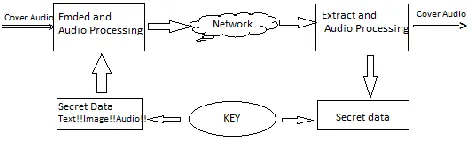
This In the current internet community, secure data transfer is limited due to its attack made on data communication. So more robust methods are chosen so that they ensure secured data transfer. Techniques such as encryption and watermarking are already used in this regard. However, the need for new techniques and new algorithms to counter constantly-changing malicious attempts to the integrity of digital data has become a necessity in today’s digital era.One of the solutions which came to the rescue is the audio Steganography. Steganography, which literary means ”covered writing” has drawn more attention in the last few years. Its primary goal is to hide the fact that a communication is taking place between two parties. The sender embeds secret data of any type using a key in a digital cover file to produce a stego file, in such a way that an observer cannot detect the existence of the hidden message [1].
[image:1.612.329.565.364.437.2]At the other end, the receiver processes the received stego-file to extract the hidden message. An example of audio steganography is depicted in Fig. 1 where the cover file being used is a digital audio signal. An obvious application is a covert communication using innocuous cover audio signal, such as telephone or video conference conversations.
Fig. 1: Blocks diagram for audio steganography
To minimize the difference between the original medium and the one obtained after embedding the hidden data, recent steganography techniques benefit from the natural limitations in the auditory and visual perceptions of human in one hand, and on the other hand from the properties of digital media through utilizing them as a cover to vehicle secret communications. Image and video based steganography relies on the limited human visual system in remarking luminance variation at levels greater than 1 in 240 in uniform gray levels or 1 in 30 of random patterns [2].
II. PREVIOUS WORKS
International Journal of Emerging Technology and Advanced Engineering
Website: www.ijetae.com (ISSN 2250-2459, Volume 2, Issue 7, July 2012)372
Some of the latter methods require previous knowledge of signal processing techniques, Fourier analysis, and other areas of high level mathematics. When developing a data-hiding method for audio, one of the first considerations is the likely environments the sound signal will travel between encoding and decoding. There are two main areas of modification which we will consider. First, the storage environment, or digital representation of the signal that will be used, and second the transmission pathway the signal might travel
A. Parity coding
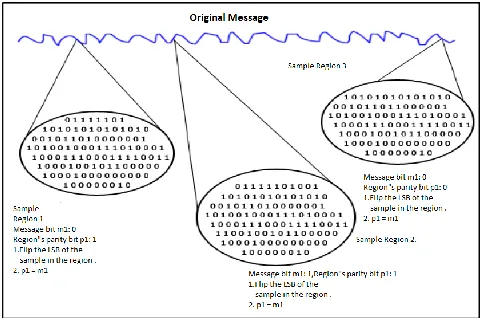
[image:2.612.48.291.448.607.2]One of the prior works in audio data hiding technique is parity coding technique. Instead of breaking a signal down into individual samples, the parity coding method breaks a signal down into separate regions of samples and encodes each bit from the secret message in a sample region's parity bit[3]. If the parity bit of a selected region does not match the secret bit to be encoded, the process flips the LSB of one of the samples in the region. Thus, the sender has more of a choice in encoding the secret bit, and the signal can be changed in a more unobtrusive fashion . Figure 2, shows the parity coding procedure.
Figure 2. Parity Coding Procedure.
B. Phase coding:
The phase coding method works by substituting the phase of an initial audio segment with a reference phase that represents the data. The phase of subsequent segments is adjusted in order to preserve the relative phase between segments.
Phase coding, when it can be used, is one of the most effective coding methods in terms of the signal-to perceived noise ratio. When the phase relation between each frequency component is dramatically changed, noticeable phase dispersion will occur. However, as long as the modification of the phase is sufficiently small (sufficiently small depends on the observer; professionals in broadcast radio can detect modifications that are imperceivable to an average observer), an inaudible coding can be achieved [4]. . Phase coding relies on the fact that the phase components of sound are not as perceptible to the human ear as noise is. Rather than introducing perturbations, the technique encodes the message bits as phase shifts in the phase spectrum of a digital signal, achieving an inaudible encoding in terms of signal-to-perceived noise ratio [5].
Phase coding is explained in the following procedure:
a. The original sound signal is broken up into smaller segments whose lengths equal the size of the message to be encoded.
b. A Discrete Fourier Transform (DFT) is applied to each segment to create a matrix of the phases and Fourier transform magnitudes.
c. Phase differences between adjacent segments are calculated.
d. Phase shifts between consecutive segments are easily detected. In other words, the absolute phases of the segments can be changed but the relative phase differences between adjacent segments must be preserved. Therefore the secret message is only inserted in the phase vector of the first signal segment as follows:
International Journal of Emerging Technology and Advanced Engineering
Website: www.ijetae.com (ISSN 2250-2459, Volume 2, Issue 7, July 2012)373
[image:3.612.48.293.250.320.2]f. Using the new phase matrix and original magnitude matrix, the sound signal is reconstructed by applying the inverse DFT and then concatenating the sound segments back together. To extract the secret message from the sound file, the receiver must know the segment length. The receiver can then use the DFT to get the phases and extract the information (consider Figure 3 for phase cosing procedure).
Figure 3. The signals before and after Phase coding procedure
C. Spread spectrum:
Spread spectrum technique spreads hidden signal data through the frequency spectrum. Spread Spectrum (SS) is a concept developed in communications to ensure a proper recovery of a signal sent over a noisy channel by producing redundant copies of the data signal. Basically, Data is multiplied by an M-sequence code known to sender and receiver [6], then embedded in the cover audio. Thus, If noise corrupts some values, there will still be copies of each value left to recover the embedded message. In [7] conventional direct sequence spread spectrum (DSSS) technique was applied to hide confidential information in MP3 and WAV audio digital signals. To control stego speech distortion, [8] and [9] have proposed an embedding method where spreaded data is hidden under a frequency mask. In [10] spread spectrum is combined to phase shifting to increase the robustness of transmitted data against additive noise and allows easy detection of the embedded data. In this method, a reliable hiding capacity of 3 bps was attained. For a better hiding rate of 20 bps, [11] used SS technique in sub-band domain. Appropriately chosen subband coefficients were selected to address
robustness problem and resolve synchronization
uncertainty at the decoder.
D. Echo Hiding
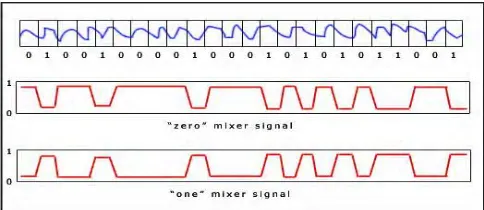
[image:3.612.329.568.399.492.2]In echo hiding, information is embedded in a sound file by introducing an echo into the discrete signal. Like the spread spectrum method, it too provides advantages in that it allows for a high data transmission rate and provides superior robustness when compared to the noise inducing methods. If only one echo was produced from the original signal, only one bit of information could be encoded. Therefore, the original signal is broken down into blocks. before the encoding process begins. Once the encoding process is completed, the blocks are concatenated back together to create the final signal [12]. Echo Hiding is shown in Figure 4and 5 .a message can be encoded using musical tones with a substitution scheme. For example, a First tone will represent a 0 and a C tone represents a 1. A normal musical piece can now be composed around the secret message or an existing piece can be selected together with an encoding scheme that will represent a message [13].
Figure 4 Synthesized spread spectrum information encoded by the direct sequence method
[image:3.612.324.566.535.640.2]International Journal of Emerging Technology and Advanced Engineering
Website: www.ijetae.com (ISSN 2250-2459, Volume 2, Issue 7, July 2012)374
III. PROPOSED WORK
Here we will discuss the limitation of the previous procedure and how those are different with present method. There are two main disadvantages associated with the use of methods like parity coding. The human ear is very sensitive and can often detect even the slightest bit of noise introduced into a sound file, although the parity coding method does come much closer to making the introduced noise inaudible. Another problem is robustness. One disadvantage associated with phase coding is a low data transmission rate due to the fact that the secret message is encoded in the first signal segment only. Phase coding method is used when only a small amount of data needs to be considered. Least significant bit (LSB) coding is the simplest way to embed information in a digital audio file. By substituting the least significant bit of each sampling point with a binary message, LSB coding allows for a large amount of data to be encoded[14]. Among many different data hiding techniques proposed to embed secret message within audio file, the LSB data hiding technique is one of the simplest methods for inserting data into digital signals in noise free environments, which merely embeds secret message-bits in a subset of the LSB planes of the audio stream. The following steps are:
a. Receives the audio file in the form of bytes and converted in to bit pattern.
b. Each character in the message is converted in bit pattern.
c. Replaces the LSB bit from audio with LSB bit from character in the message.
[image:4.612.323.566.133.322.2]This proposed system is to provide a good, efficient method for hiding the data from hackers and sent to the destination in a safe manner. This proposed system will not change the size of the file even after encoding and also suitable for any type of audio file format. In fig 6. we can see the spectrogram of cover audio signal and stego audio signal.
Fig .6 spectrogram of cover audio signal and stego audio signal
Encryption and Decryption techniques have been used to make the security system robust. Low-bit encoding embeds secret data into the least significant bit (LSB) of the audio file. The channel capacity is 1KB per second per kilohertz (44 kbps for a 44 KHz sampled sequence). This method is easy to incorporate.
IV. APPLICATIONS
Audio data hiding can be used anytime you want to hide data. There are many reasons to hide data but most important is to prevent unauthorized persons from becoming aware of the existence of a message. In the business world Audio data hiding can be used to hide a secret chemical formula or plans for a new invention. Audio data hiding can also be used in corporate world.
V. CONCLUSION
International Journal of Emerging Technology and Advanced Engineering
Website: www.ijetae.com (ISSN 2250-2459, Volume 2, Issue 7, July 2012)375
ACKNOWLEDGEMENT
Mrs. Anubhuti Khare one of the authors is indebted to Director UIT RGPV Bhopal for giving permission for sending the paper to the journal. I am also thankful to the Chairman of Bansal Institute of Science & Technology Bhopal for giving permission to send the paper for publication. Last but not least, I would like to thanks our HOD Prof. Manish Saxena and colleagues for supporting us.
REFERENCES
[1] Walter Bender, Daniel Gruhl, Norishige Morimoto, Anthony Lu, ”Techniques for Data Hiding”, IBM Systems Journal, vol. 35, no. 3 and 4 pp. 313-336, 1996.
[2] E. Zwicker and H. Fastl, Psychoacoustics, Springer Verlag, Berlin, 1990.
[3] K. Gopalan, ”Audio steganography using bit modification”, Proceedings of International Conference on Multimedia and Expo, Vol. 1, pp.629-632, 6-9 July 2003.
[4] N. Cvejic, T. Seppiinen, ”Increasing the capacity of LSB-based audio
[5] Samir Kumar Bandyopadhyay, Debnath Bhattacharyya, Poulami Das, Debashis Ganguly and Swarnendu Mukherjee, “A tutorial review on Steganography”, International Conference on Contemporary Computing (IC3-2008), Noida, India, August 7-9, 2008, pp. 105-114.
[6] Steve Czerwinski, Richard Fromm, Todd Hodes, “Digital Music Distribution and Audio Watermarking”. http://reference.kfupm.edu.sa/content/d/i/digital_music_distri bution_and_audio_wat_1045219.pdf
[7] Robert Krenn, “Steganography and steganalysis”, An Article,January http://www.krenn.nl/univ/cry/steg/article.pdf
[8] Francesco Queirolo, “Steganography in Images”, Final Communications Report http://eric.purpletree.org/file/ Steganography%20In%20Images.pdf
[9] Ingemar J. Cox, Ton Kalker, Georg Pakura and Mathias Scheel. “Information Transmission and Steganography”, Springer, Vol. 3710/2005, pp. 15-29.
[10] LoboGuerrero, A., Marques, F., Lienard, P.B.J., “Enhanced audio data hiding synchronization using nonlinear filters”,
[11] K. Gopalan, et al, ”Covert Speech Communication Via Cover Speech ByTone Insertion”, Proceeding of IEEE Aerospace Conference, Big Sky,MT, March 2003.
[12] K. Gopalan and S. Wenndt, ”Audio Steganography for Covert DataTransmission by Imperceptible Tone Insertion”, WOC 2004, Banff,Canada July 8 10, 2004.
[13] Gang. L, A.N. Akansu, M. Ramkumar, ”MP3 resistant oblivioussteganography”, Proceedings of IEEE International Conference on Acoustics, Speech, and Signal Processing, Salt Lake City, UT, Vol. 3, pp.1365-1368, 7-11 May 2001.