ISSN: 2088-8694 290
Speed Tracking of Field Oriented Control Permanent Magnet
Synchronous Motor Using Neural Network
Wahyu Mulyo Utomo*, Nooradzianie Muhammad Zin*, Zainal Alam Haron*, Sy Yi Sim*, Azuwien Aida Bohari*, Roslina Mat Ariff**, Dirman Hanafi**
* Department of Power Electrical, Universiti Tun Hussein Onn Malaysia ** Department of Mechatronic and Robotic, Universiti Tun Hussein Onn Malaysia
Article Info ABSTRACT
Article history: Received Mar 9, 2014 Revised Apr 28, 2014 Accepted May 15, 2014
The field oriented control theory and space vector pulse width modulation technique make a permanent magnet synchronous motor can achieve the performance as well as a DC motor. However, due to the nonlinearity of the permanent magnet synchronous motor drive characteristics, it is difficult to control by using conventional proportional-integral-derivative controller. By this reason in this paper an online neural network controller for the permanent magnet synchronous motor is proposed. The controller is designed to tracks variations of speed references and also during load disturbance. The effectiveness of the proposed method is verified by develop simulation model in MATLAB-simulink program. The simulation results show that the proposed controller can reduce the overshoot, settling time and rise time. It can be concluded that the performance of the controller is improved.
Keyword:
Permanent Magnet Synchronous Motor Neural Network
Copyright © 2014 Institute of Advanced Engineering and Science. All rights reserved.
Corresponding Author: Wahyu Mulyo Utomo,
Department of Power Electrical, Universiti Tun Hussein Onn Malaysia 86400 Parit Raja, Batu Pahat, Johor, Malaysia Email: [email protected]
1. INTRODUCTION
Permanent magnet synchronous motors (PMSM) has been use either in low or mid power applications such as adjustable speed drives, computer peripheral equipment, robotics and electric vehicles lately. Permanent magnet synchronous motor has the features density of high power, free maintenances and high efficiency which has been used in widely application in the various electric drives [1]. In 1998, Pillay & Krishnan presented that PM motor drives and classified them into two categories which are permanent magnet synchronous motor drives (PMSM) and brushless dc motor (BDCM) drives [2]. The PMSM has a sinusoidal back emf and to produce the constant torque, it need sinusoidal stator currents while the BDCM has a trapezoidal back emf and to produce the constant torque, it need rectangular stator currents. The PMSM has features similar to a wound rotor synchronous machine except the permanent magnet of PMSM will produce excitation instead of field winding for servo applications and tend to not have any damper windings. The PM motor family divided into two categories which are internal rotor and external rotor. Both designs are used in critical applications like wind power generators and elevator winches.
The PM motors can be used in Vector Control (VC) or so called Field Oriented Control applications [5]. In order to drive a PMSM smoothly, an Electronic Control Unit (ECU) shall be designed such that the stator current space vector. So, FOC can achieve this goal. In FOC, motor stator currents & voltages are manipulated in the direct-quadrature (d-q) reference frame of the
rotor.
The artificial neural networks (ANN) are best suited for solving the problems that are nonlinear in nature. In ANN we can use parallel processing methods to solve some real-world problems where it is difficult to define a conventional algorithms. The ability of ANN to learn large classes of nonlinear functions is well known [7]-[8]. It can be trained to emulate the unknown nonlinear plant dynamics by presenting a suitable set of input/output patterns generated by the plant [6]. Once system dynamics have been identified using an ANN, many conventional control techniques can be applied to achieve the desired objective.
In this paper, a model of ANN closed-loop PMSM control system that is controlled by SVPWM are develops and presents an analysis of ANN speed controller for speed performance in FOC PMSM drive. The effectiveness of the proposed method is verified by develop simulation model in MATLAB-simulink.
2. RESEARCH METHOD
2.1. Permanent Magnet Synchronous Motor Dynamic Modeling
PMSM is essentially a three phase AC motor with sinusoidal back EMF driven by a DC source, which is converted to three-phase alternating currents supplying to the three stator windings of PMSM. The mathematic model of PMSM idq synchronous rotating reference frame can be obtained from synchronous machine model. Due to the constant field produced by permanent magnets, the field variation is zero. It is also assumed that saturation and losses of core are negligible, the induced emf is sinusoidal and there is no damper winding on rotor. Using these assumptions, the voltage equations can write as follow:
d s d d
d
d q ed
qv
R i
L
i
L
i
dt
dt
(1)q s q q q d e d e PM
d
d
v
R i
L
i
L
i
dt
dt
(2)The produced torque of the machine can be presented as follow:
3
[
(
) ]
2
PM q d q d q eT
P
i
L
L i i
(3)While, the maximum speed can be identified from the relationship:
L f m m e
d
T
T
K
J
dt
(4)The update frequency of the control loops must be high enough and the SVPWM should be properly configured to ensure sinusoidal currents applied to the stator windings.
2.2. Field Oriented Controller (FOC) Description
Field oriented control (FOC) also known as decoupling or vector control, came into the field of ac drives research in the late 1960s and was developed prominently in the 1980s to meet the challenges of oscillating flux and torque response in inverter fed induction and synchronous motor drive. The inexplicable dynamic behavior of large current transients and the resulting failure of inverters was a curse and barrier to the entry of inverter fed ac drives into the market.
IJPEDS Vol. 4, No. 3, September 2014 : 290 – 298
directquadrature (d-q) reference frame of the rotor, a way must be mathematically transformed using the Park and Clarke transformations before they can be used to output SVPWM. Which means that the stator current feedback transformed from the three-phase static reference frame of the stator windings to the two axis rotating d-q references frame of the rotor.
2.3. Permanent Magnet Synchronous Motor Drive System
[image:3.595.183.431.201.346.2]Figure 1 is the diagram of velocity/current control loop using FOC technology based on proposed ANN speed controller and PID speed controller.
Figure 1. PMSM drive system with PID controller
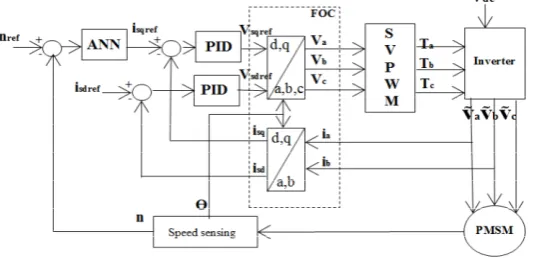
This paper proposed an ANN control method of FOC based on SVPWM to reduce the overshoot, steady state error and rise time. The ANN speed control is added to the speed controller to produce the speed reference. The block diagram of the proposed ANN speed controller of FOC for PMSM drive system is shown in Figure 2.
Figure 2. PMSM drive system with ANN controller
2.3. Proposed ANN Speed Controller Structure
[image:3.595.169.436.457.586.2]Figure 3. PMSM drive system with ANN controller
The controller consists of input layer, hidden layer and output layer. Based on number of the neuron in the layers, the ANN is defined as a 1-3-1 network structure. The first neuron of the output layer is used as a torque reference signal (a21=mf). The connections weight parameter between jth and ith neuron at mth layer is
given by wmij, while bias parameter of this layer at ith neuron is given by bmi. Transfer function of the network
at ith neuron in mth layer is defined by:
1
1
1 m
S
m m m m
i ij j i
j
n w a b
(5)The output function of neuron at mthlayer is given by:
( )
m m m
i i
a
f
n
(6) where: f is activation function of the neuron.In this design the activation function of the output layer is unity and for the hidden layer is a tangent hyperbolic function given by:
2 2
( ) 1
1 m i m m i n f n e
(7)
Updating of the connection weight and bias parameters are given by:
( )
( 1) ( )
m m
ij ij m
ij
F k
w k w k
w
(8)
( )
( 1) ( )
m m
i i m
i F k
b k b k
b
(9)
After the neural network architecture is modelled, the next stage defines the learning model to update network parameters. By this learning capability, it makes the ANN suitable to be implemented for the system with motor parameters which are difficult to define and vary against with environment. The training process minimizes the error output of the network through an optimization method. Generally, in learning mode of the neural network controller a sufficient training data input-output mapping data of a plant is required. Since the motor parameters of the PMSM drive vary with temperature and magnetic saturation, the online learning Back propagation algorithm is developed. Based on first order optimization scheme, updating of the network parameters are determined. The performance index sum of square error is given by:
2
1
( ) ( ) 2 i
i
IJPEDS Vol. 4, No. 3, September 2014 : 290 – 298
The gradient descent of the performance index against to the connection weight is given by:
m n
F F i
m m m
wij ni wij
(12)
The sensitivity parameter of the network is defined as:
m i m i F s n
(13)
m
m i
i m m
i i a F s a n
(14)
Gradient the transfer function again to the connection weight parameter is given by:
1 m m i i m ij
n
a
w
(15)From substitution Equation (13) and (15) into (8) the updating connection parameter is given by:
1
(
1)
( )
( )
1( )
m m i m m
ij i i i
w
k
w
k
s
k a
k
(16)With the same technique the updating bias parameter is given by:
1
(
1)
( )
( )
m m i m
i i i
b
k
b
k
s
k
(17)3. RESULTS AND ANALYSIS
The simulation result of the PMSM drive system is presented to verify the feasibility of the proposed ANN speed controller under various operating speed conditions. In this section the dynamic model of a three-phase PMSM, space vector PWM and neural network control model have been developed. The simulation is developed using Borland C++, and then embedded as S-function in Simulink-Matlab. The parameters for the motor are given in Table 1.
The simulation is observed during start up response which is by using constant references speed 100 rad/s with no load condition as shown in Figure 4. With the same reference speed, the simulations of both PID and ANN speed controllers are run simultaneously.
Table 1. Parameters of PMSM
Variables Parameter Value
P Poles 4 J Moment of Inertia 0.0008 [kgm²]
Ld,Lq Rs
λpm
d-q axis Inductance Armature Resistance
Flux
Figure 4. Start up response for ANN and PID speed controller
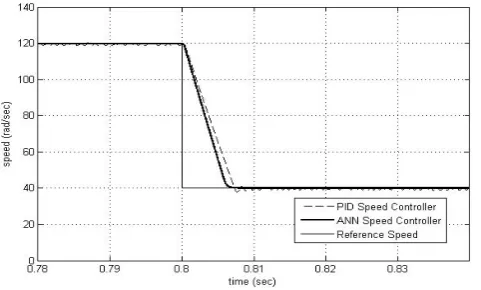
[image:6.595.192.422.347.489.2]From the results, it show that by using ANN speed controller produced a better start-up performance compare to the PID speed controller where the overshoot is totally removed and the settling time more faster than PID speed controller in achieving desired output speed . Second testing is observed during stepping-up and stepping-down response application. For stepping- up response, the speed reference is varying from 60rad/sec to 120rad/sec is shown in Figure 5.
Figure 5. Stepping-up response for ANN and PID speed controller
[image:6.595.185.426.583.728.2]IJPEDS Vol. 4, No. 3, September 2014 : 290 – 298
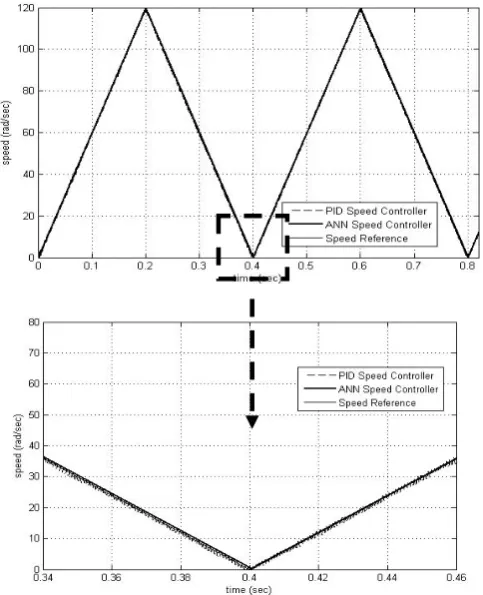
[image:7.595.185.427.126.424.2]The last testing, the simulation is verify by using triangular speed reference for both PID and ANN speed controllers as shown in Figure 7.
Figure 7. Output speed when using triangular speed reference
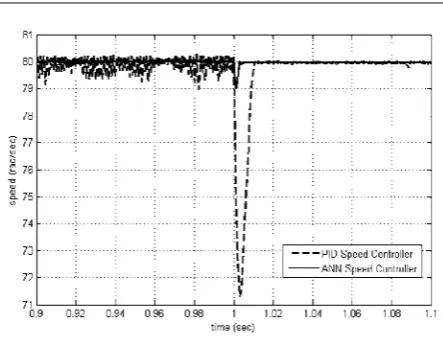
[image:7.595.93.516.535.675.2]Both system PID and ANN speed controller is also tested on the effect of nominal load disturbance. Figure 9 shows the load disturbance applied and Figure 8 shows the speed tracking response for both systems. The system is tested with value of 5 Nm load at 1.0s with 80rad/sec speed reference.
Figure 8. Load disturbance for PID and ANN speed controller
Figure 9. Output speed when load disturbance is applied
Refer to the Figure 8, at the initial both systems are running with no load. From Figure 9, it is obvious that the ANN controller drop the speed from 80rad/sec to 79rad/sec with great settling time. While, PID controller drop the speed from 80rad/sec to 71.3rad/sec with largest settling time. So, it show that that the
proposed ANN speed controller produce significant improvement control performance compare to the PID controller such as reduce overshoot, settling time and rise time speed response.
4. CONCLUSION
This paper has presented the modeling and simulation of the field oriented control for PMSM drive using online neural network controller. In order to investigate effectiveness of the proposed controller, some reference speed model was tested. The simulation study is realized in MATLAB program. The results of the proposed and conventional PID controller are plotted in the same speed graph with intention to make details comparison based on visual observation on steady state error, rise time and overshoot speed responses. It can be conclude that the speed performance of the PMSM can be improved by applying the online ANN controller scheme.
ACKNOWLEDGEMENTS
All the authors would like to express a sincere acknowledgment to Universiti Tun Hussein Onn Malaysia for the valuable support during completion this research and manuscript.
REFERENCES
[1] K Song, W Liu, G Luo. Fuzzy Logic Based Online Electromagnetic Loss Minimization of PMSM Drive. IEEE Transactions on Vehicle Power and Propulsion. 2008: 1.
[2] P Pillay, R Krishnan. Modeling, Simulation, and Analysis of Permanent-Magnet Motor Drives, Part 1: The Permanent-Magnet Synchronous Motor Drive. IEEE Transactions on Industry Applications. 1989; 25: 265-273.
[3] LK Wong, FHF Bung, PKS Tam. Combination of Sliding Mode Controller and PI Controller using Fuzzy Logic Controller. IEEE International Conference on Fuzzy System. 1998; 1: 296-301.
[4] M Marufuzzaman, MBI Reaz, MA Mohd Ali. FPGA Implementation of an Intelligent Current dq PI Controller for FOC PMSM Drive. IEEE Transactions on Computer Applications and Industrial Electronics(ICCAIE). 2010: 602.
[5] ES Sergaki, SP Georgilakis, AG Kladas, GS Stavrakakis. Fuzzy Logic Based Online Electromagnetic Loss Minimization of PMSM Drives. IEEE Transactions on Electrical Machines. 2008; 1.
[6] J Weidong, W Qunjing, C Quan, S Xiaofeng. SVPWM Strategy for Three-Level Inverter based on SVPWM Strategy for Two-Level Inverter. Transactions of China Electrotechnical Society. 2009; 24: 108-114.
[7] Y Yi, D Mahinda, MA Rahman. Implementation of an Artificial Neural Network based Real Time Adaptive Controller for an Interior PMSM. IEEE Transaction On Industry Application. 2003; 39: 96-103.
[8] KS Narenda, K Parthasarathy. Identification and Control of Dynamical Systems using Neural Networks,"IEEE Transaction Neural Network. 1990: 4-27.