University of Huddersfield Repository
Muhamedsalih, Hussam, Blunt, Liam, Martin, Haydn, Jiang, Xiang and Elrawemi, Mohamed
An interferometric autofocusing method for online defect assessment on a rolltoroll process
using wavelength scanning interferometry
Original Citation
Muhamedsalih, Hussam, Blunt, Liam, Martin, Haydn, Jiang, Xiang and Elrawemi, Mohamed (2014)
An interferometric autofocusing method for online defect assessment on a rolltoroll process
using wavelength scanning interferometry. In: Proceedings of EUSPEN 14th International
Conference 2014. EUSPEN, Dubrovnik, Croatia, pp. 177180. ISBN 9780956679031
This version is available at http://eprints.hud.ac.uk/id/eprint/20158/
The University Repository is a digital collection of the research output of the
University, available on Open Access. Copyright and Moral Rights for the items
on this site are retained by the individual author and/or other copyright owners.
Users may access full items free of charge; copies of full text items generally
can be reproduced, displayed or performed and given to third parties in any
format or medium for personal research or study, educational or notforprofit
purposes without prior permission or charge, provided:
•
The authors, title and full bibliographic details is credited in any copy;
•
A hyperlink and/or URL is included for the original metadata page; and
•
The content is not changed in any way.
For more information, including our policy and submission procedure, please
contact the Repository Team at: [email protected].
An interferometric auto-focusing method for on-line defect
assessment on a roll-to-roll process using wavelength
scanning interferometry
H. Muhamedsalih, L. Blunt, H. Martin, X. Jiang and M. Elrawemi
University of Huddersfield, UK
Keywords: auto focus, wavelength scanning, embedded metrology and PV defect
Abstract
The quality and lifetime of flexible photovoltaic (PV) modules is dependant on
having an effective vapour barrier layer which protects active elements from
environmental degradation. An effective flexible barrier layer can be produced by
employing a thin film of Al2O3 (40-100 nm thick) on a polymer substrate using
atomic layer deposition (ALD). By measuring the surface of the barrier coating
critical defects that will result in excess vapour transmission can be detected and
minimised. Such, knowledge of defect size, type and distribution forms a crucial
dataset for informing process control. This paper reports on a practical embedded
inspection technique to measure the surface topography of the thin ALD deposited
Al2O3 barrier film on a roll-to-roll manufacturing platform. The method combines
wavelength scanning interferometry (WSI) along with an auto-focus method.
Example measurements are given and discussed.
1 Introduction
Flexible PV cell degradation due to water ingress can be minimised and controlled by
implementing a thin (40-100 nm thick) barrier coating of Al2O3 using atomic layer
deposition technique (ALD). However, it has been found in previous studies that
there is a correlation between surface defects in the film barrier and the water vapour
transmission rate (WVTR) [1]. In order to guarantee the barrier condition, surface
inspection needs to be carried out during the roll to roll manufacturing process.
However, measuring the entire surface topography of barrier coatings over a large
area substrate, under laboratory conditions, is impractical and very time consuming.
measurement and is only able to sample of very small selected zones, effectively
batch sampling. In this paper the authors introduce a concept system using that
combines wavelength scanning interferometry (WSI) together with an interferometric
auto-focusing method in order realise the possibility of measuring surface topography
of a vapour barrier film across a large area on a roll-to-roll manufacturing platform.
2 The Wavelength Scanning Interferometer (WSI)
WSI is employed to measure the surface topography of the barrier coating and is
capable of generating surface maps with unambiguous height, without the well-known 2π phase ambiguity limitation, figure 1. The interferograms are produced
with no mechanical movement but by scanning the wavelength of a halogen light in
the visible region (683.4 nm-590.9 nm) using an acousto-optic tuneable filter
(AOTF). Such a measurement methodology can provide significant enhancements in
speed compared to comparable methods such as white light interferometry. In
addition, WSI can be stabilised against environmental disturbances by using an
active control of the reference arm, thus enabling nanometre scale measurements
with large amounts of environmental isolation [2]. This active control consists of a
reference interferometer which provides positional feedback and a piezo-electric
transducer which moves the reference mirror.
PI controller B.S
PZT
Reference mirror
Sample Objective lens (5X) SLED
Halogen lamp AOTF
CCD
AOTF
driver Edge-pass filter
Stabiliser WSI
Photo-detector
[image:3.420.63.315.339.459.2]Optical fiber
Figure 1: Configuration of the WSI
The system can compensate for disturbances in the optical path length up to a few
microns at 102 Hz. The reference interferometer is sourced by a super luminescent
diode (SLED) light source having a central wavelength of 820 nm and sharing the
detected by a photo-detector which monitors the SLED light only, via a dichroic
filter that allows the scanned visible light to pass through to the CCD. During the
measurement process, 256 interferograms are captured over a field of view of
640x480 pixels. A periodic interference pattern produced for each captured pixel is
analysed individually using Fourier transform algorithm. The full analysis of all the
pixels is accelerated by parallelising the computation with a many-core graphic
processing unit (GPU). The WSI can capture and generate a full areal topography in
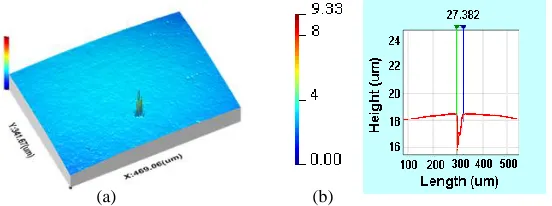
3.7 seconds. Figure 2 shows a defect of 1.85 µm amplitude and 27.4, µm width
captured using 5X objective lens.
(a) (b)
Figure 2: (a) Surface topography and defect on Al2O3 film (b) defect profile section
3 Auto-Focusing interferometric method
An effective auto-focusing methodology is crucial to the successful implementation
of the WSI for large flexible substrate measurement. The flexible substrate is held
by an air-bearing system but surface undulation is still substantial across the 500
mm web width. Fast, automated positioning of the WSI head so its focal point is at
the top layer of Al2O3 barrier is needed which must also be robust against the
possibility of mis-focusing due to the multilayer structure of the web. The
auto-focus method is based on tracking the peak of the coherence envelope of the
reference interferometer sourced by the SLED while the head is moved normal to
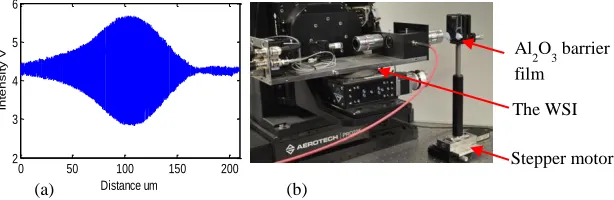
the web. Figure 3 shows a proof-of concept experiment which uses a sample of the
web mounted statically. The substrate of Al2O3 coated film barrier is attached to a
stepper motor in order to translate the film through the focal plane of the WSI
objective lens. Simultaneously the intensity response is monitored by the reference
interferometer, with the maximum intensity (coherence envelope peak) being found
[image:4.420.81.357.182.285.2]acquired continuously from the encoder of the stepper motor in order to map the
physical position of the translation stage to peak position of the coherence envelope.
This information allows the stage to move to the precise point of focus after the
scan. The speed of the auto-focusing method is dependent on the speed of motorised
translation stage. For the reported proof-of-principle experiment, the the auto-focus
routine, using a 1 mm translation distance, took approximately 0.6 second.
(a) (b)
Figure 3: (a) The coherence envelop (b) The WSI along with auto-focus method
4 Summary
This paper reports a practical implementation of wavelength scanning interferometry
and an interferometric autofocusing technique that will be used to measure surface
topography of the barrier film within a roll-to-roll manufacturing platform. The
finalised system will provide rich data on critical defects in vapour barrier layers
produced using a roll-to-roll ALD process. The speed of throughput and scope for
substrate coverage is improved substantially over off-line techniques for generating
surface topography information.
Acknowledgements
To EPSRC for grant EP/I033424/1 and EU FP7 programme for NanoMend project NMP4 LA-2011-280581.
References:
[1] Blunt et al., (2013) „In-line metrology of functional surfaces with a focus on defect assessment on large area Roll to Roll substrate‟. In: Proceedings of the 13th euspen, Berlin, pp. 71-74. ISBN 13:978-0-9566790-2-4.
[2] X. Jiang et al., (2010) “Fast surface measurement using wavelength scanning interferometry with compensation of environmental noise” Applied Optics, Vol. 49, No. 15.pp/ 2903.
0 50 100 150 200
2 3 4 5 6
In
te
n
si
ty
V
Distance um
Stepper motor The WSI
Al
2O3 barrier
[image:5.420.58.365.139.239.2]