2017 3rd International Conference on Computer Science and Mechanical Automation (CSMA 2017) ISBN: 978-1-60595-506-3
A Microblog User Interest Model Based on Participated and Not
Participated Data
Wei-Hong LIN
1and Jiu-Yang TANG
21
National University of Defence Technology, Changsha, 410073, China
2Collaborative Innovation Center of Geospatial Information Technology, Wuhan, 430079, China
Email: [email protected], [email protected]
Keywords: User interest, Forgetting mechanism, Participated and not participated interest, Micro-blog.
Abstract. Oriented to the social network and media such as micro-blog, this paper presents a constructing way of user interest model. Based on the date whether user participated or not, user interest was divided into participated part and not-participated part. Instead of gaining friends’ interests and then considering the immediate effect towards user’s interest, the influence of friends’ interests take effects through the long-term friends-generated user-participated data explicitly and the short-term friends-generated user-not participated data implicitly. Forgetting mechanism helped modelling the user interest drift. Simulated experiments verify the proposed user interest modelling method is effective and the not participated data plays a more important role than the participated data.
Introduction
With the development of social platforms, people are more likely to gain information through the ways of active following and passive accepting in the platforms than input the search term into the search engine. Aimed at improving the user satisfaction index, user interest has become a basic module of the social platforms[1]. Except the explicit interest like tags defined by users and user profiles, platforms gain the potential and dynamic interests of users by mining the log history, operational behaviours of users and their friends.
Getting user interest has become the precondition of satisfying the users’ personalized information needs. Social platforms have their own user interest model frameworks and extract valuable information from the mass data. Current frameworks obey the rules: i. Construct the user interest using user profiles and log history, ii. Combine the friends’ interest with the user interest to get real interest approximately. However, considering the friends’ influence by directly combining their interest is ignorance toward the different effects of various types of friends’ logs. The logs that user participated can reflect user’s interest and the logs that user hadn’t participated may reflect user’s interest in a different way.
In this paper, we model users’ interests in a novel framework consisting of participated interest and not participates interest. The participated interest is based on the logs with user’s actions. Long-term accumulated participated interest can indicate stable user interest. The not participated interest is based on the logs produced by friends and without user’s actions. Short-term not participated interest can indicate friends’ interests and the focus of user community. Based on microblog dataset, experiments show that models under the proposed framework work better than under the traditional framework in terms of predicting user real-time interest. Meanwhile, not participated interest occupies a greater proportion than participated interest.
Related Work
The general approach[2] keeps a single window observing the changing contexts which can induce the drifts of target concepts, updates contents of the window as time goes by, and adjusts the size of window dynamically according to the system’s behaviour such as the extent and rate of concept drift. The paper [3] thinks that fixed interval window is unsuitable to the long simulations and then uses the sliding time windows. Whether the window length is adequate or not is depending on the specific system and detected data features. It uses the multiple sliding time windows to detect data feature and recognize types of features. The paper [4] proposed a method to maximise the classification accuracy on recent data by detecting concept drift and optimizing the size of the time window. The method can be used with learning algorithms like KNN, ID3 and NBC. Aiming at the problem of user interest drift and user profile optimization, the paper [5] uses classification error-rate to track user interest drift and optimizes time window size automatically with user profile. The paper [6] proposed a user interest model based on forgetting mechanism. Short Term Interest Models (STIM)and Long Term Interest Models (LTIM) describe user’s interests with weak and strong stability individually. The forgetting functions are exponential functions and the exponential parts control the forgetting rate. The authors adopt three strategies to determine the size of window when modelling short term interest. All posts of users are adopted as the foundation of LTIM and various weights are allocated to the posts. STIM and LTIM adopt different forgetting formulas. Aiming at recommending appropriate microblogs to users, the paper [7] proposed an approach which can integrate long term and short term interest based on LDA model seamlessly. It infers the user‘s interest vector and sorts the new published microblogs by matching the microblogs with user’s recent interest vector.
The frameworks of user interest models mentioned above, either construct the user’s interest merely on user generated content, or combine user’s interest vector with friends’ interest vector to get a new interest vector of user according to the social relationship. They take no further steps to analysewhether those friends generated and user participated content exert the same effects on the user interest as those friends generated and user not participated content do. This paper proposes a novel user interest model framework based on participated interest and not participated interest, and tests the time window-based models and forgetting mechanism-based models respectively in the existing interest model framework and proposed novel interest model framework.
Representation and Modeling of User Interest
The logs history which user generated is mined to model user interest initially, and the not participated data generated by user’s friends recently is taken into consideration with the forgetting mechanism as an extra effect on the modeling of user interest.
User Interest Model Framework
The existing user interest models are mainly based on the data of user behaviors including browse, comment, retweet and tweet and so on. And the data generated by friends is used to produce the friends’ interests which have an impact on user’s interest through the relationship network as given in Equation 1 and shown in Figure 1(a).µ is the proportion of user’s initial interest and (1-µ) is the proportion of friends’ initial interests. ωk means the interest influence weight of kth friend on user.
← + (1 − ) ( + ⋯ + ) (1)
(a) (b)
Figure 1. User interest model framework.
← + + ⋯ + (2)
[image:3.612.79.537.319.404.2]Microblog user interest model consists of four parts: log preprocessing, log classification, user interest generation and user interest updating. The structure is shown in Figure 2.
Figure 2. The structure of user interest model.
Representation of User Interest
Distinguished from the topic extraction of traditional long texts, we adopt LDA topic model mining the topic distributions of logs. The accumulation of topic distributions forms the user interest vector.
LDA Topic Model
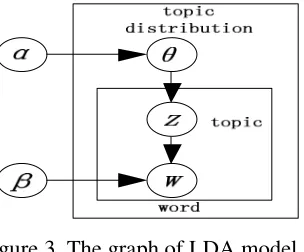
To obtain the topic of micro blog text, researchers adopt LDA and its modified models [8]. LDA model was proposed by David M. Blei, Andrew Y. Ng, and Michael I. Jordan in 2003 as a Bayesian model consisting of three layers: words, topics, documents. Its model structure is shown in Figure 3.
Figure 3. The graph of LDA model.
[image:3.612.235.387.570.696.2]a derived microblog should be replaced with the combination of its own initial topic distribution and the topic distribution of its original microblog. (w1, …,wk) is a topic distribution of a microblog.
(, ⋯ , )! = # × (, ⋯ , )% + (1 − #) × (, ⋯ , )&%% (3) User Interest Vector
The representations of user interest have three types: based on keywords, based on concept and conceptual hierarchies, and semantic based approaches [9]. Here python package jiebais adopted to extract the keywords of user generated content. The user interest is mapped into the topic vector space with the approach based on concept and conceptual hierarchies. As given in Equation 4, participated logs include the original blogs, retweet blogs and comment blogs while not participated logs include the blogs generated by friends without users’ behaviors.
=µ× ∑(, ⋯ , )!+ (1 −µ) × ∑(, ⋯ , )! (4)
Modeling of User Interest
Time Window-Based User Interest Model
User interest models based on time window follow the ideas that only recent data can reflect user’s interest, a time window is set to observe the recent data and the data before the window should be abandoned. As given in Equation 5, W represents (w1, …,wk), t denotes the micro blog’s time
attribute, T means the current time and ∆T denotes the size of time window.
(!!= ∑*+∆*,,* )! (5) Forgetting Mechanism-Based User Interest Model
User interest models based on forgetting mechanism follow the ideas that human interests wane as time goes by, forgetting speed slows down gradually and the accumulated interests become more stable [6]. As given in Equation 6 and 7, t denotes the micro blog’s time attribute, T means the current time and F(t, T) denotes the function satisfying the features of Ebbinghaus forgetting curve [10].
& = ∑)!× -(, .) (6) -(, .) = /0123 (7) Considering that in different topics or fields, a single friend affects the user to various extents with different probabilities. We denote the interest influence probability as IIP(user, friend, T) as given in Equation 8. F(t, T)is used to reduce the weight of micro blog. And IIP(user, friend, T) is set to be 0.01 as a minimum threshold for each topic if user takes no actions toward friend’s generated content.
4(5678, 98:7;, .) = ∑ABC2DEDAB2>F2G01∆0 <=>?×@(,*)
∑ABC2DEDAB2>F B=F =H2 ABC2DEDAB2>F2G01∆0 <=>?×@(,*)
(8)
Evolution of User Interest
Dynamic user interest models perform better than static user interest models at predicting user’s real time interests. Forgetting mechanism takes effect in the topic distributions and interest influence probability. A hybrid model based on time window and forgetting mechanism is given in Equation 9.
Int = ∑*+∆*,,* )!× -(, .) (9)
IntLMNO= μ ∑VWOXYZYVWXN[\+∆\,X,\ WRNSF(t, T)+ (1 − μ) ∑ ∑]OYNR[MWRNSF(t, T) × R^X VWOXYZYVWXN[
\+∆\,X,\
IIP(user, friend, T) (10)
Experiments and Results
[image:5.612.101.509.467.604.2]We use the Micro blog dataset crawled from October 2015 to March 2016. We select out the users whose Chinese characters text proportion is over 95% as the seeds. The logs and profiles of those users and their friends are chosen to form the final dataset. The statistical information of the final dataset can be seen from table 1. We analyze the 218486 logs in October and find there are 142956 original logs of seed users, 9727 logs that seed users retweet or reply to strangers, 20961 logs that seed users retweet or reply to their friends. In fact, the number of logs generated by friends is 44842 that mean the participated data occupies 46.7% proportion and 53.3% is the not participated data. As the number of users’ concerned relationship increases, the proportion of not participated data grows higher.
Table 1. Statistic Information of Microblog Dataset.
Object Users Concerned relationship
Total logs Tweet(original) logs
Retweet logs Reply logs
Value 753795 2651326 2009830 1340688 436330 232812
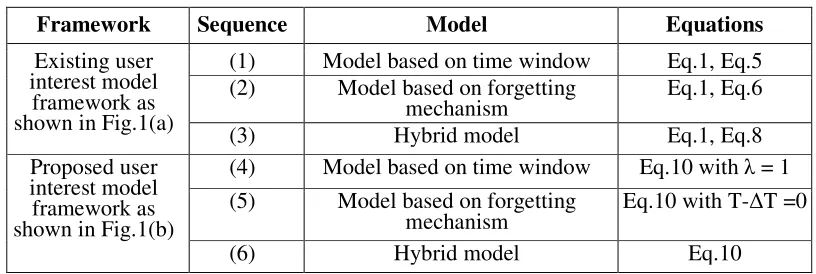
Several parameters of LDA model need to be determined including topic number K, iterations, alpha and beta. Xing Wei and W. Bruce Croft find that retrieval results are not sensitive to the values of alpha and beta [11]. We adopt the common settings that alpha equals to 50/K and beta equals to 0.01. We test with different values of K to find the optimal K value. Iterations is set to be 500 in order to gain a good topic model with less time. η in Eq.3 is set to be 0.6 or 0.8. And µ in Eq.10 is to be set from 0 to 1, 0.1increments each time. We set H in Eq.7 to be 8 hours and find the optimal λ is 0.7 after testing λ from 0.2 to 0.9 with 0.1 increments each time. Experiments contain three models in two frameworks as shown in table 2.
Table 2. Experiments Model Setting.
Framework Sequence Model Equations
Existing user interest model
framework as shown in Fig.1(a)
(1) Model based on time window Eq.1, Eq.5
(2) Model based on forgetting
mechanism Eq.1, Eq.6
(3) Hybrid model Eq.1, Eq.8
Proposed user interest model framework as shown in Fig.1(b)
(4) Model based on time window Eq.10 with λ = 1
(5) Model based on forgetting
mechanism Eq.10 with T-∆T =0
(6) Hybrid model Eq.10
We adopt the precision of interest prediction to evaluate the results of experiments. Ranking the topics with user interest distribution and the topics with microblog topic distribution separately, and then calculate the top topic of microblogs’ score in the user’s top-k interests as given in Equation 11 and 12. Mid is the identifier of microblog.
result( = h0, :9 jk:l1, :9 jk:l∉ :7876+
∈ :7876+ (11) score =∑qDF ∈rB2Bs>2%qDF
With the settings above and ∆T = 3 days, top-k = 3, we get average scores of models corresponding to different topic number K as shown in Figure 4.
Figure 4. Average scores of models corresponding to different topic number K.
We can see the optimal topic number is 20 and the average score starts to decrease once the topic number K is over 20. It verifies again that excessive topics are not suitable for short text like microblog. Compared the results of model 1,2,3 with model 4,5,6, we find that the models under the proposed framework based on participated and not participated interest perform better than the models under the existing framework. Under topic number K=20, model 4 has a 4.4% increment comparing with model 1,model 5 has a 6.1% increment comparing with model 2,model 6 has a 5.13% increment comparing with model 3.
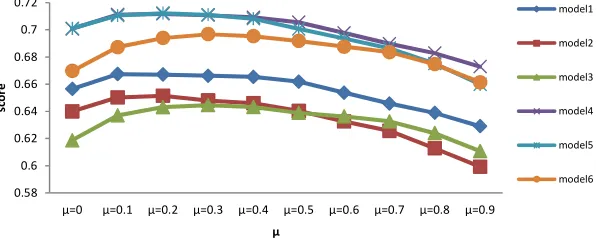
With the changed settings and optimal topic number K=20, we get scores of models corresponding to different values of parameter µ as shown in Figure 5. We can see that model 4,5 and 6 perform better than model 1,2,and 3. The optimal value of µ is different to six models. As a whole, the optimal values of µ for models in the proposed framework are bigger than those in the existing framework. The scores of models decrease monotonically once µ is over the optimal value. The optimal value of µ is less than 0.4 which means the not participated interest plays a more important role than the participated interest in predicting user’s real time interest. It shows that not participated data generated by friends recently can reflect the hotspots of user community in a certain extent and give rise to the drift of user interest.
Figure 5. Scores of models corresponding to different values of weight µ.
Conclusion and Expectation
Aiming at the problem of predicting the real-time interest of user, this paper proposes a user interest model based on the participated data and the not participated data. Experiments show that user interest models in proposed framework perform better than those in traditional framework. Existing methods mainly rely on the participated data but the results of experiments find that the not participated data plays a more important role. In further research work, we will concentrate on optimizing the size of time window dynamically and recommending useful information to users with their real-time interests.
0 0.2 0.4 0.6
10 20 30 40 60 80 100
a
v
e
ra
ge
s
co
re
topic number K
model1 model2
model3 model4
model5 model6
0.58 0.6 0.62 0.64 0.66 0.68 0.7 0.72
μ=0 μ=0.1 μ=0.2 μ=0.3 μ=0.4 μ=0.5 μ=0.6 μ=0.7 μ=0.8 μ=0.9
sc
o
re
μ
model1
model2
model3
model4
model5
[image:6.612.157.458.475.596.2]References
[1] Nozomi Nori, Danushka Bollegala, Mitsuru Ishizuka, Exploiting User Interest on Social Media for Aggregating Diverse Data and Predicting Interest. ICWSM, 109, B3, 241–248, 2011.
[2] Gerhard Widmer, Miroslav Kubat, Learning in the Presence of Concept Drift and Hidden Contexts. Machine Learning 23,1, 69-101, 1996.
[3] Armengol, J., Vehi, J., Travé-Massuyès, L. and M.A. Sainz, Interval Model-Based Fault Detection using Multiple Sliding Windows. IFAC SAFEPROCESS’00, Budapest, Hungary, 168-173, 2000.
[4] I. Koychev , R. Lothian, Tracking drifting concepts by time window optimization, in Proc. 25th SGAI Int. Conf. Innovat. Tech. Appl. Artif. Intell., 46–59, 2005.
[5] HongxiaoFei, Yi Dai, Jun Mu, Qinjing Huang, Guiqiong Luo, Method of drifting user's interests based on time window optimization , Computer Engineering, Vol. 8, 210-214, 2008.
[6] Yuan Cheng, Guang Qiu, Jiajun Bu, Kangmiao Liu, Ye Han, Can Wang, Chun Chen, Model bloggers' interests based on forgetting mechanism, WWW, 1129-1130,2008.
[7] Chen Jie, Liu Xue-jun, Li Bin, Personalized Microblogging Recommendation Based on Long-term and Short-Long-term Interest of User, Journal of Chinese Computer Systems, 37, 5, 952-956, 2016.
[8] Bo Huang, Yan Yang, Amjad Mahmood, Hongjun Wang, Microblog Topic Detection Based on
LDA Model and Single-Pass Clustering. RSCTC: 166-171, 2012.
[9] Sun Yusheng, Liu Wei, Qiu Rongrong, et al, Research Development of User Interest Modelling
in China, Journal of Intelligence, 32, 5, 145-149, 2013.
[10] Murre, J.M. and Dros, J. Replication and analysis of Ebbinghaus’ forgetting curve. PloS one, 10, 7, 1-23, 2015.
[11] Xing Wei, W. Bruce Croft, LDA-based document models for ad-hoc retrieval, SIGIR, 178-185, 2006.