2017 2nd International Conference on Computer, Network Security and Communication Engineering (CNSCE 2017) ISBN: 978-1-60595-439-4
A Data Encryption Transmission Scheme Based on WiFi
Xiao-rui SONG
1,*, Li-min SONG
2and Rong-xi
HE
3Collage of Information Science and Technology, Dalian Maritime University, Dalian Liaoning 116026,China
*Corresponding author
Keywords: WiFi encryption, RSA, AES, SHA, The socket communication.
Abstract. Aiming at the wireless local area network data transmission is not security, this article has carried on the further research. Because of WiFi itself security system imperfect, so the design is on the basis of the WLAN security system, using a combination of RSA and AES to double encryption of the message, at the same time combined with SHA algorithm to calculate the hash value as a digital signature, so as to ensure the confidentiality of transferring data, integrity, and non-repudiation. This design also uses Java programming for point-to-point socket communication to verify the safety and feasibility of the scheme.
Introduction
With the development of information technology, network has increasingly become important information exchange means in the field of agriculture, industry, national defense, and gradually permeates into every area of society. The current wireless networks as the mainstream media of modern data transmission has been widely used. At the same time, network security issues have become increasingly urgent, if data to be intercepted and tampered with, it would violate the interests of the users and even nation[1]. The general wireless network security methods including WEP and WPA is no longer safe, such as WiFi password can be cracked easily, and data of transmission is not reliable. So this scheme decides to adopt the end-to-end data encryption technology[2]to transmit the data package. End-to-end encryption is to point that opening a special security channel for data transmission, in this process, information always has been in a encryption state, only the transmitter and the receiver know the decryption method, even if the content of message to intercepted by computer hackers, it is also very difficult to decrypt the content, and all transmitted data packages within a line ensure the content of the message without the hand of others, so that solve the problem of message leaking and tampering .
Brief Description of Encryption Algorithm
Symmetric Encryption Algorithm
American ANSI launched a collection of activities of AES in 1997, finally the NIST decided to choose Rijndael as new AES in 2000[3]. Rijndael algorithm is an iterative block cipher, its input and output is 128 bits, and the key length can be 128, 192, or 256 bits. Nr is encryption round number, the size of Nr has relationship with key length and group size. For example, clear text block length and key length all is 128 bits, the corresponding encryption round number Nr is 10. AES128 encryption process run in a byte of 4 * 4 matrix, the matrix is referred to as the "state". The concrete encryption and decryption process please see section 5.2 the AES algorithm principle in the book “Password coding and information security: C++ practice”.
The round function includes four parts: ByteSub, ShiftRow, MixColumn and AddRoundKey[4]. ByteSub: The state matrix to be input is transformed with the S-box substitution table nonlinearly, which makes each state word is replaced by the corresponding bytes. ShiftRow: the row of the state matrix of the input shall be carried out shift cyclically in accordance with the different offsets. MixColumn: each column of the state matrix is treated as a polynomial a(x) on GF (28), with a fixed
polynomial c(x) to model(x4+1) multiply. AddRoundKey: the corresponding byte in the round key
state is XOR by bit.AES's key generates the sub_key of each round by key expansion .AES128 is inputting 4 words (16 bytes) key, through the key expansion to generate 11 4-word round key for the initial round key plus 10 round function later.
Asymmetric Encryption Algorithm
RSA algorithm can be used both for data encryption and for digital signatures. Its reliability is based on the difficulty of big integer factorization[5], as long as there is enough length of key, the algorithm is difficult to be cracked. Specific steps of the generation of public key and private key are as follows:
(a).Generate two confidential large prime p and q randomly;(b). Calculate n = p * q; (c).Calculate the Euler function value: φ (n) = (p-1) (q-1);(d). choose a integer e, meet 1<e<φ(n), and meet the gcd (e,φ(n)) = 1, that is e and φ(n) relatively prime; (e).According to extended Euclidean algorithm, d is calculated by d*e≡1 (mod (p-1) (q-1));(f) (e, n) is the public key, and (d, n) is the private key.
When using the RSA algorithm to encrypt and decrypt, it is necessary to group the plaintext and ciphertext bit strings, assuming that each plaintext is grouped into m and the ciphertext is c.Encryption for c ≡ me (mod n),decryption for m ≡ cd (mod n).
Secure Hash Algorithm
The Secure Hash Algorithm SHA[6] is a message digest that can calculate any message of less than 264 bits into a fixed length of 160 bits. The processing steps of the algorithm mainly include five parts:
A Data Encrypted Transmission Scheme for Industrial Control
In the industrial production, the operator often needs to communicate with the remote machine to complete some operation through the wireless network. The transmitted data must keep integrity and confidentiality. Otherwise, if the information the receiver receives is inconsistent with the sender sent, he performs the wrong instruction, the consequence will be unimaginable. So it becomes crucial to ensure that the data cannot be easily steal and freely tampering by others.
This paper comes up with a more secure data transmission scheme that encrypting data packets at the sending end, transmitting them in ciphertext, and decrypting the data packets at the receiving end. This scheme has combined the traditional symmetric encryption algorithm AES with the asymmetric encryption algorithm RSA, first two-ways identification each other, only succeed, can the message be transmit .At the same time, inserting the random number ciphertext randomly in the transmitted data packets in order to reduce the possibility of data successful crack after being intercepted by a third party. The specific process is as follows:
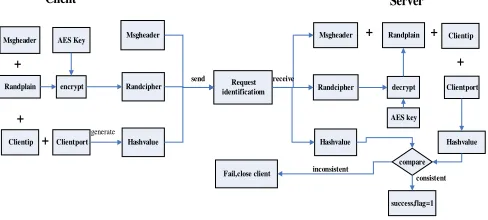
(A)In order to validate the client's legitimacy, the client need to send the request identification to the server, the specific format is: Message header + random ciphertext + hash value. The detailed process is shown in Figure 1.
Msgheader
Randcipher
Hashvalue AES Key
Randplain encrypt Msgheader
Clientip + Clientport
Request identificatiom send
Server Client
Msgheader
Randcipher
Hashvalue
Randplain Clientip
Clientport
Hashvalue decrypt
AES key
+ +
compare
Fail,close client inconsistent
generate
receive
success,flag=1 consistent
+
+
[image:3.612.186.430.314.424.2]+
Figure 1. Server identifies client.
Since the program is used in a specific industrial production, the server and the client can know the message header and AES key in advance. The random number is encrypted by AES key. The input of Hash Function is the message header, random number plaintext ,client IP address and port ,finally calculate the hash value, as shown in Figure 2.After receiving the message header and random number ciphertext, the server decrypts the random number ciphertext, and then combines the IP address and port of the connected client to calculate the hash value, compare the received hash value with the calculated Hash value, if consistent, it proves that the client’s identification to the server is successful, otherwise the identification fails, the server disconnect the illegal client, as shown in Figure 3.
Figure 2. Client requests identification to server. Figure 3. Server receives identification.
Msgheader public cipherkey Randcipher hashvalue encrypt AES key public key Randplain Msgheader generate Send public key
Msgheader public cipherkey Randcipher hashvalue decrypt AES key public key Randplain Msgheader + hashvalue generate send receive
compare Receive public key
unsuccessfully
[image:4.612.192.420.73.206.2]Receive public key successfully inconsistent consistent Server Client + + +
Figure 4. Client receives RSA public key.
To prevent an illegal user from disguising as a server to send public key to the client, the server sends RSA public key that requires AES key encryption and hash value as a digital signature to represent the real server. The input of Hash function is the message header, RSA plaintext and random number plaintext, as shown in Figure 5, 6. Similarly, the client receives the message header, RSA public key ciphertext and random number ciphertext, decrypts them respectively, calculates the hash value, and then compares it with the received hash value. If consistent, it proves that the server sends the public key to the client successfully, otherwise it fails and needs to send again, as shown in Figure 7. In this regard, the identification has finished.
[image:4.612.179.438.575.716.2]
Figure 5. Server encrypts RSA public key. Figure 6. Server sends RSA public key.
Figure 7. Client receives public key.
Send encrypted message Msgheader Magplain Hashvalue Randplain + + Public key encrypt encrypt AES key Msgheader Msgcipher Randcipher Msgheader Magplain Hashvalue Randplain Private key decrypt decrypt AES key Msgheader Msgcipher Randcipher Hashvalue cpmpare generate
Failure to encrypt message encrypt message successfully inconsistent consistent Server Client + + generate
(C) If the identification are successful, they can send encrypted information to each other. The specific format sent by the client is: message header + encrypted message + random number cipher + hash value. The specific process shown in Figure 8.
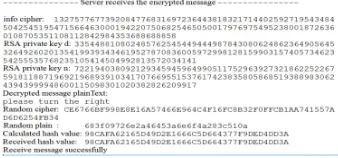
The input of Hash function is the message header, message ciphertext, and random numbers plaintext, as shown in Figure 9. The server receives the encrypted message and decrypts it with the RSA private key. The random number is decrypted with the AES key and then compute the hash value, compare with the received hash value, judge whether the received message is correct, as shown in Figure 10.
[image:5.612.337.506.189.268.2]
Figure 9. Client sends message. Figure 10. Server receives message.
(D) The server sends information similar to the client. The only difference is that the encrypted information is encrypted with the RSA private key. The client decrypts it with the RSA public key. The result is shown in Figure 11 and Figure 12.
Figure 11. Server sends message. Figure 12. Client receives message.
The scheme improves the security of data transmission through identification and encryption of two parts greatly. The identification part can prevent the illegal client from accessing the server at will. Once the identification fails, the server immediately closes the connection with the client, and all subsequent operations will be invalid. The RSA public key is encrypted by AES key encryption to further improve the security of the key transmission. After the success of the identification, if it was attacked by hackers, each generated random number is arbitrary, doping in the encrypted message which makes it difficult for the attacker to determine the length of the specific ciphertext and the location of specific encrypted information, and therefore cannot break. The end of the message add hash value, once opposite side find hash value are inconsistent ,can he infer that there are illegal attackers. Such a tight communication system is bound to bring great challenges to the attacker.
Conclusion
pass the certification. The final system have been gotten the Panasonic company in Japan to test, test tool also can not break this protocol, again proved the reliability of the system. So the program can not only be applied to industrial production to achieve the safe transmission of data, but also in other areas to achieve its application value.
Acknowledgements
National Natural Science Foundation of China (61371091), Dalian Maritime University "thirteen five" key research projects (3132016318).
References
[1] Wang Qinghong. Design and application of security model for data encryption network communication system [J]. Computer Security, 2013, 09: 46-48.
[2] Dong Haijun. Data encryption technology in computer network communication security research [J]. Electronic Testing, 2016, 11: 94-95.
[3] Jie City ho. Graphic password technology [M]. Beijing: People's Posts and Telecommunications Press, 2015.1.
[4] Yang Bo. Modern cryptography [M]. 3. Beijing: Tsinghua University Press, 2015: 95-96.