2017 2nd International Conference on Computer Engineering, Information Science and Internet Technology (CII 2017) ISBN: 978-1-60595-504-9
Energy-Efficient Scheduling of Writers/Readers
Problem with Lock-Free Objects
JING LI
ABSTRACT
To reduce energy consumption of embedded real-time system with dependent tasks caused by resource sharing, an algorithm called Writer Reader Aware Speed Assignment (WRAS) was proposed to divide tasks into writers and readers and then calculate proper speeds for every writers and readers under the Earliest Deadline First (EDF) policy. The difference from prior work is the using of lock-free and wait-free protocol for synchronization, most prior researches were based on the lock-based protocol. Many simulations have been done to test the proposed algorithm, compared with existing work, WRAS performs better in energy saving, the lowest energy consumption can be get when using wait-free protocol where all tasks execute at the lowest speed.
INTRODUCTION
Nowadays, embedded systems are used widely in people’s lives and many scientific fields, most prior work were focused on how to improve the performance of a system. Currently, one of the most critical design problem of many battery-driven real-time embedded systems is how to reduce energy consumption so that the battery life will be prolonged1. Energy consumption has become the major evaluating indicator whether an embedded system is good or not, alongside more traditional performance metrics like the speed of execution.
The power consumption consists of static and dynamic two parts. The static power consumption is mainly produced by leakage currents; it is a static value to a system. The dynamic power consumption2 can be calculated as follows:
𝑃𝑑𝑦𝑛𝑎𝑚𝑖𝑐 = 𝐶𝐿× 𝑉𝑑𝑑2 × 𝑓𝑐𝑙𝑜𝑐𝑘 (1)
where 𝐶𝐿is the switched capacitance, 𝑉𝑑𝑑is the supply voltage, and 𝑓𝑐𝑙𝑜𝑐𝑘is the processor clock frequency which can be simply calculated as 𝑘 × 𝑉𝑑𝑑, where 𝑘 is a constant related to the processor. So the dynamic power consumption can be simply expressed as follows:
𝑃𝑑𝑦𝑛𝑎𝑚𝑖𝑐 = 𝐾 × 𝑓𝑐𝑙𝑜𝑐𝑘3 (2)
Where K is a constant.
Dynamic voltage scaling (DVS) is a technique using the character of equation _________________________________________
(2) To dynamically assign the processor clock frequency to change the dynamic power consumption. 𝑓𝑐𝑙𝑜𝑐𝑘 is referred as processor speed S. A simple way to reduce energy consumption is to slowdown the speed of the processor when it is not fully utilized. It will obviously incur an impact on the performance of the system due to the low speed. However, the late completion is allowed as long as the real-time systems meet their deadlines.
Many energy-efficient DVS scheduling algorithms have been proposed in the field of independent tasks, the problem of DVS with dependent tasks caused by resource sharing has been mentioned in recent decade. Most real-time embedded systems contain concurrent accesses to shared resources, resulting in various synchronous problems. Many prior researches have been done to improve such instance. There are three traditional solutions: (1) lock-based—e.g., Priority Inheritance and Priority Ceiling protocols; (2) lock-free3; (3) wait-free—e.g., NBW protocol4, Chen’s protocol5, Improved Chen’s protocol6.
Jejurikar and Gupta7 have proposed CSMS algorithm to let the non-critical section executes at a relatively low speed, and the critical section executes at the maximum speed. Later Chanson8 et al. proposed the dual speed (DS) algorithm, the main point is also using two speed strategy. Lee9 et al. improved the DS algorithm, they calculated multiple speeds for the critical section, and the non-critical section also executes at one low speed, the algorithm is called Multi-speed (MS) algorithm. Elewi10 et al. later developed MS algorithm to IMS algorithm by reducing the length of high speed interval. All these algorithms are based on the lock-based protocol.
Different from those work, lock-free and wait free protocol are used in this paper. We assume that the dependent tasks may access lock-free or wait-free sharing objects, all these tasks can be divided into two parts: writers and readers, and they are scheduled by the EDF scheduling policy. A new algorithm called Writer Reader Aware Speed Assignment (WRAS) is proposed to calculate proper speeds for tasks execution. The feasibilities of the WRAS algorithm were evaluated by a set of simulations. As a result, the WRAS algorithm performs well in energy saving.
The rest of this paper is organized as follows: Section II presents the system models. Section III presents the WRAS algorithm. Section IV presents the simulation results. Finally, Section V is the conclusion.
·SYSTEM MODEL
In this paper, we consider a real-time task scheduling on an ideal DVS processor which can operate at any speed between its minimum speed and maximum speed. Without loss of generality, we set the maximum speed 𝑠𝑚𝑎𝑥= 1, and all other speeds are normalized with respect to 𝑠𝑚𝑎𝑥.
The power consumption can be simply defined as a function 𝑃𝐶(𝑠) of the real-time processor speed 𝑠. In prior research, different kinds of 𝑃𝐶(𝑠) have been proposed, Chen et al. proposed 𝑃𝐶(𝑠) of Marvel XScale approximated by 0.08 + 1.52𝑠3 Watt. As the speed 𝑠(𝑡) is a function of the time 𝑡, so the energy consumption 𝐸𝐶(𝑡1,𝑡2] in the time
interval (𝑡1, 𝑡2] is ∫ 𝑃𝐶(𝑠(𝑡))𝑑𝑡 𝑡2
𝑡1 .
assume that 𝐴𝑖= 0 𝑎𝑛𝑑 0 ≤ 𝐶𝑖≤ 𝐷𝑖= 𝑇𝑖, ∀𝜏𝑖∈ 𝒯. It means that every task is released at time 0 and the relative deadline is equal to the period. The shared lock-free objects are expressed as 𝒪 = {𝑜1, 𝑜2, … , 𝑜𝑚}. Let 𝐿𝑖 be the execution time of one retry loop for a single one object, and 𝐿𝑚𝑎𝑥 be the worst-case execution time of a retry loop for any object. Further, 𝑂𝐴(𝜏
𝑖) = {𝑜𝑖,1, 𝑜𝑖,2, … , 𝑜𝑖,𝑛𝑖} is defined as the list of lock-free objects that the task 𝜏𝑖 will access, it is obviously that 𝑛𝑖≤ 𝑚.
The tasks are divided into writers and readers. For convenience, we regard "𝑤" as a writer task, and "𝑟" as a reader task. We let 𝑤𝑓 represent the probability that a job will experience an interference. A task will experience an interference if it executes a retry loop that does not successfully complete. The interference will appear if and only if 𝑤 and 𝑟 or 𝑤 and 𝑤 concurrently access to a shared object, because two readers can concurrently access to a shared data object with out interfere with each other.
If all task instances of all tasks can meet their deadline, we say it is schedulable. We use 𝑙𝑐𝑚 (least common multiple) to mark the hyperperiod of all tasks’ periods. We just need to evaluate the schedulability and performance of the algorithm in the time interval (0, 𝑙𝑐𝑚].
·WRAS ALGORITHM
We divided tasks into writers and readers. Under the EDF scheduling policy, considering the worst-case retry loop. To guarantee all tasks meet their deadlines, the base processor speed must satisfy the following condition:
𝑠𝑏 ≥ ∑ 𝐶𝑖+𝐿𝑚𝑎𝑥
𝑇𝑖
𝑛
𝑖=1 (3)
As we can see, the base processor speed is calculated by considering the worst case retry loop. That is to say an interference will occur whenever a job is preempted by a higher-priority job. However, this interference will not happen when a high priority reader preempt a low priority reader, when we can calculate a relatively lower speed 𝑠′ which will satisfy the following condition:
𝐶𝑖+𝐿𝑚𝑎𝑥
𝑠𝑏 ≥
𝐶𝑖
𝑠′ (4)
𝑠′≥ 𝐶𝑖×𝑠𝑏
𝐶𝑖+𝐿𝑚𝑎𝑥 (5)
Whenever a writer instance 𝑤𝑖,𝑗 preempts a writer/reader, or a reader instance 𝑟𝑖,𝑗 preempts a writer, an interference will occur if there exists a task 𝑗𝑜𝑏 𝜏𝑥,𝑦∈ 𝒯𝑝 such that
𝑂𝐴(𝑤
𝑖) ∩ 𝑂𝑏𝑗𝐴(𝜏𝑥,𝑦) ≠ {∅} (6)
OR
𝑂𝐴(𝑟
𝑖) ∩ 𝑂𝑏𝑗𝐴(𝑤𝑥,𝑦) ≠ {∅} (7)
Therefore, the speed for a task job 𝜏𝑖,𝑗 can be calculated as follows:
𝑠𝑖,𝑗∗ =
{
𝑠𝑏 , 𝑖𝑓∃𝜏
𝑥,𝑦 ∈ 𝒯𝑝 𝑠. 𝑡. 𝑂𝐴(𝑤𝑖) ∩ 𝑂𝑏𝑗𝐴(𝜏𝑥,𝑦) ≠ {∅} 𝑜𝑟 𝑖𝑓∃𝑤𝑥,𝑦 ∈ 𝒯𝑝 𝑠. 𝑡. 𝑂𝐴(𝑟
𝑖) ∩ 𝑂𝑏𝑗𝐴(𝑤𝑥,𝑦) ≠ {∅} (8) 𝑠′ , 𝑜𝑡ℎ𝑒𝑟𝑤𝑖𝑠𝑒
·SIMULATION
In our simulation, five algorithms have been considered: Maximum Processor Speed(MPS), Base Processor Speed(BPS), Multi Speed(MS), Interference Aware Speed Assignment(IASA)12, and Writer Reader Aware Speed (WRAS). Under the MPS, tasks always execute at the maximum processor speed. Note that only the MS algorithm was designed for tasks with lock-based objects implemented using the SRP. The BPS algorithm was designed for tasks with wait-free objects or totally independent tasks set, whose processor speed will always be the base processor speed 𝑠𝑏 ≥ ∑
𝐶𝑖 𝑇𝑖
𝑛
𝑖=1 . For convenient, the performance of the above algorithm are normalized
with respect to the MPS algorithm.
We generated task sets which consist of 5-15 tasks with different periods and WCETs, the period of task is [50-1500ms] and WCET is [5-200ms]. We set the utilization factors from 0.1 to 0.9 (step by 0.1). After the task set was generated, the WCETs of tasks were selected to satisfy the utilization which we choose. In our simulation, we consider the worst-case situation, any two tasks will concurrently access to lock-free objects. As to the MS algorithm, tasks will access to the corresponding lock-based objects instead. For each task 𝜏𝑖, the lengths of the access of lock-based objects for the MS algorithm were selected under the constraint of 𝑏𝑓, where 𝑏𝑓 represents the percentage of the critical section which could occupy in 𝜏𝑖’s execution time. So the maximum length of any critical section was no larger than 𝑏𝑓 × 𝐶𝑖, the value of 𝑏𝑓 is set to 0.5 in our simulation. We set the value of 𝐿𝑚𝑎𝑥 as 2ms,
𝑤𝑓 range from 0% to 100%, (step by 10%), and 𝑆𝑖𝑚𝑇𝑖𝑚𝑒 (Simulation Time) as 100,000ms. The energy consumption can be calculated by ∫0𝑆𝑖𝑚𝑇𝑖𝑚𝑒𝑃𝐶(𝑠(𝑡))𝑑𝑡.
Figure 1. Normalized Energy Consumption.
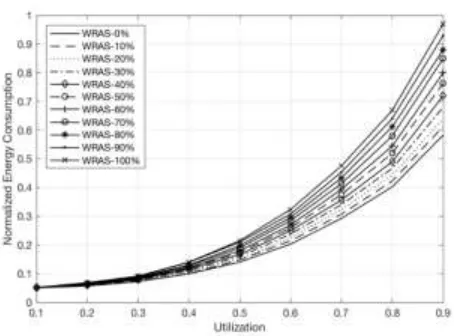
Figure 2. Normalized Energy Consumption (𝑤𝑓: 0%~100%).
In addition, the WRAS can save more energy than the IASA, from Figure 2, we can see the energy consumption increased as 𝑤𝑓 range from 0% to 100%, in particular, the WRAS and the IASA cost the same energy when 𝑤𝑓 is 100%. The WRAS even performs better than the BPS When the 𝑤𝑓 is in range 0% to 50%.
·CONCLUSION
[image:5.612.182.409.267.435.2]·ACKNOWLEDGEMENTS
This study was supported by the National Key Scientific Instrument and Equipment Development Projects, China (Grant No. 2013YQ19046705).
·REFERENCES
1. Sergey Zhuravlev, Juan Carlos Saez, Sergey Blagodurov, Alexandra Fedorova, and Manuel Prieto. Survey of energy-cognizant scheduling techniques. IEEE Transactions on Parallel and Distributed Systems, (7):1-19, 2013.
2. Jian-Jia Chen and Chin-Fu Kuo. Energy-efficient scheduling for real- time systems on dynamic voltage scheduling (dvs) platforms. In Proceedings of the IEEE 13th International Conference on Embedded and Real-Time Computing Systems and Applications (RTCSA), 2007.
3. J. H. Anderson, S. Ramamurthy, and K. Jeffay. Real- time computing with lock-free shared objects. ACM TOCS, 15(2):134-165, 1997.
4. H. Kopetz and J. Reisinger. The Non-Blocking Write Protocol NBW: A Solution to a Real-Time Synchronization Problem. In Proceedings of the IEEE Real-Time Systems Symposium (IEEE RTSS), pages 131-137, 1993.
5. J. Chen and A. Burns. Asynchronous Data Sharing in Multiprocessor Real-Time Systems using Process Consensus. In Proceedings of the IEEE Euromicro Conference on Real-Time Systems (ECRTS), pages 2- 9, 1998.
6. H. Cho, B. Ravindran, and E. D. Jensen. A Space-Optimal, Wait- Free Real-Time Synchronization Protocol. In Proceedings of the IEEE Euromicro Conference on Real-Time Systems (ECRTS), pages 79-88, 2005.
7. R. Jejurikar and R. Gupta. “Energy aware task scheduling with task synchronization for embedded real time systems.” In Proc. of International Conference on Compilers, Architecture and Synthesis for Embedded Systems (CASES), pp. 164-169, 2002.
8. F. Zhang and S. T. Chanson. “Processor voltage scheduling for real- time tasks with non-preemptible sections.” In Proceedings of the 23rd IEEE Real-Time Systems Symposium (RTSS’02), pp. 235-245, 2002.
9. J. Lee, K. Koh, and C. Lee.“Multi-speed DVS algorithms for periodic tasks with non-preemptible sections.” 13th IEEE International Conference on Embedded and Real-Time Computing Systems and Applications (RTCSA 2007). pp. 459-468, 2007.
10. Elewi A M, Awadalla M H A, Eladawy M I. Energy-efficient multi-speed algorithm for scheduling dependent real-time tasks[C]// International Conference on Computer Engineering & Systems. IEEE, pages 237-242, 2008.
11. Nicholas Hunt, Paramjit Singh Sandhu, and Luis Ceze. Characterizing the Performance and Energy Efficiency of Lock-Free Data Structures. Proceedings of the 15th Workshop on Interaction between Compilers and Computer Architectures, pages 63-70, February 2011.