Exploring the Utility of a Simple Model of Writing
A thesis submitted in partial fulfilment of the requirements for
the degree of Professional Doctorate in Applied Educational
and Child Psychology
John Price (Student u0956801)
University of East London
Acknowledgements
I am indebted to my supervisors, Dr. Sharon Cahill and Dr. Naina
Cowell, for their guidance through this research. Dr. Cahill in
particular has showed admirable patience and given lots of
encouragement whilst applying academic integrity and rigour to
her guidance.
I am also indebted to the children and their parents who kindly
agreed to participate in the research, along with school staff.
Finally, I want to thank my wife and children for their
encouragement and my good friend Sue, who sadly passed away
Abstract
Are speaking and writing very much alike, or significantly different, and how do spoken language skills relate to writing? These are important questions, with implications in both theoretical and practical domains. However,
notwithstanding a modest, but growing body of research, the nature of the relationship between spoken and written language continues to remain somewhat opaque at this point in time. The aim of this thesis was to explore the relationship between spoken and written language in a group of Year 5 children (aged 9 -10) within two UK primary schools.
The investigation was framed by an alternative construction of a Simple Model of Writing closely mirroring the structure of the model used to represent the Simple View of Reading (SVR). In the proposed model, variability in
written language skills is seen to be substantially predicted by spoken
language and transcription skills. Seventy-four Year five students, aged nine to ten, attending two primary schools in the South of England kindly provided samples of their spoken language, written language, and transcription skills (spelling and handwriting). The data was analysed using a range of statistical measures designed to identify relationships between variables, with a primary focus on the relationship between spoken and written language.
Contents
List of tables viii
List of figures viii
Chapter 1
Introduction and overview of the thesis
11.1 Key Issues 1
1.2 The importance of expressive language skills 2 1.3 Attempts to improve written language skills 5 1.4 The value of understanding the relationship between
spoken and written language skills
11
1.5 Potential benefits for teaching 13
1.6 Historical perspectives on the relationship between speaking and writing
14
1.7 Challenges of exploring the relationship between speaking and writing
17
Chapter 2
Identification and review of existing
research and theory
24
2.1 Issues regarding terminology 24
2.2 Literature search 25
2.3 Search strategy 26
2.4 Results of the literature search 29
Exploring the theoretical and empirical evidence
2.5 The case for a common expressive language core 30 2.6 Evidence of the speaking-writing relationship arising
from studies of emergent writers
35
2.7 Evidence from children with speech and language impairments (SLI) and older students
36
2.8 Evidence from studies of writing in transparent orthographies
2.9 Evidence linked to the ‘Gender Gap’ 41
2.10 Summary of literature review 42
Chapter 3
Exploring an alternative Simple Model of
Writing
45
3.1 Representation of the role of spoken language within existing models of writing
45
3.2 The case for an alternative ‘Simple Model of Writing’ framework
49
3.3 The Simple Model of Reading 50
3.4 An alternative Simple Model of Writing 52
3.5 Potential benefits of a simplified model 54
Chapter 4
Context and focus of the thesis
594.1 Conceptual, theoretical and epistemological framework 59
4.2 Context and objectives of the research 61
4.3 Terminology 62
4.4 Research aim and questions 62
Chapter 5
Method
645.1 Design 64
5.2 Participants 65
5.3 School Characteristics 66
5.4 Recruitment of participants 68
5.5 Participant attrition 69
5.6 Data collection procedure 70
5.7 Task administration procedures 70
5.9 Measures 73
5.10 Scoring moderation process 78
5.11 Gathering participant’s views 83
5.12 Ethical considerations 83
Chapter 6
Results
866.1 Overview 86
6.2 Restatement of research aim and questions 86
6.3 Treatment of data 88
6.4 Analytic strategy 88
6.5 Results 91
6.6 Participant views 93
6.7 Summary 98
Chapter 7
Discussion of results
1007.1 Considering the findings in relation to the proposed Simple Model of Writing
100
Exploring the contribution of individual components
7.2 Impact of spoken language skills on written composition
102
7.3 Impact of transcription skills on written composition 106 7.4 Additional findings emerging from the analysis 111 7.5 The relative strength of writing skills within this cohort 112
7.6 The absence of a gender gap 112
7.7 Impact of exposure to speaking and writing experiences outside of the school context
115
7.8 Comparing the Simple Model of Writing to the Simple Model of Reading in terms of explanatory power?
7.9 Implications for teacher assessment and intervention 119
Chapter 8
Operationalising the Simple Model of
Writing
124
8.1 Assessing handwriting skills 124
8.2 Assessing spelling skills 125
8.3 Assessing spoken language skills 129
8.4 Assessing written language skills 135
Chapter 9
Further considerations
1419.1 Using the model to promote the value of developing children’s spoken language skills
141
9.2 Possible ways forward 144
9.3 Separating transcription skills within a simple model 147
9.4 Developing a measure of spelling fluency 149
Chapter 10 Conclusion
15410.1 Limitations of the study 154
10.2 Reflections 155
10.3 Closing thoughts 160
List of Tables
Table 1 Characteristics of the studies included in the literature review
29
Table 2 Demographic details of participants 68
Table 3 Correlations between variables 91
Table 4 Hierarchical regression analysis predicting writing quality 92 Table 5 Relative strengths and weaknesses for the four elements
across the participant group
96
List of Figures
Figure 1 Representation of Gough & Tunmer’s SVR Model 10 Figure 2 Representation of the proposed Simple Model of Writing 11
Figure 3 Representation of the complex and interconnected dimensions of literacy events
21
Figure 4 Summary of the article selection process 28 Figure 5 Chenoweth and Hayes’ model of the text generation
process
46
Figure 6 Hayes’ revised model of the writing process 47
Figure 7 The Simple Model of Reading 50
Figure 8 A Simple Model of Writing 52
Figure 9 Proposed depiction of model to be used to identify individual writers’ strengths and difficulties
55
Figure 10 Robson’s description of exploratory research 64
Figure 12 Holistic scoring criteria 80 Figure 13 Example of participant response to Paragraph Writing
prompt (1 of 2)
81
Figure 14 Example of participant response to Paragraph Writing prompt (2 of 2)
81
Figure 15 Example of participant response to Visual Passage Retell prompt
82
Figure 16 Scoring criteria for Visual Passage Retell 82 Figure 17 Example of participant response to the Giving Directions
prompt
82
Figure 18 Scoring criteria for Giving Directions 83
Figure 19 Proposed Simple Model of Writing 101
Figure 20 Using the model to identify skill profiles 120 Figure 21 Diagrammatic illustrating the role of automaticity of
transcription skills on written composition
128
Figure 22 Statutory requirements for teaching spoken language 130 Figure 23 Standards and Testing Agency 2016. Interim teacher
assessment frameworks at the end of key stage 1
136
Figure 24 Standards and Testing Agency 2016. Interim teacher assessment frameworks at the end of key stage 2
137
Figure 25 Simple Model of Writing representing the balance between spelling and handwriting in emergent writers
148
Figure 26 Simple Model of Writing representing the balance between spelling and handwriting in writers developing proficiency
149
Figure 27 Sample pages from the Essential Spelling Skills Analysis (ESSA)
152
Chapter 1
Introduction and overview of the thesis
1.1 Key Issues
“Thought is not merely expressed in words; it comes into existence through them’” (Vygotsky, 1964. p.215).
The reciprocal relationship between the expression and development of thought also operates through the medium of writing and is encompassed in the
commonly used axiom ‘How do I know what I think until I write it down?’ (cited in McCutchen, 1984, p.231). Notwithstanding the role of spoken and written forms of expression in terms of both expressing and shaping thought, the nature of the relationship between the two remains somewhat opaque. Do they differ to a large degree, or just at the phoneme (producing sounds), versus grapheme (writing letters) level? Does one influence the other and does the nature of the relationship change over time? These issues, and others related to the
the need for accuracy and adequacy. These issues will be covered over the course of the thesis (chapters 3 & 8).
1.2 The importance of expressive language skills
Both spoken and written language skills are vital to learning and to success in modern literate societies. They are central to learning in school and they exert a significant influence on the development of a person’s literacy skills and
subsequent career and broader life outcomes. They are essential skills which allow people to participate fully in society and to contribute to the economy (DfE, 2012; Kim, Al Otaiba, & Wanzek, 2015; Clark, 2012). The National Literacy Trust (Impact Report 2011/2012) reports that:
“Without good reading, writing and communication skills a child won’t be able to succeed at school and as a young adult they will be locked out of the job
market. They will be unable to reach their full potential or make a valuable contribution to the economic and cultural life of our nation. Their poor literacy skills will also affect them as parents as they will struggle to support their child’s learning and generations of families will be locked in poverty and social
exclusion.” (p.3)
difficulties typically ranges between 50% and 70% depending on the defining criteria used (St. Clair, Pickles, Durkin, & Conti-Ramsden, 2011). There is evidence that the association between language skills and behaviour difficulties persists over time (Lindsay, Dockrell, & Strand, 2007) and that children with language difficulties are at greater risk of developing psychiatric disorders. Baker & Cantwell, (1987) tracked the progress of a group of children who had diagnosed language difficulties from the age of 5 up until 9+. They found that a quarter of the children assessed at 9+ had received psychiatric diagnoses despite showing no signs at the time of the baseline assessment. Expressive language problems can be a particularly significant risk factor for boys (Ripley, & Yuill, 2005). However, unless children have an expressive language problem that affects speech intelligibility, which may impact on their progress with literacy development (Bishop & Adams, 1990), their expressive language difficulties can often go unrecognised.
mechanism for understanding situations and self-regulation of behaviour (Berk & Winsler, 1995, cited in Ripley & Yuill, 2005).
Though anecdotal in nature, this chimes with the author’s experience, with over thirty years of either directly teaching children labelled as having behaviour problems, or working as an educational psychologist. Weak, often
unrecognised, expressive language skills are often key factors contributing to problematic situations, with written expression playing a key part in many situations. When exploring specific triggers for episodes of challenging
behaviour the author has found that the expectation to engage in a writing task features very frequently. The motivation underpinning the refusal to engage with such tasks is often ascribed to a desire to challenge the authority of the teacher and responded to as such via the individual teacher’s or school’s system of behavioural correction. Such expressive language difficulties are easier to disguise or hide from view within the domain of spoken language exchanges. However, if a child has a difficulty with expressive language, particularly written expression, then the act of writing will bring this into focus, both in respect of teachers and of peers. Thus writing, as a concrete form of expressive language, plays a crucial part in the chain of precipitating factors linking language
difficulties with secondary behaviours that can act as barriers to social participation, academic progress and mental health.
results from the 2016 Key Stage 2 National Curriculum assessments for 11 year olds published by the Department for Education (DfE) reported that 34% of pupils failed to meet the expected standard in reading (as measured by the set test), with 28% failing to meet the expected standard in writing (as measured by teacher assessment). This continuing concern regarding the quality of children’s writing skills has led to the development of a number of intervention
programmes designed to improve writing skills.
1.3 Attempts to improve written language skills
Evidence of the effectiveness of such programmes has so far been varied. The initial review of Every Child a Writer for example reported that ‘Statistical
analysis of pupils’ attainment data showed that the rate of progress in writing in ECaW schools was no greater than that in comparison schools.’(Fisher & Twist, 2011. p.9)
The impact evaluation for the Big Writing programme (Harland, Lynn, &
Sainsbury, 2014) measured pupils’ progress in relation to the four key areas or strands that formed the focus of the programme. These included compositional form and purpose, which is described as ‘address to reader; vocabulary form and style’; textual shape, described as ‘organisation, structure, linking of ideas’; spelling and handwriting described as ‘accuracy; neatness and control’; and sentence structure and punctuation, described as ‘connectives, punctuation and sentence openers’. The authors reported that there was no statistically significant change in pupils’ writing performance from baseline to endpoint on either the individual strands or the overall scores. The researchers felt that there were plausible explanations for this outcome, primarily related to the short time span between the baseline and endpoint assessments, suggesting that impact may be detected over a longer time period but that attribution of any change to the impact of the Big Writing programme would require a control group.
Targeting a group of students aged 8-9 years who had low compositional fluency Berninger et al (2002) allocated the participants into one of four groups who each received twenty-four lessons over four months. There were four experimental conditions. Group one worked on spelling skills using the
combined approach (group 3) led to significant increases in both spelling and composing.
Dunsmuir, et al (2008) explored a writing intervention that built on this research and adapted it to a UK context. They delivered four intervention sessions of 40 minutes duration each week for a total of 10 weeks to 115 year 4 students across 8 schools. The children were randomly allocated to one of two cohorts with one cohort receiving the intervention first (whilst the waiting group acted as controls) and vice-versa. The structure of the sessions (maximum group size of 6 students) included tuition on elements of phonic spelling skills and
handwriting, composition skills, and cued spelling. The interventions led to significant overall improvements in spelling skills and written composition skills for those students in the intervention groups. However, the authors found no significant difference between the control and experimental groups on
measures of progress with these skills. During the focus group feedback
sessions, which followed the interventions, one of the key factors reported to be acting to reduce the effectiveness of the intervention was that the generation and articulation of ideas was challenging for many of the participants. In other words, spoken language skills.
numbers of participants, 378 in the experimental group and 366 in the control group. They were dispersed across a large number of schools, 31 schools spread across 7 local authorities. The pre and post writing tasks were relatively authentic examples of written tasks with the participants being asked to write a first person narrative, drawing on personal experience and written under
controlled conditions. To control for task bias the pre and post test writing tasks were split so that half the participants took task 1 as the pre-test and task 2 as the post test whilst the other half completed them in the reverse order. The test design and marking was carried out by a third party organisation, who are experienced in this field, but who had no connection to the intervention. The results showed only a modest effect size of 0.21 in terms of gains for the intervention group. However, because of the large number of students taking part in the research the difference in post-intervention scores between the experimental and control groups was highly significant in statistical terms.
To date, it appears that the outcomes of attempts to improve writing skills appear to have had only modest impact at best. Though some appear to have promise there are continuing difficulties around the rigour of the research
designs, the validity of the writing tasks used, and translation of performance on the writing tasks into meaningful data that could be used for measures of
effectiveness or for comparison purposes.
expressive language skills, of which writing is one form. The majority of the programmes which specifically target talking in relation to improving written skills link talk directly to the processes involved in writing. This is often referred to as ‘oral rehearsal’ which uses talk in a number of ways. As a way of reducing cognitive load during writing; for reviewing of text; for helping writers to ‘hear’ their own writing; or for practicing sentences aloud as a preliminary to writing them down. (e.g. see ‘Big Writing’, ‘Talk for Writing’, ‘Every Child a Writer’). The relationship between general spoken language skills and writing outcomes are not emphasised within the interventions.
Notwithstanding the importance of written language skills alongside spoken language skills as a vital means of expressing or sharing thought, the concerns regarding writing standards and the plethora of intervention programmes (see above), writing and oralcy have received a comparatively modest amount of systematic investigation within the broader field of literacy and language
development (Miller & McCardle, 2011; Miller, Molfese, & Berninger, 2011; DfE, 2012). More specifically, there has been relatively little empirical research surrounding the relationship between spoken language skills and written language skills (Dockrell & Connelly, 2009; Shanahan, 2006). Thus, key
questions such as; ‘Are speaking and writing alike or significantly different?’ and ‘Is practice in talking good practice for writing?’ remain significantly
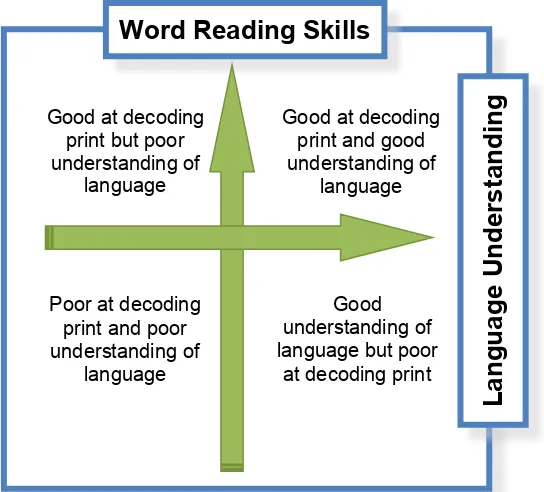
Good at decoding print but poor understanding of
language
Poor at decoding print and poor understanding of
language
Good at decoding print and good understanding of
language
Good understanding of language but poor
at decoding print
Word Reading Skills
La ngua ge Unde rs ta nding
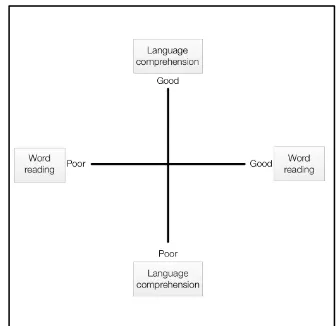
and the quality of written composition. In their model Gough & Tunmer (ibid) proposed that effective reading is the product of the combination of two
[image:19.595.112.384.200.446.2]independent skills, word decoding/identification (the ‘mechanics’ of reading) and linguistic comprehension, as represented in the top right quadrant (Fig.1).
Figure 1. Representation of Gough & Tunmer’s (1986) SVR model
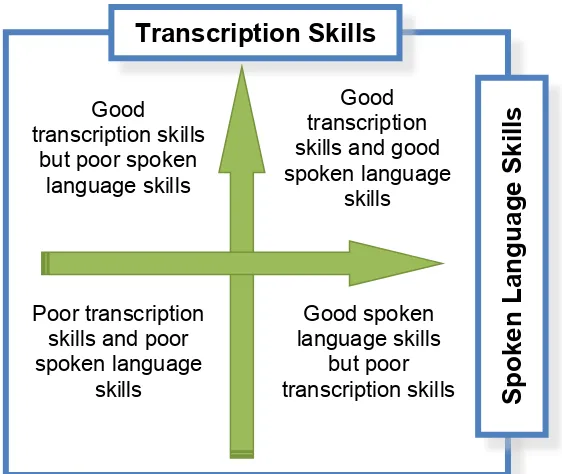
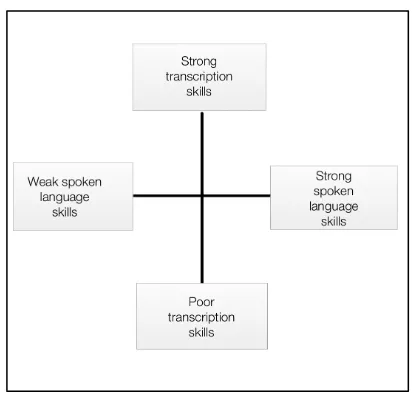
The proposed ‘Simple Model of Writing’ seeks to explore whether, in a similar fashion, effective writing could be viewed as the product of the combination of two independent skills, transcription (the ‘mechanics’ of writing e.g. handwriting and spelling) and spoken language skills, as represented in the top right
Poor transcription skills and poor spoken language
skills
Good transcription skills and good spoken language skills Good spoken language skills but poor transcription skills Transcription Skills Spoke n La ngua ge Sk ills Good transcription skills
[image:20.595.138.419.78.315.2]but poor spoken language skills
Figure 2. Representation of the proposed Simple Model of Writing
1.4 The value of understanding the relationship between spoken and
written language skills
One could question the usefulness of exploring the relationship between spoken language skills and conventional forms of written skills at a time when, due to advances in technology and the use of social media, modes of
American context emphasises the role that writing plays in obtaining
employment, carrying out daily responsibilities to keep a job, and potentially gaining later promotion (National Commission on Writing [NCOW], 2004). The NCOW surveyed major US companies on the role of writing in the workplace. Despite the fact that nearly 70% reported that professional, salaried positions include some writing responsibilities, over a third also indicated that only about thirty-three percent or less of new employees have the writing skills that
companies hiring staff most value (NCOW, 2004, p. 13). More than half of these companies reported that these same writing skills are taken into account during consideration for promotion. Results from the National Literacy Trust (State of the Nation and Impact report 2014/2015) reported that 11% of pupils in the UK completing the primary phase of their education in 2014 failed to meet the required level for reading and a greater proportion,15%, failed to reach the expected levels for writing. The Department for Education published interim results of the assessments completed by 11 year olds in 2016 which reflected greater concern (www.gov.uk National Curriculum assessments at key stage 2 in England, 2016 [revised]). In line with the new National Curriculum, different criteria were used to define and measure expected standards. As reported earlier (p.13), the interim results showed that 34% of pupils failed to meet the expected standard in reading (as measured by a nationally administered test), with 28% failing to meet the expected standard in writing (as measured by teacher assessment).
components is increasingly urgent at a time where the methods of translating thought into text (transcription skills) are developing/expanding rapidly (Crystal, 2014). Spoken language development, for example, may become more
prominent over the course of the next decade in the light of continuing improvements in the accuracy and sophistication of voice recognition and transcription devices/programs. The increasingly telegrammatic and idiographic form of written communication emerging from the use of mobile devices to send texts or sending messages via social networking sites such as Twitter and Instagram may also fundamentally alter the writing process in general. Given the rapidly changing nature of the transcription process and the increased interplay between informal and formal written communication via the use of contemporaneous written communication such as Twitter, texting and email, (Plester, Wood & Joshi, 2009; Wood et al, 2011) it is increasingly urgent that we gain a better understanding of the relationship between spoken and written language skills. This will help ensure effective communication skills irrespective of the media used.
1.5 Potential benefits for teaching
In the realm of teaching, a better understanding of the key components that combine to produce written expression skills, including the precursor
This is particularly salient at a time when, within the UK context, the
development of writing skills consistently fails to meet the expected standard for core academic skills (DfE Primary School Performance Tables, 2016). Similar concerns exist within the North American context where the most recent
statistics in relation to writing indicate that only 30% of students in grades 8 and 12 (age 13 & 18) can write at or above a proficient level (National Center for Education Statistics - NCES, 2012). The latest statistics (2015) published by the NCES do not report on writing, but the figures regarding reading (only 36% scoring at or above the required level of proficiency at 8th-grade) suggest that poor literacy skills continue to be a concern.
1.6 Historical perspectives on the relationship between speaking and
writing
Historically, the theoretical stances surrounding the relationship between speaking and writing have tended to split into three broad positions: very
similar, with only minor differences; very different and largely separate skills, or alike at some points and different at others depending upon the stage of
development and the context of the communicative act.
down’. Whilst the latter view could be seen as overly simplistic when applied to writing across the developmental span rather than just to the early stages of writing skills development, the suggested concordance between spoken and written language skills has such a strong surface plausibility that it can appear almost axiomatic.
Other theorists such as Olson (1977) have argued that they are entirely
different linguistic skills, so distant so as to be akin to separate languages. At a basic level, the modality of output differs in that speaking involves producing sounds, whereas writing involves producing marks on a page. In addition, spoken language is a naturally acquired or primary skill for the vast majority of speakers, whereas writing is a secondary or taught skill. There are also
differences in the way that language is used in written and spoken production (O’Donnell, 1974; Biber, 1988, 2009; Gibson, Gruner, Kibler, & Kelly, 1966). For example, written language appears to use punctuation in some ways that have no equivalent when using intonation in spoken language (Nunberg, 1990). Spoken language makes use of a wide range of supplementary cues such as tone of voice, pauses, facial expression, prosody and gesture which are not available within written discourse (though this is changing a little with the increasing use of visual devices such as emoticons and pictures within social media). Other distinctions relate, for example, to the speed, time-bound nature, spontaneity and immediately interactive nature of spoken conversation in contrast to the more measured process of written construction.
Despite such distinctions between spoken and written language, with the exception of technical writing such as legal documents or complex instruction manuals, much the same sentences are acceptable in each medium depending on the particular function of the discourse. For example, an expressive piece of writing might be quite similar to spoken language. In the other direction, a formal talk might be quite close to a written essay. In contrast, poetic writing will differ considerably from typical spoken language. Whilst the form that the
examples of expression take is influenced by function, context and intended audience, they are nevertheless all forms of expressive language.
The third broad stance taken is that they are sometimes similar in form and structure and sometimes distinct depending on the stage of development and purpose of the communicative act (Kroll, & Vann, 1981). Kroll & Vann (ibid) articulated a developmental view where, at the early stages, writing is akin to speech written down. At the stage of education where the technical aspects of writing are being learned it becomes more formal and distanced from typical oral dialogue. When writing becomes skilled and sophisticated, where the author constructs an increasingly nuanced dialogue with the reader, it begins to resemble or reflect spoken language. Kroll & Vann (ibid) proposed a
children learn to differentiate between oral and written language, learning that speaking and writing in their most common forms often differ in structure and style. Writing is more formal, explicit and autonomous, whilst speaking tends to be more context dependent and conversational. The final (integrated) stage represents skilled writing and speaking where each mode of expression is either appropriately differentiated or systematically integrated depending on the context, audience and purpose of communication. According to this
developmental theory, speaking and writing are both alike, and different,
depending on the stage of development and the context, audience and function of communication.
Whilst such historical theoretical positions regarding the relationship between spoken and written skills continue to inform the general debate (Crystal, 2014), they have largely been replaced in the research literature by empirical, rather than theoretical, explorations of the relationships between oral and written language. However, these relationships have proven difficult to empirically investigate.
1.7 Challenges of exploring the relationship between speaking and
writing
medium of writing has received much less attention (Shanahon, 2006; Miller, & McCardle, 2011; Myhill & Fisher, 2010; DfE, 2012). There is a general
consensus in the literature that there is less evidence relating to writing than reading (Myhill & Fisher, 2010). Indeed, international studies such as the Programme for International Student Achievement (PISA) and the Progress in International Reading and Literacy Study (PIRLS) use indicators from reading as proxy measures for literacy and don’t include writing in their assessments.
Empirical research exploring the relationship between elements of oral skills and written skills is gradually emerging (Kim, Al Otaiba, & Wanzek, 2015; Kim, Al Otaiba, Wanzek, & Gatlin, 2015; Connelly, Dockrell, Walter, & Critten, 2012; Kim et al, 2011; Berninger & Abbott, 2010; Dockrell, & Connelly, 2009; Hayes, 2009, 2012; Fey, Catts, Proctor-Williams, Tomblin, & Zhang, 2004; Cheneweth & Hayes, 2001; Abbott & Berninger, 1993). However, the assertion made by Groff (as long ago as 1979); that there is little research “to prove the
assumption that the oral language of children greatly influences their written language” (p. 35), and Shanahan’s (2006) concerns that research into the relations between oral language and writing is: “more provocative than comprehensive” (p.174), remain apposite. More recently, Silverman, et al (2015) echoed this view, suggesting that “At this point, the empirical evidence for the relationship between language skills and writing outcomes is thin’
A number of factors could be considered to contribute towards the relative lack of a large body of systematic research in this area. The emphasis on the relationship between oral language skills and ‘literacy skills’ (within both the educational and academic spheres of research) for the last two decades has centred on the development of reading skills and aspects of oral language skills directly related to the reading process. Examples include phonological
processing, vocabulary development, linguistic comprehension, working memory, along with broader influences on oral skills development such as socioeconomic factors that are thought to contribute to reading progress (Snowling & Hume, 2012; Henning, McIntosh, Arnott, & Dodd, 2010; DCSF, 2009; Rose, 2006; Shanahan, 2006). Written composition skills have taken somewhat of a ‘back seat’ on this journey, with the word spelling aspect of written language skills forming the main focus of research (Clarke, Snowling, Truelove, and Hulme, 2010). The emphasis on the development of accurate reading and writing at the word level has been driven by the debate around ‘dyslexia’ and the push to improve reading standards (Elliot & Grigorenko, 2014; Bishop & Snowling, 2004; DCFS, 2009).
broader contextual factors that combine to produce a spoken ‘performance’ (Crystal, 2014). This might include, but is not limited to, the physical aspects involved in speech production (phonological processing, motor planning, motor co-ordination), knowledge of vocabulary, sentence construction, grammar and syntax use. All of these component skills (or knowledge) will be sensitive to the functional context of the vocal performance such as being prompted to generate a persuasive argument, to recount an event, to construct a narrative, or some other function such as an on-going conversation. Added to these elements are complex factors related to a person’s confidence as a speaker within a specific social and cultural context and the role played by others involved in the
dialogue (Kucer, 2014; Crystal, 2014).
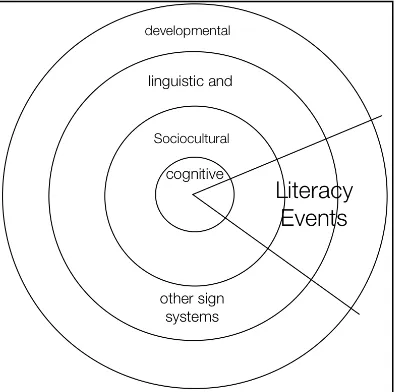
Figure 3. Representation of the complex and interconnected dimensions of literacy events. From ‘Dimensions of Literacy’, Kucer, 2014, p.6.
In short, spoken and written expressive language skills are complex and multi-dimensional, which renders them difficult to study empirically. This is perhaps well illustrated by Berninger, Rijlaarsdam, & Fayol (2012) who pose the question; ‘What is the nature of the representations, operations, and cross-domain mapping and transformation processes involved in cognitive [to]
linguistic translation?’ (p.27). The complexity, depth and scope of this question is reflected in their attempts to map the factors involved. For example, the authors list 29 categories of ‘kinds of cognitions’ (with numerous specific
variations) and 8 general classes of ‘cognitive operations’ that operate on these cognitions. They describe 7 general ways (with 29 sub-methods) by which access to these cognitions in unconsciousness may be gained during
translation. Three general conceptual models related to the translation process are described, with 20 sub-models. They also outline 5 general ways (with 10 sub-processes) in which the relationship or interaction between executive function and working memory processes during translation may operate. This level of complexity, as reflected in this description of components,
renders the area difficult to study empirically. In addition, one would need to take into account the complex process of communicating the linguistic message via the medium of either spoken or written expression. Given these challenges, it is unsurprising that examination of the relationship between speaking and writing is not well documented.
The complexity of both spoken and written forms of expressive language, make aspects of definition and measurement challenging. The expression of
language through both speaking and writing can take several forms, depending on the function and context of the expressive act. Which one(s) should be chosen as representative measures of general linguistic competence in their respective domain of speaking or writing? For example, narrative production, expository arguments and definition of single words communicated via speaking or writing could be viewed as indicators of linguistic competency, but which specific form of linguistic expression could act as a reliable and valid measure representing overall expressive language skills in that particular domain? Added to this is the question of whether the mode of expression, spoken versus
written, significantly alters the outcome. Also, the question of whether
production of a spoken narrative can be directly comparable to the production of a written narrative and whether both could act as compatible measures of a core linguistic competence remains debatable (Kim, Al Otaiba, & Wanzek, 2015; Yu, 2010).
within which the elements are sampled and which methods of collecting and analysing/measuring the samples are most appropriate should be considered. More naturalistic methods of collecting samples of language, though more ecologically valid and authentic, present challenges for measurement and analysis. Whilst increasingly sophisticated methods for analysis of more naturally occurring samples of children’s writing and speaking have been
Chapter 2
Identification and review of existing research and theory
Despite the significant challenges facing researchers seeking to explore the relationship between spoken and written language skills, a growing body of research is emerging. A review of relevant theory and empirical research in the existing literature surrounding this area is presented in Chapter Two.
2.1 Issues regarding terminology
One of the key issues with research in this area is the varying definitions and means of measuring ‘oral language’. For many of the researchers, oral
language is conceptualised as the ability to understand the spoken language of others (Berninger, 2000). This is known as receptive language. Expressive language is the ability to use vocabulary and put words together into sentences to express one’s thoughts. However, the two are often conflated as though they were a unitary construct. Berninger (ibid) suggests that, “These two language systems are often lumped together as oral language although one is aural (by ear) and one is by mouth (oral) and the two systems may not develop at the same rate” (p.65). The distinction between the two complementary but separate systems is brought into focus with children who experience specific language difficulties who can sometimes have a significant difference in development between their receptive and expressive language skills (Benner, Mattison, Nelson, & Ralston, 2009) The two language systems are localised in different brain structures (Kim, Relkin, Lee, & Hirsch. , 1997). Wernicke’s area is
in the production of language. Victims of strokes, where one or other of the two discrete areas is affected show particular language problems. For example, stroke victims who have damage to Wernicke’s area, (Wernicke’s aphasia), may experience great difficulty in understanding spoken or written language. They may produce spoken sentences that do not make sense but may not be aware that they are using the incorrect words. Those who suffer damage to Broca’s area, (Broca’s aphasia), may understand spoken and written language well but find great difficulty in producing the words to express their thoughts. Typically they also have difficulty with writing.
This blurring of the distinction between spoken language skills and receptive language skills and the subsequent variation in terminology was taken into account in the generation of search terms used within the literature search.
2.2 Literature search
research presented in the literature review was subdivided into several
categories for the purpose of summarising: evidence for an integrated language system, evidence from emerging writers, evidence from children with speech and language impairment, evidence from older students, and evidence from transparent orthographies.
2.3 Search Strategy
Initially, the search terms “oral language”, “written language”, “oral and written language”, “writing skills”, and “speaking and writing” were used based on their relation to the research questions being explored. These keywords were then entered into the EBSCO search engine. The specific databases covered by the search included Education Research Complete, PsycARTICLES, and psycINFO (accessed between 2nd & 9th September 2016). The search looked for these specific terms using a Boolean structure (though the settings also allowed for related terms to be included within the search) within either the title or the
research aim and questions, allowing the researcher to screen out spurious results. Full reports were then obtained for the articles identified following this initial screening (with spurious results again being filtered out). Where more information was necessary to determine the eligibility of an article for the review, further information was sought from the author. Finally, the reference lists of included articles were scanned and explored for potential additional articles (sometimes referred to as a ‘snowball’ literature search technique; see Chapman, Morgan & Gartlehner, 2010). Repeated articles were filtered out throughout the article selection process.
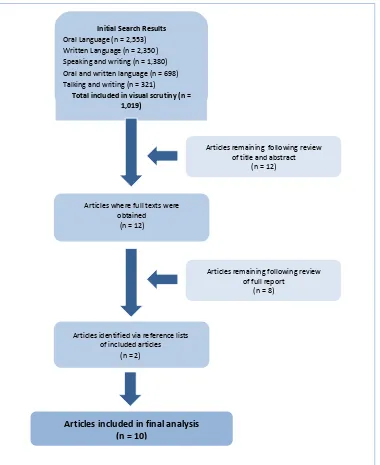
The search terms “oral language” and “written language” when entered as individual search terms did not prove to have sufficiently discriminatory power generating 2,553 and 2,350 results respectively (see Figure 4). Initial visual inspection of the first 100 results in each case confirmed that these search terms were too broad. The search phrase “speaking and writing” (1,380 results) was also found, following visual inspection of the first 100 results to be similarly overly inclusive. Complete visual inspection of the outcomes from the search phrase “oral and written language” (698 results) suggested that this phrase appeared to best balance the degree of specificity and inclusivity required to capture key articles. However, the search phrase “talking and writing” (321 results), though producing a very varied range of articles, did produce two key articles, including a recent meta-analysis of potentially relevant research (Kent & Wanzek, 2016) which had not been identified by the search using the phrase “oral and written language”. Given the small number of relevant articles
and the reference lists were scanned and explored for potential additional articles. This generated a number of additional key research articles (2),
including several articles within published books. Where judged appropriate, the books were accessed and the articles scrutinised. The search process
identified a total of 10 articles which were judged to be directly relevant to empirical explorations of the role of spoken language, mediated by transcription skills, in the writing process (Figure 4).
Figure 4. Summary of the article selection process (based on a figure in Nadeem et. al., 2013)
Initial Search Results
Oral Language (n = 2,553) Written Language (n = 2,350) Speaking and writing (n = 1,380) Oral and written language (n = 698) Talking and writing (n = 321)
Total included in visual scrutiny (n = 1,019)
Articles where full texts were obtained
(n = 12)
Articles remaining following review of title and abstract
(n = 12)
Articles remaining following review of full report
(n = 8)
Articles identified via reference lists of included articles
(n = 2)
[image:37.595.108.488.267.732.2]2.4 Results of the literature search
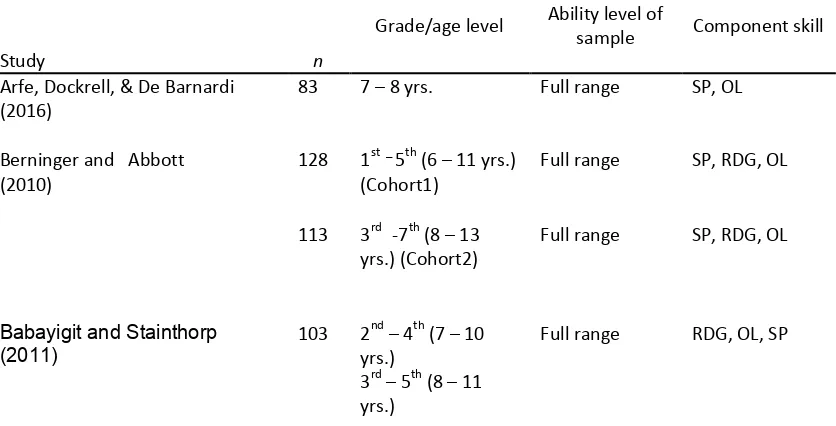
[image:38.595.114.532.526.739.2]Search results support the assertions regarding the paucity of research that explicitly examines the links between speaking and writing (Dockrell & Connelly, 2009). Nonetheless, the literature search identified an accumulating number of empirical studies that have attempted to explore the contribution of spoken language (often in combination with other factors) to writing skills at various points of development (see Table 1). The identified studies were reviewed in narrative form within the relevant sections of the chapter where they fitted most closely. Where considered to be of significance in clarifying the theme being elaborated, and not sufficiently addressed by the post 2000 studies, a small number of additional studies carried out before 2000 (and therefore not reflected in the literature search) were included in the analysis of relevant literature. Characteristics of the studies generated by the search are outlined in Table 1.
Table 1. Study Characteristics (adapted from Kent & Wanzek, 2016)
Study n
Grade/age level Ability level of sample Component skill
Arfe, Dockrell, & De Barnardi
(2016) 83 7 – 8 yrs. Full range SP, OL
Berninger and Abbott (2010)
128 1st _ 5th (6 – 11 yrs.) (Cohort1)
Full range SP, RDG, OL
113 3rd -‐7th (8 – 13
yrs.) (Cohort2) Full range SP, RDG, OL
Babayigit and Stainthorp
(2011) 103
2nd – 4th (7 – 10 yrs.)
3rd – 5th (8 – 11
yrs.)
Full range
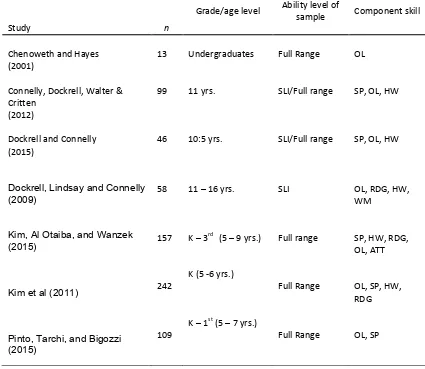
Table 1. (continued)
Study n
Grade/age level Ability level of sample Component skill
Chenoweth and Hayes (2001)
13 Undergraduates Full Range OL
Connelly, Dockrell, Walter & Critten
(2012)
99 11 yrs. SLI/Full range SP, OL, HW
Dockrell and Connelly (2015)
46
10:5 yrs.
SLI/Full range
SP, OL, HW
Dockrell, Lindsay and Connelly (2009)
Kim, Al Otaiba, and Wanzek (2015)
Kim et al (2011)
Pinto, Tarchi, and Bigozzi (2015)
58 157 242 109
11 – 16 yrs.
K – 3rd (5 – 9 yrs.)
K (5 -‐6 yrs.)
K – 1st (5 – 7 yrs.)
SLI
Full range
Full Range
Full Range
OL, RDG, HW, WM
SP, HW, RDG, OL, ATT
OL, SP, HW, RDG OL, SP
Note. RDG = reading: OL = oral language: HW = handwriting: SP = spelling
Exploring the theoretical and empirical evidence
2.5 The case for a common expressive language core
[image:39.595.106.531.114.483.2]empirical evidence of a common core language competence linking all forms of linguistic understanding and expression. For example, Berninger and Abbott (2010), using subtests from the Wechsler Individual Attainment Test (WIAT II, Wechsler, 2005) investigated the development of skills in the areas of reading comprehension, listening comprehension, written expression, and oral
expression (language by eye, ear, hand and mouth) within and between individual students. Two cohorts of students in American schools, spanning grades 1 to 5 (ages 6 to 11) and 3 to 7 (ages 8 to 13), participated in the study. Their analysis pointed to a high degree of correspondence in the development of these four areas of language suggesting a common underlying language dimension. However, when investigating the ipsative profiles of individual participants (the degree to which the four aspects of language they measured differed within an individual’s profile and how this balance changed over time) they found that 25% to 30% of individuals showed relative strengths or
weaknesses (defined as plus or minus 1SD) in one of the four language
dimensions. The ipsative profile tended to change across grades 3 to 5 (ages 8 – 11) with specific aspects of language progressing at different rates. They suggested that, whilst the four language systems are closely related, each system remains unique. Written expression was measured using the analytic scoring rubric from the WIAT II (Wechsler, 2005). This subtest includes three written expression tasks. For Written Word Fluency, the child generates as many words as possible within a given time limit (one minute) for a designated category (things that are ‘round’). For Sentence Combining, for several
writes a paragraph in response to a prompt, ‘My favourite game is….’ within a given time limit (up to 10 minutes). With scores allocated in relation to spelling, punctuation, organization and vocabulary range. Written expression never featured as a relative strength in any participants’ individual profile. In fact, “ipsative scores for written expression consistently differed from the ipsative scores for the other language systems across the grade levels analysed” (p.644). Where written expression was identified as a relative weakness in grade 1 (age 6 – 7), the weakness increased in magnitude and persisted over time. When exploring the unique contribution of oral expression to written expression the results showed that, though it contributed uniquely in grade 7 (age 12 – 13), the relationship was not clear-cut, with listening comprehension joining with oral expression in contributing towards written expression and sometimes contributing uniquely. The researchers suggest that “….oral
language may continue to develop during the school years when children learn written language and may contribute to learning to write” (p. 649). This study did not include an analysis of the potential impact of transcription skills (spelling and handwriting) in mediating the relationship between oral language and writing, though investigation of the relationship between transcription skills and writing has been investigated by the authors and other researchers in separate studies (see, for example, Wagner et al, 2011; Berninger et al, 1997; Graham et al, 1997; Jones & Christensen, 1999; Graham, Harris & Fink, 2000). It is
Related more specifically to expressive language, the notion of a linguistic source common to both oral and written modes of expression would fit with the processing model proposed by Levelt (1989). In this model language production is split into three strata; ‘conceptualization’ (preparation of the message to be conveyed), ‘formulation’ (conversion of the message into linguistic form which is labeled as the ‘Lemma Stratum’), and ‘word form’ (articulation of the message through either writing or speaking- phonology or orthography).
Building on Levelt’s model, Cleland & Pickering (2006) have proposed that though the conceptual and lemma strata are modality neutral (the same for both speaking and writing), the word form stratum is modality specific. This would suggest that, at a deeper level, the two forms of linguistic expression share common roots.
Double-Object sentence, had been used to describe the initial picture (e.g. The woman is feeding the girl some yoghurt), then the subsequent sentence would follow this syntactic pattern (e.g. A shopkeeper sold a customer some sweets). Using a sentence completion method, Cleland & Pickering (ibid) found strong evidence that this syntactic priming effect operated across modalities (e.g. from speaking to writing and vice-versa). This suggests that, at least at the sentence production level, speaking and writing share common production mechanisms.
At the level of grammatical information concerning individual words, evidence from neuropsychology (Caramazza & Hillis, 1991) suggests that grammatical category information is represented “separately and redundantly in each modality-specific lexical system” (p. 170). Marinellie (2009) also found
differences in children’s display of lexical knowledge between oral and written definitions of words. However, evidence from neuropsychology that examines the production of sentences rather than single words, is supportive of a shared mechanism model. For example, studies of impairments associated with the majority of reported cases of Broca’s aphasia show deficits in sentence production across spoken and written modalities (Benson & Ardila, 1996).
scarce, evidence from empirical studies where speaking and writing have featured may help clarify the plausibility of such a proposition.
2.6 Evidence of the speaking-writing relationship arising from studies
of emergent writers
Kim et al (2011) investigated the link between the development of oral language skills and writing when including the contribution of mechanical transcription skills. Exploring the emergent writing skills of a large cohort of American Kindergarten children (n = 242), they examined the relative influence of oral language skills, spelling, letter writing fluency (a proxy measure of handwriting proficiency), and reading, on expressive writing skills. They found that oral language (comprised of vocabulary, grammatical knowledge, and sentence imitation), spelling and letter writing fluency were uniquely and positively related to writing skill accounting for 33% of the variance after accounting for reading skills. However, given the very early stage of skills development, particularly in relation to formal literacy skills, they speculated that this pattern might change at a later developmental stage.
two expository prompts (the children were asked to write about a favourite game and to write about a classroom pet they would like and why). The outcome from structural equation modelling identified Kindergarten oral
language skills and lexical literacy skills (spelling and word reading) as unique predictors of third grade writing quality. They found that the role of oral
language as an independent predictor of subsequent writing quality differed between narrative writing and expository writing. Whilst Kindergarten oral language skills uniquely contributed to narrative writing in third grade, this was not the case with expository writing. Their explanation for this finding related to the possible differences in syntactic sophistication required to successfully produce narrative versus expository writing. Narrative writing, they suggested, was more closely linked to the syntactic structures used in oral language production. If this is the case then one might expect children with speech and language impairments to produce poorer quality written compositions, more pronounced in narrative writing tasks.
2.7 Evidence from children with Speech & Language Impairments
(SLI) and older students
Connelly, Dockrell, Walter, and Critten (2012) investigated the relative effects of oral language development, spelling and handwriting skills on the written
pattern of pauses and bursts of activity observed during the writing process. Bursts are said to be associated with both writing productivity and writing quality. When compared to less skilled writers, skilled writers are observed to produce a greater number of bursts during the writing process. The bursts also tend to be longer in duration. Language bursts have been identified in skilled (Kaufer, Hayes & Flower, 1986; Chenoweth & Hayes, 2001; Hayes, 2009 & 2012) and developing writers (Alves, Branco, Castro, & Olive, 2011 – quoted in Hayes, 2012 [ibid]). Connelly et al (2012, op.cit.), found that oral language skills development was positively correlated to written composition outcomes for both cohorts (as measured by number and length of bursts) where transcription skills were strong.
This link between oral language skills and written composition was further illustrated in a study by Dockrell & Connelly (2015) who examined the writing of 23 children with SLI (average age 10:5) with that of 23 children matched for age and 23 matched for vocabulary levels (though younger in age). They found that the children with SLI performed significantly below their age matched peers on all aspects of writing, including spelling.
1995). Children were allowed 15 minutes to write a letter outlining their ideal house. The letter was assessed on six dimensions, each rated on a 4-point scale, which were scored independently of each other: ideas and development; organisation, unity and coherence; vocabulary; sentence structure and variety; grammar and usage; capitalisation and punctuation.
Though not using the measurement metric of burst length, a similar pattern of relationships persisting over a longer period of development had been identified by Dockrell, Lindsay and Connelly (2009) who reported on the outcomes of a study tracking the progress of a group of 58 children with speech & language impairment (SLI) from the age of 8 to 16. During that period the children were assessed at regular points (8,11, 12, 14, & 16) on measures of writing
performance and its’ relationship with oral language, handwriting fluency and reading. They found that measures of vocabulary and spelling were consistent factors in explaining variation in writing quality.
2.8 Evidence from studies of writing in transparent orthographies
The unique role of spoken language skills in influencing written language skills is often difficult to discern, particularly at the earlier stages of writing
development. This is because of the constraining effects of transcription skills (particularly spelling) and their impact on the effective operation of cognitive structures or processes posited to be key components of writing skills such as working memory and executive function (Abbott & Berninger, 1993; Berninger, 1999). Spelling, particularly when writing in English, is considered to be a constraining factor. Juel (1988) followed young writers from grade 1 to grade 4 and found that spelling skills exerted a major impact on writing production accounting for 29% of their writing quality in grade 1, reducing to 10% by grade 4. This relationship has been reflected in subsequent research (Williams, Larkin, & Blaggan, 2013; Abbott, Berninger, & Fayol, 2010; Kim et al, 2011).
the participants and the fact that Italian, though much more ‘transparent’ than English, nevertheless still contains a number of spelling ambiguities. A similar pattern was found by Arfe, Dockrell, & De Bernardi (2016) when they explored the components contributing to the written composition skills of 83 Italian children aged 7-8 years. They found that spelling along with oral and written grammatical skills were important factors predicting the written composition skills of the participants. The researchers found that oral skills contributed to a greater extent than spelling skills to overall text quality.
Exploring the development of written composition skills in a more transparent orthography, where the development of accurate spelling is likely to be more rapid, Babayigit and Stainthorp (2011) tracked the development of written composition skills in two cohorts of Turkish-Cypriot children from 2nd – 3rd grade (average age 7:8) and 3rd – 4th grade (average age 9:7). Their results indicated that, in these groups, the mechanics of writing (spelling and handwriting) were not related to compositional quality. The authors emphasized the central role of
oral language skills in developing children's comprehension and written
composition.
2.9 Evidence linked to the ‘gender gap’
Though not ostensibly an exploration of the relationships between spoken language, transcription skills and written composition, and therefore not
included in the literature search, the research regarding gender related literacy attainments in England may provide some supplementary evidence for the presence of an enduring relationship between spoken language competencies and written composition skills.
The impact of language skills on literacy skills, including written composition skills, is reflected in the persistent issue with the gap between girls and boys literacy achievement, including writing (Ofsted, 2012; DfE, 2012; Harland, Lynn, & Sainsbury, 2014). Though measured on this occasion in terms of reading outcomes (the usual proxy measure for ‘literacy attainment’) rather than written composition skills, research commissioned by Save the Children (Moss & Washbrook, 2016), found that two thirds of the gender gap in achievement in reading skills at age eleven is attributable to the fact that boys, on average, have poorer language skills than girls at age five. Using national databases, they tracked the percentage of boys who were attaining below the expected standard in language development at age five with their progress with reading ages at seven and eleven. The same tracking process was used with the
were stable and constant across all social classes. However, because boys are more likely to fall into this group this affected the gender gap in attainment at age eleven.
2.10 Summary of literature review
There is an emerging body of empirical evidence that is supportive of the proposition that good oral language skills are positively and uniquely related to good written skills where the mechanical skills of handwriting and spelling are well developed. The strength and direction of this relationship (i.e. to what degree oral language skills determine written language skills or vice-versa) and how this relationship changes over the developmental trajectory remain
questions requiring further clarification (Shanahon, 2006; Biber, 2009). This is understandable given the complex and multi-faceted nature of writing with several component skills or broader factors having been shown to be related to writing, including for example; handwriting fluency (Berninger, 1999; Graham et al, 1997: Medwell, Strand & Wray, 2009), working memory and executive function (Connelly, et al ibid, 2012; Bourdin & Fayol, 1994; Abbott & Berninger, 1993), instructional variables (Olinghouse, 2008), reading (Abbott, Berninger & Fayol, 2010), pupil’s views of themselves as writers (Bottomley & Henk, 1997), and the broader cultural influences on writing (Crystal, 2014: Kucer, 2014).
Even when restricting the focus to a small range of cognitive factors, such as handwriting, spelling and spoken language skills as represented in the
One of the major ‘constraining’ factors within the English language is spelling. Whilst this becomes less of a constraining factor as children progress through the education system and spelling skills become better established, it has been demonstrated to significantly affect both writing productivity and writing quality for most students up to the age of 10-11 (Abbott, Berninger, & Fayol, 2010).
Particularly in the early stages of learning to write, handwriting also exerts a constraining effect, though in the majority of students this skill becomes fairly well established by age 10 (Abbott et al, 2010, op. cit.). However, transcription-related skills continue to contribute to compositional fluency and quality further through the education system, albeit to a lesser magnitude (Abbott & Berninger, 1993).
There is a developmental shift between ‘learning to write’ where at the earliest stages writing closely resembles ‘speech written down’ and the direction of influence is predominantly oral skills > writing, to later stages where ‘writing to learn’ becomes more prominent and the relationship between oral language and written language becomes more reciprocal with each affecting the other. Running alongside this developmental trajectory is the impact on both oral and written language skills of exposure to printed material via reading
comprehension (Abbott, Berninger, & Fayol, 2010).
Evidence from research in more transparent orthographies, where the
(e.g. Babayigit & Stainthorp, 2011) is supportive of a strong relationship between oral competencies and written skills.
Chapter 3
Exploring an alternative Simple Model of Writing
Chapter Three considers the representation of the role of spoken language (sometimes referred to as oral language) within existing models of writing and presents the case for a model illustrating a more explicit depiction of the role of spoken language in the writing process.
3.1 Representation of the role of spoken language within existing
models of writing
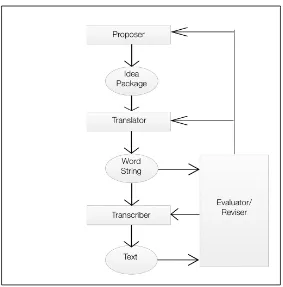
A number of models of writing have been developed, for example, ‘the simple view of writing’ (Juel, 1988) and the ‘not-so-simple view of writing’ (Berninger, 2000). These models, along with other iterations (Berninger & Swanson, 1994; Chenoweth & Hayes, 2003 – see Figure 5) typically represent modifications to the original Hayes and Flower (1980) model which include working memory and executive function as influential cognitive structures or processes in the
translation of thought into text (Berninger & Swanson, 1994; Berninger, 2000). Within Juel’s (1988) original model the act of writing was split into three broad sequential processes; the generation of the ideas (‘ideation’), the transformation of the ideas into the appropriate linguistic structure (‘translation’), and the
Figure 5. Chenoweth and Hayes model of the text generation process (source:
Chenoweth and Hayes, 2003, p. 113)
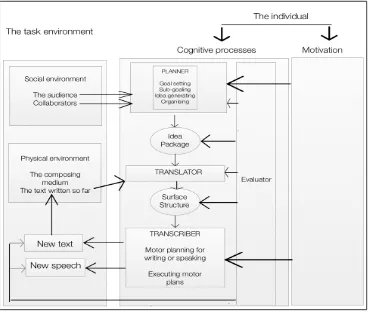
Structure’ in the diagram). The first of these is posited to hold the ideas in mind whilst they are translated into the surface form of the linguistic structures
[image:56.595.116.487.266.578.2]through which they are going to find expression. The second serves to hold in mind the surface structure of the language to be expressed whilst the motor planning and execution process related to either speaking or writing is completed.
Figure 6.Hayes’ revised model of the writing process (source: Hayes, 2012, p.16)
This is also reflected in a modified ‘simple view of writing’ framework proposed by Dockrell, Marshall, & Wyse (2015) in which the three key components of text generation, transcription, and executive functions (which the researchers
strategies for self-monitoring and regulation) operate within a system where the cognitive flow is determined by working memory capacity which is posited to be an important cognitive structure or process linked to writing quality (Hooper et al, 2011; Berninger et al, 2010). The limitations of working memory make writing a challenging task given the multiple processes involved such as planning, revising, transcription (Berninger et al, 2010). McCutcheon (1996) found that poor writers typically have poorer working memory when compared to good writers. Berninger (2000) reported that working memory had both general and domain specific impacts on the writing process.
General oral language skills are not an explicit component within any of the models, but could be assumed to contribute to text generation skills. However, general oral language skills (however they are defined and measured) and specific text generation skills may not overlap to the degree assumed within the models (Arfe, Dockrell, & Bernardi, 2016). One interpretation of the
processing only at the point of transcription (i.e. motor planning for writing or speaking and the subsequent execution of that motor plan).
3.2 The case for an alternative ‘Simple Model of Writing’ framework
All of the current models of writing incorporate expressive language skills, variously referred to as ‘text generation’, ‘ideation’ or ‘translation’ within the writing process. However, the degree to which these language skills, which are deployed within the writing process, relate to general oral language skills is unclear (Arfe, Dockrell, & De Bernardi, 2016 op.cit). Kim et al (2011), exploring the componential skills of beginning writers at the end of Kindergarten stated that “it is reasonable to hypothesize that individual differences in children’s sophistication in oral language may be related to children’s writing skills” (p.517). Whilst the empirical evidence (see above) confirms the relationship between oral language skills and written skills and supports Kim et al’s (ibid) ‘reasonable hypothesis’, the role of general oral language skills, specifically spoken language, has not been explicitly represented within models of writing thus far.
evaluation by Harland, Lynn, & Sainsbury, 2014), it is talking related directly to the writing process, ‘talking about writing’, rather than practicing general spoken language skills. Dockrell, Marshall, & Wyse (2015) suggest that one of the main advantages of depicting a clear model of the components contributing to writing is that it enables teachers to more effectively identify and teach the component skills. Hayes & Olinghouse (2015) suggest that there may be advantages in having several such models of writing with which to inform curric