2017 3rd International Conference on Electronic Information Technology and Intellectualization (ICEITI 2017) ISBN: 978-1-60595-512-4
Research On 3D Emotional Face
Animation Based on Dirichlet
Free Deformation Algorithm
Shi Chen and Huachao Zhong
ABSTRACT
In the process of people's daily communication, the human face has played a decisive role, it includes joy, anger, sadness, music and other complex expressions, and also bear the function of language expression. Therefore, the construction of three-dimensional facial expression animation model and synthesis technology in computer graphics is one of the hot spots. How do you create realistic facial expressions and actions on virtual 3D people? This paper introduces the 3D facial expression animation system based on the Dirichlet free deformation algorithm. The system consists of two parts: the first part, using the Natural Point facial expression capture system to collect facial expression data; the second part, the use of Autodesk Maya animation software to establish the corresponding Face 3D model, and then use the Dirichlet free deformation algorithm as a deformation technique. Experimental results show that the system can be very good and real-time simulation of human (hi, anger, sad, music, etc.) complex expression. This study is of great help to human-computer interaction systems.
INTRODUCTION
Since Frederic I. Parke [1] proposed a face animation study in 1972, in the ensuing forty years, face modeling and animation technology developed rapidly, from early simple cartoons to realism and can be fake Face model, which are ________________________
accumulated on behalf of the generation of scientists. With the development of computer graphics and the progress of animation industry, people's research on human face animation technology has gradually become a research hotspot in the field of computer graphics. With the 3D face model and the maturity of animation technology, it is widely used in virtual reality, web conferencing, network teaching, telemedicine, human-computer interaction, game animation, film production and so on. 3D emotional face animation includes three aspects: face modeling, emotional data collection and face animation, this article on these three aspects made a detailed introduction.
This article includes five parts. The first part introduces the 3D face modeling method. The second part is that facial expression data collection. The third part is that facial expression animation simulation. The fourth part is that the experimental results analysis. The fifth part includes summarizes and prospects.
3D FACE MODELING
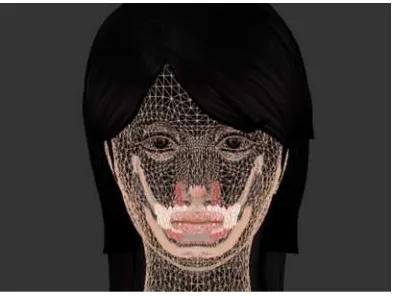
Three-dimensional face modeling is the use of graphics technology and computer-aided, in the virtual three-dimensional space to generate a realistic face model. Since Parke first proposed the study of face animation in 1972, after the scholars in this field put forward a variety of facial animation model. Akimoto and Denis [2] used two face photographs taken from two sides of the vertical and horizontal directions to create a face model. This method was simple to operate but had a large error; Waters [3] used 3D data obtained by laser scanning Information for specific face modeling. Pinhin [4] of the University of Washington used a number of images to construct a human face model, which was modeled with high efficiency but required a lot of manual processing. University of Toronto, Lee [5] and others to establish a multi-layer face model, the face model is divided into the skin layer, muscle layer, bone layer and were modeling, this method to construct the face model realistic, but the drawbacks need a large amount of work and the system is huge, the model is so difficult. With the development of science and technology and the improvement of people's needs, face modeling requires more and more sophisticated and realistic, the current three-dimensional face modeling is more commonly used method is the use of 3DS MAX, AutoCAD, Maya, Poser and other professional three-dimensional production software, Constructs a human face model based on anatomical knowledge. This method of making the face model visual effects more realistic, with the help of software tools to make modeling easy and cost greatly reduced. Therefore, this article uses Maya animation software to produce a realistic virtual face model, she has eyebrows, eyes, hair, tongue, teeth, eyelashes and other physiological structure. As shown in Figure 1, this model includes 5465 geometric vertices and 10,681 triangular patches.
realistic expression? In this paper the DFFD deformation algorithm is used to solve this problem. The algorithm is described in detail in the third part, and the facial expression is more realistic in the area of different functional areas such as eye, eyebrow, lower lip and upper lip.
Figure 1. Head texture.
DATA COLLECTION
x USB Cable and 16ft A to B USB cable, their role is USB Hub and control computer connection; the eighth is 6 x USB cable, its role is to connect the camera and USB Hub.
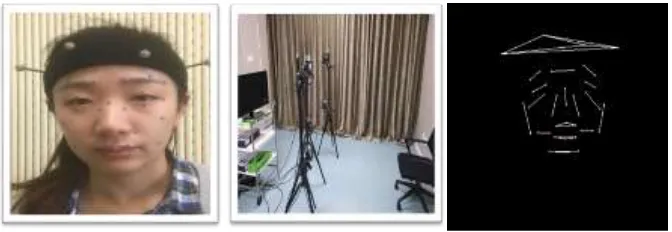
Figure 2. Data acquisition equipment.
Facial expression data collection is divided into the following parts: ① spatial information calibration, ② paste the characteristics of points and collect information
Figure 3. Feature points. Figure 4. Experimental scenario. Figure 5. Head frame.
FACE EXPRESSION ANIMATION SIMULATION
Face animation is the use of deformation technology to drive the face model deformation to simulate the real face of the action and expression. Face expression is extremely complex, it plays a key role in people's daily communication, so facial expression animation has always been a hot computer graphics and is also difficult. At present, the simulation method of face animation is mainly two kinds of data driven method and parameter control method. The more successful face animation technology is the data-driven method, data-driven method is to use the collected action data. We need to deal with the collected data to meet our needs, and then use these processed data to drive the deformation of the face model, to simulate the real expression of the expression of action. In this paper, face facial expression capture system to collect facial data, the use of DFFD [6] deformation algorithm as a deformation technology to achieve facial expression animation simulation.
In this paper, the DFFD [9] free deformation algorithm is used as the deformation technique. The principle of the DFFD deformation algorithm is that the coordinates of a given set of control points P={p1,p2,p3...,pn} and any point x, The points in the set P are represented by the Sibson coordinate difference. The Sibson coordinate is a local coordinate system, and the point x can only affect its control point influence by its surroundings, so the set of control points that affect point x may be all the points in set P, or it may be a subset of P. Assuming that M is the set of control points that affect point x, point x can be expressed by equation (1), where M is a subset of P sets.
△𝑥=∑𝑛𝑖=0𝑢𝑖 ∗ 𝑚𝑖 (1)
Among them, ∑ni=0ui=1, and ui>0(0 ≤i≤n), mi ∈ M.
x`=x +△ x. Calculating the coordinates of △x can be x`, Here we give the formula
for △ x.
The Sibson [10] coordinates reflect the spatial position between the point and the neighbor. Therefore, we can use the Sibson coordinates as the motion influence factor of the neighbor to the point x. Let U=(u0,u1,u2...,un) denote the local
coordinates. According to Mn、Pn`and U can be uniquely determined by point x, The linear combination of P is as follows:
△𝑥=∑𝑛𝑖=0𝑢𝑖 ∗ 𝑝𝑖,∑𝑛𝑖=0𝑢𝑖=1, among them, 𝑖 ∈[0,n], 𝑢𝑖>0. (2)
𝑢𝑖=𝑉𝑂𝐿(𝑉(𝑀𝑛)(𝑚𝑖)⋂𝑉(𝑃𝑛
`)(𝑥))
[image:6.612.123.453.228.396.2]𝑉𝑂𝐿(𝑉(𝑃𝑛`)(𝑥)) (3)
Figure 6. The Voronoi diagram of {𝑝1,𝑝2,𝑝3,𝑝4}. Figure 7. The Voronoi diagram of {𝑝1,𝑝2,𝑝3,𝑝4}.
Figure 8. The contribution of 𝑝4 to 𝑝.
Where 𝑃𝑛` is the intersection of sets M and x. VOL () represents the volume of
the Voronoi element; V (P) (𝑥) represents the Voronoi element occupied by the point x in the Voronoi diagram V (P). 𝑢𝑖 is the Sibson coordinates of the point x relative to the neighbor 𝑚𝑖.
𝑝
1.
𝒑𝟐..
𝒑𝟑. 𝐩.
𝒑𝟏.
𝒑𝟐..
𝒑𝟑.
[image:6.612.234.360.469.549.2]Here we draw the picture in two-dimensional situation. Fig.6 shows the Voronoi diagram of the set P={𝑝1,𝑝2,𝑝3,𝑝4}, and there is a point p in the convex hull. Figure
7 shows the Voronoi diagram after the addition of p,𝑝1,𝑝2,𝑝3,𝑝4 where Voronoi is adjacent to Voronoi of p, then they are called p's Sibson neighbors; Figure 7 is the superposition of Figure 6 and Figure 7, where the shaded portion represents the area occupied by 𝑝4 for the Voronoi diagram unit where 𝑝 is located. So the Sibson coordinates of 𝑝 are the area occupied by 𝑝4in the Voronoi diagram unit of 𝑝.
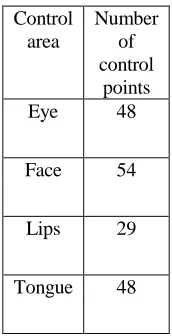
[image:7.612.254.340.303.471.2]In this paper, the data collected by the face is used as the control point, and the DFFD deformation algorithm is used as the deformation technique to realize the deformation effect on the 3D face model established by Maya software. There are four control areas, which are the eye, face, lips, tongue. The control point of the corresponding control deformation effect is better, but the consequences are a large
TABLE I. CONTROL AREA AND NUMBER OF CONTROL POINTS.
amount of calculation. Comprehensive deformation effect and running speed, the number of control points in each region of the experiment is shown in TABLE I.
Another kind of face animation simulation method-parameter control method, Parke initially used some parameters to describe the facial expression changes, but the various parameters often produce some conflict, it cannot produce a real face expression. After several years of research, researchers have gradually formed two commonly used parameters control standards, Ekman and Friese proposed FACS (facial action and coding system) and based on MPEG-4[7] specified FAP[8] (facial animation parameter). According to the anatomical principle and muscle movement mechanism, FACS defines 44 basic units for simulating muscle movement and assigns different expressions to each unit. It is clear that this method has a small amount of data and a simple advantage. FAP parameters by setting the face of different parameters to drive face expression, MPEG-4 standard set a total of 68 FAP, through the combination between them can simulate the normal face of most
Control area
Number of control
points
Eye 48
Face 54
Lips 29
of the expression. The lack of FAP is the face of the movement between the various parts of the division, and the normal face of a part of the movement when the face is bound to affect other parts of the co-operation. Due to the split effect of FAP, simulated expression will appear unnatural, uncoordinated and so serious consequences.
EXPERIMENT AND RESULT ANALYSIS
The purpose of this paper is to study the 3D animated face animation. The experiment is carried out according to the simulation experiment. The experimental environment includes: a notebook (CPU: Inter Core i7-6700HQ, graphics card: NVIDIA GeForce GTX960M, 8G memory, Windows 7 operating system), the development environment VS2013, Development Language C ++, OpenGL development kit, Natural Point OptiTrack facial expression capture system, a number of performers. The overall route of the experiment includes the realization of 3D head modeling, the realization of the Maya modeling software, the realization of the DFFD free deformation algorithm, and the combination of computer graphics knowledge, control point settings (such as the third part of the situation), expression data of the collection, 3D face animation simulation. Through the debugging of the whole system, it is verified whether the system satisfies the normal simulation of facial expression and the judgment of simulation effect. Finally, the system simulation results prove to meet the actual demand.
a. Performer expression b. Simulation animation Figure 9. Comparison of real and simulated expressions
CONCLUSIONS
In this paper, we focus on the 3D emotional face animation based on the Dirichlet free deformation algorithm. The experimental results show that the system can simulate the basic expression of normal face and has good practicability. The shortcomings of this paper is not enough to simulate the expression, some special expressions can`t be a real simulation. In the future work, we will do for these further improvements.
REFERENCES
1. F. I. Parke. Computer generated animation of faces. Proc of ACM National conference, 1972,1: 451-457.
2. Akimoto T, Suenaga Y, Wallace R S. Automatic 3d facial models[J]. IEEE Computer Graphics and Applications, 1993; 13( 5) : 16~22.
3. Waters K, Terzopoulos D. Modeling and animating faces using scanned data[J]. Visualization and Computer Animation,1991,2(4):23-128.
5. Lee Y C, Terzopoulos D, Waters K. Realistic face modeling for animation[C]// In: SIGGRAPH Proceeding Los Angeles,CA.USA,1995:55-62.
6. Bourke P. Triangulate, an algorithm for interpolating irregularly-paced data with applications in Terrain modeling[J/OL]. http://www.mhri.edu.cn.au/~pdb/ modelling/ triangulate.html, 2005-02-10.
7. Pandzic I S, Forchheimer R. MPEG-4 facial animation: the standard, implementations and applications [M]. New York: John Wiley & Sons, 2003: 1-328.
8. Tekalp AM, Ostermann J. Face and 2 -D mesh animation in MPEG-4. Signal Processing: Image Communication, 2000, 15:387~421.
9. Chen L C, Huang M J. A DFFD simulation method combined with the spectral element method for solid-fluid-interaction problems[M]. Academic Press Professional, Inc. 2017.