Xiao-liang ZHANG
aand Hai-su CHEN
b, *School of control and Computer engineering, North China Electric Power University, Beijing, China
Email: [email protected], [email protected]
*Corresponding author
Keywords: Database audit, TNS protocol, Oracle database, Database security.
Abstract. As companies rely more and more on information systems, security of database becomes increasingly important. The database has a security mechanism to ensure completeness and correctness, however attackers or unauthorized users always want to operate database through non-formal ways. Therefore, it’s important to record user’s operations worked on the database.
This paper puts forward a new way to record user’s actions in the audit system, which accesses to the network through the bypass monitoring method, this way audits database by setting the policy. The advantages are that the audit system does not affect the communication between the client and the database server, and database problem does not affect the database audit system. In this paper, Oracle database communication protocol TNS will be example to describe the audit system. This paper also introduces TNS in the protocol framework and shows its level position, then designs a framework for the audit system according to the network model.
Introduction
A database is often the most strategic asset of an information system that needs to be protected. Attackers and illegal users always want to operate the database through informal ways, so it is very important to record operations on the database.
Audit capabilities provided by Oracle database tend to record a large number of audit operations, lack of effective analysis tool when faced with massive data. It is not easy to find attacks, illegal access and other aspects of security issues if database administrators to analyze the audit data in person. At the same time, the computer system itself and other hardware failures may cause the correctness and integrity of the data was destroyed.
In this paper, we design a database audit method to meet the needs of security audit. It has advantages of not affecting communication between the client and the database, the failures of the database and the audit system will not affect each other, and the data captured by the audit system can be further analyzed.
Related Protocol
OCI and NET8 Protocol
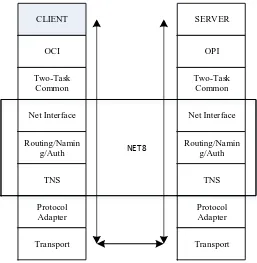
Oracle provides a complete network interconnection service, which is called Oracle Net Service, also known as NET8 service [1, 2]. Oracle network protocol achieves the top three layers of OSI, Oracle client OCI and server-side OPI make up the session layer. This layer is responsible for establishing a complete SQL session between client and server, and the process is as follows:
To parse the SQL statement, and analyze the grammar,
Apply cursor for the SQL statement,
Bind variables for SQL statements,
Get the metadata information of record set from server’s data dictionary,
Execute SQL statement,
Return the result and close the cursor.
2016 International Conference on Artificial Intelligence and Computer Science (AICS 2016) ISBN: 978-1-60595-411-0
TTC (Two-Task Common) layer corresponds to the presentation layer, which represents the character set and data type conversion between client and server [3]. As showed in Fig. 1, the following layers are NET8 layer, and the Oracle does not put this layer on the OSI model, but as a separate layer. This part consists of 3 components: Net Interface, Routing/Naming/Auth and TNS. Net Interface transmits data, while the other two layers responsible for transparent support for the underlying protocol.
CLIENT
OCI
Two-Task Common
Net Interface
Routing/Namin g/Auth
TNS
Protocol Adapter
Transport
SERVER
OPI
Two-Task Common
Net Interface
Routing/Namin g/Auth
TNS
Protocol Adapter
Transport
[image:2.595.169.426.161.424.2]NET8
Figure 1. TNS protocol hierarchy
AnalysisofProtocol
TNS Protocol Connection Process
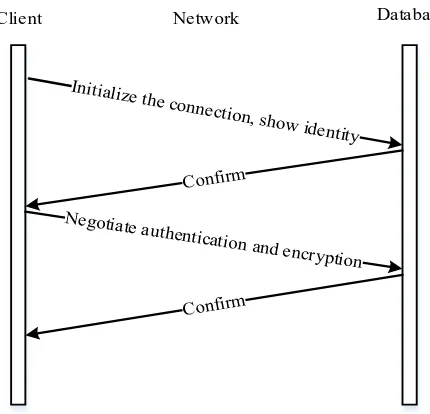
The TNS protocol defines the language used between the database and the client, allowing the implementation of services such as authentication [4]. Database software is responsible for the execution of the user’s verification process, however, because messages are transmitted back and forth between the client and the database, they must through multiple layers of software.
Oracle clients receive user’s specified parameters and pass them to the TNS layer. To initialize this connection, the TNS layer sends a connection string containing client information to a database, and the second half of the string initialize user’s connection of operating system.
Client Network Database
Figure 2. Request Security Network Services
After any requirements of the protocol by the security network services, database users are verified by using Oracle password protocol [5]. This protocol is used to avoid the third party access to the password.
TNS Protocol Packet Structure
In this paper, the packet structure is drawn by capturing a large number of packet and analyzing the meaning of the field corresponding to relevant type packets. You can see the entire data format frame through WireShark tool, so the obtained results in this paper are based on the capture tool.
A database audit system NIC acquired data starts from the data link layer, through the network layer and the transport layer, finally to the application layer TNS protocol [6, 7], shown in Fig. 3.
MAC header IP header TCP header TNS header TNS data
Figure 3. TNS packet
TNS data contains a generic header, which contains information about the checksum, length, type and others. Different types of data to achieve different functions of data transmission.
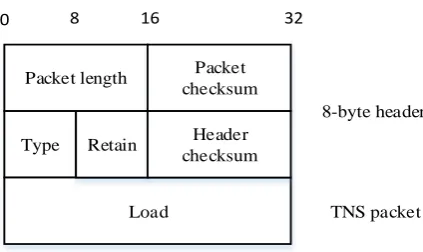
As showed in Fig. 4, the shaded portion has 8 bytes, which is a fixed-length header. Fig. 5 show the structure of the header. TNS packet is composed of two parts, which are fixed length and load.
Packet length Packet checksum
Type
Load
Retain Header
checksum
8-byte header
TNS packet
0 8 16 32
Figure 5. TNS packet header format
Packet length: 2 bytes, the unit is Byte, it represents the length of the entire TNS packet (including header and load section). The maximum packet length is 4086 bytes, referred to as session data unit (Session Data Unit, SDU), and the maximum transmission unit (Transport Data Unit, TDU) is 32767 bytes. TDU will not be smaller than the SDU.
Packet checksum: 2 bytes. Currently are zero filling.
[image:4.595.194.406.77.203.2]Packet type: the type of TNS packet, 1 byte, which is described in Table 1.
Table 1. TNS packet types
Type Meaning Type Meaning Type Meaning 1 Connect 6 Data 11 Resend 2 Accept 7 NULL 12 Marker 3 ACK 8 Unknown 13 Attention 4 Refuse 9 ABORT 14 Control 5 Redirect 10 Unknown
Reserved bits: 1 bytes are not used at present.
Header checksum: 2 bytes. Currently are zero filling. Data: according to the specific TNS type analysis.
Application of TNS Protocol
Design of Database Audit System Model
When the main program of database audit system grabs network packet and determines the protocol is Oracle communication protocol, the main program will send the data to TNS protocol analyzer module. The module will restore SQL statement according to the protocol content, and then hand over to the SQL statement module.
The function of data capture and analyze is to monitor all operations of database in the network, restore SQL statements by analyzing protocol, analyze SQL statements and extract operations on the database according security information, to lay the foundation for future database security audit and risk control. Because each database uses a different communication protocol specification, for which developer should develop different protocol analyzer modules, to complete audits of all database systems. Crawling network data is divided into the following steps: crawling data, filtering SQL data, analyzing database protocol, reunite and restore sessions, analyze SQL statements, stored data.
Process of Crawl Network Packets
the target database operations.
To resolve the information of the SQL statement
Reunite and restore sessions. Analyze protocol identification in data packets, recombine the
packets that have session information, and analyze the header, retransmission, consultation, response and other information, a complete session record is obtained.
Analyze information in the SQL statement such as: keywords, command, design specific tables
and others.
Crawl network
data Network
packet
Filter SQL data
Analyze database protocol
Reunite and restore
session
Analyze SQL statement
[image:5.595.76.521.177.217.2]Store data
Figure 6. Flowchart of grabbing packet
Crawl Packets of Server
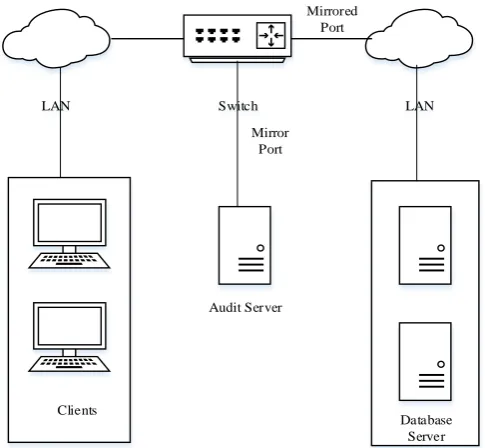
One of the most important steps in data acquisition and analysis is to crawl the server data packets, which is the basis for obtaining the user’s operations. There are two main ways to capture data packets: in Ethernet communication environment, the network card is set to “mixed mode”, then this card can receive all data packets in the local area network. Another is to set up the mirror port on the switch or router in the exchange network, to achieve crawling through the hardware.
In this paper, the architecture of the database audit system device as shown in Fig. 7, the external network interface of database audit system is connected to the mirror port, and mirror port attach to database server, so monitoring program can crawl data of operation on database without changes on network, it does not affect the normal operation of actual business of the network.
LAN Switch LAN
Clients
Database Server Audit Server
Mirrored Port
Mirror Port
Figure 7. Database audit system device architecture
Filter SQL Data
[image:5.595.177.420.411.635.2]Database Audit Validation
[image:6.595.138.452.134.277.2]As showed in Fig. 8, the background monitoring program detects the session information that the client connects to the server. The connection information showed in Fig. 8 verifies the correctness of resolving Resend packets.
Figure 8. Session connection information
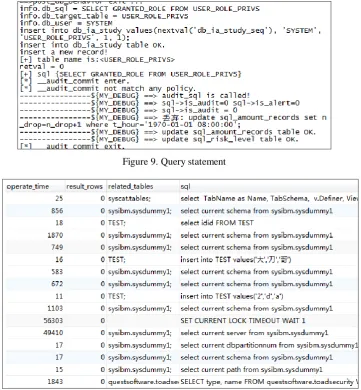
[image:6.595.123.485.358.748.2]When auditors configure the audit policy, data not meet conditions will be discarded. The result of background program is showed in Fig. 9. If the data meet the conditions will be recorded, as showed in Fig. 10, the left column is related tables, and the right is SQL statements that have been resolved successfully.
Conclusions
This paper mainly studies parsing TNS protocol based on database audit system. This paper introduces the principle of working and connecting processes of TNS protocol, and the structure of TNS packet is introduced. We have a deeper understand of communication between Oracle database server and client through the interpretation of TNS packets and parsing of TNS protocol. Then put TNS protocol module into the entire database audit system framework, to present the entire audit system.
The database audit system is designed based on the previous model, in this paper the TNS protocol is studied, but the TNS protocol is not open source and I am limited, the study is not perfect. This study is only through packet capture tool and part of open source code, is not clear about all meaning of the fields and not give specific communication process, there is still a lot of work needs to be studied.
Acknowledgment
This work is supported by “The Fundamental Research Funds for the Central Universities 2015MS34”.
References
[1] Oracle TNS Protocol Analysis[J/OL], 2007,
http://wenku.baidu.com/view/0ba5df6925c52cc58bd6bedc.html
[2] Shmueli E, Waisenberg R, Elovici Y, et al. Designing secure indexes for encrypted database[C]// Proc of the IFIP Conf on Database and Applications Security, LNCS 3654, Heidelberg, Berlin; Springer-Verlag,2005;57-68
[3] Oracle Corporation, Architecture of Oracle Net Services[Z], Oracle9i Net Services Administrator’s Guide Release 2(9.2);Part Number A96580-02
[4] Oracle Internals[J/OL], 2010, http://oracle-internals.com/
[5] Halfond W G.Orso, A Preventing SQL injection attacks using AMNESIA[M], 2006.
[6] Verwoerd T, Hunt R. Intrusion detection techniques and approaches, Computer Communications.2002.25 (15):1356-1365.