2016 International Conference on Artificial Intelligence: Techniques and Applications (AITA 2016) ISBN: 978-1-60595-389-2
Target Recognition Using of PCNN Model Based on Grid Search Method
Gang YANG
1, Xiu-yan TIAN
2,3, Han LI
2, Hong-xia DENG
2,*and Hai-fang LI
21Electric Power Research Institute, State Grid Shanxi Electric Power Company, Taiyuan 030001,
Shanxi Province, China
2College of Computer Science and Technology, Taiyuan University of Technology, Jinzhong
030600, Shanxi Province, China
3Economy and Management Department, Yuncheng College, Yuncheng 044000, Shanxi Province,
China
*Corresponding author
Keywords: Pulse coupled neural network, Grid search method, Parameters optimization, Face recognition, Pulse intensity.
Abstract. To improve the accuracy of face recognition using pulse coupled neural network(PCNN) model and save the problem that the parameters of PCNN model must be set with experience, the PCNN model based on pulse intensity (QD-PCNN) and the improved grid search method are proposed. In the QD-PCNN, pulse intensity can make the outputs of the model more accurate. When the improved grid search method is used to find the suitable parameters, the parameters are searched in a large space firstly, and then searched accurately around the parameters we have found according to the objects which are to be recognized. In the experimental process, the parameters obtained through improved grid search method is applied to QD-PCNN model to recognize faces, and the results show the efficiency of this method.
Introduction
The PCNN model[1] established by imitating animal visual cortex has been widely used in image edge detection[2], image segmentation[3], image fusion[4], image recognition[5], image denoising[6] and image enhancement[7], and showed many excellent characteristics. But in practical application, the PCNN model contains many uncertain parameters. We usually select the appropriate parameters by contrasting image processing results of many tests. Grid search method[8] can divide parameters to be searched into grid in a certain space, and then search for the best parameters by traversing grid points. But exhaustive search in the range of parameters lacks of pertinence. This paper introduces an improved grid search algorithm, which can find the appropriate parameters adaptively and can solve the problem of the parameter setting of PCNN model to a certain degree. At the same time, the PCNN model is improved to make it more suitable for face recognition.
QD-PCNN Model
The traditional PCNN model’s mathematical model is as follows:
( )
ij ij
F n I (1)
( ) ( 1)
ij ij
L n
WY n (2)( ) ( )(1 ( ))
ij ij ij
U n F n L n (3)
( ) exp( ) ( 1) ( 1)
ij n ij n V Y n ij
1 ( ) ( ) ( )
0 ( ) ( )
ij ij
ij
ij ij
U n n
Y n
U n n
(5)
ij ij ij
Q n U n n (6) Among them, of a neuron, n is the cycle number of iterations, W is the internal connection matrix,
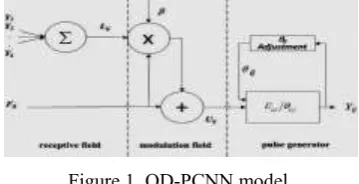
[image:2.595.207.387.295.387.2]Iij is the the external input signal, Fij(n) is the feedback input, Lij(n) is the linear link input, Uij(n) is internal action item, Yij(n) is the pulse output, θij(n) is the dynamic threshold. Inside neurons, Fij(n) and Lij(n) are linked to form Uij(n). In the model θij(n) corresponding to single neurons decays exponentially with the increase ofthe number of iterations before being activated, attenuation coefficient is , its value increases Vθ after being activated. After external stimulation Iij, neurons of PCNN model generate Internal action items Uij(n).The values of Uij(n) vary and change over time, at the same time the corresponding dynamic threshold θij(n) also varies over time, namely the values of Uij(n)∕θij(n) are different, this value is the neuron pulse intensity (qdij(n)).This item is introduced into the traditional PCNN model, and then the QD-PCNN model is formed, as shown in figure 1.
Figure 1. QD-PCNN model.
In the traditional PCNN model, the pulse generation is realized by step function (5), and the pulse value is always 1, which can not distinguish the individual strength of neural firing pulse. But in the QD-PCNN model, in addition, we will get qdij(n), as shown in equation (6), when Uij(n)>θij(n), qdij(n) is the integer part of Uij(n)∕θij(n); when Uij(n)=θij(n), qdij(n) =1; when Uij(n)<θij(n), qdij(n)=0,no pulse generation. qdij(n) is not only rich but also refined the output of the PCNN model. At the same time, qdij(n) is obtained by the coupling of individual neuron itself and the surrounding ones, and contains the gray information and geometric information.
Improved Grid Search Algorithm
Grid search algorithm is a basic parameter optimization method, the main idea is to partition grid of the needed parameter optimization according to the equal step within a fixed range, then traverse of all parameter values, and calculate the corresponding application results, make the parameters corresponding to the optimal application results as the optimal ones[9].
Improved grid search method proposed targeted improvements based on the traditional algorithm. Improved flow of grid search method is showed in figure 2.
Figure 2. Improved grid search method.
Face Recognition Based on QD-PCNN
[image:2.595.196.399.615.721.2]face database. Figure 3 is their corresponding pulse intensity map, where the first row from left to right corresponds to the three images of first man, the second row from left to right followed corresponds to the three images of second man, where the horizontal axis represents the pulse intensity values, the vertical axis represents the pixel numbers of the same pulse intensity. As is shown in the picture, there is a big difference between pulse intensity diagram of different people, the pulse intensity map of the same person is basically similar. In conclusion, the pulse intensity matrix processed by QD-PCNN model can be used to distinguish between different people's faces.
[image:3.595.75.513.225.344.2]In the process of recognition, first we calculate the pulse intensity matrix of each individual in the representation face database, then calculate the pulse intensity matrix of a test image, calculate the correlation of this matrix and each person's pulse intensity matrix, select the people who’s pulse intensity matrix has the largest correlation degree with this matrix as the recognition result.
Figure 3. The intensity image of the human face image.
Test Simulation and Result Analysis
Database Introduction
Experiments use Yale face database (including 15 people, 11 images per person), respectively, take the database of all the former N images to compose the training set, and then use the rest of the face image as a test set.
Single Face Recognition Process
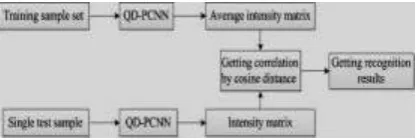
Firstly, all face images are input into QD-PCNN model, then get the pulse intensity matrix of all face images. Next calculate average pulse intensity matrix of each person’s N face images in the training set, and record this value. Then, take one picture from the test set, and put into QD-PCNN model and get its pulse intensity matrix, then calculate the cosine distance of this matrix and the previously recorded average pulse intensity matrix of each person, take the person who’s average pulse intensity matrix has the maximum cosine distance to this matrix as a recognition result. A face recognition process is shown in figure 4.
Figure 4. A face recognition process.
Experimental Procedure (Parameter Optimization Process)
[image:3.595.194.403.593.663.2]four parameters. W is expressed with the reciprocal of the distance between neurons and neurons,
that W=[0.7 1 0.7;1 0 1; 0.7 1 0.7],at the same time set V=2.
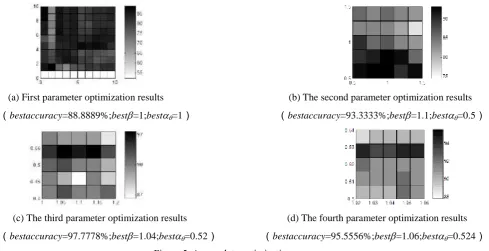
After setting W and V, the parameters were optimized. The application result select recognition accuracy rate obtained from using QD-PCNN face recognition method in the corresponding test set, first select a larger search range, setup and initial cruise range is [0,10]. The initial step distance is 1, in the subsequent iteration process the step distance is shrinking, that is [1、0.2、 0.04···]. A complete search optimization process is as shown in figure 5.
(a) First parameter optimization results (b) The second parameter optimization results
(bestaccuracy=88.8889%;best=1;best=1) (bestaccuracy=93.3333%;best=1.1;best=0.5)
(c) The third parameter optimization results (d) The fourth parameter optimization results
[image:4.595.57.547.195.446.2](bestaccuracy=97.7778%;best=1.04;best=0.52) (bestaccuracy=95.5556%;best=1.06;best=0.524)
Figure 5. A complete optimization process.
In figure 5, the horizontal axis represents the connection coefficient , the vertical axis represents the threshold attenuation coefficient . As can be seen from the figures that in every once optimization, parameter optimization range and optimization step distance are gradually smaller, at the same time, the recognition accuracy rate of the parameter combination in the local range is gradually increased. In the first search optimization process, the search step distance is 1, only a few of the combined values of and can obtain a higher recognition accuracy. And in the fourth process of searching optimization, although the combination of parameters within the range of values can achieve higher accuracy, but the highest recognition accuracy rate is lower than that of the third iteration, then take the third parameter combination as the optimal parameters combination, that is 0.52, is 1.04, the corresponding highest recognition accuracy is 97.78%.
Experimental Results and Analysis
In this experiment, the training set consists of the first 4 (N=4) and the first 3 (N=3) images of each person, the remaining images are grouped into test set separately, the face recognition method based on QD-PCNN model is trained and tested separately, the results of the experiments are compared with the corresponding results of the empirical parameters, results are as follows.
Table 1. Comparison of experimental results.
parameter setting
N
best=1.04
best=0.52
=0.7
=0.5
5 97.78% 95.56%
4 93.24% 90.48%
[image:4.595.186.409.706.787.2]As can be seen from the table, the experimental results with the optimization parameters obtained from improved grid search method are better than those parameters set by experience, when N=3 and N=4 the increases are more obvious, when N=5 recognition accuracy is also increased by 2.22%.The experimental results show that the optimization parameters obtained by the improved grid search method are more suitable for the PCNN model than parameters set by experience.
Summary
In this paper, we introduce QD-PCNN model, and improve grid search algorithm, we can find the optimal parameters within its range of parameters by several steps gradually. In the experiment, the parameter optimization is based on the improved grid search method in the QD-PCNN model and we can get the optimal parameter combination and the corresponding highest recognition rate. The experimental results show that the method can achieve higher recognition rate than traditional PCNN method, and provides a relatively simple and scientific method of parameter setting.
Acknowledgement
This research was financially supported by the National Power Grid Corp science and technology project (52053015000W) and Natural Science Foundation of Shanxi(2014021022-5).
Author brief introduction: Gang YANG, intermediate engineer, electrical engineering major; Xiu-yan TIAN (1979-), Ph.D., main research direction: video object recognition and tracking; Han LI(1990-), postgraduate, main research direction: intelligent information processing, image processing; corresponding author: Hong-xia DENG (1976-), associate professor, CCF members (12290M), main research direction: intelligent information processing, brain cognition, image processing, cloud computing, video object recognition and tracking; Hai-fang LI, Professor, Dr., CCF members (E20-0009497S), main research direction: brain science, intelligent information
processing, computer vision. Corresponding author: Hong-xia DENG, e-mail:
References
[1] Kou Guangjie, Ma Yunyan, Yue Jun, et al. Survey of bio-inspired natural computing [J]. Computer Science, 2014, 41(6A): 37-41(in Chinese).
[2] Shao Xiaopeng, Zhong Cheng, Wang Yang, et al. Application of a simplified PCNN model in color image edge detection [J]. Journal of Xidian University, 2012, 39(6): 1-9(in Chinese).
[3] Zheng Qianqian, Shu Zhibiao. A new approach for automated image segmentation based on simplified PCNN[J]. Computer Aided Drafting, Design and Manufacturing, 2013, 23(1):21-26. [4] Jiang Zhi. Image fusion algorithm based on PCNN and NSCT transform [D]. Zhejiang: Zhejiang Sci-Tech University, 2014 (in Chinese).
[5] Li Xi, Zheng Hong, Liu Cao. A method of face recognition based on HIS-PCNN [J]. Geomatics and Information Science of Wuhan University, 2014, 39(12): 1499-1503(in Chinese).
[6] Zhang Hongjuan. Study of image noise reduction and image enhancenment based on PCNN [D]. Lanzhou: Lanzhou University, 2011 (in Chinese).
[7] Zheng Weitao. Image contrast enhancement by contourlet transform and PCNN [D]. University of Electronic Science and Technology of China, 2014 (in Chinese).
[8] Wang Jianfeng, Zhang Lei, Chen Guoxing, et al.A parameter optimization method for an SVM based on improved grid search algorithm [J]. Applied Science and Technology, 2012, 39(3): 28-31(in Chinese).