2016 Joint International Conference on Artificial Intelligence and Computer Engineering (AICE 2016) and International Conference on Network and Communication Security (NCS 2016)
ISBN: 978-1-60595-362-5
Multiple Trajectories Feature Detection Technology
Based on Data Mining
Zheng SHAN
1,2,a, Yang WANG
1,2,b, Fei XUE
1,2,c, Xi MENG
1,2,d, Jin HAN
1,2,e1Information Engineering University, Zhengzhou 450001
2State Key Laboratory of Mathematical Engineering and Advanced Computing, Zhengzhou Henan HEN371, China
a[email protected], b[email protected], c[email protected], d[email protected], e[email protected]
Keywords: Behavioral Trajectories, Data Mining, Prefixspan-x, Signature, Threshold.
Abstract. The performance of behavior feature of existing malware is single and it result in detected difficultly. So we use behavioral division to build a multidimensional malicious database which is consist of file operation, net access and memory access. We improved data mining algorithms prefixspan to prefixspan-x in construction process. Prefixspan-x adds function of automatic machine frequent sequence query while discarding the frequent sequences which is not satisfied with condition. And we use this model to dynamic interception and malware detected process. It will overcome the questions that static model cannot detect packers and confusion. Experimental results show that the proposed feature detection technology has high accuracy and low false negative rate.
Introduction
Popularity of the Internet contribute significantly to the development of society, and the malicious programs also showed explosive growth. 360 security company published "2015 Chinese Internet Security Report" that, by the end of 2015, 360 Internet Security Center intercepted a total of new malware samples 356 million, compared with 2014 growth of 9.9%. This is due to technical confrontation escalating between virus and antivirus software, the virus uses a more complex encryption and anti-killing technology, so there are more variants in the Internet. Variants of malicious code and malicious code detection is the focus of prevention [1].
Based on static reverse detection method is hard to break malicious code anti-disassembly techniques and extract features of the malicious code to be detected. Signature-based antivirus software updates its virus database exist a very serious lag. But variants of malicious code and malware behavior is not changed. So feature of malicious software should be extracted from its runtime behavior.
Related Work
Malware Detecting
Malware detecting methods can be classified into heuristic based detecting methods and signature based methods [2]. The heuristic based detecting methods, such as RootkitRevealer system, compare the information upper system and the system statement of kernel, in order to identify the hiding files, processes and register information. The heuristic detecting methods can discover unknown malware, while the heuristic rules generated from the experience of analyst, and it is easy to exist high false positive rate and false negative rate in applications. Therefore, it is not generally used in detecting systems, especially in the commercial antivirus. The signature based detecting methods detecting through the signature extracted form malware. Compared to heuristic based detecting methods, signature based detecting methods have higher detecting efficiency and lower rate of false negative. So it is used generally in malware detecting tools, and it is the main method in malware detecting nowadays. Signature based detecting methods are classified into static signature detecting and dynamic signature detecting. Static signature detecting methods get signatures of malware through statically analyzing the PE structure, binary bytecodes, disassemble code of files. Static signature based detecting method need not run malware actually, so it is easy to achieve. Nowadays, there are many researches about static signature based detecting. For example, Matthew G.Schultz and EleazarEskin used the method of data mining technology to detect malware, within three ways which are RIPPER, Naïve Bayes and Multiple classifier systems. And they analyze PE of binary bytecode to extract signatures based on DLL, GNU strings and byte sequence. References [5-8] had researched the malware classifying and detecting method based on API call sequence. However, all of the above-mentioned methods are based on static analysis of PE files. And the advantages of those are that they need not execute malware, so they will not destruction the system. But so far, many malware use pack obfuscation techniques to disturb assembling. If it is not successful to unpack or compress, the static analysis of PE files will not be achieved, so that the detecting will be failed. And, the time information of API sequence can be tampered to avoid detected. Dynamic signature based detecting methods run malware programs in virtual environment, and monitor the behavior of these programs to get their behavior signature. Such as KonradRieck, who supposed collect malicious behaviors by sandbox, and established detecting models by machine learning. The reference [10] used an analysis method, which is based on CPU debug function and used trace-driven, to detect obfuscated malware. However, some malware will detect the virtual environment in virtual antivirus, so they can bypass the detecting programs through add special instructions or construct special structure. It will make antivirus programs be failed to detect malware. In dynamic detection, the program can execute in multipath, malware may execute in different paths because of different input data. Dynamically acquiring method can’t get all of the malicious behaviors, so that there will be false negative in detecting.
Malware Detecting Methods Based on Data Miming
Among data miming sequence model algorithms, prefixspan has a better performance to other algorithms. In this paper, authors enhance the traditional prefixspan to get Prefixspan-x algorithm, which has better efficiency, to satisfy a large number of sequential pattern mining to extract features of malicious code sequences.
Improved Prefixspan-x Algorithm
Related Concepts
Assume all items in each element are arranged in dictionary order. Given sequence
1 2... n e e e
, ' ' '1 2... m ( m n)
e e e
, '
1 2... m1 m
e e e e
, if the following conditions
are met:
' 1
i i
e e i m , em' em, and tell all items of
emem'
are in the rear of items of ' me , so we called
is the prefix of
;'
is the maximum subsequence of
,
is the subsequence of
, and
is the prefix of
', sowe called
' is the projection of
about
;The projection of sequence about is
, so the postfix of sequence about subsequence is''
1...
m m n
e e e
, and ''
'
m m m
e e e ;
The projection database of
is all of the sequence whose prefix is
and relative to the postfix of
, and denoted as S|.If
and
satisfy with condition (1), so the supporting number of
in S|, which is the projection database of
, is the number of sequence , while satisfy the condition
in|
S .
Prefixspan Algorithm
Prefixspan algorithm is miming sequence models through prefix projection, and during projecting, not all of the existing frequent subsequence are considered. Instead of it, prefix sequence is found, and the corresponding postfix is projected into a series of projection database. For each projection database, we just need find the local frequent model, and we don’t produce candidate key. The main procedure of this algorithm is following:
a) Scan database for one time, find frequent L2 sequence, and assume the number of it is k; b) Partition the research space: partition the whole sequence model into k research space, and make the prefix of them be frequent L2 sequence;
c) Construct the relevant databases, which are the postfix sets of relevant prefix; d) Find the subsets of frequent model recursively in these postfix sets;
Prefixspan-x Algorithm
abandon frequent sequence which is not satisfied with minimum length during constructing projection database, so that the cost of time and space during miming will be optimized.
Prefixspan-x algorithm is following:
( , min_ sup, _ min)
( 1)
( , 0, , _ min)
prefixspan-x(a, (a),S| ,L_min) a
prefixspan-x():
1) AC(S,min_sup)|1
2) S|a ( , )
3)b S| a
4
input S L
output M
prefixspan x S L
l
creatsuffix S a
pr ocess:
subpr ogr am:
) ( )
5){
6) ' ; '
7) ( ( ) _ min)
'
8) ;
9)
10) ;
11)}
'
12) | ' ( | , );
'
13) ( , ( ) 1, | , _ min);'
14) ( 1);
foreach b null
a a b
if l a L
get a
else
delete a
S creatsuffix S a a a
prefixspan x a l a S L a output M
For example, give following sequence database and assume the minimum support degree is 2, and the minimum length of frequent sequence is 1:
< read,write read,lseek >
< lseek,dup dup2,pread,close >
< read,lseek fsync close > < fsync > , find the frequent items whose support degree is more
than 2: read, lseek, fsync, close; then remove all the infrequent items, and generate database
< read read,lseek >
< lseek fsync >
< read,lseek fsync close >
Generate projection database for each frequent itemread, lseek, fsync, close, and remove all the frequent sequence which has a smaller length than 2:
< read,lseek > < lseek fsync close >
< fsync close >
write sequence< read,lseek > ,
< lseek (close)> , and then generate it’s projection database
< fsync fsync > . There are not frequent items now, so the algorithm stops.
Represent of Software Behavior Trajectory
The interaction between software and computer is implemented by the operating system, and the form of its performance is that the operating system provides a series of interfaces (i.e., system call). It will leave running trajectories after running software on the operating system (i.e., order of the system call after running by time order). It provides a basis for distinguishing normal procedures and malicious programs that studying software running trajectories to find out its behavior features.
Definition 1 Behavior trajectories: Ordered sequence composed by the system calls that are executed according to the time order. The length of the system call sequence l equals to the number of system calls in the sequence.
e.g., in the Linux system, a software behavior trajectories can be expressed as
R= read,mmap,write,close and the length of the trajectories R can be expressed as l(R)=4.
The software behavior trajectories, the trajectory fragments and the system calls have the following relationship:
We suppose that there are m trajectories in the software (i.e., the software behavior trajectories), and the m trajectories are expressed as T ,T ,T ....T1 2 3 m , the i-th of which is expressed as
1, 2, ...3
i k
T R R R R . Rk is the k-th behavior fragment of the trajectory Ti, Rk
s s s1, , ...2 3 sj
. Rk is the system call sequence which compose trajectory Ti fragment, and the j-th system call
l i m,1 j l
of the time order sequences is expressed as s . jFeature Library Construction Based on Prefixspan-x
Feature Element
Definition 2 signature: The specific behavior trajectory fragments in executing can be used to judge whether a program is malicious. Malicious behaviors of malicious programs usually present many aspects. Such as abnormal operation of the document, abnormal access to the network and unauthorized access to resources such as memory, etc. Traditional extraction of malicious program features based on behavior semanteme is the description for the specific and coherent behaviors of the malicious programs, and this method makes the detection fast and accurate. If a malicious program inserts confused program or confused behavior sequence in the behavior trajectories, the detection based on the traditional features will not detect the variants of malicious programs. Therefore, in the paper the elements of malicious behavior features have three dimensions: File flow features, network flow features and resource flow controlling features. The signature is expressed as follow:
signature=file-sign net-sign source-sign (1)
In which file-sign represents the file flow signature, and net-sign represents the network flow signature, and source-sign represents resource controlling flow signature. The detection for malicious programs is based on this three signature flow.
Signature Library Construction
Definition 3 Signature Database: The database consisted by a series of signatures which can represent the malicious programs.
( D, D, D)
SD F N S (2)
In which FD
represents the file flow signature vector space. ND
represents the network flow signature vector space, and SD
represents the resource flow signature vector space. Learning problem of malicious behavior signature database can be described as:
1. Giving the training set of the malicious programs θand the minimum support min_sup.
2. Extracting behavior trajectories of the malicious programs, i.e., file flow behavior trajectory, network flow behavior trajectory and resource control flow behavior trajectory.
3. Adopting Prefixspan-x algorithm mining the frequent sub sequence set M1 which can meet the minimum support and the minimum length.
4. Given the behavior trajectory set of the normal program, removing the normal behavior trajectory fragments from M1.
5. Generating signature database of the malicious behavior.
The database construction is divided into two phases, while one is the frequent sub sequence mining based on Prefixspan-x algorithm and the other is streamlining the frequent sub sequence set which extracted in phase one.
The specific process of phase one is as follows: For a malicious program given the training set, the paper extracts file flow behavior trajectory, network flow behavior trajectory and resource control flow behavior trajectory of the malicious programs, and respectively initializes training set of the file flow behavior trajectory, the network flow behavior trajectory and the resource control flow behavior trajectory. And then Prefixspan-x algorithm is used to extract the frequent sub sequence set.
Phase two is filtering for the normal behavior trajectory fragments. The frequent sub sequence set extracted in phase one conclude not one the malicious behavior trajectory fragments but also the normal behavior trajectory fragments. The malicious behavior signature vector space can be generated after filtering the normal behavior trajectory fragments. The date set of the normal behavior trajectories uses the behavior trajectories generated after running the normal programs in the initial operating system. The algorithm is as follows (Fig. 1):
In the algorithm 3, there exist the size problem of the normal behavior trajectory fragment set
n
D . If the size is too small, the final SD will interfuse the normal behavior trajectory fragments
resulting in a higher false alarm rate. If the size is too big, the time expenditure of the extraction algorithm will be too large. The size selection depends on the number of the sample.
M1 M2
eliminate M1 D n 1)for t M1 do
2) for s Dn do 3) if s MATCH t ; 4) Delete t From M1; 5) End for
6) End for 7)OutputM2;
I nput: Out put:
Funct i on: ( , )
Multi-Trajectories Detection Based on the Behavior Signature
Structural signature require appropriate detection model to highlight its advantages. The running trajectories are different for different properties in running program, and the sequences of the system call are different. In this paper, variable length sequences slice matching algorithm is adopted to detect the system call sequences and extracted signature.
Detection flow is as follows:
The program behavior trajectories are respectively extracted based on the file flow operations, the network operations and the resources operations such as memory within the monitoring time. Supposing that behavior trajectories are represented as R R Rf, n, s , Rf ( ,s1f s2f, ... )s3f srf ,
1 2 3
( , , .. )n n n n
n m
R s s s s , Rs ( , , .. )s s s s1s 2s 3s qs . In which, r, m, q respectively represent the length of the
system call sequences corresponding to R R Rf, n, s . i k
s represents the k-th trajectory fragment
1 k l R( )i of the i-th behavior trajectory
i=f,n,s in the system call sequence. Supposing that
0class S represents the matching weight of the sequence S, and its initial value is 0. The
following section only uses the behavior trajectories of the file flow operation as the example. Slice
f
R , then N. trajectory fragments are obtained, i.e., S S S1, , ...2 3 Sn. Ending atsk
N k l R
f
,i
S are the system call sequences whose length are l(1), l(2), l(3)...l(N).
According to the order from N to 1 and the file flow signature of the signature library, these N trajectory fragmentsS S S1, , ...2 3 SNare compared and calculated as follows: If there is a fragment
matching the signature library successfully, there will beclass S
i 1, otherwiseclass S
i 0.The weight sequence will be obtained after the above operation:
class S1 ,class S
2 ,class S
3 ...class S
m
According to the weight sequence
class S1 ,class S
2 ,class S
3 ...class S
m
Calculate the decision value,and make decision according to the decision value and decision threshold set in advance.
Calculate judgment component:
1 2
( ) ( ) ... ( )
f m
sign class S class S class S
Seek the judgment valuesignsignf signnsigns, and judge:
Ifsign
0, the behavior is malicious. Ifsign
, the behavior is normal.is a user-set judgment threshold. Different values represent different levels of security, and the smaller the value represents the higher the level of security, the higher the value represents the lower the level of security.
Experimental Design and Results Analysis
Experimental Design
Experimental basic environment: the x86-64 architecture, processor: Intel (R) Core (TM) 2 Quad CPU Q9500, CPU clocked at 2.83GHz, size of memory is 8G, operating system version is centos release 6.5 (Final), Kernel Linux 2.6.32-431.el6.x86_64. GNOME 2.28.2.
software in the system. Without using VMware and Qume but XEN4.4 because the virtual environment can easily be detected by malicious software of behavior-based virtualization software monitoring model. For example, in order to cause difficult to be detected, some malicious software can detect whether VMware communication port contains "VMXH" and hide their own malicious behavior. XEN is a hardware-based virtualization technology can avoid this defect, and virtualization running on high-level privileges can be a good monitor malicious programs.
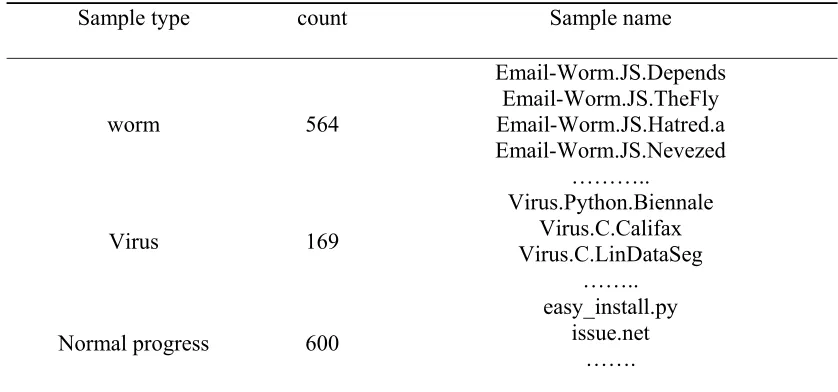
[image:8.612.95.514.544.740.2]The experimental set of experimental include 733 malicious samples and 600 normal programs. Malicious samples are downloaded from http://www.VXheaven.org and http://bbs.kafan.cn. Normal programs are from centos 6.5 initial system. Training set contains three types:100 Email-worm, 50 virus and 20 other type of worm programs. Selecting 300 normal programs from the initial system to be normal set. The test set contains two parts: part one (Table 1) is used to testing the capability of model to detect the malicious variants; part two (Table 2) is used to testing the capability of model to detect the whole malicious programs. All selected samples in test set have characteristics of time distribution because antivirus software database update was in February 2015, the samples in test set should be across the time point. So the above two test sets cover 10% malicious programs after April 2016.
Table 1. Test Set 1.
Sample type Count Sample name
Email-wrom 507 Email-Worm.VBS.Ypsan.b Email-Worm.VBS.Lee
…
Worm 57 IRC-Worm.JS.Nepmoon.a Net-Worm.Perl.Santy.c
…
Normal program 600 easy_install.py issue.net
…
Model learning process constructs signatures for each training set. Using Linux system command “strace” to obtain the behavior trajectory of normal and malicious program.
Performance
Table 2. Test Set 2.
Sample type count Sample name
worm 564
Email-Worm.JS.Depends Email-Worm.JS.TheFly Email-Worm.JS.Hatred.a Email-Worm.JS.Nevezed
………..
Virus 169
Virus.Python.Biennale Virus.C.Califax Virus.C.LinDataSeg
……..
Normal progress 600
easy_install.py issue.net
Performance of this malicious code detection experiment is as follows:
Accuracy Rate (AR): the proportion of the program correctly detected in the sample set, including the correctly detected malicious and normal programs.
Detection rate (DR): the proportion of the malicious program correctly detected in the sample set. False Positive rate (FPR): the proportion of the program incorrectly detected as malicious programs in the sample set.
Analysis of Experimental Results
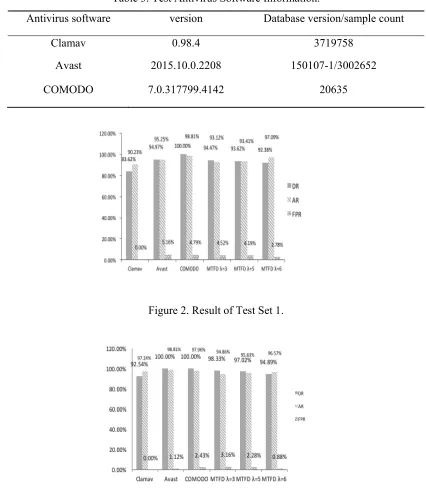
[image:9.612.90.516.219.711.2]Experiments using three popular antivirus software on Linux platform (Table 3) to scan respectively and comparing with test results with ri=3,4,5. The result is as follows:
Table 3. Test Antivirus Software Information.
Antivirus software version Database version/sample count
Clamav 0.98.4 3719758
Avast 2015.10.0.2208 150107-1/3002652
COMODO 7.0.317799.4142 20635
[image:9.612.196.397.566.702.2]Figure 2. Result of Test Set 1.
The results can be seen from Fig. 2 and Fig. 3, the model has a great detection results of the malware and its variants and the result closes to the antivirus software test result. Because the selected test samples are from Internet, antivirus software has most of signature of the malicious software and the antivirus software detection of virus database mechanism has a very high accuracy rate. But due to limitation of the number of samples of the virus database, each test result is different. The new virus cannot be detected because the test sample selection has characteristics of time distribution and the antivirus software’s virus database version updating late the new virus cannot be detected. This model is restricted to the size of the training set and the limit of the user-defined security levels, AR and FPR is unstable. When the threshold value is lower, the DR is higher and the FPR will be higher. When the threshold is higher, the FPR is lower and the DR is relatively lower. Model’s AR is close to the selected antivirus software and the false negative rate is relatively lower than antivirus software.
Conclusion
In oreder to solve the problem of spreading malicious programs and variants, this paper bases on data mining and software behavior trajectory proposed a malicious programs feature extraction and detection method. Using improved Prefixspan-x algorithm of data mining sequential pattern to extract feature. Experiments show that the model has better detection capabilities on the Linux platform and the result is close to the current detection result of the popular antivirus software. The downside is that there is still much room for improving performance of Prefixspan-x algorithm of data mining sequential pattern which is next step needs to be optimized direction.
References
[1]Han Xiao-guang, Qu Wu, Yao Xuan-xia et al. Research on malicious code variants detection based on texture fingerprint [J]. Journal on Communications, 2014, 08: 125-136.
[2]Wang Rui, Feng Deng-guo, Yang Yi et al. Semantics-Based Malware Behavior Signature Extraction and Detection Method [J]. Journal of Software, 2012, 02: 378-393.
[3]Cogswell B., Russinovich M. Rootkit revealer 2006 http://www microsoB
com/technet/sysinternals/Utilities/RootkitRevealermspx.
[4]Matthew G. Schultz, EleazarEskin, ErezZadok. Data Mining Methods for Detection of New Malicious Executables [C]. IEEE Computer Society, 2001: 38-49.
[5]Wang Shuo, Zhou Ji-liu, Peng Bo. Unknown virus detection based on API sequence and support vector machine [J]. Journal of Computer Applications, 2007, 08: 1942-1943.
[6]Zhu Ying-ying, Ye Mao, Liu Nai-qi et al. Host intrusion detection based on sequence of Windows Native API [J]. Journal of Computer Applications, 2008, 18: 109-112.
[7]Gong Tao. Research of Malware Detection Based on Data Mining [D]. University of Science and Technology of China. 2012. 05.
[8]Bai Jin-rong, Wang Jun-feng, Zhao Zong-qu. Malware Detection Approach Based on Structural Feature of PE File [J]. Computer Science, 2013, 01:122-126.
[9]Konrad Rieck. Learning and Classification of Malware Behavior [C]. Detection ofIntrusions and Malware and Vulnerability Assessment 5th InternationalConference, DIMVA 2008, Paris, France, July 1 0-11, 2008.
[11]Zhang Xiao-kang. Research of Malicious Code Detection Technology Based on Data Mining and Machine Learning [D]. University of Science and Technology of China, 2009.
[12]Wang Xin-zhi, Sun Le-chang, Zhang Min et al. Malicious Behavior Detection MethodBased on Sequential Pattern Discovery [J]. Computer Engineering, 2011, 24: 1-3.
[13]Wang Li-na, Tan Xiao-bin, Pan Jian-feng et al. Application of PrefixSpan* Algorithm in Malware Detection [J]. Computer Engineering, 2010, 07: 119-121.
[14]Gong Wei, Liu Pei-yu, Jia Xian. Sequential patterns mining algorithm based on improved PrefixSpan [J]. Journal of Computer Applications, 2011, 09: 2405-2407.