2017 2nd International Conference on Information Technology and Industrial Automation (ICITIA 2017) ISBN: 978-1-60595-469-1
Research on Low Power Consumption
Technology of Zigbee Network
Yingjie Jiang and Mindan Bai
ABSTRACT
Research Zigbee low-power energy-saving technology is particularly important. Zigbee network itself has the characteristics of low power consumption, the paper in-depth study of CC2530 chip low-power technology based on the proposed new energy-saving mechanism, improve the node life effect is obvious.
INTRODUCTION
Zigbee wireless sensor network has a wide range of applications. Zigbee has a significant feature is the low power consumption, the so-called low power consumption, that is, Zigbee equipment only 2 batteries for power supply, can be maintained for 6 to 48 months. In the long-term use of the process, due to the battery voltage level down, the actual use of electricity accounted for about 60%. Zigbee network energy savings can reduce the terminal node power consumption.
ZIGBEE NETWORK ENERGY SAVING STRATEGY
Zigbee's low-power strategy is mainly reflected in the protocol stack layer and Zigbee network topology. Zigbee communication protocol MAC layer and the Network layer has a lot of energy-saving mechanisms. Communication unit of the _______________________
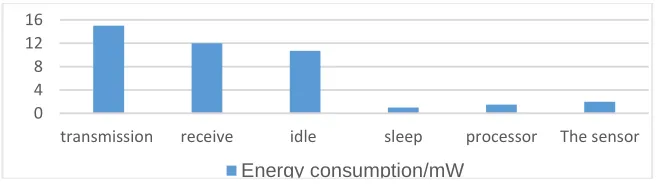
Zigbee node is the most energy consuming. The wireless communication unit has four states, transmission mode, receive mode, idle mode, and sleep mode. The energy consumption of each unit of the node is shown in Figure 1. The Zigbee network is designed for use with less than 1% duty cycle applications. Then take CC2530 as an example, analyze its energy saving mechanism.
CC2530 Power Management Mechanism
The CC2530 uses a power management scheme to minimize node power consumption. There is a definition of the CC2530 sleep pattern in HAL / hal_sleep.c:
Power default setting is PM0, that is, the normal work, clock, power regulator are in working condition. CC2530 out of PM2 can be awakened by sleep timer, I / O reset. While in deep sleep, can only be I / O interrupt and reset wake-up. As a result, the deep sleep mode is more power efficient. CC2530 maximum network sleep time is 510s, sleep timer has a 24-bit counter and 24-bit comparator, when the timer reaches the comparator set value, will interrupt wake-up MCU.
Zigbee Routing Algorithm
Zigbee routing algorithm includes tree routing algorithm and AODVjr routing algorithm. Tree routing algorithm based on Zigbee distributed address allocation mechanism, the advantage of address path addressing is rapid, the disadvantage is that energy waste, can not guarantee the shortest path. The AODV protocol is a hop-by-hop on-demand vector routing protocol. The AODVjr protocol is a streamlined version of the AODV protocol and follows the shortest path to find the shortest path principle. However, the AODVjr routing algorithm has some flaws. Due to the particularity of the algorithm, RREQ messages will be abused, resulting in time wasting and unnecessary energy loss in the nodes, so there is still room for improvement.
ENERGY SAVING OPTIMIZATION STRATEGY
Figure 1. The energy consumption of each unit of the node.
(1)Set The Node to Work
In a Zigbee network with fewer end nodes, the work cycle is set for each node to ensure that it communicates with the coordinator node for a specified period of time. Each node does not send and receive data at the same time, and the data transceiver time is less than the working cycle interval. This ensures that only one terminal node communicates with the coordinator in a certain time interval, reducing congestion and energy waste caused by multi-node simultaneous communication with the coordinator. Assuming that the start time of node 1 is T1, the period is T, then the working time of node 2 is:
T1 + T < t2 ≤ T1 + 2T (1)
The working time of the Nth node is:
T1 + (N − 1) × T < tn < T1 + N × T (2)
(2)Extend The Application Layer Periodic Sleep Time
The extension of the sleep time can be solved by modifying the definition of the application layer sleep function, and the reasonable increase in the cycle sleep time, so that the node has more non-working hours to achieve the purpose of energy saving is the most direct and practical. Software optimization without changing the hardware conditions. Set the sleep time code as follows:
OSAL_SET_CPU_INTO_SLEEP (90000); // set the sleep time 90s
The original set sleep time is 54s, sleep time setting is limited, not too long can not be too short, the experiment found on the development board 90s good results, can effectively reduce energy consumption.
(3)Routing Optimization Strategy Improvement
Based on the tree routing algorithm, combined with the AODVjr algorithm, and by comparing the node energy, select the appropriate nodes in the energy-rich nodes for data transmission. When the RREQ packet is received, the node is discarded by
0 4 8 12 16
transmission receive idle sleep processor The sensor
determining the size of the remaining energy of the node. If the energy is not enough for the next forwarding task, the next node is selected for the next message forwarding task. To avoid unnecessary energy consumption. This is the most commonly used route-saving algorithm. The formula for the last residual value of the node energy (3):
Emin = 𝛼√𝐸0
(𝐷+1) √𝑇3 (3)
E0 is the initial energy, αis the energy slowdown coefficient, and D is the node network depth. The longer the working time is, the less the node can be, the algorithm can greatly reduce the energy consumption of the node.
Figure 2. Node energy change.
EXPERIMENTAL TESTING AND SIMULATION
It is necessary to simulate the routing algorithm. The initial energy of the node is 1500J, the so-called energy threshold. When the node energy is less than 500J, Select the other node for the next data transfer task. In this experiment, the data is simulated by Omnet ++ software. Single node theoretical energy changes as shown in Figure 2. The traditional routing algorithm has high energy consumption, so the improved routing algorithm energy saving effect is obvious.
CONCLUSION
Zigbee technology itself is a low-power technology. This paper analyzes the routing algorithm, and puts forward the optimized energy-saving scheme on the basis of analyzing its energy-saving mechanism. Through the control node and coordinator working time, so that the node network has effective, efficient, energy-saving communications; set the application layer periodic sleep time, and appropriate to extend the sleep time, sleep state is low power mode, can effectively save energy consumption. At the same time, the traditional routing algorithm is
0 375 750 1125 1500 1875
1 2 3 4 5 6 7 8
improved. Based on the combination of tree routing and AODVjr routing algorithm, the new algorithm is added to effectively realize the energy saving effect, and the energy saving scheme is experimentally tested and verified to confirm the feasibility of the scheme.
REFERENCES
1. Du Junzhao. Zigbee technical principles and practice. Beijing: Machinery Industry Press, 2014.11.
2. Dong Ziyu. A Zigbee routing optimization algorithm [J]. Electronic Science and Technology, 2016.9.
3. Lei Bin .Zigbee network routing algorithm analysis and optimization [J]. Xi'an: Xi'an University of Technology, 2016.