University of Huddersfield Repository
Hajjaji, Mufeed and Denton, Paul
The Integration of Risk Management into Maintenance Project Approaches for SMEs
Original Citation
Hajjaji, Mufeed and Denton, Paul (2011) The Integration of Risk Management into Maintenance
Project Approaches for SMEs. In: Proceedings of 21st International Conference on Production
Research ICPR21 July 31 August 4, 2011. ICPR, Stuttgart, Germany. ISBN 9783839602935
This version is available at http://eprints.hud.ac.uk/id/eprint/11190/
The University Repository is a digital collection of the research output of the
University, available on Open Access. Copyright and Moral Rights for the items
on this site are retained by the individual author and/or other copyright owners.
Users may access full items free of charge; copies of full text items generally
can be reproduced, displayed or performed and given to third parties in any
format or medium for personal research or study, educational or notforprofit
purposes without prior permission or charge, provided:
•
The authors, title and full bibliographic details is credited in any copy;
•
A hyperlink and/or URL is included for the original metadata page; and
•
The content is not changed in any way.
For more information, including our policy and submission procedure, please
contact the Repository Team at: [email protected].
21st International Conference on Production Research
THE INTEGRATION OF RISK MANAGEMENT INTO MAINTENANCE PROJECT
APPROACHES FOR MANUFACTURING SMEs
M. Hajjaji, P.D. Denton
School of Computing and Engineering, The University of Huddersfield, Queensgate, Huddersfield, West Yorkshire, UK, HD1 3DH.
Abstract
In today‟s dynamic commercial environments, project management approaches are becoming ever more crucial in supporting industrial organizations to achieve their client and enterprise goals. An often undervalued area of this important practice may be seen as the deployment of effective risk management solutions to aid managers make effective decisions. Neglecting risk management is often cited as a primary factor, which may lead to assumed failure within maintenance projects. The purpose of this research paper as arisen from one of the most important areas in project management, both from researcher and practitioner perspectives; „How to avoid failure and achieve higher rates of project success?‟. The outcome of this work is to demonstrate, through a pilot study within a manufacturing SME, how the adoption of project management tools and specific risk management solutions can be important tools for enabling managers to achieve higher levels of maintenance success.
Keywords:
Risk Management; Manufacturing Maintenance; Project Management; SMEs
1 INTRODUCTION
Contemporary organizations now face a wide array of competitive challenges, for which the deployment of client focused project management approaches is an important key. Best practice project management has rapidly evolved in recent years and is now supported by a wide array of tools, techniques, and standards. It is proposed that by using appropriate tools and techniques in the right way will have a direct impact on delivering successful projects [1]. Moreover, the deployment of project management software can deliver a significant impact on the quality of managers‟ decisions and their performance [2]. Despite the fact that with all the support and help that can be provided by using well regarded project management software and structured approaches, projects may still fail to meet their target deadlines and fall outside budget. These failures could be regarded as either, a result of bad management or that the system or the software package used by the enterprise was not fit for its purpose. For instance, insufficient risk management is cited as one of the main factors, which is likely to cause project failure and this is often neglected within many established practices [3]. There is no doubt that many enterprises do implement inefficient project management approaches, but still manage to finish their projects successfully. Despite this, it is now recognized that the deployment of effective project management within an organization will increase the chance of projects delivering higher ranges of success [4]. Generally, a valid process of project evaluation and control, supported by appropriate project management tools and techniques, can help managers in managing project risk in order to reduce the incident of projects being late and over budget. Managing project risk is widely considered as one of the important subjects in the area of project management, and this has great influence and the potential to improve enterprise efficiency [5].
Nowadays, the integration of risk management techniques and solutions into maintenance projects have received considerable amount of interest from both, researchers and practitioners within industrial sectors [6] [7]. A point of focus for these interests is concentrated on the effectiveness of risk analysis in support of maintenance
decisions [7], and using risk-based planning as a management tool [8]. In practice, developing an effective project planning approach can help many enterprises in reducing the overall cost of maintenance activities and making an optimum utilization of their resources [9]. However, managers who practice without the deployment of underpinning planning theories, inclusive of risk management techniques, are highly likely to exhibit poor performance and may ultimately view subsequent reductions in client business. To ensure that project managers can deal with project risks effectively, any project planning activity must be well developed and embedded within the host enterprise [10].
TECHNIQUES
There exists a wide range of different project management tools and techniques which can be used to support project managers in making effective decisions during the lifecycle of projects. However, in the world of business it is typically considered that everything is required to be undertaken in a very short timeframe and to produce outstanding results of exceptional quality. As such, dealing with hundreds or potentially thousands of project tasks has become almost impossible using ordinary manual calculations. For example, the utilization of spreadsheet functionality in Microsoft Excel (MSE) has become one of the most popular approaches used to build project management models and to undertake risk analysis for many projects. MSE‟s scenario manager may be considered to be one of the powerful functions that can be used to analyze the affect of different scenarios on the best estimation of the project‟s cost or duration [13]. Nevertheless, because of the tremendous improvements in computer technology, some software packages and programs also have become favorable and widespread in the field of engineering project management. Therefore, it can be considered that MSE is now a traditional tool with which to undertake project evaluation. Within contemporary IT markets, there further exists a range of different tools which can be used for analyzing project risk by implementing more sophisticated statistical techniques, such as Monte Carlo simulations. One of the widely known tools is called Palisade Software which can fully integrate and operate within MSE. Palisade is one of the worldwide known corporations which specialize in producing data analysis software including risk analysis software. Palisade Corporation was founded in 1984 and its first product PRISM, existed as a solution in which risk could be quantified for the first time on desktop computer by using Monte Carlo Simulation. The company became one of the world‟s leading risk analysis software providers when it presented the @Risk package with the new feature of implemented Monte Carlo simulation within the Excel spreadsheets. Presenting the results in a graphical manner is one of the primary benefits of using @Risk, as these graphs provide the decision makers with useful results in a way that help them in taking their decisions more confidently.
Palisade software also can integrate with Microsoft Project (MSP) and be used to undertake risk analysis on estimated or ongoing plans in the way that help project managers to make improved estimations and more effective control of the project costs. MSP can be considered as one of the most powerful tools which have been designed to help the users in managing projects effectively [14]. MSP contains various sets of valuable functions that can provide project managers with almost everything they need for planning, monitoring, and controlling of their projects. In terms of planning, MSP can be used effectively to generate the cash flows of a project especially in capital projects, where there exist numerous tasks. MSP can deal with thousands of tasks and resources in one plan, at the same time, so in the planning stage it can save a large amount of time as it is able to generate numerous calculations that can be considered difficult or time consuming to perform manually [15]. Nevertheless, it is widely recognized that calculating Earned Value (EV) is also considered as one of the powerful tools which can be used for the purpose of project control. EV analysis can be considered as the missing link between cost reporting and cost control. However, MSP can be used effectively for controlling a project during its implementation stage, as EV can be calculated automatically by MSP when the original plan within MSP is updated.
The methodology adopted for this study is based on a combination model of descriptive research and experimental research through case studies as described by Yin [16]. Since the primary objective of this research work is related to the further development and implementation of improved risk into project management approaches, and these can only be implemented in a real-life experimental context, this approach seems valid. In order to develop improved understandings of potential and more effective solutions, the authors completed an industrial case study investigation of the application of typical risk management software package (@Risk, and PrecisionTree, Palisade Corporation) within an industrial SME. This paper reports upon the conducted case study and aims to identify, evaluate and disseminate the effectiveness of implementing such tools for helping managers, specifically in SMEs, to make more successful operational decisions. The high level methodology that was implemented by the authors comprised two simple steps: 1) To study and analyze the current practice for an industrial case study enterprise, and 2) To examine and evaluate, if appropriate project management software could be implemented to improve real life project delivery performance. In this paper, a representative sales order quotation process was analyzed within a third party enterprise, to examine the effectiveness of using @Risk in risk analysis calculations and to compare the obtained results with existing business processes, internal to the operation of the partner enterprise. In addition, this work attempts to examine how effectively, the further use of PrecisionTree may be in helping managers to make decisions for the purpose of resources planning.
4 THE CASE STUDY 4.1 Background
This case study represents a practical application, from which the authors could experience the real benefits of using project management software in order to improve enterprise productivity. The case study organization is a customer-focused SME and is one out of four operating within a collaborative Group of enterprise. The Group holds a collective turnover of approximately 2.5 million Euros, with the individual contribution of the case study SME in the region of 0.6 million Euros. The Group operates nationally within the United Kingdom, providing the engineering and manufacturing sector with machine maintenance and repair services. In the event of relocated machines or equipment breakdown, the Group‟s commitment to its customers is to provide a quick response to return their machines into service. The Group enterprises share their resources between each other and hold a total resource pool of 16 highly skilled engineers.
4.2 As-Is Position
21st International Conference on Production Research
identify suitable project management tools and techniques in order to improve the efficiency of their resources. The study enterprise offers clients a broad range of bespoke commercial arrangements; comprising service agreements, maintenance and breakdowns offerings, together equipment sales and refurbishment. The enterprise has signed many service agreements that include undertaking full maintenance and service schedules, which could be delivered once or several times in the year. Also, in case of breakdown events these agreements cover a rapid respond from the enterprise, which must be responded within 24 hours from the time the order is placed. In relation to this commitment to their customers, the enterprise has faced many challenges with respect to the re-planning of schedules due to potential resources shortages and time pressures.
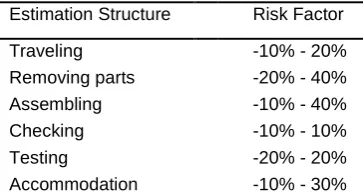
[image:4.595.355.511.59.165.2]When maintenance or refurbishment orders are requested by client email or fax, a quotation is issued for that request depending on the tasks that are contained within the customer enquiry, which sometimes is clarified and confirmed by a further telephone call, and potential site visit. However, because of the high risk and uncertainty of some tasks in this kind of work and the quotation must prepared as a fixed price, the enterprise regularly has to add a risk factor to the total amount of its quotations in order to cover any increase in the project‟s costs which could happen during the implementation stage. The risk ratio, which applied to only maintenance and refurbishment contracts, is depending on how risky is that project, in some cases could rise up to 40% which is counted from the total amount of the quotations. Table 1 shows the typical estimation structure used by the enterprise when risk factors are assigned to an individual project.
Table 1: Typical estimation structure
Estimation Structure Risk Factor
Traveling Removing parts Assembling Checking Testing Accommodation
-10% - 20% -20% - 40% -10% - 40% -10% - 10% -20% - 20% -10% - 30%
However, this safety factor is assigned according to the experience of the enterprise‟s engineers and similar previous projects undertaken. The main risk here comes from increasing task durations which are counted in hours and leads to higher project costs which, subsequently affect other projects in the main plan of the enterprise and lead at the end to defer some of the planned projects because of the shortage in their resources capacity.
4.3 Business Analysis
The enterprise produces approximately 200 quotations per year, which are priced in average 15,000 Euros per quote, and the enterprise wins in average 20% of these opportunities. Figure 1 identifies the percentage of quotations which were won and lost per year. The figure illustrates that 30% of the quotations were lost because customers considered that the estimated price was too high. Nevertheless, 30 % of the quoted maintenance jobs were lost because the customers were not satisfied about the durations of projects. In terms of reputation, the enterprise lost 20% of the quotations mainly because of not finishing projects on time.
[image:4.595.75.257.426.524.2]
Figure 1: Percentage of Quotations were won and lost.
By analyzing the current practice of the enterprise, initial findings indicate that because of not using any kind of formal project management tools and techniques, there were a number of key issues recorded. These relate to contracts estimation, where the enterprise may be missing out on valuable opportunities for improving its productivity and quotation conversion. For instance, if the enterprise would improve its estimation in terms of price and win 5% out of the 30% of lost quotations because of producing high prices, the enterprise could raise its revenue up to 25%. In terms of project planning, the enterprise could face shortages in its resource capacity when projects exceed their original durations and when breakdown orders arrive. Therefore, this leads to difficulties in re-scheduling the planned projects, or accepting new jobs. One of the main reasons which create problems in the planning process is that the enterprise takes into account the risks which are affecting the project tasks in terms of cost by assigning a risk factor to the total amount of maintenance quotations. But at the same time raising the costs, would consequently mean a raise in the estimated durations of maintenance tasks, and this is currently not considered when the enterprise wins and attempts to schedule such projects. This can be considered as one of the reasons why the enterprise has a potential bad reputation for not always finishing projects on time. As with many SMEs, customer satisfaction is considered as important criteria for measuring success. However, in order to remain competitive in the market, there are two main issues that are raised from this case study and have already been addressed: First improving the estimations on quotations; and secondly, to help internal quotation engineers in the formal planning process.
5 PILOT IMPLEMENTATION AND RESULTS 5.1 Cost Estimation
The main issue here relating to the generation of a quotation was regarded as the application of a safety
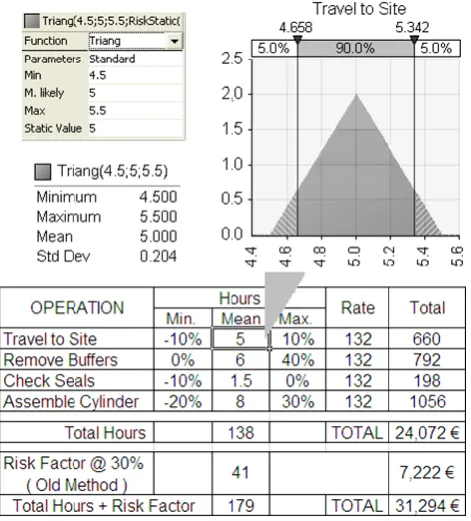
most likely (Mean); and maximum; which are required for the purpose of this research examination. However, different risk factors are applied for all the tasks in the quotation by using @Risk in order to compare the simulation results with those obtained by the old system. According to the enterprise estimation structure in Table 1 each estimated working hours can have a range of minimum and maximum percentages which can simply be entered as values automatically by the MSE model into the simulation. Figure 2 illustrates a part of this maintenance quotation in MSE after integrated with @Risk to apply different risk factors for each task.
Figure 2: The quotation in MSE integrated with @Risk
[image:5.595.312.549.223.350.2]After assigning all the inputs, outputs and running the simulation, the results were presented automatically, as shown in Figure 3.
Figure 3: The estimated cost by using the simulation
The results indicate that there is 90% chance the total amount of quotation cost could raise up to 26,640 Euros. In contrast with the ordinary method, the estimated cost generated by the simulation raises the original total amount by just 11%. However, there is 19% different between
ultimately can be regarded as a reason for not accepting this quotation.
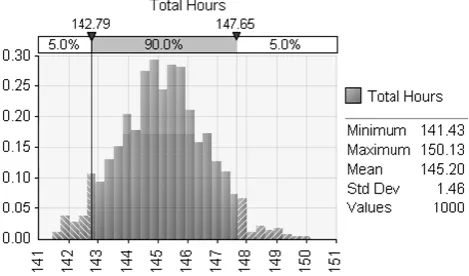
[image:5.595.312.549.510.623.2]Also, the results as shown in Figure 4 indicate that there is a 90% chance that the total hours required to finish the work could raise from 138 hours to just over 152 hours. According to this result, the project would run 14 hours over its original estimated time and represent a duration increase of a further 2 days. Conversely, according to internal quotation engineer‟s expectations, if a 30% increase was applied to the total period of the project, the working hours will be expected to rise from 138 to 179 hours, which ultimately increases the project duration by about 5 days.
Figure 4: The estimated cost by using the simulation
In order to have better estimation for project cost and durations, it is possible to check from the simulations, which are the most important tasks in terms of costs, that have significant impact on the total cost of the project then recalculate the risk factors for each of these tasks in the software and re-run the simulation. This can provide the enterprise‟s commercial managers with the opportunity of taking more effort to control these tasks in order to reduce the incidences of being late and over budget in their projects. Figure 5 illustrates the impact of tasks on the budget refurbishment project.
Figure 5: The impact of tasks on the project budget
[image:5.595.53.286.561.696.2]21st International Conference on Production Research
Figure 6: The estimated cost after assuming of control of tasks
Also, the result in Figure 7 shows that the working hours of the project were decreased from 152.41 down to 147.65 hours, through which it could potentially save almost 5 working hours.
[image:6.595.49.284.307.445.2]
Figure 7: The estimated duration of the project after assuming of controlling of tasks
Analyzing all these results, in terms of cost estimate indicate that the simulation gives a much better cost estimation, since the foundation cost could lead to a lower priced quotation, which could directly increase the chance of the enterprise winning the follow on sales order. In addition, the enterprise will take further benefit from the simulation results when the planners proceed with the subsequent project planning activities.
5.2 Project Planning
The enterprise and wider Group is currently making valuable steps forward in the implementation of an appropriate project planning solution in order to change its manual planning system with a suitable tool that can help the Group to save its reputation, and gain more maintenance contracts. However, MSP and another software package called PlanningForce Program Manager have been partially implemented and tested. The main problem here in delaying for the full implementation of this approach, has been impacted by current resource constraints within the enterprise, with sufficient time not been available for more detail data capture and analysis. However, now after assigning a dedicated staff member to oversee this area, tasks have become more organized and enabled the enterprise to have more time to look into better solutions for planning matters.
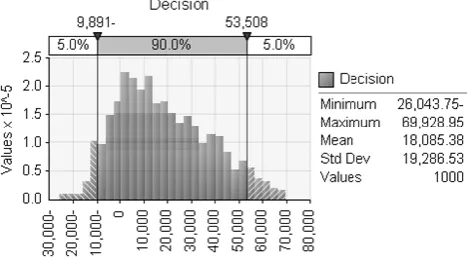
Using whiteboard for projects planning was an effective planning tool when the enterprise was not gaining many maintenance or services contracts. More recently the Group has developed its business model and gained more and more contracts at the same time as SMEs; the Group aims to keep its engineers busy all the time in order keep generating cash to support further growth. This situation has put the enterprises at high risk by facing shortages in their resources and forcing them to re-schedule projects, every time by placing incoming breakdowns jobs instead of planned projects. In order to solve this problem the enterprise discussed, the worth of employing a full time engineer for covering breakdown jobs and additional allocation for incoming new jobs. However, from the historical data the enterprise receives on average 3 to 5 working days per month as breakdown jobs, also the enterprise refuses on average 4 days per month as incoming new jobs. For the purpose of this issue, the authors built a model and examined the situation by using PrecisionTree software in order to help the enterprise in making an informed decision on employing a new engineer. The first thing in building the model is to calculate the expected outcome and income from employing the new engineer. The engineer is expected to be paid 15 Euro per hour and to work 1,920 hours per year, so the total outcome in the model would be 28,800 Euros per year. The expected income for this model would be 17,280 Euros, which is counted from working 4 days in new jobs; also another income is counted from the probability of allocating the engineer for working between 3 to 5 days of incoming breakdown jobs. After inputting all these assumptions into the model the outcome of the simulation as shown in Figure 8 indicates that the decision for employing a new engineer can be considered as a very good decision to take.
Figure 8: The result of the PrecisionTree model
[image:6.595.327.535.423.611.2]Figure 9: The estimated income from employing new engineer.
6 CASE STUDY REPORT
The case showed that in the absence of detailed historical records; forecasters tend to apply high risk factors on the total which lead at the end to lose 30% of the quotations. However, In terms of cost estimate “@Risk” makes a large difference in analyzing risk in comparison with the classic method used by the case study enterprise and it does not require professionals to be implemented. The case further shows that improving the estimation criteria with the help of a risk management tool when producing quotations such as @Risk software, the enterprise could increase the chance for raising its revenue up to 25% and this could provide a further, basis for subsequent estimation and planning. Nevertheless, the result obtained from the PrecisionTree model indicates that the decision for employing a new engineer can be taken with high confidence, which ultimately could raise enterprise revenue and improve the marketplace image by finishing projects on time and delivering higher levels of customers‟ satisfaction.
7 CONCLUSIONS
This work reports important aspects relating to engineering project management in order to identify the usefulness of using risk management software as an effective project management tool. The primary deliverable of this research is to highlight that project managers can take more effective decisions, when supported by the right tools and techniques, for leading maintenance project to success. The case study applications show that in terms of cost estimation there is a great opportunity for the enterprises to increase their revenue by improving the estimation structures with the help of using adequate project management tools and techniques. In terms of planning aspects, the results support that the use of risk analysis software can provide maintenance planners with an early warning for incoming risks, so they can plan to avoid or mitigate these risks. Also, the simplicity in using such tools and the low cost of investment of many well known software packages would encourage many SMEs to implement such tools.
The aforementioned benefits may be obtained by using an integration of two or more project management tools as presented in this research paper. In respect of the resource constraints of SME management, who can hardly find time for developing their management ability, this documented approach would start to recognize, identify and control risks in their projects and allow them to plan more effectively. Therefore they will be able to improve their ability in managing project risks and ultimately this may increase the success of their businesses.
management tools within SMEs is to develop a specific methodology for encouraging SMEs in the UK, to implement specific risk management tools and project planning approaches in order to improve management competency.
8 REFERENCES
[1] Patanakul, P., Iewwongcharoen, B., Milosevic, D., 2010, An Empirical Study on The Use of Project Management Tools And Techniques Across Project Life-Cycle and Their Impact on Project Success, Journal of General Management, 35, 41-65.
[2] Ali, A. S. B., Anbari, F. T., Money W. H., Impact of Organizational and Project Factors on Acceptance And Usage of Project Management Software and Perceived Project Success, 2008, Project Management Journal, 39, 5-33.
[3] Lawrence P., Scanlan J., 2007, Planning in the Dark: Why Major Engineering Projects Fail to Achieve Key Goals, Technology Analysis and Strategic Management, 19, 509-525.
[4] Alan M., Ann L., Project Management Tools and Techniques in High-technology SMEs, 2007, Management Research News, 30, 153-166.
[5] Raz T., Michael E., 2001, Use and Benefits of Tools for Project Risk Management, International Journal of Project Management, 19, 9-17.
[6] Norman F. S., 1999, Measuring and Evaluating Maintenance Process Using Reliability, Risk, and Test Metrics, Transactions on Software Engineering, 25, 6-18.
[7] Backlund F., Hannu J., 2002, Can We Make Maintenance Decisions on Risk Analysis Results?, Journal of Quality in Maintenance Engineering, 8, 77-91.
[8] George B., Gautam M., 2003, Using @RISK to Calculate Portfolio Performance, Brunel University Press, England.
[9] Palmer, R. D., 2005, Maintenance Planning and Scheduling, McGraw-Hill Professional Publishing, USA.
[10] Zwikael O., Sadeh A., 2007, Planning Effort as an Effective Risk Management Tool, Journal of Operations Management, 25, 755–767.
[11] Leopoulos, V. N., Kirytopoulos, K. A., Malandrakis C., 2006, Risk Management for SMEs: Tools to Use and How, Production Planning & Control, 17, 322-332. [12] Antony J., Kumar M., Labib A., 2008, Gearing Six
Sigma into UK Manufacturing SMEs: Results From a Pilot Study, Journal of the Operational Research Society, 59, 482-493.
[13] Day A., 2003, Mastering Risk Modeling: A Practical Guide to Modeling Uncertainty with Excel, Pearson Education Limited, Great Britain.
[14] Ron B., 2000, Complete Idiot's Guide to Project Management with Microsoft Project 2000, Penguin Group Incorporated, USA.
[15] Lisa, B., 2002, Managing with Microsoft Project 2002, Course Technology, USA.