A study of Factors Affecting the Satisfaction level in E–banking
Jaideep Sharma, Research Scholar, IMSAR(MDU Rohtak), Dr. V K Kaushik, Professor, TIT&S, Bhiwani,
Abstract:
Owing to the high costs involved in increasing the current client base, one of the main goals of banks and other financial services providers, which operate through the internet, should be to develop customer satisfaction in order to improve their results. To achieve this aim, Banks face most vital challenge in providing and maintaining service quality. Motivated by the growing interest in e-banking, our focus in this research paper is on identifying the key dimensions of e-banking service quality and its relationship with customer satisfaction. This paper attempts to accumulate literature in order to understand the overall structure of the formation of e-Satisfaction. The purpose of this paper is to uncover and interpret the current researches in the dimensions of e-service quality. There are a range of studies on the dimensions, measures and attributes of e-service quality. This paper attempts to synthesize the available literature in order to understand the conceptual nature of e-service quality. The literature reviewed provide underlying patterns of relationships between e-banking satisfaction and its influencing factors. Such understanding is relevant for academicians and researchers for furthering the work in this field. The insights into the previous studies, considered for this paper, are discussed and suggestions for future research are provided.
Keywords: - e-Banking; e-Service quality; Satisfaction; website quality
International Research Journal of Management and Commerce
ISSN: (2348-9766)
Impact Factor 5.564 Volume 4, Issue 11, November 2017
INTRODUCTION
Internet Banking is one of the increasingly business in E-commerce worldwide. Electronic banking(e-banking), also known as cyber banking, virtual banking ,online banking, or home banking, includes various banking activities conducted from home, business, or on road rather than at a physical bank location through the use of electronic means. E-banking is the delivery of banking services and products through the use of electronic means irrespective of place, time and distance. With the exception of cash withdrawals, through E banking customer can do any type of banking transactions at the click of a mouse. Indeed the use of the internet as a new alternative channel for the distribution of financial services has become a competitive necessity instead of a just a way to achieve competitive advantage with the advent of globalization and fiercer competition. Banks use online banking as it is one of the cheapest delivery channels for banking products. Such service also saves the time and money of the bank with an added benefit of minimizing the likelihood of committing errors by bank employees. There are numerous advantages to banks offered by E-banking such as mass customization to suit the likes of each user, innovation of new products and services, more effective marketing and communication at lower costs.
banking is changing the banking industry and is having the major effect on banking relationship. E-banking is increasingly becoming a ‘need to have’ than a ‘nice to have’ service. In India, ICICI Bank Ltd. has started internet banking service in 1997 as brand name ‘Infinity’, followed by HDFC Bank in 1999. Now almost all banks are providing Internet banking services to their customers.
OBJECTIVES
A number of studies have examined the development of electronic banking (or e-banking) and various service quality dimensions essential of customer satisfaction in e-banking. These studies point to the need for understanding factors which are important in the e-service quality.
METHODOLOGY
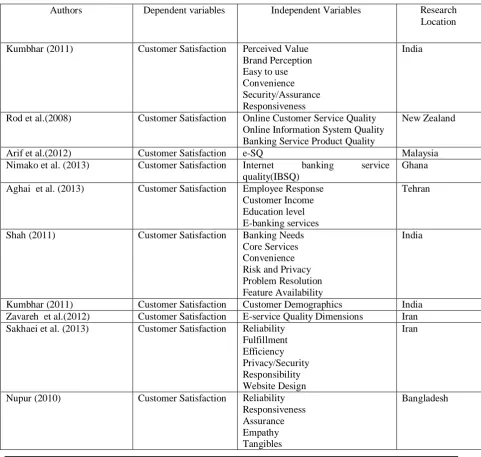
[image:3.595.66.548.286.743.2]A search on Google Scholar with key word related to “e-banking, customer Satisfaction, e-service quality “was carried out to find the studies related to E-banking. Only openly accessible studies were taken due to permission restrictions from the publishers. Hence, 15 articles were downloaded, of which only 10 studies have focused on e-service quality and customer satisfaction in e-banking. The dropped articles were more concerned towards the adoption of e-banking rather than on e-service quality dimensions. Hence ten studies, which have considered e-service quality as their main theme, are considered for the current paper. Iran, Ghana, Malaysia, Tehran, New Zealand, Bangladesh & India are the study area of the considered articles published in different national and international journals. A summary of the ten articles is presented in Table 1.
TABLE 1: SUMMARY OF SELECTED LITREATURE ON E-BANKING
Authors Dependent variables Independent Variables Research
Location
Kumbhar (2011) Customer Satisfaction Perceived Value
Brand Perception Easy to use Convenience Security/Assurance Responsiveness
India
Rod et al.(2008) Customer Satisfaction Online Customer Service Quality Online Information System Quality Banking Service Product Quality
New Zealand
Arif et al.(2012) Customer Satisfaction e-SQ Malaysia
Nimako et al. (2013) Customer Satisfaction Internet banking service
quality(IBSQ)
Ghana
Aghai et al. (2013) Customer Satisfaction Employee Response Customer Income Education level E-banking services
Tehran
Shah (2011) Customer Satisfaction Banking Needs
Core Services Convenience Risk and Privacy Problem Resolution Feature Availability
India
Kumbhar (2011) Customer Satisfaction Customer Demographics India
Zavareh et al.(2012) Customer Satisfaction E-service Quality Dimensions Iran Sakhaei et al. (2013) Customer Satisfaction Reliability
Fulfillment Efficiency Privacy/Security Responsibility Website Design Iran
Nupur (2010) Customer Satisfaction Reliability
Responsiveness Assurance Empathy Tangibles
A REVIEW OF PERTINENT LITRETURE
The studies included in Table 1 are diverse but still, a significant pattern in the structure of customer satisfaction formation can be found. In this section more detailed discussion of some critical aspects associated to Table 1 are provided.
Kumbhar, V.M. (2011) attempted to examine a contribution of various dimensions of service quality in customer’s satisfaction. He has taken total 13 variables which all were found significant and were good predictors of overall satisfaction in e-banking. However, A result of principle component analysis indicates that Perceived Value, Brand Perception, Cost Effectiveness, Easy to Use, Convenience, Problem Handling, Security/Assurance and Responsiveness are important factors in customer satisfaction in e-banking.
Rod, M. et al. (2011) empirically examines the relationships between three service quality dimensions, overall internet banking service quality and customer satisfaction. Their results show that online customer service quality and online information system quality are significantly and positively related to overall internet banking service quality. Although banking service product quality does not have a significant relationship with overall internet banking service quality. The structural model results also shows a significant and positive relationship between perception of overall internet banking service quality and customer satisfaction.
Arif et al. (2012) examined the relationship and the impacts of e-SQ and e-Satisfaction on e-Loyalty in internet banking. The modified version of E-SERVQUAL instrument was used to determine e-SQ for internet banking service of a commercial bank in Malaysia. Based on the review on e-SQ dimensions for internet banking, the authors added three dimensions: site aesthetics and customization and assurance - to cover all potential demands of the Malaysia Internet banking customers. They verified that website aesthetics and guide, efficiency-system availability and contact-responsiveness of internet banking e-SQ were positively and significantly associated with e-satisfaction.
Aghaei et al. (2013) conducts a research to explore the degree of customer satisfaction of e-banking services as well as the factors influencing their satisfaction. The findings suggest the positive relationship between Customer Satisfaction and services provided by employees, customers' income, positive experience of services of electronic banking. But no
significant correlation was found between customers' satisfaction and their education level as well as their familiarity with the services provided by banks.
Shah (2011) research revealed that Banking Needs, Core services, Convenience, risk and Privacy concerns are the main factors for overall satisfaction of online consumers. On the other side, Feature Availability and Consumer Continuation were found to moderately affect the customer satisfaction using E-banking services. In order to promote customer satisfaction, it is inevitable for banks to give due emphasis to all the above mentioned factors.
Kumbhar (2011) study shows that, customer demographics are the important factors which effect the customer satisfaction and adoption of E-banking services. According to his research, highly educated, higher income group and younger customer are using this service, but, remaining customers are not frequently using these services. There is significant difference in customer satisfaction in Public and Private Sector Banks. Private Sector banks are providing better service quality than public sector banks.
Zavareh et al. (2012) has conducted a research to check effects of E-service quality dimensions on Customer Satisfaction in Internet Banking Services in Iran. They have used E-Servqual with some modifications to measure e-SQ for internet banking services. They indicated that six dimensions – efficient and reliable services, fulfilment, security/trust, site aesthetics, responsiveness/contact and ease of use constituted e-SQ for the Iranian internet banking. The result of correlation analysis proved that there was positive correlation between e-SQ and e-CS for Iranian Internet Banking Customer.
Sakhaei et al. (2013) done a research to understand the impact of service quality factors on internet banking on customer satisfaction in Iran. They have taken six service quality dimensions namely efficiency, reliability, responsiveness, fulfilment, website design and security/privacy. The results indicate that the reliability index has the most effective and website design has the least effective on customer satisfaction than other indicators.
between banks and corporate customers is the most important factor in the success of new financial services.
CONCLUSIONS
Even though the studies reviewed above present varied views of the formation of customer satisfaction, cohesively they present a basic pattern with regard to the determinants of customer satisfaction in e-banking. Security/Assurance is found to be the major determinant for developing satisfaction and trust. Website Quality and Ease of Use are another most important dimensions of E-banking service quality which affect the customer satisfaction. Most of the studies view that website is a form of service product provided by the bank as an alternate channel of delivery. Hence, the quality of service in these studies is viewed as website quality and vice versa. Therefore, banker and banking service designers should think over these dimensions and make possible changes in the e-banking services according to the customer’s expectation and need of the time. It will be helps to enhance service quality of e-banking and increase the level of customer’s satisfaction in e-banking.
This paper attempted to examine the determinants of Customer Satisfaction in internet banking environments based on the literature reviewed. The studies reviewed belong to diverse geographies indicating the importance of this paper in understanding the concept further. In addition, the studies present a pattern of relationship between the determinants of e-banking service quality and customer satisfaction which can be researched further for better understanding of the customer satisfaction phenomenon in e-banking. Such understanding is helpful to practitioners and academicians which in turn catalyzes the growth of banking industry in Indian context.
REFRENCES
(1) Aghai, M., Biglar, R., Jamshidian, M.M. & Asadollahi, A. (2013). Investigating the Effect of Electronic Banking Systems on Customer Satisfaction in Tehran. Journal of Basic and Applied Scientific Research. Vol. 3(5), pp. 319-324
(2) Arif, M. S.M., Yun, L.O., Zakuan, N. & Jusoh, A. (2012). Examining Dimension of Electronic Service Quality for Internet banking Services. Procedia-Social and Behavioural Sciences. Volume 65(2012).854-859.
(3) Kumbhar, V.M. (2011).Factors affecting The Customer Satisfaction in E-banking: Some Evidence from Indian Banks. Management Research and Practice. Vol 3(4),pp. 1-14
(4) Kumbhar, V.M. (2011)). Service Quality perception and customers’ satisfaction in Internet Banking service: A case study of public and private sector banks. Cyber Litreature.Vol (4(2). 21-29.
(6) Nupur, J.M. (2010). E-banking and Customer’s Satisfaction in Bangladesh: An Analysis. International Review of Business Research Papers.Vol. 6(4). Pp. 145-156.
(7) Rod, M., Ashill, N.J., Shao, J. & Carruthers, J. (2008). An examination of the relationship between service qualities dimensions, overall internet banking service quality and customer satisfaction. Marketing Intelligence & Planning. Vol.27 (1), pp. 103-126.
(8) Sakhaei, S.F., Afshari, A.J. & Esmaili, E, E. (2013). The Impact of Service Quality on Customer Satisfaction in Internet Banking. Journal of Mathematics and Computer Science. Volume 9(2014).33-40
(9) Shah, A. (2011). Factors influencing Online Banking Customer Satisfaction and their importance in improving overall Retention Levels: An Indian Banking Perspective. Information and Knowledge Management, Volume 1(1).45-54