© Associated Asia Research Foundation (AARF)
A Monthly Double-Blind Peer Reviewed Refereed Open Access International e-Journal - Included in the International Serial Directories.
Page | 408
DETERMINATION OF EFFECTIVENESS AND SATISFACTION
LEVEL AMONG EMPLOYEES REGARDING SELECTION PROCESS
Monika Jindal
Assistant Professor at A.S College Khanna -M com,BEd, UGC (NET), Pursuing PhD.
ABSTRACT.
To select means to choose, selection is the process of picking up individuals out of the pool of job applicants with requisite qualification and competence to fill jobs in the organization. It is a method to differentiate the qualified and unqualified applicants by applying various techniques such as interviews; test etc.The objective of the study is to examine the satisfactory level of employees regarding selection. For achieving this objective research carried out at 50 employees of Chankya Dairy Products Ltd.For testing reliability stastical test chi-square was applied. .When an organization selects an employee for a job than there are many attributes that’s to be considered. Attributes like qualification, technical skills, communication skills and references play an important role. By the analysis we can conclude that the HR manger have to focus on selecting the right person through other source like campus placement, internet etc. and there is need to change the recruitment policy at some extend.
INTRODUCTION
In HRM as well as in organization, recruitment plays an important role in achieving
organization vision, Mission, goal and objectives. To acquire and retain high quality workers Inte rnational Research Journal of Management and Comme rce
ISSN: (2348-9766) Impact Factor- 5.564, Volume 4, Issue 7, July 2017 We bsite- www.aarf.asia, Email : editor@aa rf.asia , ed itoraarf@g mail.co m
© Associated Asia Research Foundation (AARF)
A Monthly Double-Blind Peer Reviewed Refereed Open Access International e-Journal - Included in the International Serial Directories.
Page | 409 is critical to an organization. Profitability of the organization depends on its utilization. If
there utilization is done properly will make profit otherwise it will make loss. To retain right
man at the right place at right time, some information regarding the job is highly essential.
This information is obtained through job analysis, Job description and job specification.
Without these recruitment will be unsuccessful. All recruitment should be based on
organization’s human resources plan.HRM department should assist line managers to develop
their human resource plans effectively. To conduct recruitment efficiently, HRM department
should process the recruitment after checking with budget provision and final approval from
the top management. Recruitment is the process of searching for prospective employees and
stimulating them to apply for jobs in the organization. When more people apply for jobs then
there will be a scope for recruiting better person. The job –seekers too, on the other hand, are
in search of organizations offering them employment. Recruitment is a linkage activity
bringing together those with jobs and those seeking jobs.
SELECTION
Meaning:To select means to choose .selection is the process of picking up individuals out of the pool of job applicants with requisite qualification and competence to fill jobs in the
organization. It is a method to differentiate the qualified and unqualified applicants by
applying various techniques such as interviews, test etc.
Definition
“Selection is the process in which candidates for employment are divided into two classes – those who are to be offered employment and those who are not”
-Dale Yoder REVIEW OF RELATED LITERATURE
A literature review provides an overview and a critical evaluation of body of literature
relating to a research topic or a research problem. “A literature review is the process of
reading,analyzing, evaluating, and summarizing scholarly materials about a specific topic.”(Richard nordquist)
© Associated Asia Research Foundation (AARF)
A Monthly Double-Blind Peer Reviewed Refereed Open Access International e-Journal - Included in the International Serial Directories.
Page | 410 of human resource in an organization highly depends on the quality of applicants attracted
because organization is going to select employee from those who were attracted. The
objective of selection function are to get the right person to the right job and maintain a good
image as a good employer and maintain the selection process as cost effective as possible.
Karthiga G.(2015) studied the various factor that should be considered for the recruitment and selection process and the satisfaction level of the employees towards the recruiting .
Recruitment process has a greater impact on the company as a fresh blood, new idea enters.
Selection process should also be modified according to requirement.
Dr. Gupta R. and Jain J. (2014) studied that an effective approach to recruitment and selection can help an organization to maximize the competitive advantages by choosing the
best pool of candidate quickly and cost efficiently. But successful recruitment and selection
can be costly and time consuming. Still, recruitment and selection is crucial for a business,
because unsuccessful recruitment and selection can be responsible for failure of the business.
Mustapha , Mudashira A.(2013),studied that the aim of recruitment goes beyond mere filling of vacancies to include individual development and achievement. It aims to build a
strong organization where effective team work, and the individual needs are realized at the
same time. To achieve this aim, the organization must re- adopts recruitment policies which
are internally consistent. A good selection process is one that is properly planned and well
operated, poor recruitment efforts could lead to the selection of poor applicants because
positions are to be filled too quickly. This study also recommended that for the recruitment
and selection process to be effective, it should be consistent with an established standard, fair
and transparent.
Sudhamsetti N., Dr. D.N.M R. (2014), revealedthat Recruitment and selection are two important functions of human resource management. Technically speaking the function of
recruitment precedes the selection function. It includes finding, developing prospective
employees and attracting them to apply for jobs in an organization. Selection is the process of
finding out the most suitable candidate to the job. Recruitment is the first stage in the process
which continues with selection and ends with the placement of candidate. Recruitment
facilitates in acquiring the number and the types of people necessary to ensure continued
operations of the organizations .Recruitment is finding the potential applicants for actual or
© Associated Asia Research Foundation (AARF)
A Monthly Double-Blind Peer Reviewed Refereed Open Access International e-Journal - Included in the International Serial Directories.
Page | 411 those seating jobs. The purpose of recruitment is to identify suitable man power to meet the
job requirements and job specifications.
Badalona S., Marques L. (2013), studied that workforce diversity is an important topic, which should be of increasing concern for HR managers, as its central objective cannot be
separated from business strategy. Thus, it is suggested that HR managers must be able to
guide organizations through and provide leadership in managing diversity in a way that fully
realize the potential benefits that differences can bring. That is, be aware of behavior and
attitudes, acknowledge biases/prejudices, avoid assumptions, and focus on job performance
and conduct. This in turn will help the HR manager in his/her substantive activity such as a
leadership development and explicit focus on workforce diversity. HRM may be able to
achieve these goals through an integrated approach with the combined broader role of
organizational management.
RESEARCH METHODOLOGY
It is a systematic way of conducting a project it is a series of steps, which are undertaken in
order to reach at the final decision. This report is based on primary as well as secondary data,
however primary data collection was given more importance since it is overhearing factor in
attitude studies. One of the most important uses of research methodology is that it helps in
identifying the problem, collecting, analyzing the required information and providing an
alternative solution to the problem.
Need of the study
The study is needed to find out the various barriers perceived by chanakya industry.
Chanakya dairy product ltd. Play an important role in the economic growth and development
of country. Chanakya dairy product ltd. has a significant share in export of the country and
also provides a large no. of employment opportunities to the population of India. The study
conducted to find out the various barriers perceived by chanakya industry and various ways
© Associated Asia Research Foundation (AARF)
A Monthly Double-Blind Peer Reviewed Refereed Open Access International e-Journal - Included in the International Serial Directories.
Page | 412 Objectives of the study
Objective is the single most important aspect of research design and implementation may be
based on findings on some other research – taking something which the other person has
invested. There are certain objectives of this study that are as follows:
To analyze the effectiveness of selection process adopted in the chanakya dairy
product ltd.
To examine the satisfactory level of employees regarding selection at chanakya
dairy product ltd.
Scope of the study
The study isconducted at chanakya dairy product ltd. Mandi Gobindgarh.
Research design: DescriptiveAnalysis
Collection of Data
Primary data: In this study questionnaire has been used for receiving primary data. First ly Thequestionnaire was formulated.And then responses were collected from the
respondents.Secondary data: In this study information from various websites and journals are collected.
Sample size: The sample size of this study is 50 employees/ employers of chanakya dairy product ltd. or we can say that 50 respondents. In this study the data is collected from 50
respondents and then analyses and interpret.
Sampling method: The convenience sampling method is used for collecting data from the respondents and with the help of statistical techniques that data is analyzed.
© Associated Asia Research Foundation (AARF)
A Monthly Double-Blind Peer Reviewed Refereed Open Access International e-Journal - Included in the International Serial Directories.
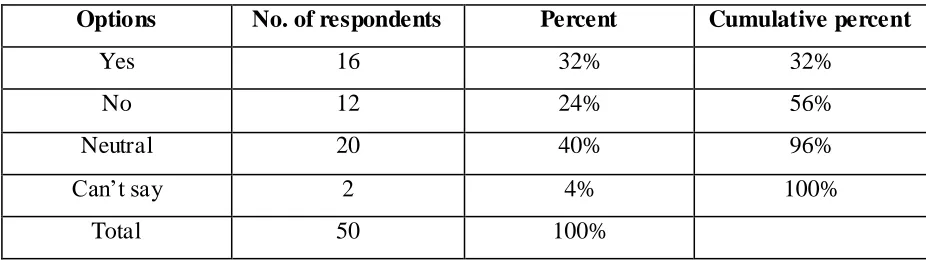
Page | 413 1) Analysis of adve rtisement of vacancies
Table no 1.1
Options No. of respondents Percent Cumulative percent
Yes 16 32% 32%
No 12 24% 56%
Neutral 20 40% 96%
Can’t say 2 4% 100%
Total 50 100%
Inte rpretation: According to the table no. 1.1,32% respondents say that the vacancies are properly advertised, 24% say that there is no advertisement of the vacancies and 40%
respondents feels that there may be advertisement or may not be.
[image:6.596.66.529.96.227.2]2) Analysis about the fairness of policy Table no. 1.2
Options No. of respondents Percent Cumulative percent
Fair 15 30% 30%
Moderate 21 42% 72%
Unfair 11 22% 94%
Can’t say 3 6% 100%
Total 50 100%
Inte rpretation: As per the above table no. 1.2, 30% respondents feels that the recruitment policy is fair, and 42% respondents feels that it is moderate, 22% gives there view that the
© Associated Asia Research Foundation (AARF)
A Monthly Double-Blind Peer Reviewed Refereed Open Access International e-Journal - Included in the International Serial Directories.
Page | 414 3) Analysis about Conside red thinks while selecting employees
Experience Table no.1.3 (a)
Options No. of respondents Percentage Cumulative percent
P:1 9 18% 18%
P:2 18 36% 54%
P:3 10 20% 74%
P:4 8 16% 90%
P:5 5 10% 100%
Total 50 100%
Inte rpretation: The table no.1.3(a) represents that 18% respondents gives first preference experience while selecting employee for a job,36% respondents gives second preference ,
20% respondents gives third preference,16% respondents gives fourth preference and the rest
10% respondents gives fifth preference to experience while selecting an employee.
Communication skills Table no.1.3 (b)
Options No. of respondents percentage Cumulative percent
P:1 5 10% 10%
P:2 12 24% 34%
P:3 10 20% 54%
P:4 6 12% 66%
P:5 17 34% 100%
Total 50 100%
Inte rpretation: The table no.1.3 (b) represents that 10% respondents gives first preference communication skill while selecting employee for a job,24% respondents gives second
© Associated Asia Research Foundation (AARF)
A Monthly Double-Blind Peer Reviewed Refereed Open Access International e-Journal - Included in the International Serial Directories.
Page | 415 and the rest 34% respondents gives fifth preference to communication skill while selecting an
employee.
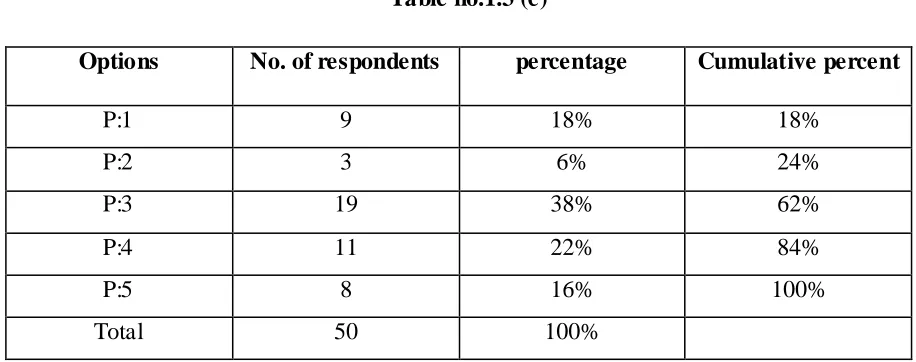
[image:8.596.64.522.126.307.2]Technical skill Table no.1.3 (c)
Options No. of respondents percentage Cumulative percent
P:1 9 18% 18%
P:2 3 6% 24%
P:3 19 38% 62%
P:4 11 22% 84%
P:5 8 16% 100%
Total 50 100%
Inte rpretation: The table no.1.3(c) represents that 18% respondents gives first preference technical skill while selecting employee for a job,6% respondents gives second preference ,
38% respondents gives third preference,22% respondents gives fourth preference and the rest
16% respondents gives fifth preference to technical skill while selecting an employee.
Qualification Table no.1.3 (d)
Options No. of respondents percentage Cumulative percent
P:1 7 14% 14%
P:2 6 12% 26%
P:3 5 10% 36%
P:4 21 42% 78%
P:5 11 22% 100%
Total 50 100%
© Associated Asia Research Foundation (AARF)
A Monthly Double-Blind Peer Reviewed Refereed Open Access International e-Journal - Included in the International Serial Directories.
Page | 416 10% respondents gives third preference,42% respondents gives fourth preference and the rest
22% respondents gives fifth preference to qualification while selecting an employee.
[image:9.596.66.520.491.649.2]Reference Table no.1.3 (e)
Options No. of respondents percentage Cumulative percent
P:1 20 40% 40%
P:2 11 22% 62%
P:3 6 12% 74%
P:4 4 8% 82%
P:5 9 18% 100%
Total 50 100%
Inte rpretation: The table no. 1.3(e) represents that 40% respondents gives first preference reference while selecting employee for a job,22% respondents gives second preference , 12%
respondents gives third preference,8% respondents gives fourth preference and the rest 18%
respondents gives fifth preference to reference while selecting an employee.
4) Analysis of prope r selection procedure Table no.1.4
Options No. of respondents Percentage Cumulative percent
Strongly Agree 9 18% 18%
Agree 6 12% 30%
Average 20 40% 70%
Disagree 11 22% 92%
Highly Disagree 4 8% 100%
Total 50 100%
© Associated Asia Research Foundation (AARF)
A Monthly Double-Blind Peer Reviewed Refereed Open Access International e-Journal - Included in the International Serial Directories.
Page | 417 procedure is average and 22% respondents are disagree and 8% respondents are highly
disagree with the selection procedure.
[image:10.596.65.533.148.235.2]5) Analysis regarding effective performance of selected employee Table no.1.5
Particulars No. of respondents Percent Cumulative percent
Yes 33 66% 66%
No 17 34% 100%
Total 50 100%
Inte rpretation: As per the table no.1.5 , 66% respondents show that there is an effective performance of selected employee, while 34% respondents not feels like that.
HYPOTHESIS TESTING
As per the data to thetest the significance of references while selecting an employee for a job
Chi square test was applied.
Ho: There is no significance of references while selecting an employee for a job. H1:There is significance of references while selecting an employee for a job. Calculated value = 14.82, @5% level of table value of chi square = 9.488
Result: calculated value greater than tabulated value, Ho is rejected.
Decision: there is significance of references while selecting an employee for a job.
FINDINGS
© Associated Asia Research Foundation (AARF)
A Monthly Double-Blind Peer Reviewed Refereed Open Access International e-Journal - Included in the International Serial Directories.
Page | 418 20%, 4% respondents are dissatisfied and highly dissatisfied with the current
recruitment policy of the organization.
Adve rtisement of vacancies: Due to acquire less qualified workers, the organization gives less advertisement of vacancies. As per my study24% respondents said that
there are no advertisement of vacancies and 32%respondents are agree with it.
Fairness of policy : As per my study30% respondents said that the policy followed by the organization is fair and transparent but on the other hand 28% respondents not
think like that.
Most important think while selecting candidates: According to my study 40% respondents give preference to reference while selecting an employee. Because during
my study I found that the workers are working in the organization is less qualified.
CONCLUSION
In every organization selection plays a vital role. According to this study the organization
follow internal source of recruitment. So some respondents wants that there will be change in
organization recruitment .When an organization selects an employee for a job than there are
many attributes that’s to be considered. Attributes like qualification, technical skills,
communication skills and references play an important role. By the analysis we can conclude
that the HR manger have to focus on selecting the right person through other source like
campus placement, internet etc. and there is need to change the recruitment policy at some
extend.
BIBLIOGRAPHY BOOKS:
1. Gupta Shashi k., Joshi Rosy (2011).Human Research. New Delhi: Kalyani Publishers.
2. Mamoria C.B, Gankar S.V. (2001).Personnel Management. New Delhi: Himalaya
publisher House.
3. Sharma R.K., Gupta Shashi K. (2013).Integrated Marketing Communication and
brand Equity. New Delhi kalyani publisher.
4. Kothari C.R, Garg Gaurav. (2015).Research Methodology. New Delhi: New age
© Associated Asia Research Foundation (AARF)
A Monthly Double-Blind Peer Reviewed Refereed Open Access International e-Journal - Included in the International Serial Directories.
Page | 419 JOURNALS
Ekwoaba J., Ikeije ugochukuy (2015), “The impact of recruitment and selection criteria on organization performance”, Global journal of human resource
Management, volume 3, No. 2.
Karthiga G. (2015), “A study on recruitment and selection process, International
journal of scientific and research publications, Volume – 5, issue -4.
Pandey S., Sharma P. (2015), “Analysis of the pron and cons of online recruitment
methods in India, International journal of engineering and management science vol.6
(2).
Mustapha , Mudashira A.(2013), “ the impact of well planned recruitment and
selection process on corporate performance in Nigerian banking , International journal
of academic research in business industry and social science vol. 3”,
Sudhamsetti N. , Dr. D.N.M R. (2014), “ A Study On Recruitment & Selection
Process With Reference To Three Industries, Cement Industry, Electronics Industry,
Sugar Industry In Krishna Dt Ap,India, IOSR Journal of Business and Management