GE-INTERNATIONAL JOURNAL OF ENGINEERING RESEARCH
VOLUME -3, ISSUE -5 (May 2015) IF-4.007 ISSN: (2321-1717)
A Monthly Double-Blind Peer Reviewed Refereed Open Access International e-Journal - Included in the International Serial Directories. GE- International Journal of Engineering Research (GE-IJER)
Website: www.aarf.asia. Email: [email protected] , [email protected]
Page 1
TUNING OF A NOVEL THIRD-ORDER FORWARD COMPENSATOR,
PART II: DELAYED INTEGRATING PROCESS
GALAL ALI HASSAAN1
1Department of Mechanical Design & Production, Faculty of Engineering, Cairo University, Egypt.
ABSTRACT
The objective of this paper is to investigate the possibility of using a new proposed
feedforward third-order compensator to control a delayed integrating process. The
compensator is tuned using MATLAB optimization toolbox for different process time delay
levels between 0.2 and 7.4 seconds. The simulation results show that the proposed
compensator is robust and provides acceptable performance for the closed-loop control
system in the time and frequency domains. The performance of the proposed compensator is
compared with the performance of the control system using PD-PI and PI controllers. The
proposed compensator has he fastest step response with good performance measures.
KEYWORDS –Third-order feedforward compensator, Delayed integrating process, Compensator tuning, Objective functions (ITAE, ISE, IAE, ITSE, ISTSE), Compensator
robustness, Control system performance.
I. INTRODUCTION
A delayed integrating process is one of the difficult processes to control since it is an
unstable one and requires careful selection and tuning of relevant controllers and
compensators. Researchers paid an extensive attention to this control problem over decades.
Here, I am going to present some of the researchers efforts in this aspect over the last 16
years.
Zhang, Xue and Sun (1999) presented a PID controller design method for integrating
processes with time delay and time constant. They used the H∞ performance criterion for
GE-INTERNATIONAL JOURNAL OF ENGINEERING RESEARCH
VOLUME -3, ISSUE -5 (May 2015) IF-4.007 ISSN: (2321-1717)
A Monthly Double-Blind Peer Reviewed Refereed Open Access International e-Journal - Included in the International Serial Directories. GE- International Journal of Engineering Research (GE-IJER)
Website: www.aarf.asia. Email: [email protected] , [email protected]
Page 2 presented analytical tuning rules for PID controllers. He has tuned a PI controller used with
delayed integrating process providing gain margin of 2.96 dB and phase margin of 46.9
degrees [2]. Zhang, Wang and Xu (2002) proposed a control scheme based on the Smith
predictor for the control of integrating processes with long time delay. They employed
optimal control theory and derived analytical tuning rules [3]. Skogestad (2003) presented
analytical rules for PID controller tuning resulting in good closed-loop behavior. He
presented analytical tuning rools for PI controllers used with integrating and first-order
processes and for PID controllers used with delayed second-order, integrating with lag and
double integrating processes [4].
Arvanitis et. al. (2003) investigated the use of the PDE structure in controlling
integrating plus dead time processes. They compared with known PI/PID controller tuning
methods for delayed integrating processes [5]. AbdelFattah, Gesraha and Hanafy (2004)
developed a robust controller against modeling errors for integrating processes with time
delay. They illustrated the good response of the proposed scheme [6]. Erikson and Johansson
(2007) studied the design of PID controllers for systems with varying time-delays. Their
tuning rules achieved significant improvements off jitter margin at the expense of slight
decreases in other performance criteria [7]. Shamsuzzoha and Lee (2008) presented a simple
IMC-PID controller design technique for two representative integrating processes with time
delay. They claimed that their proposed tuning rule was superior pver other existing methods
[8].
Liu, Gao and Zhao (2009) proposed a model identification method based on
closed-loop step response test for integrating processes with time delay. They used illustrative
examples to demonstrate the effectiveness of their proposed identification algorithms [9].
Ruscio (2010) presented analytical results for PI controller tuning based on integrator plus
time delay models. His technique may be used to provide modified Ziegler-Nichols
parameters with increased robustness margins [10]. Rao and Sree (2011) proposed a design
for PID controllers based on internal model control principles, direct synthesis method and
stability analysis method for pure integrating process with time delay. They evaluated the
robustness of the proposed controller for uncertainty in model parameters. They used Pade's
first-order approximation in dealing with the time delay [11]. Dostal, Bobal and Babic (2012)
proposed a technique for the design of controllers for time delay systems having integration
GE-INTERNATIONAL JOURNAL OF ENGINEERING RESEARCH
VOLUME -3, ISSUE -5 (May 2015) IF-4.007 ISSN: (2321-1717)
A Monthly Double-Blind Peer Reviewed Refereed Open Access International e-Journal - Included in the International Serial Directories. GE- International Journal of Engineering Research (GE-IJER)
Website: www.aarf.asia. Email: [email protected] , [email protected]
Page 3 approximations. They considered a control system with two feedback controllers using the
polynomial approach [12].
Ugon, Nandong and Zang (2013) presented a multi-scale control scheme for
controlling time delay processes. Their scheme provided improved performance over the
modified Smith predictor and the conventional PID controller [13]. Hassaan (2014) tuned a
PD-PI controller used to control an integrating plus time delay process. He used the
second-order Pade approximation to compensate the effect of the time delay. He succeeded to get a
time response of the closed-loop system through tuning the controller without any overshoot
and undershoot [14]. Hassaan (2015) presented a novel third-order feedforward compensator
to control underdamped second-order-like processes. He tuned the compensator using
MATLAB optimization toolbox and different objective functions. He could reduce the
maximum percentage overshoot to only 0.25 % and the settling time to 2.1 soconds using an
ITAE objective function for an 0.05 damping ratio process [15]. Ajmeri and Ali (2015)
designed controllers of the modified Smith predictor for pure integrating plus first-order and
double integrating processes with large time delays. They considered two simulation
examples to illustrate the usefulness of their proposed tuning rules [16].
II. THEDELAYEDINTEGRATINGPROCESS
An integrating process with time delay has the transfer function, Gp(s) [1,2,5,17]:
Gp(s) = (Kp/s) e-Tds
(1)
Where Kp is the process gain and Td is the process time delay.
It is possible to deal with the exponential term in Eq.1 using Pade approximation
[18,19,20]. The first-order Pade approximation of the exponential term in Eq.1 is:
e-Tds ≈ (2 – Tds) / (2 + Tds)
(2)
The second-order Pade approximation of the exponential term in Eq.1 is:
e-Tds ≈ (12 – 6 Tds + Td2s2) / (12 + 6 Tds + Td2s2)
GE-INTERNATIONAL JOURNAL OF ENGINEERING RESEARCH
VOLUME -3, ISSUE -5 (May 2015) IF-4.007 ISSN: (2321-1717)
A Monthly Double-Blind Peer Reviewed Refereed Open Access International e-Journal - Included in the International Serial Directories. GE- International Journal of Engineering Research (GE-IJER)
Website: www.aarf.asia. Email: [email protected] , [email protected]
Page 4 To investigate the choice either the first-order or second-order approximation in the analysis
of the control system and compensator tuning, a step response of the process of Eq.1 will be
presented using both Pade approximations in Eqs.2 and 3. The unit step response of the
delayed integrating process with Kp = 0.2 and Td = 0.2 and 3 seconds is shown in Fig.1 for a
time span up to 10 seconds as generated by the step command of MATLAB [21].
Fig.1 Step response of a delayed integrating process using Pade Approximation.
It is clear from Fig.1 that for both levels of time delay, the process has the same step
response for both first-order and second-order Pade approximations. Therefore, the first-order
Padi approximation is adopted for use in the present work. The effect of the process time
delay on the step response of the delayed integrating process is shown in Fig.2.
GE-INTERNATIONAL JOURNAL OF ENGINEERING RESEARCH
VOLUME -3, ISSUE -5 (May 2015) IF-4.007 ISSN: (2321-1717)
A Monthly Double-Blind Peer Reviewed Refereed Open Access International e-Journal - Included in the International Serial Directories. GE- International Journal of Engineering Research (GE-IJER)
Website: www.aarf.asia. Email: [email protected] , [email protected]
Page 5 The common factor in the time responses of Fig.2 is the instability of the process. The
proposed third-order feedforward compensator is required to provide a stable control system
with good performance measures either in the time domain or in the frequency domain.
III. THE THIRD-ODER COMPENSATOR
A feedforward third-order compensator was proposed by Hassaan to control
underdamped second order-like processes [15]. The compensator has the transfer function:
Gc(s) = Kc / (s3 + a1s2 + a2s + a3)
(4)
Where Kc, a1, a2 and a3 are the compensator parameters to be tuned to achieve stable control
system and accepted performance parameters.
IV. CLOSED-LOOP TRANSFER FUNCTION
The block diagram of the control system is consisted of an error detector, feedforward
compensator block and a delayed integrating process block. The feedback elements have unit
feedback. The open-loop transfer function of the closed-loop system is:
G(s)H(s) = Gc(s)Gp(s)
(5)
Combining Eqs.1, 2, 4 and 5 gives:
G(s)H(s) = N1(s) / D1 (s)
(6)
Where:
N1(s) = -0.5TdKpKc s + KpKc
D1(s) = 0.5Tds5 + (1+0.5Tda1)s4 + (0.5Tda2+a1)s3 + (0.5Tda3+a2)s2 + a3s
The closed-loop transfer function of the system, M(s) as G(s) / [1 + G(s)H(s)] using Eq.6
becomes:
M(s) = (b4 – a3) / (b0s5 + b1s4 +b2s3 + b3s2 + b4s = b5)
(7)
Where:
GE-INTERNATIONAL JOURNAL OF ENGINEERING RESEARCH
VOLUME -3, ISSUE -5 (May 2015) IF-4.007 ISSN: (2321-1717)
A Monthly Double-Blind Peer Reviewed Refereed Open Access International e-Journal - Included in the International Serial Directories. GE- International Journal of Engineering Research (GE-IJER)
Website: www.aarf.asia. Email: [email protected] , [email protected]
Page 6 b2 = 0.5Tda2 + a1 , b3 = 0.5Tda3 + a2
b4 = a3 – 0.5TdKpKc , b5 = KpKc
V. COMPENSATOR TUNING
The third-order feedforward compensator is tuning using the following procedure:
i. The unit step time response of the compensated control system, c(t) is evaluate using
Eq.7 and the step command of MATLAB [21].
ii. An error function, e(t) is defined as:
e(t) = 1 – c(t)
(8)
iii. Several objective functions are used to tune the compensator based on Eq.8. Namely,
the IAET, ISE, IAE, ITSE and ISTSE [22-25].
iv. The MATLAB optimization command ‘fminunc’ is used to minimize the objective
function [26].
v. A process gain of 0.2 (Kp) is used and a time delay from 0.2 to 3 seconds is covered.
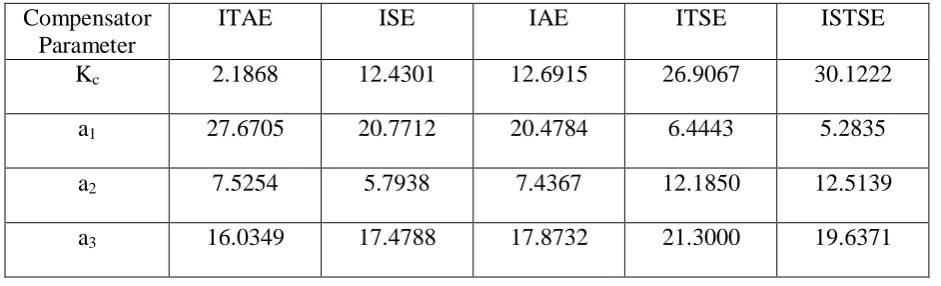
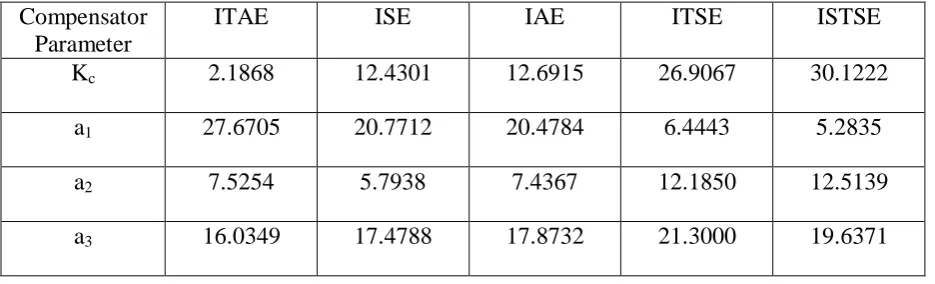
vi. The tuned parameters of the third-order compensator are given in Tables 1, 2, 3 and 4
[image:6.595.64.535.508.651.2]for time delay of 0.2, 1, 1.8 and 3 seconds respectively.
Table 1 Tuned Compensator Parameters for 0.2 s Time Delay
Compensator Parameter
ITAE ISE IAE ITSE ISTSE
Kc 2.1868 12.4301 12.6915 26.9067 30.1222
a1 27.6705 20.7712 20.4784 6.4443 5.2835
a2 7.5254 5.7938 7.4367 12.1850 12.5139
GE-INTERNATIONAL JOURNAL OF ENGINEERING RESEARCH
VOLUME -3, ISSUE -5 (May 2015) IF-4.007 ISSN: (2321-1717)
A Monthly Double-Blind Peer Reviewed Refereed Open Access International e-Journal - Included in the International Serial Directories. GE- International Journal of Engineering Research (GE-IJER)
Website: www.aarf.asia. Email: [email protected] , [email protected]
[image:7.595.64.534.112.253.2]Page 7 Table 2 Tuned Compensator Parameters for 1.0 s Time Delay
Compensator Parameter
ITAE ISE IAE ITSE ISTSE
Kc 17.6871 11.4953 11.5856 23.7469 18.7047
a1 17.4421 20.8311 20.5154 8.5236 7.6991
a2 13.3544 4.9882 6.0142 5.1799 6.3800
[image:7.595.65.533.303.444.2]a3 16.2875 18.3687 18.5278 22.0515 20.0756
Table 3 Tuned Compensator Parameters for 1.8 s Time Delay
Compensator Parameter
ITAE ISE IAE ITSE ISTSE
Kc 16.3869 10.9197 10.9482 14.6363 17.3906
a1 17.0882 20.3076 20.2551 17.5098 16.3321
a2 6.9253 4.9571 4.9902 4.0514 5.6391
a3 18.9610 19.2519 19.2792 20.4897 19.4400
Table 4 Tuned Compensator Parameters for 3.0 s Time Delay
Compensator Parameter
ITAE ISE IAE ITSE ISTSE
Kc 2.1868 12.4301 12.6915 26.9067 30.1222
a1 27.6705 20.7712 20.4784 6.4443 5.2835
a2 7.5254 5.7938 7.4367 12.1850 12.5139
a3 16.0349 17.4788 17.8732 21.3000 19.6371
VI. TIME-BASED SYSTEM PERFORMANCE
The performance of the closed-loop control system incorporating the delayed integrating
process and the proposed third-order compensator is assessed using its unit step response
[image:7.595.66.534.493.635.2]GE-INTERNATIONAL JOURNAL OF ENGINEERING RESEARCH
VOLUME -3, ISSUE -5 (May 2015) IF-4.007 ISSN: (2321-1717)
A Monthly Double-Blind Peer Reviewed Refereed Open Access International e-Journal - Included in the International Serial Directories. GE- International Journal of Engineering Research (GE-IJER)
Website: www.aarf.asia. Email: [email protected] , [email protected]
Page 8 1, 1.8 and 3 seconds time delay is shown in Figs.3 to 6 using the ITAE, ISE, IAE, ITSE and
ISTSE objective functions.
Fig.3 Compensated system time response for 0.2 s time delay.
GE-INTERNATIONAL JOURNAL OF ENGINEERING RESEARCH
VOLUME -3, ISSUE -5 (May 2015) IF-4.007 ISSN: (2321-1717)
A Monthly Double-Blind Peer Reviewed Refereed Open Access International e-Journal - Included in the International Serial Directories. GE- International Journal of Engineering Research (GE-IJER)
Website: www.aarf.asia. Email: [email protected] , [email protected]
Page 9 Fig.5 Compensated system time response for 1.8 s time delay.
Fig.6 Compensated system time response for 3.0 s time delay.
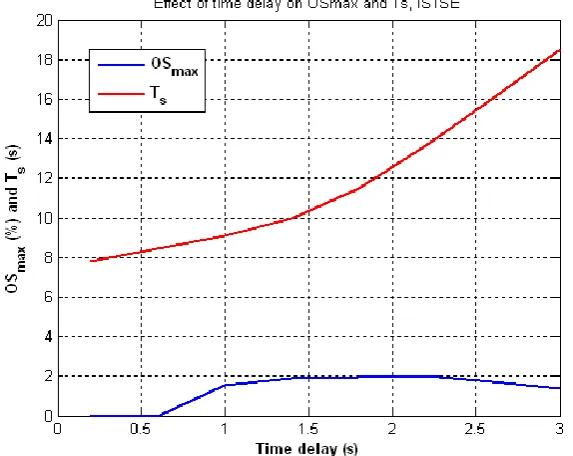
The effect of time delay on the performance parameters (maximum percentage
overshoot and settling time) of the compensated unstable delayed integrating process using
GE-INTERNATIONAL JOURNAL OF ENGINEERING RESEARCH
VOLUME -3, ISSUE -5 (May 2015) IF-4.007 ISSN: (2321-1717)
A Monthly Double-Blind Peer Reviewed Refereed Open Access International e-Journal - Included in the International Serial Directories. GE- International Journal of Engineering Research (GE-IJER)
Website: www.aarf.asia. Email: [email protected] , [email protected]
[image:10.595.162.449.112.340.2]Page 10
Fig.7 Effect of delay time on maximum percentage overshoot and settling time.
VII. FREQUENCY-BASED SYSTEM PERFORMANCE
The frequency-based control system performance is measured through its gain and phase
margins as a measure for the relative stability of the closed-loop control system [27]. Table 5
gives the gain and phase margins of the compensated integrating process for time delay from
0.2 to 7.4 seconds.
Table 5 Frequency Response Stability Parameters.
The values of both gain and phase margins for the time delay range investigated come
[image:10.595.65.546.566.681.2]GE-INTERNATIONAL JOURNAL OF ENGINEERING RESEARCH
VOLUME -3, ISSUE -5 (May 2015) IF-4.007 ISSN: (2321-1717)
A Monthly Double-Blind Peer Reviewed Refereed Open Access International e-Journal - Included in the International Serial Directories. GE- International Journal of Engineering Research (GE-IJER)
Website: www.aarf.asia. Email: [email protected] , [email protected]
Page 11
VIII. COMPARISON WITH PUBLISHED RESEARCH WORK
To examine the effectiveness of the application of the proposed third-order
feedforward compensator to control the delayed integrating process, it is compared with the
work of Ruscio using a PI controller [10] and the work of Hassaan using a PD-PI controller
[14]. For an integrating process having an 0.2 gain and 7.4 time delay, the unit step response
of the feedback control system incorporating the delayed integrating process using the three
techniques is compared in Fig.8.
Fig.8 Unit time response comparison.
The performance comparison between the three controlling/compensating techniques is given
in Table 6 for both time-based and frequency-based specifications of the closed-loop control
system.
Table 6 Time-based and Frequency-based Specifications for Compared Controlling
Techniques.
Controller / compensator
PI (Ruscio [10]) PD-PI (Hassaan [14] Present
Maximum percentage overshoot (%)
26.425 0 18.712
Settling time (s) 103.045 106.426 36.192
Gain margin (dB) 11.30 27.80 7.16
Phase margin (degrees)
GE-INTERNATIONAL JOURNAL OF ENGINEERING RESEARCH
VOLUME -3, ISSUE -5 (May 2015) IF-4.007 ISSN: (2321-1717)
A Monthly Double-Blind Peer Reviewed Refereed Open Access International e-Journal - Included in the International Serial Directories. GE- International Journal of Engineering Research (GE-IJER)
Website: www.aarf.asia. Email: [email protected] , [email protected]
Page 12 - The present compensator provides the fastest response over the other two techniques.
- Hassaan's PD-PI controller provides the smoothest response without any overshoot.
But the It is only 35.1 % of Ruscio's PI controller and 34 % of Hassaan's PD-PI
controller.
- The performance of Hassaan's PD-PI controller is better than that of Ruscio's PI
controller with respect to maximum percentage overshoot, gain and phase margins.
- The maximum percentage overshoot using the present compensator is 70.8 % of that
of Ruscio PI controller.
IX. CONCLUSIONS
- First-order Pade approximation was used to compensate for the time delay of the
integrating process.
- Using Pade approximation, the delayed integrating process had a third-order transfer
function.
- Using a feedforward third-order compensator to control the delayed integrating
process resulted in a dynamic control system of the fifth-order-type having zero
steady-state error.
- The third-order compensator was tuned using the MATLAB optimization toolbox.
- Five error-based objective functions were used in the compensator tuning process
(ITAE, ISE, IAE, ITSE and ISTSE).
- The ISTSE objective function has shown fast time response over the other objective
functions.
- The ISTSE objective function has shown fast time response over the other objective
functions.
- The effect of the process time delay on the maximum percentage overshoot and
settling time was shown when using an ISTSE objective function.
- The maximum percentage overshoot was in the range 0 ≤ OS ≤ 2 % and the settling
time was in the range 7.8 ≤ Tr ≤ 18.5 seconds for time delay in the range 0.2 ≤ Td ≤ 3
GE-INTERNATIONAL JOURNAL OF ENGINEERING RESEARCH
VOLUME -3, ISSUE -5 (May 2015) IF-4.007 ISSN: (2321-1717)
A Monthly Double-Blind Peer Reviewed Refereed Open Access International e-Journal - Included in the International Serial Directories. GE- International Journal of Engineering Research (GE-IJER)
Website: www.aarf.asia. Email: [email protected] , [email protected]
Page 13 - The effect of process time delay on the control system specifications based on the
frequency response of the closed-loop control system was investigated in terms of the
system gain and phase margins.
- The gain margin has changed in the range 7.16 ≤ GM ≤ 13.1 dB for time delay in the
range 0.2 ≤ Td ≤ 7.4 seconds.
- The phase margin has changed in the range 50.4 ≤ GM ≤ 75.7 degrees for time delay
in the range 0.2 ≤ Td ≤ 7.4 seconds.
- The range of the gain and phase margins of the control system using the proposed
compensator was within the recommended range for good control system
performance indicating the robustness of the proposed compensator with respect to
the change in the time delay of the integrating process.
- The performance of the control systems incorporating the feedforward third-order
compensator and the delayed integrating process was compared with other two
techniques using PD-PI and PI controllers.
- The present compensator showed faster step response that the other two techniques
and maximum percentage overshoot less than that using PI controller.
REFERENCES
1. W. Zhang, X. Xue and Y. Sun, Quantitative performance design for integrating
processes with time delay, Automatica, 35, 1999, 719-723.
2. S. Skogestad, Probably the best simple PID tuning rules in the world, AIChE Annual
Meeting, Reno, Nevada, November, 2001.
3. . Zhang, H. Wang, W. Wang and X. Xu, Novel controller for integrating and stable
processes with long time delay, 15th Triennial World Congress, Barcelona, Spain,
2002.
4. S. Skogestad, Simple analytic rules for model reduction and PID controller tuning,
Journal of Process Control, 13, 2003, 291-309.
5. K. Arvanitis, G. Syrkos, I. Stellas and N. Sigrimis, Controller tuning for integrating
GE-INTERNATIONAL JOURNAL OF ENGINEERING RESEARCH
VOLUME -3, ISSUE -5 (May 2015) IF-4.007 ISSN: (2321-1717)
A Monthly Double-Blind Peer Reviewed Refereed Open Access International e-Journal - Included in the International Serial Directories. GE- International Journal of Engineering Research (GE-IJER)
Website: www.aarf.asia. Email: [email protected] , [email protected]
Page 14 control configuration, Proceedings of the 11th IEEE Conference on Control and
Automation, Rodos, Greece, June 28-30, 2003, Paper T7-40.
6. H. AbdelFattah, A. Gesraha and A. Hanafy, Control of integrating dead time
processes with long time delay, Proceeding of the 2004 American Control
Conference, Boston, Massachusetts, June 30-July 2, 2004, 4966-4971.
7. L. Eriksson and M. Johansson, PID controller tuning rules for varying time delay
systems, Proceeding of 2007 Control Conference, July 11-13, 2007, New York,
619-625.
8. M. Shamsuzzoha and M. Lee, PID controller design for integrating processes with
time delay, Korean Journal of Chemical Engineering, 25(4), 2008, 637-645.
9. T. Lu, F. Gao and C. Zhao, Identification of time delay model for integrating
processes from closed-loop step test, Proceedings of the 7th Asian Control Conference
, 27-29 August, 2009, 615-619.
10.D. Ruscio, On tuning PI controllers for integrating plus time delay systems, Modeling,
Identification and Control, 31(4), 2010, 145-164.
11.C. Rao, A. Rao and R. Sree, Design of PID controllers for pure integrator systems
with time delay, International Journal of Applied Science and Engineering, 9(4),
2011, 241-260.
12.P. Dostal, V. Bobal and Z. Babik, Control of unstable and integrating time delay
systems using time delay approximations, WSEAS Transactions on Systems, 11(10),
2012, 586-595.
13.B. Ugon, J. Nandong and Z. Zang, Multi-scale control of integrating time-delay
processes, Proceedings of the 6th International Conference on Process Systems
Engineering, 25-27 June 2013, Kuala Lumpur, 374-379.
14.G. A. Hassaan, Tuning of PD-PI controller used with an integrating plus time delay
process, International Journal of Scientific and Tecnology Research, 3(9), 2014,
309-313.
15.G. A. Hassaan, Tuning of a novel third-order feedforward compensator, Part I: Used
with underdamped second-order-like process, International Journal of Scientific
GE-INTERNATIONAL JOURNAL OF ENGINEERING RESEARCH
VOLUME -3, ISSUE -5 (May 2015) IF-4.007 ISSN: (2321-1717)
A Monthly Double-Blind Peer Reviewed Refereed Open Access International e-Journal - Included in the International Serial Directories. GE- International Journal of Engineering Research (GE-IJER)
Website: www.aarf.asia. Email: [email protected] , [email protected]
Page 15 16.M. Ajmeri and A. Ali, Simple tuning rules for integrating processes with large time
delay, Asian Journal of Control, 18(2), 2015, 1-8.
17.I. Chien and P. Fruehau, Consider IMC tuning to improve controller performance,
Chemical Engineering Progress, 86, October 1990, 33-41.
18.A. Hanta and A. Prochazka, Rational approximation of time delay, Proceedings of the
17th Annual International Conference on Technical Computing, Prague, 2009, 9
pages.
19.P. Juneja, A. Ray and R. Mitra, Dead time modeling for first order plus dead time
process in a process industry, International Journal of Computer Science and
Communication, 1(2), 2010, 167-169.
20.L. Pekar and E. Kureckova, Rational approximations for time-delay systems: case
studies, Mathematical Methods and Techniques in Engineering and Environmental
Science, Proceedings of the 13th WSEAS International Conference on Mathematical
and Computational Methods in Science and Engineering, 2011, 217-222.
21.C. Houpis and S. Sheldon, Linear control systems design with MATLAB (CRC Press,
2013).
22. F. Martins, Tuning PID controllers using the ITAE criterion, International Journal of
the Engineering Education, 21(5), 2005, 867-873.
23.C. Calistru and P. Georgescu, Tuning of PID robust controllers based on ISE criterion
minimization, 7th International Conference on Electro-mechanical and Power
Systems, Iasi, Romania, October 8-9, 2009, I-30 to I-35.
24.S. Cheng and C. Hwang, Designing PID controllers with a minimum IAE criterion by
a differential evolution algorithm, Chemical Engineering Communications, 170(1),
1998, 83-115.
25.A. Marzoughi, H. Salamat, M. Rahmat and H. AbdulRahim, Optimized PID controller
for the exhaust temperature control of a gas turbine system using particle swarm
optimization, International Journal of the Physical Sciences, 7(5), 2012, 720-729.
26.C. Lopez, MATLAB optimization techniques (Springer, 2014).
GE-INTERNATIONAL JOURNAL OF ENGINEERING RESEARCH
VOLUME -3, ISSUE -5 (May 2015) IF-4.007 ISSN: (2321-1717)
A Monthly Double-Blind Peer Reviewed Refereed Open Access International e-Journal - Included in the International Serial Directories. GE- International Journal of Engineering Research (GE-IJER)
Website: www.aarf.asia. Email: [email protected] , [email protected]
Page 16
DEDICATION
Prof. Sherief Mourad:
I have the pleasure to dedicate this research work to Prof. Sherief Mourad, Dean of the Faculty of Engineering, Cairo University, Egypt.
Dr. Mourad has a pleasant cooperative character.
He follows the policy of open door as a policy in his administration work as a dean of
the eldest and biggest Faculty of Engineering in Egypt.
Dr. Mourad also corresponds with his staff through e. mail although of his huge
responsibilities.
Mr. Dean: You are one of those one will never forget and this why I dedicate this
GE-INTERNATIONAL JOURNAL OF ENGINEERING RESEARCH
VOLUME -3, ISSUE -5 (May 2015) IF-4.007 ISSN: (2321-1717)
A Monthly Double-Blind Peer Reviewed Refereed Open Access International e-Journal - Included in the International Serial Directories. GE- International Journal of Engineering Research (GE-IJER)
Website: www.aarf.asia. Email: [email protected] , [email protected]
Page 17
BIOGRAPHY
Prof. Galal Ali Hassaan:
Emeritus Professor of System Dynamics and Automatic Control. Has got his B.Sc. and M.Sc. from Cairo University in 1970 and 1974. Has got his Ph.D. in 1979 from Bradford University, UK under the
supervision of Late Prof. John Parnaby.
Now with the Faculty of Engineering, Cairo University, EGYPT. Research on Automatic Control, Mechanical Vibrations , Mechanism
Synthesis and History of Mechanical Engineering.
Published 10’s of research papers in international journals and
conferences.
Author of books on Experimental Systems Control, Experimental Vibrations and
Evolution of Mechanical Engineering.
Chief Justice of International Journal of Computer Techniques.
Member of the Editorial Board of International Journal of Mechanical and Production
Engineering Research & Development and International Journal of Industrial
Engineering & Technology.
Reviewer in some international journals.
Scholars interested in the authors publications can visit: