A Monthly Double-Blind Peer Reviewed Refereed Open Access International e-Journal - Included in the International Serial Directories.
GE- International Journal of Engineering Research (GE-IJER)
Website: www.aarf.asia. Email: [email protected] , [email protected]
Page 69
PARAMETER OPTIMIZATION WHILE DRY TURNING AISI 1045 STEEL
USING CBN TOOL- BY RESPONSE SURFACE METHODOLOGY
B. Sai Chandra1, Dr. M.V.R.D. Prasad2
1 Department of Mechanical Engineering, VNR Vignana Jyothi Institute of Engineering and
Technology, Hyderabad, Telangana, India.
2 Department of Mechanical Engineering, VNR Vignana Jyothi Institute of Engineering and
Technology, Hyderabad, Telangana, India.
ABSTRACT
Dry machining is a machining process without coolant and it is more popular as a finishing process. The purpose of this research project is to optimize the parameters using Response Surface Methodology when dry turning AISI 1045 steel using CBN tool. The factors that are investigated are cutting speed, feed and depth of cut, Surface roughness(Ra) is the response variable investigated. The experimental design will be based on the central composite design. The experiment is designed using Response Surface Methodology. The empirical relationship to predict response, optimum value of parameters to minimize the response and the process parameters which are effecting the response are determined.
Keywords- CBN Tool, Dry Turning, Response Surface Methodology, Surface Roughness, Optimization.
1. INTRODUCTION
A Monthly Double-Blind Peer Reviewed Refereed Open Access International e-Journal - Included in the International Serial Directories.
GE- International Journal of Engineering Research (GE-IJER)
Website: www.aarf.asia. Email: [email protected] , [email protected]
Page 70
should be selected to optimize the economics of machining operations, as assessed by productivity, total manufacturing cost per component or some other suitable criterion.
1.1 Dry Machining
Dry machining is also a process of metal removal but it does not involve the use of wet cutting fluids that are hazardous to environment and also costs sufficiently high.
Manufacturers all over the world are trying to discover new method to eliminate the use of cutting fluids. According to studies carried out. In The United States of America 15% of the cost of the production is spent in purchase, storage, handling, utilization and safe disposal of the fluid [9].
The dry machining has the advantage of complete elimination of harmful cutting fluids, non-pollution of the water and air, eliminates costs involved in purchase, storage, handling, utilizing and safe disposal of the fluid, reduction in overall production time and improved working conditions, no danger to health of the operator.
1.2 Response Surface Methodology
Response Surface Methodology (RSM) is a collection of mathematical and statistical techniques useful for the modelling and analysis of problems in which a response of interest is influenced by several variables and the objective is to optimize this response. simply an RSM model can be represented as
y = f (x1, x 2) + e
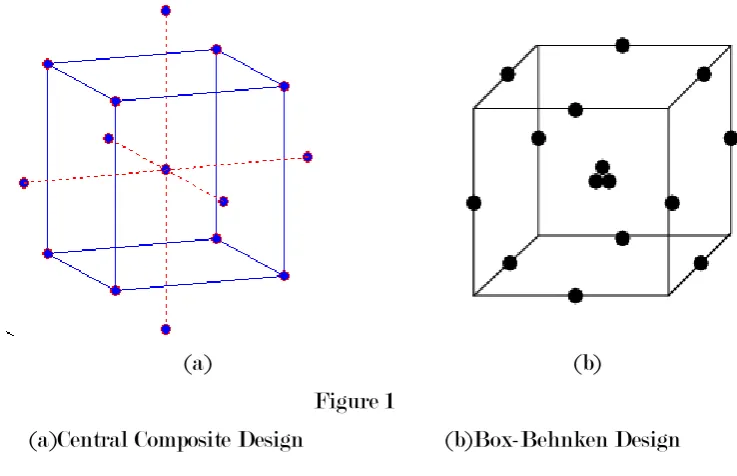
The variables x1 and x2 are independent variables where the response y depends on them. The dependent variable y is a function of x1, x2, and the experimental error term, denoted as e. The error term e represents any measurement error on the response. There are two types of RSM Models. Central Composite Design (CCD) and Box Behnken Design.
A Monthly Double-Blind Peer Reviewed Refereed Open Access International e-Journal - Included in the International Serial Directories.
GE- International Journal of Engineering Research (GE-IJER)
Website: www.aarf.asia. Email: [email protected] , [email protected]
Page 71
Faced (CCF) designs have the star points on the faces of the cube. Faced designs have three levels per factor, in contrast with the other types that have five levels per factor.
The Box-Behnken design is an independent quadratic design in that it does not contain
an embedded factorial or fractional factorial design. In this design the treatment combinations are at the midpoints of edges of the process space and at the centre. These designs are rotatable (or near rotatable) and require 3 levels of each factor.
[image:3.595.124.493.198.436.2]
(a) (b)
Figure 1
(a)Central Composite Design (b)Box-Behnken Design
1.3 Research Methodology
Considering the input parameters cutting speed, feed rate and depth of cut, a face centred central composite design is proposed using response surface methodology through design of experiments. The machining is done using the input parameters and the surface roughness values are recorded. The statistical analysis of these recorded values are analysed using response surface methodology and parameters which have significant effect on output parameter i.e. surface roughness are determined. A mathematical model is also developed which gives the relationship among variables. After developing the model, confirmation tests are conducted with values, within the range of selected machining parameters. The result obtained from the confirmation test is compared to that of predicted result, so as to find out how close both the results match.
2. LITERATURE REVIEW
A Monthly Double-Blind Peer Reviewed Refereed Open Access International e-Journal - Included in the International Serial Directories.
GE- International Journal of Engineering Research (GE-IJER)
Website: www.aarf.asia. Email: [email protected] , [email protected]
Page 72
coolants. Dry machining is only possible when all the operations can be done dry. Technology has to be further improved if dry cutting is to be fully employed in industries. As the costs for waste disposal increase, industries will be forced to implement strategies to reduce the amount of coolants they use.
Anselmo Eduardo Diniz et.al [2] has conducted several experiments by varying parameters such as cutting speed, feed, depth of cut and tool material in rough turning of ABNT 1045 steel in dry and wet cutting. The analysis of the results showed that wet turning is, as expected, better for tool life. The second conclusion is that dry cutting cannot be used with large depth of cut. But the main conclusion is that, if the tool material is changed to a more
wear resistant one, dry cutting can be used with results very similar to those obtained with a flood of fluid.
P. Subhash et.al [3] has investigated the effect of AlTiN coated cemented carbide tool and various cutting parameters – speed, feed and depth of cut – on the surface integrity of NIMONIC 75 under dry machining condition using response surface methodology (RSM). The final result showed the significance of each machining parameter individually on the surface integrity and a model to predict the value of surface roughness between that particular range of cutting parameters.
M.Y. Noordin et.al [4] has performed cutting tests with constant depth of cut and under dry cutting conditions. The factors investigated were cutting speed, feed and the side cutting edge angle (SCEA) of the cutting edge. The main cutting force, i.e. the tangential force and surface roughness were the response variables investigated. The experimental plan was based on the face centred, central composite design (CCD). The experimental results indicate that the proposed mathematical models suggested could adequately describe the performance indicators within the limits of the factors that are being investigated.
Samir Khamel et.al [5] has performed an experimental study to investigate the effects of process parameters (cutting speed, feed rate and depth of cut) on performance characteristics (tool life, surface roughness and cutting forces) in finish hard turning of AISI 52100 bearing steel with CBN tool. The cutting forces and surface roughness are measured at the end of useful
A Monthly Double-Blind Peer Reviewed Refereed Open Access International e-Journal - Included in the International Serial Directories.
GE- International Journal of Engineering Research (GE-IJER)
Website: www.aarf.asia. Email: [email protected] , [email protected]
Page 73
statistical approaches bring reliable methodologies to model, to optimize and to improve the hard turning process. They can be extended efficiently to study other machining processes.
V.Mugendiran et.al [6] has performed an experimental study on the influence of three input parameters, (spindle speed, tool feed, and steps size) along with surface roughness and wall thickness as output parameters were analyzed. Obtained experimental results from incremental forming were used for analysis. The optimal results were predicted based on Response Surface Methodology and the analysis of variance. The obtained results predict a predominant interaction between the forming parameters which can be effectively and efficiently identified to produce minimum surface roughness and maximum wall thickness.
H.Joardar et.al [7] has investigated the effect of certain cutting variables on cutting forces in straight turning of aluminum metal matrix composites under dry cutting condition. Cutting speed, depth of cut and weight percentage of SiCP are selected as the influencing parameters. The application of response surface methodology and face central composite design for modelling, optimization, and an analysis of the influences of dominant cutting parameters on tangential cutting force, axial cutting force and radial cutting force of aluminum metal matrix composites produced through stir casting route. Experiments are carried out using aluminum (LM6) alloy reinforced with silicon carbide particles. The mathematical models are developed and tested for adequacy using analysis of variance and other adequacy measures
using the developed models. The predicted values and measured values are fairly close, which indicate that the developed models can be effectively used to predict the responses in the turning of aluminum metal matrix composites. The contour plots of the process parameters revel that the low cutting forces are associated with the lowest level of depth of cut and the highest level of cutting speed and the sensitivity analysis revealed that cutting speed is most significant factor influencing the response variables investigated.
A Monthly Double-Blind Peer Reviewed Refereed Open Access International e-Journal - Included in the International Serial Directories.
GE- International Journal of Engineering Research (GE-IJER)
Website: www.aarf.asia. Email: [email protected] , [email protected]
Page 74
3. EXPERIMENTAL DETAILS 3.1 Work Piece Material
[image:6.595.109.495.539.636.2]AISI 1045, steel is a medium carbon, medium tensile steel characterized by good weldability, good machinability and high strength. EN8D is the international standard for AISI 1045 [10].
Table 1: Chemical Composition
Elements C Si Mn P S
Specified Values
0.4 - 0.45 0.1 - 0.4 0.7 - 0.9 0 - 0.05 0 - 0.05
Sample Piece Values
0.45 0.22 0.70 0.022 0.021
3.2 Cutting Tool
Cubic Boron Nitride (CBN) is chosen as cutting tool as it has high hardness (next to diamond). The characteristics are high hardness, high thermal stability, chemical resistance and an ability to maintain sharp cutting edges during usage. Due to the thermal stability of the CBN tool it is ideal for dry machining as it can withstand the heat produced during the machining process.
3.3 Experimentation
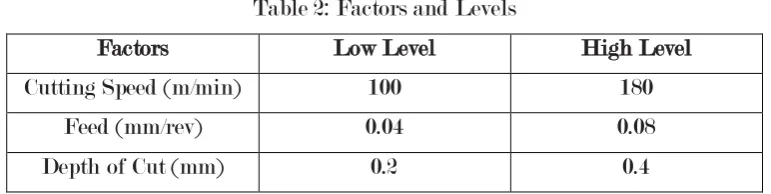
In this particular experiment three factors have been studied. The factors and their levels are given in Table 2.
Table 2: Factors and Levels
Factors Low Level High Level
Cutting Speed (m/min) 100 180
Feed (mm/rev) 0.04 0.08
Depth of Cut (mm) 0.2 0.4
A Monthly Double-Blind Peer Reviewed Refereed Open Access International e-Journal - Included in the International Serial Directories.
GE- International Journal of Engineering Research (GE-IJER)
Website: www.aarf.asia. Email: [email protected] , [email protected]
[image:7.595.67.539.91.549.2]Page 75
Table 3: Experiments Designed Using Central Composite Face Centred Design
Experiment no.
A B C Cutting
speed (m/min)
Feed (mm/rev)
Depth of Cut (mm)
1 -1 -1 -1 100 0.04 0.2
2 -1 1 -1 100 0.08 0.2
3 1 1 1 180 0.08 0.4
4 1 -1 1 180 0.04 0.4
5 0 0 0 140 0.06 0.3
6 1 -1 -1 180 0.04 0.2
7 0 1 0 140 0.08 0.3
8 0 0 0 140 0.06 0.3
9 0 0 -1 140 0.06 0.2
10 1 0 0 180 0.06 0.3
11 -1 1 1 100 0.08 0.4
12 0 -1 0 140 0.04 0.3
13 0 0 0 140 0.06 0.3
14 0 0 0 140 0.06 0.3
15 -1 0 0 100 0.06 0.3
16 -1 -1 1 100 0.04 0.4
17 1 1 -1 180 0.08 0.2
18 0 0 0 140 0.06 0.3
19 0 0 1 140 0.06 0.4
20 0 0 0 140 0.06 0.3
A Monthly Double-Blind Peer Reviewed Refereed Open Access International e-Journal - Included in the International Serial Directories.
GE- International Journal of Engineering Research (GE-IJER)
Website: www.aarf.asia. Email: [email protected] , [email protected]
Page 76
[image:8.595.92.510.66.365.2](a) (b)
Figure 2
(a) Performing Dry Machining (b) Machined Work Pieces 4. RESULTS AND DISCUSSION
The surface roughness values (Ra) of the machined pieces are determined using digital surface roughness tester. The knob of the tester is made to contact with the surface of the work piece material through certain length. The surface roughness value through that length is displayed in the tester. The surface roughness values obtained are listed in the Table 4.
Table 4: Experimental Results
Experiment No. Cutting Speed
(m/min)
Feed (mm/rev)
Depth of Cut (mm)
Surface Roughness (Ra)
(µm)
1 100 0.04 0.2 0.96
2 100 0.08 0.2 1.3
3 180 0.08 0.4 0.4
4 180 0.04 0.4 0.64
5 140 0.06 0.3 0.81
6 180 0.04 0.2 0.56
7 140 0.08 0.3 0.68
8 140 0.06 0.3 0.79
9 140 0.06 0.2 0.74
[image:8.595.67.538.488.751.2]A Monthly Double-Blind Peer Reviewed Refereed Open Access International e-Journal - Included in the International Serial Directories.
GE- International Journal of Engineering Research (GE-IJER)
Website: www.aarf.asia. Email: [email protected] , [email protected]
Page 77
11 100 0.08 0.4 1.5
12 140 0.04 0.3 0.69
13 140 0.06 0.3 0.8
14 140 0.06 0.3 0.76
15 100 0.06 0.3 1.36
16 100 0.04 0.4 1.45
17 180 0.08 0.2 0.4
18 140 0.06 0.3 0.83
19 140 0.06 0.4 0.9
20 140 0.06 0.3 0.8
After finding out the surface roughness for each experiment, analysis was carried out in two phases. Firstly the factors effecting the response were found out using ANOVA and then optimization was carried out using response optimizer in doe++ software.
4.1 Significant Terms Effecting The Response
[image:9.595.111.498.456.710.2]Analysis of variance was done to find out the significant terms which are effecting the response. The following plots obtained from analysis are used to interpret the terms effecting the response.
A Monthly Double-Blind Peer Reviewed Refereed Open Access International e-Journal - Included in the International Serial Directories.
GE- International Journal of Engineering Research (GE-IJER)
Website: www.aarf.asia. Email: [email protected] , [email protected]
[image:10.595.110.502.74.368.2]Page 78
Figure 4: Residual Vs Fitted value
[image:10.595.114.499.439.717.2]A Monthly Double-Blind Peer Reviewed Refereed Open Access International e-Journal - Included in the International Serial Directories.
GE- International Journal of Engineering Research (GE-IJER)
Website: www.aarf.asia. Email: [email protected] , [email protected]
Page 79
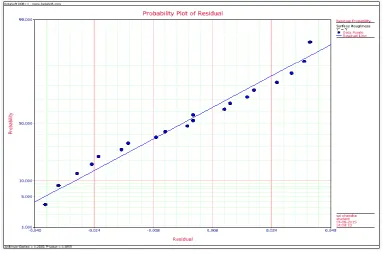
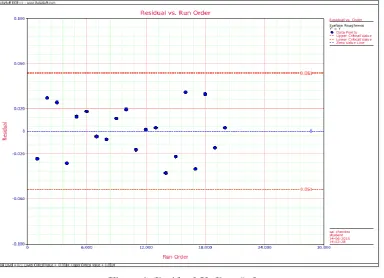
The normal probability plots of the residual, the plots of the residual vs. fitted value
and run order for Surface roughness (Ra) are shown in Figures 3,4 and 5respectively. A check
on the plot in Figure 3revealed that the residual generally fall on a straight line implying that
[image:11.595.74.534.209.647.2]the error is distributed normally. Also Figures 4 and 5 revealed that they have no obvious pattern and unusual structure. This implies that the models proposed are adequate and there is no reason to suspect any violation of the constant variance and independence assumption.
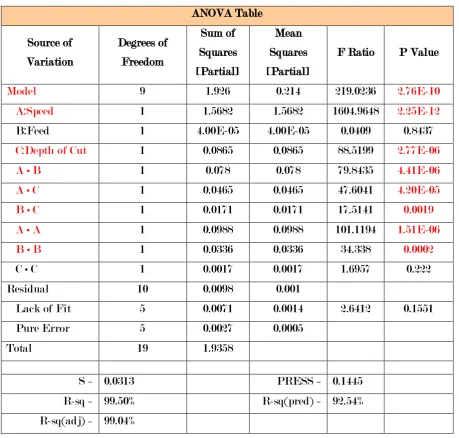
Table 5: ANOVA Table ANOVA Table
Source of Variation
Degrees of Freedom
Sum of Squares [Partial]
Mean Squares [Partial]
F Ratio P Value
Model 9 1.926 0.214 219.0236 2.76E-10
A:Speed 1 1.5682 1.5682 1604.9648 2.25E-12
B:Feed 1 4.00E-05 4.00E-05 0.0409 0.8437
C:Depth of Cut 1 0.0865 0.0865 88.5199 2.77E-06
A • B 1 0.078 0.078 79.8435 4.41E-06
A • C 1 0.0465 0.0465 47.6041 4.20E-05
B • C 1 0.0171 0.0171 17.5141 0.0019
A • A 1 0.0988 0.0988 101.1194 1.51E-06
B • B 1 0.0336 0.0336 34.338 0.0002
C • C 1 0.0017 0.0017 1.6957 0.222
Residual 10 0.0098 0.001
Lack of Fit 5 0.0071 0.0014 2.6412 0.1551
Pure Error 5 0.0027 0.0005
Total 19 1.9358
S = 0.0313 PRESS = 0.1445
R-sq = 99.50% R-sq(pred) = 92.54%
R-sq(adj) = 99.04%
The obtained ANOVA for response surface quadratic model is tabulated in the table 5.
The quality of the fitted model was given by the coefficient of determination, R2. This gives the
proportion of the total deviation in the predicted response and a high R2 is desirable (close to
A Monthly Double-Blind Peer Reviewed Refereed Open Access International e-Journal - Included in the International Serial Directories.
GE- International Journal of Engineering Research (GE-IJER)
Website: www.aarf.asia. Email: [email protected] , [email protected]
Page 80
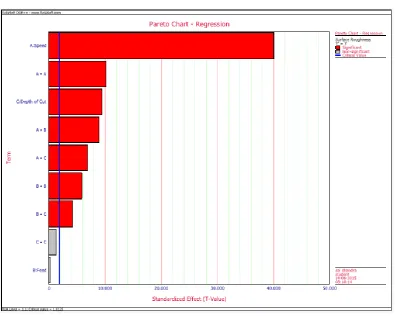
evaluated by the F probability value with 90% confidence level. The P values were used to check the significance of each coefficient. The P values less than 0.01 indicates that the model and model terms were statistically significant, this is shown by the pareto chart below (Figure 6). Following the determination of significant coefficients, the final relationship was developed based on these coefficients. The empirical relationship to predict surface roughness of dry turned AISI 1045 steel was obtained as:
Ra= 0.7972 -0.3960A -0.002B +0.0930C -0.0988AB -0.0763AC -0.0462BC +0.1895AA -0.1105BB +0.0245CC in terms of coded values.
[image:12.595.105.501.256.572.2]Ra= 1.2052 0.0299A +57.2551B +3.5135C 0.1234AB 0.0191AC 23.1250BC +0.0001AA -276.1364BB +2.4545CC in terms of actual values.
Figure 6: Pareto Chart 4.2 Optimization
A Monthly Double-Blind Peer Reviewed Refereed Open Access International e-Journal - Included in the International Serial Directories.
GE- International Journal of Engineering Research (GE-IJER)
Website: www.aarf.asia. Email: [email protected] , [email protected]
[image:13.595.121.490.67.354.2]Page 81
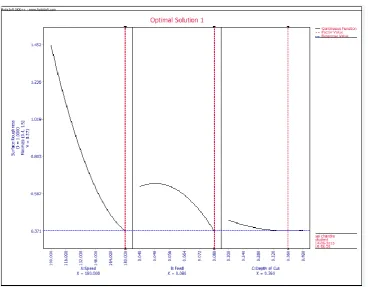
Figure 7: Optimization Plot 5. CONCLUSION
This experimental work involves analysis of surface roughness in dry turning operation on AISI 1045 steel and leads to the following conclusions:
An empirical relationship was developed to predict surface roughness of dry turned
AISI 1045 steel using response surface methodology. The developed relationship can be effectively used to predict the surface roughness at 90% confidence level.
Optimum value of parameters to minimize the value of surface roughness is
Cutting speed = 180 m/min Feed = 0.08 mm/rev
Depth of cut = 0.36 mm.
The process parameters A, C and the interactions A*A, A*B, A*C, B*B and B*C are
found to be the significant factors in judging the surface roughness and speed (A) is the most significant parameter which is effecting the surface roughness.
REFERENCES Journal Papers
A Monthly Double-Blind Peer Reviewed Refereed Open Access International e-Journal - Included in the International Serial Directories.
GE- International Journal of Engineering Research (GE-IJER)
Website: www.aarf.asia. Email: [email protected] , [email protected]
Page 82
2. Anselmo Eduardo Diniz, Adilson Jose´ de Oliveira, "Optimizing the use of dry cutting in
rough turning steel operations" International Journal of Machine Tools & Manufacture 44
(2004) 1061–1067.
3. P Subhash, Chandra Bose & C S P Rao , “Evaluation of Optimum Cutting Parameters In
Turning of NIMONIC 75 using RSM” International Journal on Theoretical and Applied
Research in Mechanical Engineering, 2319 – 3182, Volume-2, Issue-2, 2013 .
4. M.Y. Noordin, V.C. Venkatesh, S. Sharif, S. Elting, A. Abdullah, "Application of response surface methodology in describing the performance of coated carbide tools when turning AISI 1045 steel", Journal of Materials Processing Technology 145 (2004) 46–58.
5. Samir Khamel, Nouredine Ouelaa, Khaider Bouacha, "Analysis and prediction of tool wear,
surface roughness and cutting forces in hard turning with CBN tool", Journal of
Mechanical Science and Technology 26 (11) (2012) 3605-3616.
6. V.Mugendiran, A.Gnanavelbabu, R.Ramadoss, "Parameter optimization for surface roughness and wall thickness on AA5052 Aluminium alloy by incremental forming using response surface methodology", Procedia Engineering 97 ( 2014 ) 1991 – 2000.
7. H. Joardar, N.S. Das, G. Sutradhar, S Singh, "Application of response surface methodology for determining cutting force model in turning of LM6/SiCP metal matrix composite", Measurement 47 (2014) 452–464.
8. A. Esteves Correia, J. Paulo Davim, " Surface roughness measurement in turning carbon
steel AISI 1045 using wiper inserts", Measurement 44 (2011) 1000–1005.
9. http://www.mmsonline.com/articles/machining-dry-is-worth-a-try
10. http://2.imimg.com/data2/KE/JE/MY-/grades.pdf