JOURNAL OFCLINICALMICROBIOLOGY,
0095-1137/99/$04.0010 Mar. 1999, p. 664–674 Vol. 37, No. 3
Copyright © 1999, American Society for Microbiology. All Rights Reserved.
Validation of Binary Typing for
Staphylococcus aureus
Strains
WILLEMVANLEEUWEN,1* HENRI VERBRUGH,1JOSVAN DERVELDEN,1NANVANLEEUWEN,2
MAX HECK,2ANDALEXVANBELKUM1
Department of Medical Microbiology and Infectious Diseases, Erasmus University Medical Center Rotterdam, Rotterdam,1National Institute of Public Health and the Environment, Bilthoven,2The Netherlands
Received 27 July 1998/Returned for modification 10 November 1998/Accepted 3 December 1998
Most of the DNA-based methods for genetic typing of Staphylococcus aureus strains generate complex
banding patterns. Therefore, we have developed a binary typing procedure involving strain-differentiating DNA probes which were generated on the basis of randomly amplified polymorphic DNA (RAPD) analysis. We present and validate the usefulness of 15 DNA probes, according to generally accepted performance criteria for
molecular typing systems. RAPD analysis with multiple primers was performed on 376S. aureusstrains of
which 97% were methicillin resistant (MRSA). Among the 1,128 RAPD patterns generated, 66 were selected which identified 124 unique DNA fragments. From these amplicons, only 12% turned out to be useful for isolate-specific binary typing. The nature of the RAPD-generated DNA fragments was investigated by partial
DNA sequence analysis. Several homologies with knownS. aureussequences and with genes from other species
were discovered; however, 87% of the probe sequences are of previously unknown origin. The locations of most
of the DNA probes on the chromosome ofS. aureus NCTC 8325 were determined by hybridization. Seven
fragments were randomly dispersed along the genome, five were clustered within the 2500- to 2600-kb position
of the genome, and the remaining four did not recognize complementary sequences inS. aureusNCTC 8325.
A total of 103S. aureusstrains (69% MRSA) were used for the validation of the binary typing technique. The
15 DNA probes provided stable epidemiological markers, both in vitro (type consistency after serial passages on culture media) and in vivo (comparison of sequential isolates recovered from cases of persistent
coloniza-tion). The discriminatory power of binary typing (D50.998) exceeded that of pulsed-field gel electrophoresis
(D 5 0.966) and RAPD analysis (D 5 0.949). Reproducibility, measured by analyzing multiple strains
belonging to a multitude of different epidemiological clusters, was comparable to that of other genotyping techniques used. Contribution of the DNA probes to the discriminatory power of the system was analyzed by comparison of dendrograms. This study demonstrates that binary typing is a robust tool for the genetic typing ofS. aureusisolates.
Staphylococcus aureus has remained a prime pathogen of nosocomial and community-acquired infections. Worldwide, the increasing prevalence of multiresistant S. aureushas be-come an additional problem (4, 20, 25). Consequently, the epidemiology ofS. aureusinfections needs to be studied, and for this purpose multiple typing techniques based on the de-tection of DNA polymorphisms have been developed and op-timized (3, 22). Nucleotide sequence variations amongS. au-reus strains can be identified by a number of techniques, varying from pulsed-field gel electrophoresis (PFGE) (39, 46) to randomly amplified polymorphic DNA (RAPD) analysis (37). However, these techniques generate complex banding patterns which lack generally accepted interpretation criteria (8, 36). Consequently, comparison of large numbers of finger-prints is very tedious and has little validity beyond the individ-ual laboratory (8, 38, 42). Therefore, we have sought to de-velop less tedious typing systems that can be interpreted unequivocally. We have identified relatively unique domains within the staphylococcal genome on the basis of RAPD anal-ysis that could be targets for such a typing system. Strain-specific DNA probes which produce a simple binary output were isolated by using hybridization assays. This collection of probes thus constitutes a so-called library typing system that
can elucidate genetic polymorphism and clonal relatedness amongS. aureusstrains (45, 46).
In this study, the DNA probes were sequenced and homol-ogies with known sequences and their locations on the physical map ofS. aureusNCTC 8325 (29) were determined. The per-formance of this binary typing system was validated by using the evaluation criteria as proposed by Struelens et al. (33), Arbeit (3), and Maslow et al. (22). The performance criteria include the stability, discriminatory power, and reproducibility of the typing system.
MATERIALS AND METHODS
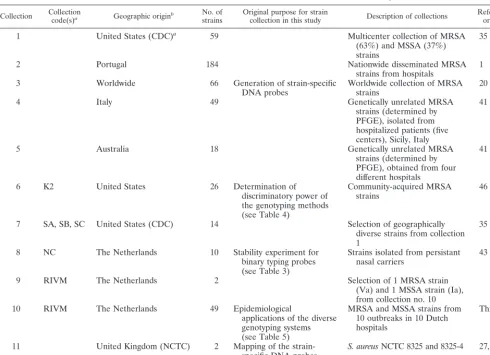
Bacteria.Strains ofS. aureus(n5463) were pooled from 11 collections
previously used for several purposes (Table 1). For cultivation, bacteria from glycerol stocks, stored at280°C, were inoculated on Columbia III agar (Becton Dickinson, Etten-Leur, The Netherlands) supplemented with 5% sheep blood and incubated at 37°C for 24 h. All strains were identified as S. aureusby standard microbiological methods (19). Methicillin resistance was determined by “direct-colony suspension” inoculation of the strains on Mueller Hinton agar (Oxoid CM 337; Brunswig Chemie, Amsterdam, The Netherlands) in the pres-ence of a disk containing 5mg of methicillin (Oxoid; Brunswig Chemie, Amster-dam, The Netherlands) and after 16 to 18 h of incubation at 35°C. Zone diam-eters were interpreted according to the guidelines of the National Committee for Clinical Laboratory Standards (26).
Binary typing.Binary typing was performed as described previously by van
Leeuwen et al. (45, 46). However, we increased the overall number of strain-specific DNA probes from 5 to 15. The same procedures were used for the generation of the DNA probes as described before (45).
(i) Generation of the strain-specific DNA probes.In short, after RAPD
anal-ysis DNA fingerprints were compared visually, and unique, strain-differentiating amplicons were selected and subsequently cloned into a TA cloning vector (Invitrogen, Leek, The Netherlands) and then transformed intoEscherichia coli
JM 109 cells. Inserts were amplified from the recombinant plasmids with M13 and T7 primers. Cloned fragments were characterized by DNA sequencing with * Corresponding author. Mailing address: Department of Medical
Microbiology and Infectious Diseases, Erasmus Medical Center Rot-terdam, Dr. Molewaterplein 40, 3015 GD RotRot-terdam, The Nether-lands. Phone: 31 10 4633668. Fax: 31 10 4633875. E-mail: vanleeuwen @bacl.azr.nl.
664
on May 15, 2020 by guest
http://jcm.asm.org/
dye-terminator chemistry by using a 373 DNA sequencing system (Perkin-Elmer, Foster City, Calif.). The insert sequences were compared with all entries in the data bank of the National Center for Biotechnology Information (NCBI) and were analyzed for nucleotide and protein sequence similarities with Basic Local Alignment Search Tool (BLASTN and BLASTP, respectively [2]).
(ii) Implementation of the binary typing system.Labeling, hybridization, and
detection of the cloned DNA fragments were performed with enhanced chemi-luminescence (ECL) direct labeling and detection systems, according to the manufacturer’s protocols (Amersham Life Science, Buckinghamshire, United Kingdom), in order to use them as probes. The hybridization characteristics of the DNA probes were defined by prescreening these probes on a Southern blot containing 14 genetically unrelated staphylococcal strains (Table 1, collection 7). DNA probes displaying differential hybridization were added to the binary typing system. Hybridization of the 15 different DNA probes was scored with a 1 or a 0 according to the presence or absence of the hybridization signal, respectively, and the resulting binary code was transformed into a decimal number. This number is further represented as the binary type.
RAPD analysis.RAPD analysis was carried out essentially as described before
(37). Fingerprints were scored visually in which a single band difference defined a novel RAPD type. The three-letter codes are based on ERIC-2, AP-1, and AP-7 priming (45) and can only be compared within each group and not across the different groups of organisms represented in Tables 3, 4, and 5.
PFGE.Restriction withSmaI (Boehringer, Mannheim, Germany) of genomic
staphylococcal DNA and subsequent separation of the DNA macrorestriction fragments was performed by contour-clamped homogeneous electric field (CHEF) PFGE as described before (39). Macrorestriction profiles were inter-preted as described by Tenover et al. (36), and each pattern is presented as a roman letter.
Mec-A–Tn554probe typing.Genomic staphylococcal DNA was digested with
ClaI endonuclease (Pharmacia Biotech, Roosendaal, The Netherlands)
accord-ing to the manufacturer’s instructions. Generation of target-specific probes and hybridization was done as described before (20).
Coagulase gene PCR.Coagulase gene polymorphism was determined by PCR
as described previously (32). The amplified part of the coagulase gene was digested with the restriction endonucleaseAluI (Boehringer) according to the manufacturer’s protocol. Restriction fragment length polymorphism (RFLP) patterns were visually interpreted and indexed by roman lettering.
PCR analysis of themecregulator genesmecIandmecR1.PCR was performed
as described before (34). Three sets of specific primers were used to amplify the different regions of themecregulator genes, i.e.,mecIand the 59end (trans-membrane part) and the 39end (penicillin-binding part) ofmecR1.
cnaprobe.The presence or absence of theS. aureuscollagen adhesin (cna) was
used as an additional genotypic marker for the differentiation ofS. aureusstrains. Probing was performed essentially as described by Smeltzer et al. (31).
spagene.Staphylococcal protein A (Spa) gene polymorphism was determined
by PCR as described previously (11). The so-called X region, a repetitive part within the gene, was amplified, and subsequently, the amplicon was digested with the restriction endonucleaseRsaI (Boehringer), resulting in two fragments com-posed of 214 and 35 bases and a third fragment containing the repetitive DNA. The number of 24-bp repeats was calculated by comparison with a 100-bp molecular weight marker (Pharmacia Biotech).
Phage typing.Phage typing was performed at the Dutch National Institute of
Public Health and the Environment by using the international set of typing phages and a set of typical Dutch phages (28, 47). Different phage patterns were given different type designations.
Ribotyping.Conventional ribotyping withEcoRI was performed by methods
[image:2.612.56.547.83.438.2]described previously (13). Restriction fragments were Southern blotted onto Hybond N1membranes (Amersham) (30), and theS. aureus16S rRNA gene, amplified by PCR, was used as a probe. Hybridization was detected by using an ECL kit (Amersham).
TABLE 1. Characterization of theS. aureuscollections used in this study
Collection Collectioncode(s)a Geographic originb No. ofstrains Original purpose for straincollection in this study Description of collections Reference(s)or source
1 United States (CDC)a 59 Multicenter collection of MRSA
(63%) and MSSA (37%) strains
35
2 Portugal 184 Nationwide disseminated MRSA
strains from hospitals 1
3 Worldwide 66 Generation of strain-specific
DNA probes Worldwide collection of MRSAstrains 20
4 Italy 49 Genetically unrelated MRSA
strains (determined by PFGE), isolated from hospitalized patients (five centers), Sicily, Italy
41
5 Australia 18 Genetically unrelated MRSA
strains (determined by PFGE), obtained from four different hospitals
41
6 K2 United States 26 Determination of
discriminatory power of the genotyping methods (see Table 4)
Community-acquired MRSA
strains 46
7 SA, SB, SC United States (CDC) 14 Selection of geographically
diverse strains from collection 1
35
8 NC The Netherlands 10 Stability experiment for binary typing probes (see Table 3)
Strains isolated from persistant
nasal carriers 43
9 RIVM The Netherlands 2 Selection of 1 MRSA strain
(Va) and 1 MSSA strain (Ia), from collection no. 10
10 RIVM The Netherlands 49 Epidemiological
applications of the diverse genotyping systems (see Table 5)
MRSA and MSSA strains from 10 outbreaks in 10 Dutch hospitals
This study
11 United Kingdom (NCTC) 2 Mapping of the strain-specific DNA probes (see Fig. 1)
S. aureusNCTC 8325 and 8325-4 27, 29
aK2, community-acquired MRSA strains from a New York City hospital; SA, SB, SC,S. aureusstrains from the CDC collection; NC, nasal carrier; RIVM, National Institute of Public Health and the Environment (Bilthoven, The Netherlands).
bCDC, Centers for Disease Control and Prevention; NCTC, National Collection of Type Cultures (Central Public Health Laboratory, London, United Kingdom).
on May 15, 2020 by guest
http://jcm.asm.org/
MecAPCR.AllS. aureusstrains were investigated for the presence of themecA
gene by PCR as described before (24).
Physical mapping.Genomic DNAs fromS. aureus NCTC 8325 (29) and
8325-4 (27) were digested withSmaI (Boehringer),SgrAI (Boehringer Mann-heim), andAscI (New England Biolabs, Leusden, The Netherlands) according to the manufacturers’ protocols. Macrorestriction fragments were separated by PFGE and subsequently transferred onto Hybond N1membranes (Amersham) for Southern hybridization (30). Probing with the 15 strain-specific DNA frag-ments was done as described above under “Binary typing.”
Statistical analysis.The discriminatory power of binary typing and other
genotyping formats used in this study, defined as the average probability that different genotypes will be assigned to two unrelated strains in the population of a given genus, was calculated by using the formula of the Simpson index of diversity as explained by Hunter and Gaston (17, 18). The contribution of the DNA probes to the discriminatory power of the binary typing system was ana-lyzed by cluster analysis and comparison of the dendrograms. First, all of the probes (n515) were used to characterize 40 unique (Table 1, collections 6 and 7) and 10 outbreak clusters (Table 1, collection 10) ofS. aureusstrains. The percentages of similarity of the hybridization patterns were calculated with Dice coefficient and with unweighted pair group mathematical analysis to display relatedness hierarchies among the strains. Subsequently, the procedure was repeated after discarding the DNA probe that had the lowest level of discrimi-nation.
RESULTS
Selection of the strain-specific DNA probes.RAPD analysis
with multiple primers was performed on 376S. aureusstrains (Table 1, collections 1 through 5) of which 97% were methi-cillin-resistant. One hundred and twenty-four amplicons were selected from 66 RAPD patterns. Overall, 98 DNA fragments (79%) were successfully cloned, and from those a total number of 17 clones displayed a strain-specific character after hybrid-ization withEcoRI-digested DNA from the 14 epidemiologi-cally unrelated S. aureus strains (Table 1, collection 7 [38% MRSA]). However, 3 of the 17 clones shared the same DNA sequence, and two of these were consequently discarded. The remaining 80 fragments hybridized with DNA of all strains either at single (n 542) or multiple sites (n5 14) or recog-nized the digested DNA from their source strain (n524) only.
The latter fragments were not included since these fragments did not contribute significantly to the discriminatory power of the system.
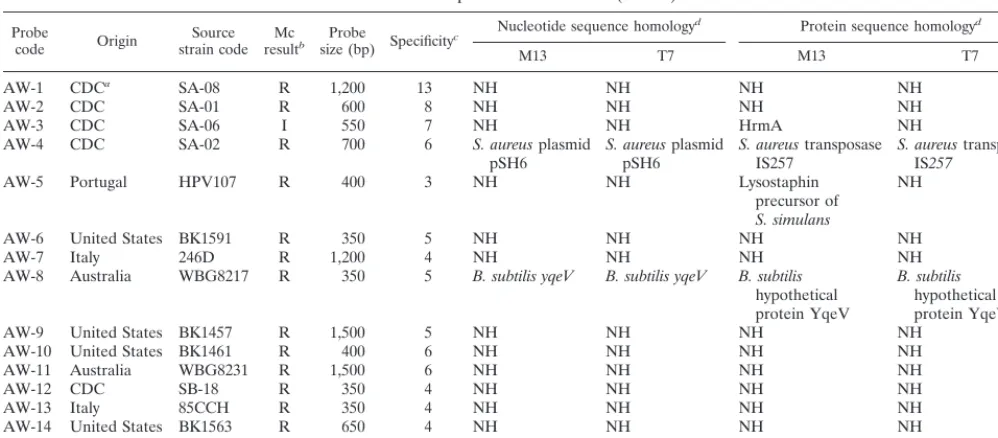
Characterization of the DNA probes. The origin and the
nature of the 15 RAPD-generated DNA probes are outlined in Table 2. Sequence data were obtained from both termini (M13 and T7), and the DNA sequences were analyzed separately for homology by using the BLAST program with the nucleotide and protein sequence data bank, including the unfinished mi-crobial genomes data bank (NCBI). A large proportion of these sequences did not match with known DNA elements (87%) for the nucleotide sequence data bank and 80% for the protein data bank). Probe AW-3 (M13 terminus) appeared to have a low score (BLAST score of 36) with the gene product encoded byhrmAofNostocsp. in the protein sequence data-base. Probe AW-4 (both termini) displayed a high score (1571) with theS. aureusmultiresistance plasmid pSH6 for insertion sequences IS256 and IS257 in the search of the nucleotide sequence data bank and a high score (593) with IS257 trans-posase in the search of the protein sequence data bank. The M13 terminus of probe AW-5 displayed a low homology score (89) with the lysostaphin precursor ofStaphylococcus simulans. Finally, probe AW-8 (both termini) appeared to have a high level of similarity (BLAST score 573) with the yqeV gene, a hypothetical protein, and part of the polycystronic locus of the
Bacillus subtilis dnaKoperon.
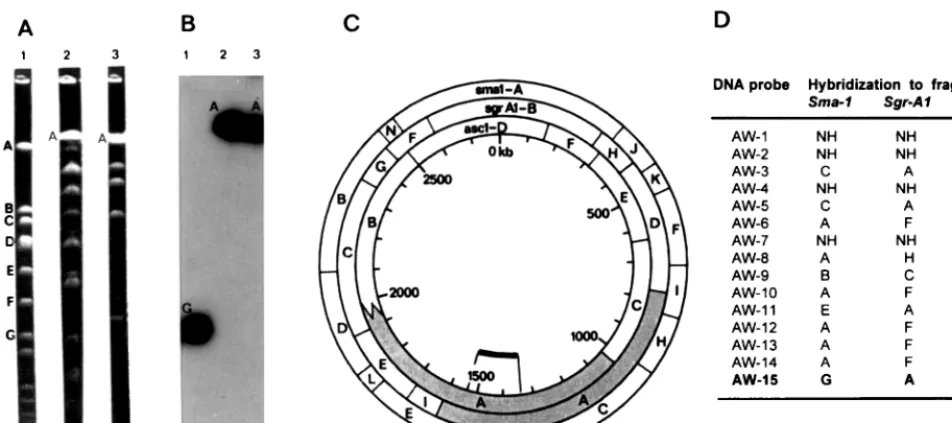
The locations of the strain-specific DNA probes were deter-mined on the physical map of the S. aureusNCTC 8325 ge-nome (Fig. 1) and on the restriction fragments of S. aureus
[image:3.612.54.553.91.310.2]NCTC 8325-4. Four of the 15 DNA probes (AW-1, AW-2, AW-4, and AW-7) failed to hybridize to either of the two staphylococcal genomes. Five probes (AW-6, AW-10, AW-12, AW-13, and AW-14) were found to be physically clustered in the same DNA region (position 2500 to 2600 kb), while the TABLE 2. Summary of the demographic data and the sequence homologies from the RAPD-generatedS. aureusDNA fragments
with strain-specific characteristics (n515) Probe
code Origin strain codeSource resultMcb size (bp) SpecificityProbe c
Nucleotide sequence homologyd Protein sequence homologyd
M13 T7 M13 T7
AW-1 CDCa SA-08 R 1,200 13 NH NH NH NH
AW-2 CDC SA-01 R 600 8 NH NH NH NH
AW-3 CDC SA-06 I 550 7 NH NH HrmA NH
AW-4 CDC SA-02 R 700 6 S. aureusplasmid
pSH6 S. aureuspSH6 plasmid S. aureusIS257 transposase S. aureusIS257 transposase
AW-5 Portugal HPV107 R 400 3 NH NH Lysostaphin
precursor of
S. simulans
NH
AW-6 United States BK1591 R 350 5 NH NH NH NH
AW-7 Italy 246D R 1,200 4 NH NH NH NH
AW-8 Australia WBG8217 R 350 5 B. subtilis yqeV B. subtilis yqeV B. subtilis
hypothetical protein YqeV
B. subtilis
hypothetical protein YqeV
AW-9 United States BK1457 R 1,500 5 NH NH NH NH
AW-10 United States BK1461 R 400 6 NH NH NH NH
AW-11 Australia WBG8231 R 1,500 6 NH NH NH NH
AW-12 CDC SB-18 R 350 4 NH NH NH NH
AW-13 Italy 85CCH R 350 4 NH NH NH NH
AW-14 United States BK1563 R 650 4 NH NH NH NH
AW-15 Italy 76CCH R 300 5 NH NH NH NH
aCDC, Center for Disease Control and Prevention.
bMc; methicillin susceptibility disk-diffusion test; R, resistant; I, intermediate.
cNumber of strains hybridizing with a particular probe. The probes were tested on 14 CDC strains (Table 1, collection 7).
dNH; no homology. Cloned DNA sequences of insert termini (M13 and T7) were analyzed for sequence homologies with nucleotide and protein sequences in the NCBI data bank by using the BLAST computer program (2).
666 VANLEEUWEN ET AL. J. CLIN. MICROBIOL.
on May 15, 2020 by guest
http://jcm.asm.org/
remaining seven probes were found to be scattered on the physical map ofS. aureusNCTC 8325.
Stability experiments. The in vivo stability of the binary
typing system was assessed by testing sequential isolates ofS. aureusfrom five individuals who were previously classified as being persistent nasal carriers (Table 1, collection 8) (43). The 15 DNA probes uniformly and correctly identified each of the twoS. aureusstrains isolated from five persistent nasal carriers in 1988 and 1995, respectively, in accordance with the other genotyping techniques (Table 3). Moreover, we tested the in vitro stability of the DNA probes by serial passage (503) of strains Ia and Va (Table 1, collection 9). Again, all descendent isolates were shown to be identical, i.e., their binary types did not change with serial passages (data not shown).
Discriminatory power. We compared the discriminatory
power of our binary typing system with that of generally
ac-cepted typing systems included PFGE, RAPD analysis, and
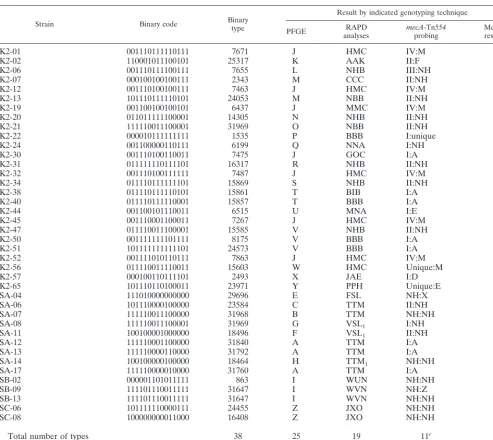
mecA-Tn554probing. Comparative analysis of the discrimina-tory power of these genotyping systems is displayed in Table 4 and is expressed by the Simpson index of diversity (D). RFLP analysis of the mecA gene and Tn554 generated 11 unique patterns from the 40 epidemiologically unrelated strains (Ta-ble 1, collections 6 and 7) and had the lowest score (D 5
[image:4.612.65.541.71.282.2]0.848). Due to the absence of themecAgene, the typing data of the MSSA strains were deleted for theDvalue determina-tion. PFGE and RAPD analysis differentiated the collection into 25 and 19 subtypes with D values of 0.966 and 0.949, respectively. However, the binary typing system distinguished 38 unique genotypes and had aD score of 0.998. Only two binary types, 31969 and 31647, were each found twice in the collection. Type 31647 was found to be identical by PFGE, RAPD analysis, andmecAgene polymorphism, but one strain FIG. 1. Physical mapping of the DNA probes onS. aureusNCTC 8325 (29) restriction fragments. (A) PFGE macrorestriction patterns ofS. aureusNCTC 8325 digested withSmaI,SgrAI, andAscI (lanes 1, 2, and 3, respectively). Restriction fragments are coded by descending molecular size. (B) Example of hybridization results with probe AW-15 to PFGE patterns ofS. aureusNCTC 8325. Lanes are the same as for panel A. (C) Hybridization results of probe AW-15 depicted on the physical map ofS. aureusNCTC 8325. (D) Mapping results of the 15 strain-specific DNA probes (AW-1 through AW-15) to the macro-restriction fragments of theS. aureus
NCTC 8325 genome. NH, no hybridization of the strain-specific DNA probe to the macrorestriction fragments.
TABLE 3. Stability of the strain-differentiating DNA probes determined withS. aureusstrains obtained from persistent nasal carriers
Persistent
carrier (sex)a Strainb Isolation date Binary code (type)c
Result by indicated genotyping techniqued: RAPD
analysis PFGE polymorphismspa Coagulase genepolymorphism Presence/absenceofcna
099 (F) NC-711 1988 001010110101111 (5551) CCC J 9 F 2
NC-220 September 1995 001010110101111 (5551) CCC J 9 F 2
060 (F) NC-1740 1988 101010011100101 (21733) FCC M 9 D 2
NC-1733 February 1995 101010011100101 (21733) FCC M 5 D 2
038 (F) NC-1288 1988 000000011100111 (231) EDE G 7 B 2
NC-105 June 1995 000000011100111 (231) EDE G 7 B 2
076 (F) NC-705 1988 000010011100101 (1253) AEA A 7 A 1
NC-054 May 1995 000010011100101 (1253) AEA A 7 A 1
145 (M) NC-714 1988 000000010100101 (165) BBB B 8 B 1
NC-063 May 1995 000000010100101 (165) BBB B 8 B 1
aPersistency defined as 10 identical culture results from longitudinal sampling over 3 months (43). bNC, strain from nasal carrier. See Table 1, collection 8, for more details.
cOverall results after hybridization with 15 strain-specific DNA probes (AW-1 through AW-15, respectively). The decimal number represents the binary type. See Materials and Methods for more information.
dResults (except for presence/absence ofcna) are given as codes for each technique. See Materials and Methods for more information.
on May 15, 2020 by guest
http://jcm.asm.org/
[image:4.612.56.552.553.686.2](SB-13) lacked Tn554. Types 31969 and 31647 reportedly also share a single phage type (35). Strains K2-21 and SA-08 share binary type 31969 but clearly differed by the other genotyping systems (Table 4). It has to be emphasized that a common clonal origin for some of the (even epidemiologically unre-lated) strains described in the present communication cannot be fully excluded.
Reproducibility.In order to test the reproducibility of our
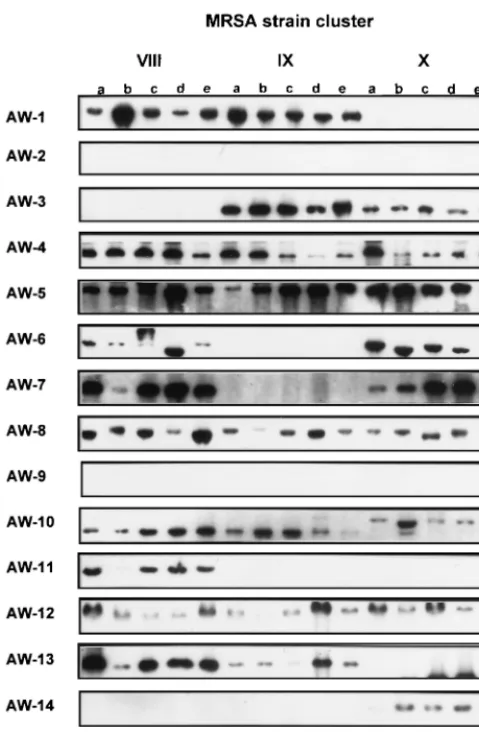
binary typing system, we tested 10 different clusters of epide-miologically related S. aureusstrains (four to five strains per outbreak; four MSSA and six MRSA clusters). A representa-tive illustration of the binary typing hybridization results is outlined in Fig. 2. The genetic relatedness of the strains within a cluster was primarily defined on the basis of epidemiological
[image:5.612.56.550.101.542.2]data and possession of identical phage types within the cluster. The reproducibility of the binary typing technique was calcu-lated as the number of isolates correctly assigned to the same type within a cluster divided by the total number of strains tested. Overall, 45 of 49 (92%) strains were correctly typed, i.e., 30 of 30 MRSA and 15 of 19 MSSA strains (Table 5). Interestingly, the nonconcordant MSSA strains also showed genetic variation by one or more of the other genotyping sys-tems applied to the same set of strains. Thus, binary typing is similarly sensitive to such variation in the genome ofS. aureus. The contribution of the DNA probes to the discriminatory power of the system was analyzed by comparison of the den-drograms. Increasing subtraction of the distinct DNA probes reduced the resolution of the binary typing system among the TABLE 4. Analysis of the discriminatory power of the binary typing method compared with other genotyping techniques, estimated on the
basis of the typing results for epidemiologically unrelated MRSA strains from New York City and geographically diverse
S. aureusstrains from the United Statesa
Strain Binary code Binarytype
Result by indicated genotyping technique
PFGE analysesRAPD mecAprobing-Tn554 Methicillinresistanceb
K2-01 001110111110111 7671 J HMC IV:M R
K2-02 110001011100101 25317 K AAK II:F R
K2-06 001110111100111 7655 L NHB III:NH R
K2-07 000100100100111 2343 M CCC II:NH R
K2-12 001110100100111 7463 J HMC IV:M R
K2-13 101110111110101 24053 M NBB II:NH R
K2-19 001100100100101 6437 J MMC IV:M R
K2-20 011011111100001 14305 N NHB II:NH R
K2-21 111110011100001 31969 O NBB II:NH R
K2-22 000010111111111 1535 P BBB I:unique R
K2-24 001100000110111 6199 Q NNA I:NH R
K2-30 001110100110011 7475 J GOC I:A R
K2-31 011111110111101 16317 R NHB II:NH R
K2-32 001110100111111 7487 J HMC IV:M R
K2-34 011110111111101 15869 S NHB II:NH R
K2-38 011110111110101 15861 T BIB I:A R
K2-40 011110111110001 15857 T BBB I:A R
K2-44 001100101110011 6515 U MNA I:E R
K2-45 001110001100011 7267 J HMC IV:M R
K2-47 011110011100001 15585 V NHB II:NH R
K2-50 001111111101111 8175 V BBB I:A R
K2-51 101111111111101 24573 V BBB I:A R
K2-52 001111010110111 7863 J HMC IV:M R
K2-56 011110011110011 15603 W HMC Unique:M R
K2-57 000100110111101 2493 X JAE I:D R
K2-65 101110110100011 23971 Y PPH Unique:E R
SA-04 111010000000000 29696 E FSL NH:X S
SA-06 101110000100000 23584 C TTM II:NH I
SA-07 111110011100000 31968 B TTM NH:NH S
SA-08 111110011100001 31969 G VSL1 I:NH R
SA-11 100100001000000 18496 F VSL1 II:NH R
SA-12 111110001100000 31840 A TTM I:A R
SA-13 111110000110000 31792 A TTM I:A R
SA-14 100100000100000 18464 H TTM1 NH:NH S
SA-17 111110000010000 31760 A TTM I:A R
SB-02 000001101011111 863 I WUN NH:NH S
SB-09 111101110011111 31647 I WVN NH:Z S
SB-13 111101110011111 31647 I WVN NH:NH S
SC-06 101111110000111 24455 Z JXO NH:NH S
SC-08 100000000011000 16408 Z JXO NH:NH S
Total number of types 38 25 19 11c 3
D 0.998 0.96 0.949 0.848
aSee Table 1 for more information on the origins of the strains used. bR, resistant; I, intermediately resistant; S, susceptible.
cThemecA-Tn554typing data for the MSSA strains (n58) were deleted.
668 VANLEEUWEN ET AL. J. CLIN. MICROBIOL.
on May 15, 2020 by guest
http://jcm.asm.org/
genotypic results of the uniqueS. aureusstrains (Fig. 3a). A similar effect on the epidemiological concordance among the hybridization patterns of theS. aureusoutbreak cluster strains was noticed after subtraction of the same DNA probes (Fig. 3b). Consequently, none of the probes can be discarded from the binary typing system.
DISCUSSION
Whole genomes of bacteria are currently being sequenced at high rates, and information can be derived from analysis and comparison of these chromosomes. Essential paralogous re-gions as well as narrowly distributed gene families can be identified. The latter groups may be genus, species, or even strain specific. For instance, the genome ofMycoplasma geni-taliumcommits about 5% of its content to a single species-specific domain, encoding an adhesin gene (10). Another type of DNA variability was observed after completion of the Hae-mophilus influenzaeDNA sequence (9). Repeats in the genes encoding enzymes involved in lipopolysaccharide biosynthesis and iron acquisition and a gene encoding an adhesin display clear heterogeneity (16, 40). The E. coli genome highlights
novel insertion sequence elements, phage remnants, and many DNA fragments of unusual composition, indicating genome plasticity and horizontal gene transfer (5). Many bacterial vir-ulence genes are found as discrete DNA fragments, present in pathogenic organisms but absent from nonpathogenic mem-bers of the same genus or species, e.g., the “pathogenicity islands” of uropathogenicE. colior enteropathogenicE. coli
(14, 23). Unfortunately, only a single genome sequence of a gram-positive bacterium is known. TheB. subtilisgenome con-tains phage-type elements as well, again indicating DNA flex-ibility (21). Based on theoretical comparative analysis, many DNA elements contributing to DNA variation can be pin-pointed. No experimental studies have been described as yet, however. Practically, the genome variability ofS. aureusstrains can be visualized on the basis of RAPD analysis and the use of the amplicons thereof as probes. We describe here an ap-proach for isolating species-specific DNA elements for a bac-terium for which the whole genome sequence is not in the public domain. The aim of the present study was to validate the use of strain-differentiating DNA probes for the genotyping of
S. aureus and to develop a new typing format, providing a simple binary output based on the use of RAPD-generated DNA probes. Such probes can detect sequence variation be-tween genomes without prior knowledge of the target DNA sequence, as has been presented before (45, 46). We now have extended the number of DNA probes to 15 and have shown the typing system to have a very high index of reproducibility, stability (100%), and discriminatory power (D5 0.998). Hy-bridization studies revealed that only 12% of the RAPD am-plicons, visually selected for uniqueness, exhibited the desired genetic typing characteristics forS. aureusstrains. Primer site variation may be the origin of the remaining 88% of the dif-ferentiating amplicons. The nature of the DNA probes used in this study remains largely unknown. In one case (probe AW-4) homology with a mobile genetic element, IS257, was found. IS257is an insertion sequence identified as commonly occur-ring in staphylococcal plasmids (7). These plasmids often code for diverse resistance determinants. The investigation of fur-ther alignments awaits publication of the whole S. aureus ge-nome sequence.
The locations of the DNA probes on the physical map ofS. aureusNCTC 8325 (29) (Fig. 1) andS. aureusNCTC 8325-4, a derivative of 8325 cured of phages P11, P12, and P13 (27), were determined. Some probes (n 54) were neither on the physical map of S. aureus NCTC 8325 nor present on the restriction fragments of NCTC 8325-4. The remainder of the probes recognized elements on both genomes, which argues against a putative relationship with the prophage sequences that are present inS. aureusNCTC 8325 but not inS. aureus
NCTC 8325-4. Seven probes showed random locations and five clustered together around the 2500- to 2600-kb region of theS. aureus NCTC 8325 genome. These latter probes all share a nucleotide sequence of 80 bp, but the main part of their nu-cleotide sequence was totally different. It is possible that this DNA region is part of a direct repeat and spacer region, which can be used to generate sequence variation patterns between genomes (44). The location of these probes coincides with that of several potentially variable elements: essential genes for recombination between genomes (recA) or DNA repair (uvr), virulence factors (hla), and diverse Tn551insertion sites (29). The probes that hybridized to DNA regions scattered through-out the genome seemed to have no linkage with variable DNA sequences, except for one probe (AW-15) which is located in the vicinity of resistance determinants (mecregion), virulence factors (spa), and the origin of replication.
[image:6.612.55.295.71.437.2]The stability of the binary typing system was evaluated with FIG. 2. Representative example of binary typing results obtained with the
complete panel of strain-specific DNA probes (AW-1 through AW-15) from three MRSA clusters VIII, IX, and X (n515, collection 10). Each cluster encompassed five strains (a, b, c, d, and e) and displayed identical hybridization results.
on May 15, 2020 by guest
http://jcm.asm.org/
TABLE 5. Survey of geno- and phenotypic results for epidemic outbreak strains of MRSA and MSSA from Dutch hospitals and nursing homes
Cluster codea
Epidemiological data
Isolation date
(mo/yr) Binary code
b Binary
typec Phagetyped Ribo-typee
Result for indicated typing method:
Hospital Patient Isolatesource PFGEf RAPD
analysisg
Coagulase gene
polymorphismh cna
i spaj mecAk mecIk mecR1 k
59 39 MSSA
Ia A 1 Groin 11-96 101001111111101 21501 A A AAA 2/2 11 2 2 1 2
Ib A 1 Sputum 11-96 101001111111101 21501 A A AAA A 2/2 11 2 2 1 2
Ic A 1 Blood 11-96 101001111111101 21501 A A AAA A 2/2 11 2 2 1 2
Id A 2 Sputum 11-96 101001111111101 21501 A A AAA A 2/2 11 2 2 1 2
Ie A 3 Blood 07-96 101001111111101 21501 A A AAA A 2/2 11 2 2 1 2
IIa B2 1 Pus 12-96 001000000100000 4128 A B BBB NR 1/1 5 2 2 1 2
IIb B1 1 Pus 10-96 001000000100000 4128 A B B1BB NR 1/1 5 2 2 1 2
IIc B1 2 Pus 08-96 001000000100000 4128 A B1 B1BB NR 1/1 10 2 2 1 2
IId B2 3 Pus 11-96 001000010100000 4256 A B2 B1BB NR 1/1 11 2 2 1 2
IIe B2 4 Pus 10-96 001000000100000 4128 A B BBB NR 1/1 5 2 2 1 2
IIIa B1 5 Pus 11-96 000000110101011 427 B C CCC NR 2/2 10 2 2 1 2
IIIb B3 6 Urine 10-96 000000110101011 427 B C CCC NR 2/2 10 2 2 1 2
IIIc B3 6 Urine 10-96 000000110101011 427 B C CCC NR 2/2 10 2 2 1 2
IIId B3 (B1)l 7 Pus 12-95 010000110101011 8619 B C
1 CCC NR 2/2 10 2 2 1 2
IIIe B1 8 Urine 02-96 010000110101011 8619 B C1 CCC NR 2/2 10 2 2 1 2
IVa C 1 Nose 11-96 001011010100010 5794 A D DDD B 2/1 7 2 2 1 2
IVb D (C)m 2 Exit site 04-96 001001010100010 4770 A D DDD B 1/1 9 2 2 1 2
IVc C 3 Nose 07-96 001011010100010 5794 A D1 DDD1 B 2/1 11 2 2 1 2
IVd C 4 Pus 08-96 001011010100010 5794 A D1 DDD1 B 2/1 11 2 2 1 2
MRSA
Va En 1 Unknown 01-96 110111111111111 28671 XVI-3 A E
1 EEE1 C 1/1 10 1 1 1 1
Vb E 2 Unknown 01-96 110111111111111 28671 XVI-3 A E1 EEE1 C 1/1 10 1 1 1 1
Vc E 3 Unknown 01-96 110111111111111 28671 XVI-3 A E1 EEE1 C 1/1 10 1 1 1 1
Vd E 4 Unknown 01-96 110111111111111 28671 XVI-3 A E EEE1 C 1/1 10 1 1 1 1
Ve E 5 Unknown 01-96 110111111111111 28671 XVI-3 A E1 EEE1 C 1/1 10 1 1 1 1
VIa F1o 1 Unknown 10-96 001110010000000 7296 XVI-4 A F FFB NR 1/1 9 1 2 1 2
VIb F1 2 Unknown 05-96 001110010000000 7296 XVI-4 A F FFB NR 1/1 9 1 2 1 2
VIc F1 3 Nose 05-96 001110010000000 7296 XVI-4 A F FFB NR 1/1 9 1 2 1 2
VId F1 4 Unknown 07-96 001110010000000 7296 XVI-4 A F FFB NR 1/1 9 1 2 1 2
VIe F1 5 Unknown 04-96 001110010000000 7296 XVI-4 A F FFB NR 1/1 9 1 2 1 2
VIIa F2o 1 Nose 10-96 001110000000000 7168 XI-6 A F
1 FFB NR 1/1 9 1 2 1 2
VIIb F2 2 Nose 10-96 001110000000000 7168 XI-6 A F1 FFB NR 1/1 9 1 2 1 2
VIIc F2 3 Nose 10-96 001110000000000 7168 XI-6 A F1 FFB NR 1/1 9 1 2 1 2
VIId F2 4 Nose 10-96 001110000000000 7168 XI-6 A F1 FFB NR 1/1 9 1 2 1 2
VIIe F2 5 Nose 10-96 001110000000000 7168 XI-6 A F1 FFB NR 1/1 9 1 2 1 2
VIIIa G 1 Sputum 01-96 100111110111101 20413 Z-72 A G GGF D 2/2 10 1 2 1 2
VIIIb G 2 Unknown 03-96 100111110111101 20413 Z-72 A G GGF D 2/2 10 1 2 1 2
VIIIc G 3 Unknown 04-96 100111110111101 20413 Z-72 A G GGF D 2/2 10 1 2 1 2
VIIId G 4 Pus 04-96 100111110111101 20413 Z-72 A G GGF D 2/2 10 1 2 1 2
VIIIe G 5 Nose 04-96 100111110111101 20413 Z-72 A G GGF D 2/2 10 1 2 1 2
670
VAN
LEEUWEN
ET
AL.
J.
C
LIN
.M
ICROBIOL
.
sequential isolates recovered from healthy individuals who were shown to be persistent nasal carriers ofS. aureus(43). The persistent carriers were monitored in 1988 and 1995, and similarities of the genotypes among these two sampling periods were determined with binary typing, PFGE, RAPD analysis, coagulase and protein A gene polymorphism, and the absence or presence of the cna gene. All genomic characterization techniques (Table 3), including the 15 epidemiological markers of the binary typing system, indicated a high degree of genomic stability over the years, except for thespagene typing (persis-tent carrier 060). During laboratory storage and replication, mutations and transpositional recombination may occur (6), and the stability of the epidemiological markers for the staph-ylococcal genome can be measured by in vitro stability. The in vitro stability of the binary typing system was estimated by comparing the genomes of strains before and after 50 serial passages of strains on culture media. All DNA probes gener-ated identical results after repegener-ated testing (data not shown). The Simpson index of diversity (D) expresses the discrimi-natory power of a genotyping system (17, 18). We calculated the D value for binary typing and compared this with the results of other frequently used techniques (Table 4, PFGE, RAPD analysis,mecA-Tn554probing). Certain systems, such as PFGE or RAPD analysis with multiple primers, generate complex banding patterns, and the Simpson index was calcu-lated on the basis of the similarity level, defining a genotype (36). Hunter (18) proposed that the standardized discrimina-tion index determines the discriminadiscrimina-tion index of a typing method that has a reproducibility of 95%; this is designated
D95. Both binary typing and PFGE exceed the level ofD95, and consequently these methods can be used as a single method. Less discriminating systems such as RAPD analysis andmecA -Tn554probing can be used in combination to obtain a signif-icantD95index (18, 33).
The probability of clonal linkage among epidemic strains determined to be similar by diverse genotyping techniques can be expressed at the level of reproducibility. In fact an applica-tion of in vivo stability, i.e., comparison of sequential isolates, recovered along the course of a well-documented outbreak (33). The whole-genome characterization techniques binary typing, PFGE, and RAPD analysis display adequate reproduc-ibility among the related genomes of the epidemic MRSA strains (Table 5, clusters V through X). Only the number of repeats within thespagene remain unstable within genetically related strains, and no concordance is demonstrated for ana-lyzing presence versus absence of specific genes (cna, mecA,
mecI, andmecR1). Strains originated from different locations of hospital F (Table 5, clusters VI and VII) are genetically related, as shown by the genotyping results.
Conclusion and future developments. The binary typing
method described herein provides a reproducible, high-resolu-tion molecular typing system strategy that may in the end be preferred over other means of genotyping. This method gen-erates a simply binary output which is to be preferred over the complex banding patterns generated by most other genotyping systems. Furthermore, an important advantage of the binary typing system compared to other genotyping systems is that the system essentially comprises an assay procedure that is ame-nable to extensive automation and does not require variation in electrophoretic conditions such as voltage, time of run, and temperature, etc. (38, 42). Moreover, DNA hybridization can be performed by using an enzyme-linked immunosorbent as-say-like technique, allowing implementation of this approach in most routine microbiological laboratories. It is theoretically also possible to develop specific DNA probes to determine virulence factors and resistance determinants for additional
IXa H 1 Urine 01-96 101110010101101 23725 III-29 A H HAA D 2 / 2 9 12 1 2 IXb H 1 Urine 01-96 101110010101101 23725 III-29 A H HAA D 2 / 2 9 12 1 2 IXc H 2 Pus 01-96 101110010101101 23725 III-29 A H HAA D 2 / 2 8 12 1 2 IXd H 3 Pus 01-96 101110010101101 23725 III-29 A H HAA D 2 / 2 9 12 1 2 IXe H 4 Pus 01-96 101110010101101 23725 III-29 A H HAA D 2 / 2 9 12 1 2 X1 I 1 Ven. line 01-93 001111110101011 8107 III-29 A I IAA D 2 / 2 10 12 1 2 X2 I 2 Nose 01-93 001111110101011 8107 III-29 A I IAA D 2 / 2 10 12 1 2 X3 I 3 Wound 02-93 001111110101011 8107 III-29 A I IAA D 2 / 2 10 12 1 2 X4 I 4 Bile 02-93 001111110101011 8107 III-29 A I IAA D 2 / 2 10 12 1 2 X5 I 5 Wound 02-93 001111110101011 8107 III-29 A I IAA D 2 / 2 10 12 1 2 aSee Table 1, collection 10 for more details. bOverall results after hybridization with 15 strain-specific DNA probes (AW-1 through AW-15, respectively). cBinary code transformed into a decimal number. dMSSA strains have identical phage types within a cluster. Types were dropped on account of the extensive code. eResults with Eco RI-digested genomic DNA. fAfter Sma I macrorestriction analysis. gThe three letter code summarizes the typing results per primer used (first letter, primer ERIC-2; second letter, primer AP-1; third letter, primer AP-7). hRFLP analysis of the coagulase gene and subsequent digestion of the amplicon with Alu I. NR, no restriction sites on the amplicon. iPCR result with cna gene-specific primers is presented before the shill, and the plus or minus after the shill describes the hybridization result with the PCR-generated, cna -specific DNA probe. jAnalysis of the so-called X region by PCR. Amplicons were digested with Rsa I. The number of direct repeats in this region was determined after electrophoresis. k2 ,absence of the mec -specific DNA regions analyzed by PCR; 1 ,presence of the mec -specific DNA regions analyzed by PCR. lPatient removed from hospital B3 to an annex, hospital B1. mPatient was transferred from nursing home D to hospital C. nOutbreak in a hospital on the Netherlands Antilles. oF1 and F2 are subdivisions in dif ferent locations of the same hospital.
on May 15, 2020 by guest
http://jcm.asm.org/
FIG.
3.
(a)
Dendrograms
displaying
the
grouping
of
40
unique
S.
aureus
strains
(Table
1,
collections
6
and
7)
on
the
basis
of
hybridization
scores
after
binary
typing
with
all
DNA
probes
(dendrogram
1);
deletion
of
probe
AW-4
(dendrogram
2);
deletion
of
probes
AW-4
and
AW-3
(dendrogram
3);
deletion
of
probes
AW-4,
AW-3,
and
AW-15
(dendrogram
4);
and
deletion
of
probes
A
W-4,
AW-3,
AW-15,
and
AW-6
(dendrogram
5).
(b)
Dendrograms
presenting
the
similarity
percentages
of
the
hybridization
patterns
of
10
outbreak
clusters
of
S.
aureus
strains
(Table
1,
collection
10)
obtained
with
the
complete
panel
of
DNA
probes
comprising
the
binary
typing
system
(dendrogram
1);
after
deletion
of
probe
AW-4
(dendrogram
2);
after
deletion
of
probes
AW-4
and
AW-3
(dendrogram
3);
after
deletion
of
probes
AW
-4,
AW-3,
and
AW-15
(dendrogram
4);
and
after
deletion
of
probes
AW-4,
AW-3,
AW-15,
and
AW-6
(dendrogram
5).
672 VANLEEUWEN ET AL. J. CLIN. MICROBIOL.
on May 15, 2020 by guest
http://jcm.asm.org/
diagnostic information (15). In principle, this technique can be extrapolated easily to other bacterial species (12). The binary typing system satisfies the requirements of the accepted per-formance criteria and promises to become a technically simple and fast library typing system.
ACKNOWLEDGMENTS
Marly Sijmons is acknowledged for practical assistance with DNA sequencing of the probes. M. van den Bergh (St. Radboud Ziekenhuis, Nijmegen, Netherlands), W. Grubb (Curtin University of Technology, Perth, Australia), B. Kreiswirth (PHRI, New York, N.Y.), H. de Len-castre (Rockefeller University, New York, N.Y.), R. Roberts (Cornell Medical Center, New York, N.Y.), S. Stefani (Universita di Catania, Catania, Italy), F. Tenover (CDC, Atlanta, Ga.), and E. IJzerman (Streeklaboratorium voor de Volksgezondheid, Haarlem, Nether-lands) are thanked for providing the bacterial strain collections.
This study was partially funded by the Dutch Ministry of Economic Affairs (BTS 97134).
REFERENCES
1.Aires de Sousa, M., I. S. Sanches, A. van Belkum, W. van Leeuwen, H.
Verbrugh, and H. de Lencastre.1996. Characterization of
methicillin-resis-tantStaphylococcus aureusisolates from Portuguese hospitals by multiple
genotyping systems. Microb. Drug Res.2:331–341.
2.Altschul, S. F., W. Gish, W. Miller, E. W. Myers, and D. J. Lipman.1990.
Basic local alignment search tool. J. Mol. Biol.215:403–410.
3.Arbeit, R. D.1998. Laboratory procedures for the epidemiologic analysis of
staphylococci, p. 203–286.InG. L. Archer and K. B. Crossley (ed.), Staph-ylococci and staphylococcal diseases. Churchill Livingstone, New York, N.Y.
4.Ayliffe, G. A. J.1997. The progressive intercontinental spread of
methicillin-resistantStaphylococcus aureus. Clin. Infect. Dis.24:S74–S79.
5.Blattner, F. R., G. Plunkett III, C. A. Bloch, N. T. Perna, V. Burland, M.
Riley, J. Collado-Vides, J. D. Glasner, C. K. Rode, G. F. Mayhew, J. Gregor, N. W. Davis, H. A. Kirkpatrick, M. A. Goeden, D. J. Rose, B. Mau, and Y.
Shao.1997. The complete genome sequence ofEscherichia coliK-12. Science
277:1453–1462.
6.Brikun, I., K. Suziedelis, and D. E. Berg.1994. DNA sequence divergence
among derivatives ofEscherichia coliK-12 detected by arbitrary primer PCR (random amplified polymorphic DNA) fingerprinting. J. Bacteriol.176:1673– 1682.
7.Byrne, M. E., T. G. Littlejohn, and R. A. Skurray.1990. Transposons and
insertion sequences in the evolution of multi-resistantStaphylococcus aureus, p. 165–174.InR. P. Novick (ed.), Molecular biology of staphylococci. VCH publishers, New York, N.Y.
8.Cookson, B. D., P. Aparicio, A. Deplano, M. Struelens, R. Goering, and R.
Marples.1996. Inter-centre comparison of pulsed-field gel electrophoresis
for the typing of methicillin-resistantStaphylococcus aureus. J. Med. Micro-biol.44:179–184.
9.Fleischmann, R. D., M. D. Adams, O. White, R. A. Clayton, E. F. Kirkness,
E. R. Kerlavage, C. J. Bult, J. Tomb, B. A. Dougherty, J. M. Merrick, K. McKenney, G. Sutton, W. FitzHugh, C. Fields, J. D. Gocayne, J. Scott, R. Shirley, L. Liu, A. Glodek, J. M. Kelley, J. F. Weidman, C. A. Phillips, T. Spriggs, E. Hedblom, M. D. Cotton, T. R. Utterback, M. C. Hanna, D. T. Nguyen, D. M. Saudek, R. C. Brandon, L. D. Fine, J. L. Fritchman, J. L. Fuhrmann, N. S. M. Geoghagen, C. L. Gnehm, L. A. McDonald, K. V. Small,
C. M. Fraser, H. O. Smith, and J. C. Venter.1995. Whole-genome random
sequencing and assembly ofHaemophilus influenzaeRd. Science269:496– 512.
10. Fraser, C. M., J. D. Gocayne, O. White, M. D. Adams, R. A. Clayton, R. D.
Fleischmann, C. J. Bult, A. R. Kerlavage, G. Sutton, J. M. Kelley, J. L. Fritchman, J. F. Weidman, K. V. Small, M. Sandusky, J. Fuhrmann, D. Nguyen, T. R. Utterback, D. M. Saudeck, C. A. Phillips, J. M. Merrick, J. Tomb, B. A. Dougherty, K. F. Bott, P. Hu, T. S. Lucier, S. N. Peterson, H. O.
Smith, C. A. Hutchinson III, and J. C. Venter.1995. The minimal gene
complement ofMycoplasma genitalium. Science270:397–403.
11. Fre´nay, H. M. E., J. P. G. Theelen, L. M. Schouls, C. M. J. E. Vanden
Broucke-Grauls, W. J. van Leeuwen, and F. R. Mooi.1994. Discrimination
of epidemic and nonepidemic methicillin-resistantStaphylococcus aureus
strains on the basis of protein A gene polymorphism. J. Clin. Microbiol.
32:846–847.
12. Giesendorf, B. A. J., W. G. V. Quint, P. Vandamme, and A. van Belkum.
1996. Generation of DNA probes for detection of microorganisms by poly-merase chain reaction fingerprinting. Zentralbl. Bakteriol.283:417–430.
13. Grimont, F., M. Lefevre, E. Ageron, and P. A. D. Grimont.1989. rRNA gene
restriction patterns ofLegionellaspecies: a molecular identification system. Res. Microbiol.140:615–626.
14. Groisman, E. A., and H. Ochman.1996. Pathogenicity islands: bacterial
evolution in quantum leaps. Cell87:791–794.
15. Hermans, P. W. M., S. K. Saha, W. J. van Leeuwen, H. A. Verbrugh, A. van
Belkum, and W. H. F. Goessens.1996. Molecular typing ofSalmonella typhi
strains from Dhaka (Bangladesh) and development of DNA probes identi-fying plasmid-encoded multidrug-resistant isolates. J. Clin. Microbiol.34:
1373–1379.
16. Hood, D. W., M. E. Deadman, T. Allen, H. Masoud, A. Martin, J. R. Brisson,
R. Fleischmann, J. C. Venter, J. C. Richards, and E. R. Moxon.1996. Use of
the complete genome sequence information ofHaemophilus influenzaestrain Rd to investigate lipopolysaccharide biosynthesis. Mol. Microbiol.22:951– 965.
17. Hunter, P. R., and M. A. Gaston.1988. Numerical index of the
discrimina-tory ability of typing systems: an application of Simpson’s index of diversity. J. Clin. Microbiol.26:2465–2466.
18. Hunter, P. R.1990. Reproducibility and indices of discriminatory power of
microbial typing methods. J. Clin. Microbiol.28:1903–1905.
19. Kloos, W. E., and T. L. Bannerman.1995.StaphylococcusandMicrococcus,
p. 282–298.InP. R. Murray, E. J. Baron, M. A. Pfaller, F. C. Tenover, and R. P. Yolken (ed.), Manual of clinical microbiology, 6th ed. American So-ciety for Microbiology, Washington, D.C.
20. Kreiswirth, B., J. Konblum, R. D. Arbeit, W. Eisner, J. N. Maslow, A.
McGreer, D. E. Low, and R. P. Novick.1993. Evidence for a clonal origin of
methicillin resistance inStaphylococcus aureus. Science259:227–230.
21. Kunst, F., N. Ogasawara, I. Moszer, A. M. Albertini, G. Alloni, V. Azevedo,
M. G. Bertero, P. Bessie`res, A. Bolotin, S. Borchert, R. Borriss, L. Boursier, A. Brans, M. Braun, S. C. Brignell, S. Bron, S. Brouillet, C. V. Bruschi, B. Caldwell, V. Capuano, N. M. Carter, S. K. Choi, J. J. Codani, I. F. Conner-ton, N. J. Crummings, R. A. Daniel, F. Denizot, K. M. Devine, A. Du¨sterho¨ft, S. D. Ehrlich, P. T. Emmerson, K. D. Entian, J. Errington, C. Fabret, E. Ferrari, D. Foulger, C. Fritz, M. Fujita, Y. Fujita, S. Fuma, A. Galizzi, N. Galleron, S. Y. Ghim, P. Glaser, A. Goffeau, E. J. Golightly, G. Grandi, G. Guiseppi, B. J. Guy, K. Haga, J. Haiech, C. R. Harwood, A. He´nault, H. Hilbert, S. Holsappel, S. Hosono, M. F. Hullo, M. Itaya, L. Jones, B. Joris, D. Karamata, Y. Kasahara, M. Klaerr-Blanchard, C. Klein, Y. Kobayashi, P. Koetter, G. Koningstein, S. Krogh, M. Kumano, A. Lapidus, S. Lardinois, J. Lauber, V. Lazarevic, S. M. Lee, A. Levine, H. Liu, S. Masuda, C. Maue¨l, C. Me´digue, N. Medina, R. P. Mellado, M. Mizuno, D. Moestl, S. Nakai, M. Noback, D. Noone, M. O’Reilly, K. Ogawa, A. Ogiwara, B. Oudega, S. H. Park, V. Parro, T. M. Pohl, D. Portetelle, S. Porwollik, A. M. Prescott, E. Presecan, P. Pujic, B. Purnelle, G. Rapoport, M. Rey, S. Reynolds, M. Rieger, C. Rivolta, E. Rocha, B. Roche, M. Rose, Y. Sadaie, T. Sato, E. Scanlan, S. Schleich, R. Schroeter, F. Scoffone, J. Sekiguchi, A. Sekowska, S. J. Seror, P. Serror, B. S. Shin, B. Soldo, A. Sorokin, E. Tacconi, T. Takagi, H. Takahashi, K. Takemaru, M. Takeuchi, A. Tamakoshi, T. Tanaka, P. Terpstra, A. Tognoni, V. Tosato, S. Uchiyama, M. Vandenbol, F. Vannier, A. Vassarotti, A. Viari, R. Wanbutt, E. Wedler, H. Wedler, T. Weitzenegger, P. Winters, A. Wipat, H. Yamamoto, K. Yamane, K. Yashumoto, K. Yata, K. Yoshida, H. F. Yoshikawa, E. Zumstain, H. Yoshikawa, and A. Danchin.
1997. The complete genome sequence of the Gram-positive bacterium
Ba-cillus subtilis. Nature390:249–256.
22. Maslow, J. N., M. E. Mulligan, and R. D. Arbeit.1993. Molecular
epidemi-ology: application of contemporary techniques to the typing of microorgan-isms. Clin. Infect. Dis.17:153–164.
23. Mel, S. F., and J. Mekalanos.1996. Modulation of horizontal gene transfer
in pathogenic bacteria by in vivo signals. Cell87:795–798.
24. Murakami, K., W. Minamide, K. Wada, E. Nakumara, H. Teraoka, and S.
Watanabe.1991. Identification of methicillin-resistant strains of
staphylo-cocci by polymerase chain reaction. J. Clin. Microbiol.29:2240–2244.
25. Musser, J. M., and V. Kapur.1992. Clonal analysis of methicillin-resistant
Staphylococcus aureusstrains from intercontinental sources: association of
themecgene with divergent phylogenetic lineages implies dissemination by horizontal transfer and recombination. J. Clin. Microbiol.30:2058–2063.
26. National Committee for Clinical Laboratory Standards.1998. Performance
standards for antimicrobial susceptibility testing; 8th informational supple-ment, vol. 18, no. 1. National Committee for Clinical Laboratory Standards, Wayne, Pa.
27. Novick, R.1967. Properties of a cryptic high-frequency transducing phage in
Staphylococcus aureus. Virology33:155–166.
28. Parker, M. T.1978. Phage typing ofStaphylococcus aureus. Methods
Micro-biol.11:15–21.
29. Pattee, P. A.1993. Genetic and physical map ofStaphylococcus aureusNCTC
8325, p. 2.106–2.113.InS. J. O’Brien (ed.), Genetic maps, 6th ed. Cold Spring Harbor Laboratory Press, Cold Spring Harbor, N.Y.
30. Sambrook, J., E. F. Fritsch, and T. Maniatis.1989. Molecular cloning: a
laboratory manual, 2nd ed. Cold Spring Harbor Laboratory Press, Cold Spring Harbor, N.Y.
31. Schmeltzer, M. S., F. L. Pratt, A. F. Gillaspy, and L. A. Young.1996.
Genomic fingerprinting for epidemiological differentiation ofStaphylococcus
aureusclinical isolates. J. Clin. Microbiol.34:1364–1372.
32. Schwarzkopf, A., and H. Karch.1994. Genetic variation inStaphylococcus
aureuscoagulase genes: potential and limits for use as epidemiological
marker. J. Clin. Microbiol.32:2407–2412.
33. Struelens, M. J., and the members of the European Study Group on
on May 15, 2020 by guest
http://jcm.asm.org/
miological Markers (ESGEM), of the European Society for Clinical
Micro-biology and Infectious Diseases (ESCMID).1996. Consensus guidelines for
appropriate use and evaluation of microbial epidemiologic typing systems. Clin. Microbiol. Infect.2:2–11.
34.Suzuki, E., K. Kuwakara-Arai, J. F. Richardson, and K. Hiramatsu.1993.
Distribution ofmecregulator genes in methicillin-resistantStaphylococcus
aureusclinical strains. Antimicrob. Agents Chemother.37:1219–1226.
35. Tenover, F. C., R. Arbeit, G. Archer, J. Biddle, S. Byrne, R. Goering, G.
Hancock, G. Ann He´bert, B. Hill, R. Hollis, W. R. Jarvis, B. Kreiswirth, W. Eisner, J. Maslow, L. K. McDougal, J. M. Miller, M. Mulligan, and M. A.
Pfaller.1994. Comparison of traditional and molecular methods for typing
isolates ofStaphylococcus aureus. J. Clin. Microbiol.32:407–415.
36. Tenover, F. C., R. D. Arbeit, R. V. Goering, P. A. Mickelsen, B. E. Murray,
D. H. Persing, and B. Swaminathan.1995. Interpreting chromosomal DNA
restriction patterns produced by pulsed-field gel electrophoresis: criteria for bacterial strain typing. J. Clin. Microbiol.33:2233–2239.
37. Van Belkum, A., R. Bax, P. C. J. van Straaten, W. G. V. Quint, and E.
Veringa.1994. PCR fingerprinting for epidemiological studies of
Staphylo-coccus aureus. J. Microbiol. Methods20:235–247.
38. Van Belkum, A., J. Kluytmans, W. van Leeuwen, R. Bax, W. Quint, E. Peters,
A. Fluit, C. VandenBroucke-Grauls, A. van den Brule, H. Koeleman, W. Melchers, J. Meis, A. Elaichouni, M. VanEechoutte, F. Moonens, N. Maes,
M. Struelens, F. Tenover, and H. Verbrugh.1995. Multicenter evaluation of
arbitrarily primed PCR for typing ofStaphylococcus aureusstrains. J. Clin. Microbiol.33:1537–1547.
39. Van Belkum, A., W. van Leeuwen, R. Verkooyen, S. C. Sac¸ilik, C. Cokmus,
and H. Verbrugh.1997. Dissemination of a single clone of
methicillin-resistantStaphylococcus aureusamong Turkish hospitals. J. Clin. Microbiol.
35:978–981.
40. Van Belkum, A., S. Scherer, W. van Leeuwen, D. Willemse, L. van Alphen,
and H. Verbrugh.1997. Variable number of tandem repeats in clinical strains
ofHaemophilus influenzae. Infect. Immun.65:5017–5027.
41. Van Belkum, A., P. W. M. Hermans, L. Licciardello, S. Stefania, W. Grubb,
W. van Leeuwen, and W. H. F. Goessens.1998. Polymerase chain
reaction-mediated typing of microorganisms: tracking dissemination of genes and genomes. Electrophoresis19:602–607.
42. Van Belkum, A., W. van Leeuwen, M. E. Kaufmann, B. Cookson, F. Forey, J.
Etienne, R. Goering, F. Tenover, C. Steward, F. O’Brien, W. Grubb, P. Tassios, N. Legakis, A. Morvan, N. El Sohl, R. de Ryck, M. Struelens, S. Salmenlinna, J. Vuopio-Varkila, M. Kooistra, A. Talens, W. Witte, and H.
Verbrugh.1998. Assessment of resolution and intercenter reproducibility of
results of genotypingStaphylococcus aureusby pulsed-field gel electrophore-sis ofSmaI macrorestriction fragments: a multicenter study. J. Clin. Micro-biol.36:1653–1659.
43. VandenBergh, M. F. Q., E. P. F. IJzerman, A. van Belkum, and H. A.
Verbrugh.Eight-year follow-up of Staphylococcus aureus nasal carriage:
(re)defining the persistant carrier state. Submitted for publication.
44. Van Embden, J. D. A., M. D. Cave, J. T. Crawford, J. W. Dale, K. D.
Eisenbach, B. Gicquel, P. Hermans, C. Martin, R. McAdam, T. M. Shinnick,
and P. M. Small.1993. Strain identification ofMycobacterium tuberculosisby
DNA fingerprinting: recommendations for a standardized methodology. J. Clin. Microbiol.31:406–409.
45. Van Leeuwen, W. B., M. Sijmons, J. Sluijs, H. Verbrugh, and A. van Belkum.
1996. On the nature and use of randomly amplified DNA from
Staphylococ-cus aureus. J. Clin. Microbiol.34:2770–2777.
46. Van Leeuwen, W., A. van Belkum, B. Kreiswirth, and H. Verbrugh.1998.
Genetic diversification of methicillin-resistantStaphylococcus aureusas a function of prolonged geographic dissemination and as measured by binary typing and other genotyping methods. Res. Microbiol.149:497–507.
47. Van Leeuwen, W. J., and J. A. Rost.1976. Additional set of typing phages of
Staphylococcus aureusstrains of human strains not typeable with the
inter-national basic set of phages. Zentralbl. Bakteriol. Mikrobiol. Hyg. Abt. 1 Suppl.5:1013–1019.
674 VANLEEUWEN ET AL. J. CLIN. MICROBIOL.