Data Mining Techniques for
Automatic recognition of Carnatic Raga Swaram notes
K Priya
Research Scholar Rajalakshmi Engineering College
Thandalam
R. Geetha Ramani
Phd, Associate ProfessorAnna University Chennai
Shomona Gracia Jacob
Research Scholar Anna University
Chennai
ABSTRACT
Data Mining is a powerful technology nowadays to discover and analyze large data sets. It has its applications in various fields of Arts, Science and Engineering. One such field is Music. Music is a form of arts which comes under fine arts category. It may be melody or rhythmic. It is broadly categorized as western music and classical music. Carnatic music is a form of south Indian classical music which comprises of swarams (7 notes) to evolve music. This research work deals with automatic identification of Carnatic raga Swaram notes through Data Mining algorithms. The training sets considered for the work are Avarohanam notes of 72 melakartha raga and 212 Janya raga. C4.5 decision tree algorithm, Random Tree and Rule Induction algorithm were utilized to classify the Melakartha raga and the Janya raga. However the Janya raga swaram notes were also investigated through the use of appropriate feature relevance algorithms namely Feature ranking, Correlation based Feature Selection (CFS) filtering, and Fast Correlation based Filter (FCBF) filtering. The Melakartha raga data set was accurately classified with 100% accuracy by all the aforementioned classification techniques while predictor attributes selected through feature ranking algorithm produced nearly 90% accurate classification with Rule Induction algorithm on the Janya raga data.
Keywords
Carnatic raga swarams, Classification, Feature Selection, Rule Induction.
1.
INTRODUCTION
Data Mining [1], an analysis part of knowledge discovery with immense potential helps to classify and access hidden details from a database. Data mining [2] helps in finding predictive information that experts may miss because it lies outside their expectations. Data Mining [1-2] detects patterns based on user queries with Classes, Clusters, Association, Sequential Patterns and Feature Selection. Feature selection [3] in supervised learning attempts to find a feature subset that produces higher classification accuracy. Classification [3] is the task of generalizing known structure, to apply to new data. Classification, a data mining technique is used to predict group membership for data instances. The above said data mining techniques can be applied to various fields’ viz. medical, business, arts etc.
One such field in arts is Music. Music can be classified as Western Music and Indian Classical Music [4]. The Indian classical music can be further viewed as Hindustani Music and Carnatic Music. Carnatic music is a South Indian Classical music which consists of Raga (melody), seven Swaras (note with pitch), and Thalas (rhythmic beat) to produce a musical concert note [5-6]. Each Raga consists of template Arohana and
Avarohana from which notes (Swaras) are produced. It consists of 72 main Melakartha raga from which many combinations of Janya raga can be formed.
In this paper we apply Feature Selection and Classification methods to raga swara notes to automatically recognize raga and we perform a comparative analysis on the performance of classification and feature selection algorithms.
The rest of the paper is organized as follows. Section 2 discusses the Literature survey on classification of music and raga identification. Section 3 gives the description on Carnatic Music. Section 4 narrates the Data Mining methods utilized to recognize Carnatic Music Swaras, while Section 5 presents the Experimental Results. Section 6 concludes the paper with a view on possible extensions to this research.
2.
LITERATURE SURVEY
the suite of tools available in WEKA for classification. Their study investigated the factors affecting automated genre classification. The work mainly concerned western genres and traditional Malay music. Eight genres were introduced namely,
Dikir Barat, Etnik Sabah, Inang, Joget, Keroncong, Tumbuk Kalang, Wayang Kulit, and Zapin. A total of 417 tracks from various Audio Compact Discs were collected and used as the dataset. Results showed that various factors such as the musical features extracted, classifiers employed, the size of the dataset, excerpt length, excerpt location and test set parameters enhanced classification results. Rao et.al, [10] presented an overview of techniques for Nearest Neighbor classification that placed focus on mechanisms for finding distance between neighbors using Cosine Distance, Earth Movers Distance and formulae were used to identify nearest neighbors and algorithms for classification in training and testing in order to identify Melakartha raga in Carnatic music. From the derived results it was concluded that Earth Movers Distance produced better results than Cosine Distance measure. Focused work on raga identification was initiated by Rajeswari Sridhar and T.V.Geetha, [11] who proposed a method to identify the raga of a Carnatic music signal. The input polyphonic music signal was analyzed and made to pass through a signal separation algorithm to separate the instrument and the vocal signal [12]. After extracting the vocal signal the extracted signal was segmented using the proposed segmentation algorithm. The authors presented the results on raga identification based on frequency of pitch in arohana [13]. The frequency components of the signal were determined and mapped into the swara sequence to detect the Raga of the particular song. Koduri et.al, [14] investigated the properties of a raga and the process by which people identified the raga. The authors presented a survey on the past raga recognition techniques and correlated them with human techniques, in both north Indian (Hindustani) and south Indian (Carnatic) music systems. They identified the major drawbacks and proposed minor yet multiple enhancements to the state-of-the-art raga recognition technique. Surendra Shetty et al [15] identified raga based on Note Transcription with signal processing and pitch variation. The authors depicted a system that took an audio file as input and transformed the same into a sequence of notes, and recognized the raga by extracting its arohana avarohana pattern. The system was analyzed for 50
different raga and tested for 20 different raga with 3-5 songs of each raga rising to 90 songs in entirety. The system performed with an accuracy of 95%. Shreyas Bayes et al [16] also made use of the same pitch class analysis for application in the notes of Hindustani music, whereas Sudha R [17] et al identified the raga using Musical Instrument Digital Interface (MIDI) file. Krishna A S [18] et al too reported on raga identification relating to Carnatic Music using Hidden Markov Chains. Previous and existing research investigations have focused on either the pitch frequency or determination of notes or on western music classification. There have been misclassification rates in the previously declared experimental results. However this research work concentrates on classification of Swara notes to identify the raga using data mining techniques. We have made use of feature selection and classification algorithms to accurately recognize the raga for Carnatic music.
3.
CARNATIC MUSIC
The important elements[4] of carnatic music are Sruthi which is musical pitch, swara which specifies note with lower or higher position, raga which prescribes the rules for melody, and thala which refers to beat set (measure of time) of particular composition. The other elements [5] are the arohanathat defines the ascending order of swaras in the raga, and avarohanathat defines the descending order. Thearohana and avarohana are orthogonal in that the ascending order and descending order can be different for a raga.
The swaras are seven notes [6] of scale in music as s shadja, rishabh, gandhar, madhyam, pancham, dhaivat and nishad, and are shortened to Sa, Ri, Ga, Ma, Pa, Dha, and Ni and written as S, R, G, M, P, D, N. These seven swaras have fifteen forms namely S, R1, R2, R3, G1, G2, G3, M1, M2, P, D1, D2, N1, D3, N2.
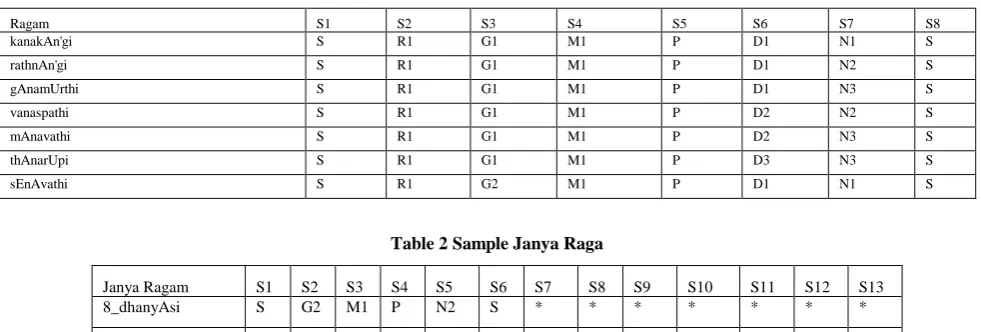
[image:2.595.49.540.562.728.2]The raga is classified based on linearity (all Swaras) and non-linearity (missing swaras) of arohana and avarohana. Samporna raga are called Melakartha raga with all 7 notes with variation in rishabha, gandhar, madhyam, pancham, daivatham and nishagam. It totally constitutes 72 raga. Some sample raga is given in Table 1. The second classification includes Janya raga which have been derived from the Melakartha raga. Sample Melakartha raga and Janya raga is given in Table 1 and Table 2.
Table 1 Sample Melakartha Raga
Ragam S1 S2 S3 S4 S5 S6 S7 S8
kanakAn'gi S R1 G1 M1 P D1 N1 S
rathnAn'gi S R1 G1 M1 P D1 N2 S
gAnamUrthi S R1 G1 M1 P D1 N3 S
vanaspathi S R1 G1 M1 P D2 N2 S
mAnavathi S R1 G1 M1 P D2 N3 S
thAnarUpi S R1 G1 M1 P D3 N3 S
sEnAvathi S R1 G2 M1 P D1 N1 S
Table 2 Sample Janya Raga
Janya Ragam S1 S2 S3 S4 S5 S6 S7 S8 S9 S10 S11 S12 S13
8_dhanyAsi S G2 M1 P N2 S * * * * * * *
15_bowLi S R1 G3 P D1 S * * * * * * *
15_gowLipanthu S R1 M1 P N3 S * * * * * * *
15_gowri S R1 M1 P N3 S * * * * * * *
15_gundhakriya S R1 M1 P N3 S * * * * * * *
15_jaganmOhini S G3 M1 P N3 S * * * * * * *
15_malaHari S R1 M1 P D1 S * * * * * * *
4.
RAGA CLASSIFICATION
FRAMEWORK
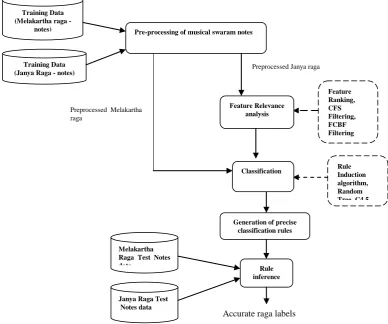
The data mining framework comprises of a feature relevance analysis phase, classification and test phase. The system design is presented in Figure 1.
The individual data sets were first preprocessed and Feature relevance algorithm was applied for the pre-processed Janya raga.
[image:3.595.119.508.276.600.2]The Melakartha raga and Janya raga were later classified using classification algorithms. The results were verified with a test data for each class of raga.
Figure 1. Proposed Data Mining Framework for Melakartha Raga and Janya Raga Classification
4.1
Training Data
The training data utilized in this analysis includes a set of 72 Melakartha raga avarohanam notes and a set of 212 Janya raga avarohanam notes. The swaram notes are unique to each raga. Melakartha raga has 8 predictor attributes named S1 to S8 while Janya raga has 13 predictor attributes referred as S1 to S13.
4.2
Data Pre-processing
Data preprocessing is the task of formatting the raw training data to a form, suitable for execution of the data mining techniques. The raga was partitioned into two data sets. The first subset comprised of Melakartha raga and the other constituted the Janya raga derived from the Melakartha raga. Missing values noted in the Janya raga dataset were appropriately replaced with suitable values.
Rule Induction algorithm, Random Tree, C4.5 Classification
Generation of precise classification rules
Melakartha Raga Test Notes
data Rule
inference
Accurate raga labels Janya Raga Test
Notes data Training Data
(Melakartha raga -
notes) Pre-processing of musical swaram notes
Feature Relevance analysis
Feature Ranking, CFS Filtering, FCBF Filtering Training Data
(Janya Raga - notes) Preprocessed Janya raga
4.3
Analysis of Raga
The Melakartha and Janya raga training records were explored individually. Each of the phases involved in the analysis is detailed below.
4.3.1
Melakartha Raga
The pre-processed Melakartha raga comprised of 72 instances defined by 8 predictors and one target class. This training data was fed to the classification phase to analyze and investigate the suitable classification algorithm that recognized the precise class of each raga. The three classification algorithms explored were C4.5 Decision tree algorithm, Random Tree algorithm and Rule Induction algorithm. All the three classification techniques produced 100 % classification accuracy on all the training records. However the Rule Induction classification algorithm showed promising results in both the training datasets. The pseudo-code of this algorithm [20] [21] is narrated in the following sub-section.
1) Rule Induction Classification Algorithm
Classification [4] [20] is a prominent phase in data mining that attempts to accurately place a given data under a certain category by evaluating the stored rules in the classifier knowledge base. Rule induction is an area of machine learning in which formal rules are extracted from a set of observations. For each class C
Initialize to the set of all examples in E While E contains examples in class C
Create a rule R with an empty left-hand side predicate class C
Until R is 100% accurate (or no remaining predicators) do For each attribute A not in R and each value V
Consider adding the condition (attribute-value) pair A V on the left hand side of R
Select a and V to maximize the accuracy and covering of the attribute
Add A V to R
Remove the examples covered by R from E
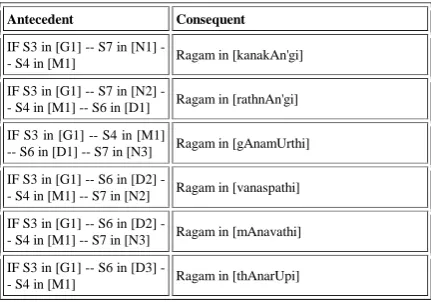
[image:4.595.63.279.616.767.2]The rules extracted may represent a full scientific model of the data, or merely local patterns in the data. Decision tree algorithms are based on a divide-and-conquer approach to the classification problem. They work in a top-down manner, seeking at each stage an attribute to split on, that separates the best classes, and then recursively processes the resulting partitions.Sample rules generated by the Rule Induction Algorithm on the Melakartha raga dataset is given below in Table 3.
Table 3 Sample classification rules for Melakartha Raga
Antecedent Consequent
IF S3 in [G1] S7 in [N1]
-- S4 in [M1] Ragam in [kanakAn'gi] IF S3 in [G1] S7 in [N2]
-- S4 in [M1] ---- S6 in [D1] Ragam in [rathnAn'gi] IF S3 in [G1] -- S4 in [M1]
-- S6 in [D1] -- S7 in [N3] Ragam in [gAnamUrthi] IF S3 in [G1] S6 in [D2]
-- S4 in [M1] ---- S7 in [N2] Ragam in [vanaspathi] IF S3 in [G1] S6 in [D2]
-- S4 in [M1] ---- S7 in [N3] Ragam in [mAnavathi] IF S3 in [G1] S6 in [D3]
-The classification accuracy is verified by presenting a new Melakartha raga test data whose class is unknown, to the Rule base and comparing the obtained class value with the expected class value. The correct class label was obtained.
4.3.1
Janya Raga
The pre-processed Janya raga contained 212 instances predicted by 13 attributes with a single target class. The classification accuracy of the aforementioned techniques did not show promising results when all the predictor features were considered. Hence the feature selection techniques were employed to identify the most contributing features to classification. Feature Relevance [3] is a process that aims at filtering a subset of attributes from the initial training dataset based on the relevance, significance and contribution of the attribute in providing accurate classification results .Three feature selection algorithms were employed viz, Feature Ranking, Correlation based Feature Selection (CFS) and Fast Correlation based Filter (FCBF). Their performance was assessed based on the classification accuracy after feature selection. Investigation in this manner revealed that the predictor attributes selected by the Feature Ranking algorithm improved the classification accuracy of Rule Induction algorithm on the Janya raga data.
1) Feature Ranking Algorithm
The Feature Ranking algorithm is also known as Univariate supervised feature ranking algorithm using CHI-2 criterion [19]. This algorithm ranks the input attributes according to their relevance. A cutting rule enables selection of a subset of these attributes. This algorithm however does not take into account the redundancy of the attributes. The significance p-value threshold was set to 0.001. The number of raga predictor attributes selected was 8. The reduced feature sub set result was used as the set of predictor attributes for the Classification phase to evaluate the classification accuracy after feature selection.
The pseudo-code of the feature selection algorithm that filtered the best set of features for the Janya raga is given below. Input: Set of all features-F
Output: Reduced Feature subset –FF Algorithm:
Step 1: Compute X2 (Chi-Square) statistic for each class-feature combination.
Step 2: Determine features that maximize X2 Step 3: Sort the feature in the order of decreasing X2.
Step 4: Add the features one-by-one to the reduced feature subset (FF) till the cardinal number is attained.
[image:4.595.318.563.676.762.2]The sample rules obtained on classification with the Rule Induction algorithm on the Janya raga data is given below in Table 4.
Table 4 Sample classification rules for Janya Raga
Antecedent Consequent
IF S5 in [D1] -- S4 in [M1] Ragam in [14_vasanthabhairavi] IF S6 in [D1] -- S7 in [S] Ragam in [15_ardhradhesi] IF S6 in [D1] -- S2 in [R1] -- S8 in [S] Ragam in [15_gujjari] IF S7 in [D1] -- S4 in [P] Ragam in [15_GummakAmbhoji]
These classification rules were used to determine the class of a new Janya raga record whose class label was previously unknown. Accuracy is validated by verifying the obtained classification result with the expected class value.
The experimental results for both the Melakartha raga and Janya raga are given in Section 5.
5.
EXPERIMENTAL RESULTS
The performance of the classification algorithms was evaluated based on the accuracy obtained on both the Melakartha raga and the Janya raga. Accuracy [22] [23] is defined as the number of samples correctly classified relative to the total number of samples in the data set. However in the case of the Janya raga, the results of the feature selection algorithm play a pivotal role in enhancing the classification accuracy.
5.1 Melakartha Raga
The C4.5, Random Tree and Rule Induction algorithms produced 100% classification accuracy with all the predictor attributes on the Melakartha raga data. The impact of the feature selection algorithms on the classification of the Melakartha raga data was minimal. Hence they were not utilized in further investigations. The accuracy is validated by presenting a Melakartha raga record whose class value is unknown and verifying the predicted class obtained on utilizing classification rules from the Rule Induction Algorithm.
5.2 Janya Raga
[image:5.595.309.548.68.436.2]The Janya raga was analyzed based on accuracy after applying feature selection algorithms viz, Feature ranking, CFS and FCFB. Table 5 clearly depicts the improvement in classification accuracy after feature selection.
Table 5 Comparison of classification accuracy on Janya Raga
Algorithms Classification Accuracy (%)
Rule Induction Random Tree C4.5
Without Feature Selection 42 41 41
Feature Ranking 90 43 20
CFS 20 41 20
FCBF 20 41 20
The training set with all swarathanas are given as input parameters. Raga name was considered as target output for classification. The feature relevance algorithm is applied to remove redundancy of swarams in Janya raga.
In the case of the Feature relevance algorithm the Misclassification significance level was set to 100% and minimum support was set to 1. The Minimum split was set to 1 and Minimum support was 100% for the classification algorithm. By following these parameters Rule induction algorithm produced a maximum of 120 accurate classifications. Iteratively the rules were framed for the remaining subsets. Finally the maximum result with minimum misclassification rate was given by Feature Ranking Algorithm and Rule Induction Classification Algorithm for Janya raga. The
after feature selection is depicted in Figure 2 and Figure 3 respectively.
Fig.2 Classification accuracy on Janya raga before feature selection
Figure 3 Comparison of classification accuracy on Janya raga with filtered predictor features
[image:5.595.309.550.487.634.2]The cumulative results of our research findings is presented as a graph in Figure 4. The classification accuracy of the Rule Induction algorithm on the Janya raga is increased by 50% after selection of predictor features through Feature selection algorithm.
Figure 4. Comparison of classification accuracy on Melakartha raga and Janya raga
The results of this research suggest that the Rule induction algorithm shows higher classification accuracy in recognizing the class of a musical raga note. Moreover the use of feature relevance analysis in raga classification is also brought out in the case of the Janya raga notes.
6.
CONCLUSION AND FUTURE WORK
[image:5.595.55.287.533.590.2]exploring the possibility to utilize computational techniques to aid in musical raga prediction is certainly a promising sphere of research. Moreover raga classification enables even common man with little knowledge of music to identify the complex structure of raga. The system proposed in this research work makes the above mentioned task easier as it identifies the raga to which each concert belongs using arohana and avarohana pattern. This work is found to be successful for both the source of raga namely Melakartha raga and Janya raga. Possible extensions to this work involve application of Genetic Algorithm methods in classification of raga to improvise the result.
7.
REFERENCES
[1] Data Mining Concepts, http://www.thearling.com/ text/dmwhite/dmwhite.htm
[2] Principles in Data mining, http://en.wikipedia.org/wiki/ [3] Data mining Technologies, http://www.anderson.ucla.edu
/faculty/jason.frand/teacher/technologies/
[4] Ries, R. E. (1969). The Cultural Setting of South Indian Music. Asian Music (University of Texas Press) 1 (2): 22– 31. doi: 10.2307/833909
[5] Gaurav Pandey, et al., Tansen: A system for automatic Raga identification, IICAI, 2003
[6] Priya K and Dr. Geetha Ramani R, 2012, GA method of evolving Carnatic Music Concert Swaras in the proceeding of ICCA 2012, ACM.
[7] Xi Shao, C. Xu, and M.S. Kankanhalli, Unsupervised classification of music genre using hidden markov model, in Proc. of the IEEE International Conf. of Multimedia Expo, 2004.
[8] Roberto Basili, Alfredo Serafini, Armando Stellato, Classification of Musical Genre: A Machine Learning Approach, @c 2004 Universitat Pompeu Fabra.
[9] Noris Mohd Norowi, Shyamala Doraisamy, Rahmita Wirza, Factors affecting Genre Classification: An investigation incorporating non-western musical forms, 2005 Queen Mary, University of London, pp. 13-20
[10] B. Tarakeswara Rao1, Sivakoteswararao Chinnam2, P Lakshmi Kanth3, M.Gargi4, Automatic Melakartha Raaga Identification System: Carnatic Music, (IJACSA) International Journal of Advanced Computer Science and Applications, Vol. 1, No. 4, 2011, pp.43-48
[11] Rajeswari Sridhar1, and T.V. Geetha, Raga Identification of Carnatic music for Music information retrieval,
International journal on recent trends in Engineering, vol. 1,2009
[12] Rajeswari Sridhar and T.V. Geetha, Comparison of signal separation algorithms as applied to Carnatic music, FRSM
2007
[13] Rajeswari Sridhar and T.V. Geetha, Swara identification of Carnatic music, IEEE Computer Society press, proceeding of ICIT 2006.
[14] Gopala Krishna Koduri, Sankalp Gulati, Preeti Rao, A
Survey of Raaga Recognition Techniques and
Improvements to the State-of-the-Art, Proceedings of Sound and Music Computing, 2011.Italy.
[15] Surendra Shetty and K.K. Achary, Raga Mining of Indian Music by Extracting Arohana-Avarohana Pattern,
International Journal of Recent Trends in Engineering
Vol. 1, No. 1, May 2009,pp.362-366
[16] Shreyas Belle and Preethi Rao, 2009, Raga Identification by using Swara Intotation, Journal of ITC sangeet research academy, vol 23, 2009.
[17] Sudha.R and Karthiravel A,2009,A system tool for identifying ragas using MIDI files in proceedings of
ICCEE2009, IEEE Explore, Dubai, 644-647,DOI: 10.1109/ICCEE.2009.49
[18] Krishna A S and Raj Kumar PV, 2011, Identification of carnatic ragas using hidden markov models in proceedings of IEEE Explore, Smolience, 107-110, DOI: 10.1109/SAMI.2011.5738857
[19] Tanagra Tutorials and Software, www.tanagraltd.com [20] Mrs.Shomona Gracia Jacob and Dr. R.Geetha Ramani.
Article: Discovery of Knowledge Patterns in Clinical Data
through Data Mining Algorithms: Multi-class
Categorization of Breast Tissue Data. International Journal of Computer Applications 32(7):46-53, October 2011. Published by Foundation of Computer Science, New York, USA.
[21] I.H. Witten and E. Frank, Data Mining: Practical Machine Learning Tools and Techniques with Java Implementations
[22] S.G.Jacob, R.Geetha Ramani, Evolving Efficient Classification Rules from Cardiotocography data through data mining methods and techniques, European Journal of Scientific Research, Vol.78, Issue 3, pp. 468-470.
[23] S.G.Jacob, R.Geetha Ramani, Mining of Classification Patterns in Clinical Data through Data Mining Algorithms,
ICACCI '12, August 03 - 05 2012, CHENNAI, India. Copyright 2012 ACM 978-1-4503-1196pp.997-1003
AUTHOR’ZS PROFILE
Dr.R. Geetha Ramani is Associate Professor, Department of Information Science and Technology, College of Engineering, Guindy, Anna University, Chennai, India. She has more than 15 years of teaching and research experience. Her areas of specialization include Data mining, Bioinformatics, Social Networks, Evolutionary Algorithms and Network Security. She has over 50 publications in International Conferences and Journals to her credit. She has also published a couple of books in the field of Data Mining and Evolutionary Algorithms. She has completed an External Agency Project in the field of Robotic Soccer and is currently working on projects in the field of Data Mining. She has served as a Member in the Board of Studies of Pondicherry Central University. She is presently a member in the Editorial Board of various reputed International Journals.
Technology, Chennai. Her areas of interest include Evolutionary Computing, Software Engineering and Network Security.
Mrs.Shomona Gracia Jacob completed her M.E. in Computer Science and Engineering at Jerusalem College of Engineering, affiliated to Anna University, Chennai, India. She has more