Munich Personal RePEc Archive
Intangible Flow Theory
Cardao-Pito, Tiago
Department of Accounting and Finance, University of Strathclyde
Business School, ISEG, Technical University of Lisbon
12 September 2004
Online at
https://mpra.ub.uni-muenchen.de/27483/
1
Intangible Flow
Theory
This is a of a preprint of an Article accepted for publication in the
American Journal of Economics and Sociology
Tiago Cardao-Pito*
Department of Accounting and Finance,
University of Strathclyde
([email protected])
and
ISEG, Technical University of Lisbon
([email protected])
2
Intangible Flow Theory
Abstract
The intangible flow theory explains that flows of economic material elements (such as physical goods; or cash) are consummated by human related intangible flows (such as work flows; service flows; information flows; or communicational flows) that cannot be precisely appraised at an actual or approximate value, and have properties precluding them from being classified as assets or capitals. Therefore, although mathematical/quantitative research methodologies are very relevant for science, they are insufficient to study economy and society.
3
1- Introduction
When one observes a highly trained economist having a conversation with a fellow human
being, he might be tempted to ask the economist whether that dialogue is occurring between two
human assets or capitals. The question would not be out of place, as these classifications are
used to refer to people in prestigious economic publications (for instance: World Bank 2003;
Ciccone and Peri 2006; Ditman et al 1973; Barro 2001; Becker 1962). One could suggest that
the difficulty of some economists to see the difference between people and things might be
reflected in the output of research they produce. The embeddedness critique has been put to
neo-classic economists because, although they tend to ignore or undermine the importance of the
social relations, economic action is embedded in structures of social relations, and therefore,
social relations are necessary to understand the economic action (Granovetter 1985; Callon
1998). The intangible flow theory develops the embeddedness critique by addressing the
dynamics of social relations in economy and society.
Let us first define intangible; flow; and intangible flow. The word intangible means not
tangible. According to Merriam-Webster’s dictionary, the term tangible can defined as “capable
of being perceived especially by the sense of touch”, “capable of being precisely identified or
realized by the mind” and “capable of being appraised at an actual or approximate value”.
Because it is one of the characteristics that distinguish goods from services, intangibility has
been often studied in organizational studies. Rathmel (1966) and Shostack (1977) noted that
there are very few products that are pure physical goods or pure services. Most products have
tangible and intangible components. However, the degree of product intangibility could be
4
distinction between approaches to intangibility, identifying two types. i) Physical intangibility: a
product is intangible if it is not palpable or cannot be touched. It is roughly the first definition on
Merriam-Webster that comes from the Latin origin of the word. Nonetheless, Flipo (1988: 287)
makes us note that “immateriality must not be confused with imperceptibility. Music is the
perfect example of a perceptible yet immaterial reality”. Even if the element has no material
body, it is possibly perceptible by one of the four other human senses. ii) Mental intangibility,
where the product cannot be grasped mentally (roughly a synthesis of the second and third
definitions of Merriam-Webster). We will use the concept of intangibility without necessarily
relating it to the sense of touch, but to the faculty of being identified with precision, that is,
capable of being precisely identified or realized by the mind and capable of being appraised at
an actual or approximate value. 1
Intangibility is not an exclusive characteristic of services. It can be used to describe other
important economic elements such as information. Mathematicians and statisticians (such as
Soofi 1994; or Cover and Thomas 2005) are aware that information is intangible and try to
devise quantitative methods to study it. Soofi (1994: 1243) clearly states: “the notions of
information consist of a spectrum ranging from semantic to technical. In the semantic context,
the term information is used in an intuitive sense. It does not refer to a well-defined numerical
quantity that can be used for measuring the extent of uncertainty differentials due to changes in
the states of nature. In the technical sense, information is referred to as a well-defined function
that quantifies the extent of uncertainty differentials”. Yet, here we attain the paradox of
quantifying intangibility, which applies to information. The elements of previous intangibility
for which scientists can find quantitative methods to attribute well defined quantities, and
therefore, can be precisely appraised at an actual or approximated value have properties of
1
Just as the passenger who reaches the train station just a few seconds too late does not need to touch the train
5
tangibility, whereas the other dimensions remain intangible. Moreover, the use of quantitative
methods is not a sufficient condition to achieve tangibility, as those methods can be used to
produce pure metaphysical speculation and imaginary projections of future scenarios that could
not be reached with precision. Furthermore, scientists support their work on concepts that are
themselves highly intangible. As noted by Hayek (1967) in his theory of complex phenomena,
there is a distinction between pattern recognition and pattern prediction, and for scientists to
recognize complex patterns they must make (intangible) conceptual predictions of those
patterns.2 As described by Soofi, semantics would be a macro set where the dimensions of
information that cannot be described through a well defined mathematical function would be
put. Hence, for the purpose of scientific knowledge, the use of mathematical analysis can only
capture certain dimensions of information. A simple distinction between data, information, and
knowledge might already bring many difficulties (Boisot and Canals 2004). The conceptual
formulation that there is a symbolic interaction between members of society mediated by
symbols and significations, where the meanings attributed evolve with processes of stimulus and
response (Blumer 1962, 1969; Perinbanayagam 1985) would not be reachable merely through
mathematical reasoning. Nevertheless, the failure of mathematical reasoning to capture them
would not imply the non existence of symbols, meanings and significations. In an apparently
simple nearby communication between two human beings, not only are semantic words and
language exchanged but a full range of highly heterogeneous transactions such as body
movements and gestures (see for instance Montepare et al 1999; Kendon 1984), facial
expressions (see Ekman and Friesen 1975), postures (see Heller 1997), eye gaze (see Knapp and
2
As in Popper (1959; 2008), and in this paper, Hayek defends a fact based scientific work, where scientific
6
Hall 1997; Richmond and McCroskey 2000) or paralinguistic sound of the voice (see Scherer
1979; Wigboldus et al. 1999) are communicated even without the need for words.
By flow we understand the movement of an element deriving from a source, which
implies that an element that is not flowing should be considered as static. A human related
intangible flow is therefore the movement of an element, deriving from a person or group of
persons, that cannot be precisely identified or realized by the mind; and cannot be apraised at an
actual or approximate value. This paper focuses on intangible flows that are also human related,
thus of direct interest to the social sciences (such as work flows, service flows, communication
flows, information flows, etc). Yet, the intangible flow concept could be embraced by the natural
sciences because not all intangible flows are human related. For instance, flows of light or atoms
could not be precisely perceived by the human senses, but scientists have figured ways of
studying them.3 As occurs with the human related intangible flows, the non human related
intangible flows can be integrated in dynamic sets comprising both tangible and intangible
flows. As in the example of Heraclitus's river passing by into which one can step only once, the
flow of the river may contain both tangible and intangible components. Most importantly, the
intangible flows referred in this theory have an instrumental property that makes them from the
field of science: they can be verified, even if through an imprecise description. Intangible flows
that cannot be demonstrated are from the domain of metaphysics, and thus not a subject of
discussion in this theory. Two examples of intangible flows that can be demonstrated are service
flows and information flows. As explained in more detail later, products (outputs) such as
3
For instance, modern physics and cosmology have been developed assuming that the speed of light was a constant
value c, but a recent theory, the variable speed of light theory suggests that the velocity of light might be
variable due several factors, which would imply the need to rewrite everything that previously assumed a
7
services have properties that distinguish them from tangible physical goods, such as
intangibility, heterogeneity, perishability, and inseparability between consumption and
production (Zeithaml et al. 1985; Zeithaml et al. 2006; Hoffman and Bateson 2006). Information
also has characteristics that distinguish it from material elements because several of its
dimensions cannot be precisely appraised at an actual or approximate value. Therefore,
intangible flows cannot be considered equivalent to flows of economic material elements such
as physical good or cash. The intangible flow theory will further advance our comprehension of
economic material flows by identifying that human related intangible flows are necessary for the
consummation of economic material flows.
The paper is organized as follows: Section 2 introduces an case study where it is possible
to observe how human related intangible flows can be associated with specific material flows;
Section 3 explains why neo-classic economics that rejects non mathematical/quantitative
scientific approaches could not be technologically prepared to reach and observe intangible flow
dynamics by itself; Section 4 formalizes the intangible flow theory; Section 5 discusses the
challenge of testing the theory while also briefly mentioning supporting empirical evidence of
another paper; and Section 6 concludes the paper.
2- Initial Case Study
The intangible flow theory is a grounded theory, developed through a collection of facts
and formalized for subsequent testability of its predictions, an ultimate goal of the grounded
theory method (Charmaz 2006). Let us observe a case study where facts could be gathered: a
conversation between two human beings (A and B) that would be associated with an apparently
simple economic activity: the selling of a restaurant's lunch for two. A dynamic interaction
between intangible and tangible flows can be identified, which in the theory is called intangible
8
place after reading a positive review in his regional newspaper. Here an intangible element,
moves from the newspaper to A’s cognition, leading him to have an action that he would not
have otherwise. 2) B will be convinced by A to attend that restaurant through an intangible
telephonic conversation, otherwise she would not be aware of that restaurant’s existence. 3)
They arrive in the restaurant, and in comes another human being, C, the maid, smiling and
delivering an intangible service; she will soon indicate the table and bring the menu. 4) When A
and B study the menu, the intangible information moves from the menu to their cognition. The
choice will be discussed and communicated to C. 5) The tangible food and drinks arrive through
the intangible service of C and required also the intangible work produced by staff in the
kitchen, those who produced and sold the items, the manager, etc. 6) The communication
between A and B does not involve only semantic words and language, but also body
movements, gestures, expressions, postures, eye gaze or paralinguistic sounds. Communicators
are, at one and the same time, senders and receivers of messages (Hargie and Dickson 2004: 14).
After the desert and coffee, it is time to ask C for the bill. 7) The intangible information
regarding the bill to pay is printed on a tangible piece of paper. 8) A is always forgetting his
wallet at home. B pays the bill with her bank card. The cash flow will be reported in both bank
accounts.
In the case above, note that although the transaction was implemented through a bank card
in (8), thus containing intangible elements, the respective cash flow has tangible characteristics,
as B, the restaurant and the banks can precisely quantify the cash flow. Therefore, the cash flow
can be considered a material flow. Note also that the intangible flow dynamics in (1)-(7) that
lead to the occurrence of the material cash flow in (8). The non occurrence of some intangible
flows would necessarily result in the non occurrence of the material cash flow: (1) the
9
the restaurant was closed. A similar reasoning is applicable to the material flow of food and
drinks in (5).
3-Why neo-classic economics could not be technologically prepared to reach and
observe the intangible flows by itself
A development towards exclusively legitimizing the reasoning obtained through
mathematical/quantitative deduction in highly-ranked economic journals and departments has
been noted (Sutter 2009; Hopwood 2008; Beed and Kane 1991; Leontieff 1982). Addressing the
predominance of economic reasoning in the disciplines of finance and accounting, which could
be enriched by other types/forms of knowledge, Hopwood (2008) complained that unfortunately,
we live in an era where curiosity is not enough reason to research. This represents the
prevalence of what Caliskan and Callon (2009) call the neo-classic (formalist) economists. This
group of researchers defines economy by its object: the study of utility maximization under
conditions of scarcity. A single concept of instrumental rationality is used to explain the
behavior of persons and organizations in every context. The utility function leads to the idea of
the homo economicus decision maker (see for instance Thaler 2000), an ultra-rational being,
whose behavior would be described perfectly by a mathematical function capable of quantifying
rational expectations about the (unknown) future without any form of bias.
Caliskan and Callon (2009, 2010) argue for the existence of an “economization” process
where the attribute (adjective) economics is the result of the “assembly and qualification of
actions, devices and analytical/practical descriptions as ‘economic’ by social scientists and
market actors.” In such a context, neo-classic economics, substantive economics, and economic
sociology and anthropology would have distinct “processes of economization.”4 However, the
4
When mentioning substantive economics Caliskan and Callon (2009, 2010) refer to the substantivist position
10
parallel validation of different approaches to explain the economy could lead to quite a
problematic interpretation, as it might obstruct the advancement of our knowledge of concrete
empirical phenomena. Contrary to Kuhn (1996), who would see distinct research paradigms
competing for the dominant status, by providing more robust explanations to economic
questions than neo-classic economic researchers, Caliskan and Callon (2009, 2010) would see
political spheres in which hypotheses are equivalently valid as long as they are portrayed in the
adequate research venue. In this relative sense, the “economization” concept could be compared
with that of “hypothesization” to explain empirical phenomena; that is, hypotheses are valid
according to the research environment in which they are depicted, not their actual verification.
Suppose three hypotheses: a) the Earth is flat and rests in the top of a cube, b) the Earth has a
spherical shape, and c) the Earth has the form of a turtle. Depending upon the ”geographization
” process accepted by the peers of the research sub-field, all hypotheses would be valid. Still, an
empirical investigation could eliminate two of them. Similarly, to understand the economy, there
are clearly specified empirical questions that can be addressed with testable/ refutable
hypotheses by scientists outside the realm of neo-classic economics, such as the causes for
growth, inflation, profits, financial decisions, economic crises, interest rates, etc. This is quite
relevant because as Keynes (1936: 383) put it, “the ideas of economists and political
philosophers, both when they are right and they are wrong, are more powerful than is commonly
understood. Indeed the world is ruled by little else. Practical men, who believe themselves to be
quite exempt from any intellectual influences, are usually the slaves of some defunct economist”.
The questions should not be confused with the answers. The same specific research questions
political economy. Nonetheless, the reasoning in Caliskan and Callon would be applicable to other heterodox
economic frameworks that do not completely accept the neo-classic propositions such as Post-Keynesianism,
Feminist Economics, Evolutionary Economics, Marxist Economics, Institutional Economics, Post Autist
11
can be studied by distinct groups of researchers. To accept the economy of thought of validating
different “economization processes” that provide contradictory hypotheses, as long as they are
launched in the proper peer group regardless of the verification of the hypotheses, would avoid
the difficult but necessary challenge of identifying which approach could better explain the
empirical phenomena that we observe in society.
A second point is related with the research methods available in each discipline to explain
the same empirical phenomena. If neo-classic economics can only use mathematical/quantitative
tools of reasoning to posit its hypotheses, then it cannot be technologically prepared to reach
intangible elements that cannot be precisely identified or realized by the mind; and cannot be
appraised at an actual or approximate value. This severe limitation of neo-classic economics is
not necessarily a form of “economization,” but a deficiency of the research methods accepted in
its research paradigm. Flows of tangible (material) elements such as physical goods or money,
can be precisely quantified and thus observed by the research tools of neo-classic economics.
However, as suggested by the intangible flow theory, the dynamics of the tangible elements
require several human related flows that do not share the same properties of the easily
quantifiable material elements that they are moving in economic action. Hence, social science
disciplines such as heterodox economics, sociology and anthropology, but also organization
studies, accounting, or history have an advantage in explaining concrete economic phenomena
over neo-classic economics, because besides accepting advanced statistical and econometric
methods of inquiry, they are open to other forms of reasoning to reach testable hypotheses that
could capture the intangible flow dynamics in society. Natural sciences can also be of great help
in contributing with methodologies to enhance the study of intangible flow dynamics, but cannot
be considered the exclusive source of scientific methodologies. Otherwise, neo-classic
economics does not accept hypotheses that are not founded on concrete mathematical reasoning,
12
fact finding” that is common in other scientific fields. Hopwood (2008: 91), identifies worrying
signs that he classifies as crude intellectual prejudice: while (neo-classic) economics as a
subject has tended to invest heavily in the intellectual policing of its own boundaries, over the
years ridding itself of its institutional, historical, political economy and other variants, this need
not necessarily imply an intolerance of completely different disciplines. But that has often been
the case”.
Nonetheless, the exclusive reliance on mathematical/quantitative research methods has
deep consequences. It makes neo-classic economics technologically improperly equipped to
study economy and society. The major problem is not the mathematical/quantitative methods,
as those are relevant instruments at the disposal of scientists. It is an idealization of these
methods leading to a theological belief that the mathematical/ quantitative tools should primarily
eliminate any other form of scientific inquiry. Mathematical/quantitative deduction, as it
requires quantification, could not be technologically prepared to observe that, as in the case
study above, the flow of many elements that cannot be quantified with precision, and have
properties precluding them to be considered either assets or capitals, are necessary for the
occurrence of the material flows. With deep respect for mathematics and aiming to expose its
abusive utilization, we call the neo-classic belief as the metaphysics of mathematics. That is,
neo-classic economics does not possess research tools necessary to understand concepts
formulated without mathematical/ quantitative reasoning or even to understand the pernicious
concepts it is obtaining with its theological belief. Hence, the intangible flow theory, formalized
in the next section, can be employed as a response to the metaphysics of mathematics in social
13
4- Enter the Intangible Flow Theory
Developed in this section, the initial formulation of the theory appeared in an approved
thesis (Cardao-Pito 2004). The first step to reach the conceptual framework is through the
tangibility of concrete material elements. Physical goods, such as cars or clothes are tangible
elements quantifiable with precision. The same applies to long-term fixed investments such as
property, equipment, and plant. However, what about money, which can take several forms, such
as notes and coins, cheques, credit cards, or online accounts? The intangible flow theory will
define that cash flows, i.e., flows of money and its equivalents (Merriam Webster), are tangible
because they can be precisely quantified at an exact value. The material practice of money is one
of its defining properties, even if related to distinct symbolic referents and social systems
(Gilbert 2005). That is, although money can have several social roles and meanings, under
discussion by social scientists, it also has a pragmatic nature in modalities of exchange and
circulation (Maurer 2006). 5 Whichever form a cash flow may assume, human beings are able to
know the exact amount of money that has been moved. In the same manner, through the cash
flow statement, a corporation presents a precise report of its complete cash movements during
each fiscal period.
Therefore, through their research tools that require mathematical/quantitative modeling,
the neo-classic economists can observe the cash flows, and they can also quantify several
empirical variables that are materialized in monetary values, such as inflation, profits, growth,
capital structures, interest rates, financial deficits, etc. When neoclassic economists call people
5
As put by Maurer (2006: 30),: “representational flaw does not mean representational failure, either for money or
for anthropological (and other social science) accounts of it” or, as put by Callon and Muniesa (2005: 1245):
“Economic calculation is not an anthropological fiction, precisely because it is not a purely human mechanical
14
and their contributions human capital or human assets they are presupposing that people and
their contributions can be owned, manipulated, and accumulated as physical goods or cash. The
denomination of humans as assets or capital could be compared with a performative function,
described in Mackenzie (2007), as instead of representing an external reality, such comparison
directly intervenes in the reality it claims to represent. People would be assets or capital because
neo-classic economists call them this, not because there is any empirical evidence that we
behave like property, equipment, merchandizing, loans or stock market shares in society.
Besides the serious ethical issues in placing people at the same level as material things, the
neo-classic economic framework is profoundly flawed, as it fails to understand the complexity of
people and their intangible activities. Let us further study two types of intangible elements that
have different properties to tangible (material) elements, namely, services and information.
Organizational literature revealed that products can be classified according to their level of
intangibility. The scale suggested by Schostack (1977) ranges from most tangible (such as
clothes and furniture) to most intangible (pure services such as consulting or teaching). In the
middle of the scale are the products combining tangible and intangible components. For
example, meals in restaurant chains mix tangible food and drinks with intangible services and
marketing. Several academic textbooks on the marketing of services (as Zeithaml et al. 2006;
Hoffman and Bateson 2006; McColl-Kennedy 2003) adapt a definition of services that could be
traced back to Rathmel (1966: 33). Services are “acts, deeds, performances, or efforts,” and
physical goods are “articles, devices, materials, objects, or things.” As noted by Rathmel
(1966), there are very few products that are purely services or purely physical goods. The most
tangible of goods requires services to be sold/delivered to customers, and the most intangible of
15
In their survey of a significant set of research in organization studies, Zeithaml et al.
(1985) identified four characteristics that distinguish services from physical goods: intangibility,
heterogeneity, inseparability of production and consumption, and perishability. The property of
perishability suggests that services cannot be saved, stored, resold, or returned as physical
goods. Lovelock and Gummeson (2004), who tried to replace the framework in Zeithmal et al
(1985), recognize that the system of Zeithaml et al. is the most widely acknowledged and amply
taught in academic textbooks. Lovelock and Gummeson suggested another characteristic that
would distinguish services from the physical goods: the non-ownership of the services: although
the customer has the right to consume the service through a rental or access fee, he cannot own
the service as he would be able to own a physical good. Nonetheless, the non-ownership of
services seems to derive from the same properties identified by Zeithaml et al. (1985), and,
particularly, the intangibility from where the other key goods-services distinctions may emerge
(Bateson 1979; Zeithaml et al. 1985). Intangible, heterogeneous, and perishable products such as
services, normally consumed when produced, are not reported on the balance sheet as assets (or
capital), unlike physical goods or other assets (or capital) such as cash.
Stiglitz (2000), an author on the theme, claims that neo-classic economic studies about
information have made a rupture with the past. Currently, it would be amply accepted that
information is imperfect, that there are costs to obtain information, and information
asymmetries, which are affected by individuals and organizational actions. Accordingly, the
traditional knowledge from the neo-classical characterization of the market economy would be
deeply affected by such findings. Following a neo-classic framework, some studies describe
information or knowledge as public goods (as World Bank 2003; Stiglitz 1999 2007),
comprising two main distinctive properties (Stiglitz 1999: 309): i) Nonrivalrousness: there is
zero marginal cost from an additional individual enjoying the benefits of the knowledge (or
16
respective use, that is, if information and knowledge are not defended with copyright, licenses,
or confidentiality, then they cannot be easily protected, unlike, for example, a machine brought
and registered in the name of a corporation. Still, the neo-classic understanding about
information might yet be very poor. Because it ignores the intangibility of information,
neo-classic economics could not notice that intangibility distinguishes information from physical
goods. Furthermore, information may not verify the same conditions of scarcity observed in
other resources. The oil or gold reserves of our planet are limited, whereas a good idea can be
downloaded on the internet as many times as possible. In order to apply its pareto optimality via
utility functions, neo-classic economics needs to assume that scarcity is the natural condition of
any resource. Thus, it misses the socio-cultural element of the analysis because scarcity could be
inherent to the human use of that resource (Daoud 2010). Moreover, resources do not always
need to be scarce. They can also be sufficient or abundant, as it occurs with information, and
poses series difficulties to the neo-classic analytical framework based on assuming the scarcity
of all resources (see Daoud 2010 or Lee and Keen 2004).
As described by Voler et al. (2009) neo-classic economics sees information as signals,
which separates information from cognition and makes a distinction between meaningful signals
and noise, with the latter being understood as a lack of determined patterns. The movement of
information would be similar to that of signals circulating on a circuit board. Yet, the logic of
neo-classic economics, that information, knowledge, and relations would be assets implies that
those so-called assets are inside the brains of human beings. Hence, they can not be separated
from the respective human cognition and affectivity. What is worse, for millenniums in
philosophy, an unsolved debate of what is in fact knowledge (and information) has subsisted.
However, taking a shortcut, neo-classic economics already makes monetary valuations of
knowledge and information without knowing what and where they are. One could suggest that
17
static. It is dynamic, as it is the work with relationships and of what are called social assets. A
relationship must be dynamized to exist.
The utility functions can be used to solve problems where resources are really scarce and
precisely quantifiable. For instance, a firm can use an utility function to decide what proportion
of physical goods x and y should buy given its limited budget. However, as described by a
neo-Schumpeterian theory of the firm (see Winter 2006; Levintahl 2006), just as the fragmentation
of knowledge in the firm makes innovation difficult and the consequences of attempted
innovation unpredictable, it tends to frustrate the economist who wants to predict the lines that
knowledge innovation will take. Innovation management researchers recognize that the
uncertainty with regard to the value-creating potential of product innovations increases with
their technological novelty, and have argued that the usefulness and value of novel products are
socially constructed (Rindova and Petkova 2007). Innovation is both a process and an outcome
(Crossan and Apaydin 2010). As noted by Winter (2006: 138) General Motors has a certain
knowledge about producing automobiles that may or may not be applicable for the problem of
producing corn flakes. Nevertheless, neo-classic economics acts as if it could quantify every
dimension of information and knowledge, in order to develop its mathematical reasoning.
Through utility functions, neo-classic economics previously assumes homogenization of human
reactions and decisions related with information. A simple mathematical “utility” function and
its two derivatives would describe the decision process of the entire mankind. Hence, it fails to
address a simple aspect as two persons can differently interpret the exact same information. The
neo-classic practice of treating information as mere parameters in the utility functions is in
direct contradiction with the facts that i) mathematical/quantitative reasoning is not
technological able to reach the semantic dimensions of information and ii) human use of
information and knowledge is not separable from the respective human cognition and affectivity.
18
economics is an unscientific belief that can be refuted through cognitive distortions of human
perception that influence human beings rather heterogeneously, and can vary even with the same
person, according to the information received or communicated. In those distortions, one could
include the halo effect that refers to drawing a general impression about an individual on the
basis of a single characteristics, as the appearance or status (see more in Naquin and Tynan
2003); the contrast effect, where the appraisal of information would be considered differently if
not compared to other information (see Plous 1993); the Freudian projection effect, which refers
to attributing characteristics or emotions of the self to other people or information (see Wade
2000) or the stereotyping effect (see Hilton and Hippel 1996). It is not a matter of finding
psychological or sociological based parameters to include in the computation of utility functions
and Pareto equilibriums, as done in what is often called behavioral economics, and represents a
mere development of the neo-classical framework, as clearly stated in the literature reviews as
Camerer and Loewenstein (2004) or Rabin (1998). Such approach would fail to capture basic
intangible instances of human cognition, social relations, symbols, meanings and significations.
To advance our scientific knowledge of economy and society we must break free from the
metaphysics of mathematics that neo-classic economics would want to impose upon social
sciences.
The Intangible Flow Theory will proceed as follows: First, one defines cash flows as
tangible flows because they represent concrete monetary transactions that are clearly identifiable
and quantifiable. Second, one posits that the information (and knowledge), physical goods, and
capital should be considered static in the generation of cash flows if they are not dynamized by
intangible flows that are mainly human-related and cannot be precisely appraised at an actual or
approximate value. Although human beings are not intangible, some of their contributions can
be intangible (such as work flows, service flows, information flows, knowledge flows,
19
Hence, we can now reach the fundamental proposition: In Society, the occurrence of
economic material flows, as the flows of physical goods or cash, is associated with intangible
flows inherent to human actions that are necessary to the prosecution of those material flows.
The cash flows cannot be considered intangible flows because even when they have an
intangible form, they have properties of tangibility, as they are precisely quantifiable at an
actual or approximate value. Thus, the analyses and decisions related to economic material
flows must consider the more relevant intangible flows that are necessary for the material flow
consummation.
According to the theory, the intangible flows with effects on the cash flows can be of
various types, such as service flows, relationship flows, communication flows, information
flows, knowledge flows, data flows, etc. Although they could not be precisely quantified, they
are necessary for the occurrence of economic material cash flows. The intangible flows require
an abstract formulation specifically because of their inherent intangibility. Therefore, an
abstraction is a necessary description for their study and understanding. Nevertheless, this
theoretical formulation can be corroborated by empirical tests that prove the association of
intangible flows with concrete cash flows.
In the developing of and with reference to this theory, these subsequent corollaries should
be considered: First corollary: associated with the occurrence of the economic material flows,
there can be a very vast and complex conjunct of intangible flows, in which, inclusively, some of
those intangible flows can be very difficult to identify. This first development appears to explain
that this is not a motive for the concept of intangible flows not to be recognized or scientifically
systematized, nor is it a motive for the concept of intangible flows not to be considered. What is
complex and what is simple depends on our knowledge and understanding, and changes over
20
However, intangible will remain the existing dimensions that scientists would not be capable to
precisely identify, realize or appraise at an actual or approximate value.
Second corollary: It is not necessary for a temporal coincidence to exist between
intangible flows and economic material flows for intangible flows to impact material flows (for
example: the training of the personnel may take some time to have effects on the productivity of
the organization, or the marketing campaigns might take some time to have intangible
consequences that will be reflected in the organization's money in-flows). Inclusive cash flows,
as they are part of a dynamic process, might have effects on intangible flows and the latter again
will have influence on other cash flows of the organization (for instance: the expenses with
publicity or branded merchandizing collocated near the potential clients, etc.).
Third corollary: The non-occurrence of economic material flows can also be a
consequence of intangible flows that have a negative effect on their consummation (such as
advertising campaign from a competitor, poor quality services, cost reduction policy, etc.).
Similarly, intangible flows exist that might worsen the cash flows of an interested person or
group (for example: staff absenteeism, political effects, etc.).
Fourth corollary: the materiality of cash flows refers to cash flows that occur within a
precise interval of time. Not yet verified cash flows cannot be considered already materialized.
This corollary establishes a difference between those cash flows that can be precisely quantified,
for they have factually taken place, from those that despite an appearance of measurability might
not be precisely quantifiable because their occurrence is uncertain. For instance, when
neo-classic economics requires projections of future cash flows to operate their concepts of
“discounted future cash flows value” or “utility maximization under pareto optimality”, the non
verified cash flows cannot be considered already materialized and thus their quantification
21
have done a mathematical synthesis of Keynes’s thinking, but Keynes himself (1936: 149) was
aware that our knowledge of factors that will govern the yield of an investment some years
hence is usually vey slight and often negligible.6 The neo-classic futurology can bring much
harm to society and social science because it may assure an appearance of certainty to rather
unknown economic outcomes.
Fifth corollary: Although mathematical/quantitative research tools can be used to
precisely measure economic material flows, they are insufficient to research and capture
intangible flows and their relationships with the material flows. This corollary explains why 1)
although mathematical/quantitative methods are very relevant for science, they are insufficient
for studying and understanding the intangible flow dynamics of concrete empirical phenomena
observed in economy and society; 2) because it professes a metaphysics of mathematics that
refuses to accept non mathematical/quantitative forms of scientific, inquiry neo-classic
economists simply cannot reach complex human-related intangible flows that are necessary for
the consummation of precisely quantifiable economic material flows.
5- The challenge of testing the theory
As currently formalized, the grounded intangible flow theory is stated for subsequent
testability. Therefore, the challenge is to identify intangible flows and establish concrete
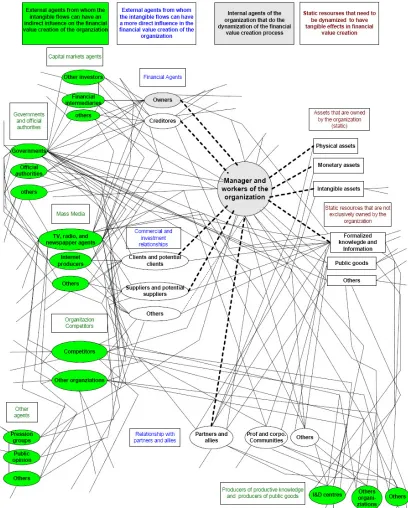
associations with economic material flows, as done on the case study above. Figure 1
exemplifies the complexity of several intangible flows with influence in the cash flows of an
6
Keynes (1936: 149): “If we speak frankly, we have to admit that our basis of knowledge for estimating the yield
ten years hence of a railway, a copper mine, a textile factory, the goodwill of a patente medicine, an Atlantic
liner, a building in the City of London amounts to little and sometimes to nothing; or even five years hence. In
fact, those who seriously attempt to make any such estimate are often so much in the minority that their
22
organization. It represents a simplified visual model with a dynamic network of intangible flows
that could be used later for testing the intangible flow effects on a organization's cash flows. The
figure's purpose is to express evidence of the intangible flows, not to represent the complete set
of relevant intangible flows.
(Figure 1 here)
Mentioned briefly here, Cardao-Pito (2010) presents empirical evidence supporting the
Intangible Flow Theory. Cardao-Pito (2010) devised a method, called “Level of Operating
Intangibility” to classify firms according to the materiality of the flows of products (outputs)
sold to customers. Physical good-intensive (as Ford and Shell) and intangible product-intensive
firms (as Microsoft and Lastminute.com) appear on both ends of the scaling system. Firms that
offer a mix of physical goods and intangible products, or firms offering products that are
themselves mixed, lie somewhere in the middle (as Coca-Cola and Pepsi Cola that sell much
intangible marketing and advertising in each bottle of their drinks). The classification was
implemented on a very large sample involving 107,070 observations of 10,281 US firms over a
period of 41 years (1966-2006) and confirmed by many econometrical tests. Cardao-Pito (2010)
shows that the materiality of product flows is strongly correlated with several firm
characteristics, which are dear to economics. Concretely, a higher Level of Operating
Intangibility was associated with five expected properties of intangible-product-intensive firms:
i) smaller size, ii) lower capital expenditures in property, equipment and plant, iii) lower
profitability, iv) higher stock market valuation of equity (market-to-book), and v) less debt in the
capital structure (leverage). As the transactions of products are eminently social processes,
Cardao-Pito’s paper provides a strong argument for using scientific approaches outside the
23
6- Conclusion
The idea that the Earth has spherical shape is not compatible with the idea that the Earth is
flat and rests on top of a cube, regardless of what Caliskan and Callon (2009) call actions,
devices, and analytical/practical descriptions that could be used to argue any of those
possibilities. Several concrete empirical phenomena of society, traditionally studied by
neo-classic economists, can be addressed by alternative explanations, such as the causes for growth,
profits, inflation, financial decisions, financial crisis, etc. Scientists outside the realm of
neo-classic economics should accept the challenge of attempting what Kuhn (1996) defines as
paradigm changes in explaining those phenomena, even if this means entering into direct
confrontation with the neo-classic explanations derived from its metaphysics of mathematics.
As in Socrates’s ancient lesson, the obstacle is not an ignorance aware of its fragility, but the self
sufficiency of an apparent knowledge.
Developing the embeddedness critique (Granovetter 1985; Callon 1998) the intangible
flow theory, and particularly its fifth corollary, demonstrates that, currently, neo-classic
economics is not properly equipped to provide explanations for empirical phenomena observed
in economy and society. Because neo-classic economics only accepts mathematical/quantitative
forms of reasoning to explain human and social activities, it simply does not have the necessary
research instruments to cope with society’s complex intangible human flows that cannot be
precisely identified or realized by the mind; cannot be appraised at an actual or approximate
value; have properties excluding them to be considered assets or capitals. Therefore, besides
exhibiting prejudice against other social sciences (Hopwood 2008), neo-classic economics, is
not technologically prepared to understand the intangible flow dynamics of empirical
phenomena. It has further consequences the exclusive acceptance of mathematical/quantitative
tools as method of inquiry, not least an obsession for measurability. As explained by the fourth
24
quantifiable with predictions of future cash flows that only apparently can be precisely
measured. For instance, projected, speculative or imaginary cash flows are necessary to compute
utility functions to calculate pareto optimality and discounted future cash flow models. As
explained by the first, second and third corollaries, the economic material flows are
consummated or annulled by intangible flows that can be highly complex and temporally non
coincident with the putative economic material flows. Similarly, to restrict human beings to
assets or capitals would fit the need for quantification through mathematical models. People
would become computational parameters. No need for other forms of scientific inquiry would be
felt. However, such a performative logic must be exposed. Serious ethical issues exist in calling
people as assets or capitals, as this would redirect us to odd discussions about ownership over
human beings and the monetary value of a person. These flawed comparisons profoundly
sabotage the understanding of intangible flow dynamics in society. People would be assets or
capitals not because of any scientific evidence of the statement, but because neo-classic
economists previously defined us as such.
The explanations of empirical phenomena might benefit from knowledge obtained from
quite distinct fields such as heterodox economics, sociology, anthropology, organization studies,
accounting, history, philosophy, etc., or interdisciplinary studies among them. We should not
argue for the substitution of a tyranny of explanations for others, as this would be repeating the
intolerance of neo-classic economics to other forms of reasoning. Moreover, although
mathematical / quantitative tools are insufficient to describe and understand intangible flows, it
does not mean that the mathematical and quantitative tools should be disdained. On the contrary,
those methods are quite relevant for empirical analysis of hypotheses and samples, and the
natural sciences can give very precious help in providing methods for quantifying several
25
by neo-classic economists. Scientific work bases itself on highly intangible concepts, and the
26
References
Beed, C. and O. Kane. (1991). “What is the critique of the Mathematization of
Economics.” Kyklos 44(4): 581-612.
Bateson, j. (1979). "Why We Need Service Marketing." In “Conceptual and Theoretical
Developments in Marketing”, ed. O. C. Ferrell, S. W. Brown, and C. W. Lamb, Jr.: 131-46.
Chicago: American Marketing Association.
Barro, R.; (2001). “Human Capital and Growth.” American Economic Review 91(2):
12-17.
Becker, G. (1962). “Investment in Human Capital: A Theoretical Analysis.” Journal of
Political Economy 70 (5): 9-49.
Blumer, Herbert (1962). "Society as Symbolic Interaction". In “Human Behavior and
Social Process: An Interactionist Approach.” Ed. A. Rose. New-York: Houghton-Mifflin,
______. (1969). “Symbolic Interactionism: Perspective and Method.” Berkeley:
University of California Press.
Boisot, M. and A. Canals. (2004). “Data, information and knowledge: have we got it
right?” Journal of Evolutionary Economics 14(1): 43-67
Caliskan, K. and M. Callon. (2009) “Economization, part 1: shifting attention from the
economy towards processes of economization.” Economy and Society 38 (3), 369-98.
_______. (2010). “Economization, part 2: a research programme for the study of markets.”
27
Callon, M. (1998). “The embeddedness of economic markets in economics.” In “The
Laws of Markets” Ed. M. Callon: 1-57. London: Blackewell.
Callon M. and F. Muniesa. (2005) “Economic markets as calculative collective devices.”
Organization Studies 26(8): 1229-50
Camerer, C. and G. Loewenstein (2004). “Behavioral Economics: Past, Present, Future.”
In “Advances in Behavioral Economics.” Ed. Camerer, C.; G. Loewenstein; and M. Rabin; NY:
Russell Sage Foundation and Princeton University Press
Cardao-Pito, T (2004). “Contributo para uma Teoria dos Fluxos Intangiveis na Criacao de
Valor Financeiro.” Lisbon: ISEG. Approved academic thesis
_______. 2010. “The Level of Operating Intangibility and the Economic Characteristics of
Firms”, American Accounting Association Annual Meeting 2010, San Francisco, July 31 –
August 4, mimeo
Charmaz, K.; 2006; “Constructing Grounded Theory: A Practical Guide Through
Qualitative Analysis”; London: Sage Publications.
Ciccone, A. and P. Giovani. (2006) “Identifying Human-Capital Externalities: Theory with
Applications.” Review of Economic Studies 73(2): 381-412.
Cover, T. and J. Thomas (2005). “Elements of information theory”, second edition. NY
Wiley.
Crossan, M. and M. Apaydin. (2010). “A Multi-Dimensional Framework of
Organizational Innovation: A Systematic Review of the Literature.” Journal of Management
28
Daoud, A. (2010). “Robbins and Malthus on Scarcity, Abundance, and Sufficiency.”
American Journal of Economics and Sociology 69(4): 1206-29.
Dittman, D; H. Juris and L. Revsine (1973). “On the Existence of Unrecorded Human
Assets: An Economic Perspective.” Journal of Accounting Research 14(1): 49-65.
Ekman, P. and W. Friesen (1975). “Unmasking the face: a guide to recognizing emotions
from facial cues.” NJ: Prentice Hall.
Flipo, J. (1988). "On the Intangibility of Services." Service Industries Journal 8(3):
286-293.
Gilber, E. (2005). “Common Cents: Situating Money in Time and Place.” Economy and
Society 34(3): 357-88
Granovetter, M. (1985). “Economic action and social structure: the problem of
embeddedness.” American Journal of Sociology (91)3: 481-510.
Hargie, O. and D. Dickson (2004). “Skilled Interpersonal Communication: Research,
Theory and Practice.” Fourth edition. London: Routledge.
Hayek, F. (1967). “The theory of complex phenomena”. In: “Studies in Philosophy,
Politics and Economics.” Ed. Kegan: 22-42.. London: Routledge.
Heller, M., (1997) ”Posture as an interface between biology and culture.”, in “Nonverbal
communication: where nature meets culture.” Ed. Segerstrale U. and P. Molnar. NJ: Lawrence
Erlbaum Associates.
29
Hoffman, K. D. and J. Bateson (2006). “Essentials of services Marketing.” 3rd Edition.
NY: Thomson-South Western.
Hopwood, A. (2008) “Changing Pressures on the Research Process: On Trying to
Research in an Age when Curiosity is not Enough.” European Accounting Review 17(1): 87 -
96
Keynes, J. (1936) “The General Theory of Employment Interest and Money.” London
Macmillan St Martins Press.
Kendon, A (1984), “Some use of gestures.” in “Perspectives on silence”. Ed. Tannem D.
and M. Saville-Troike. NJ: Norwood-Ablex.
Knapp, M. and J. Hall. (1997) “Nonverbal communication in human interaction.”, 4th
edition. Forth Worth: Harcour Brace College Publishers.
Kuhn, T. (1996) “The Structure of Scientific Revolutions.” Third edition. Chicago:
University of Chicago Press.
Lawson, T. (2006). "The Nature of Heterodox Economics," Cambridge Journal of
Economics 30(4), 483–505
Lee, F. (2009). “A History of Heterodox Economics Challenging the Mainstream in the
Twentieth Century.” London: Routledge.
Lee, F. and S. Keen (2004). “The Incoherent Emperor: A Heterodox Critique of
Neoclassical Microeconomic Theory.” Review of Social Economy 62; 169-99
30
Levinthal, D. (2006). “The Neo-Schumpeterian theory of the firm and the strategy field.”
Industrial and Corporate Change 15(2): 391–394
Lovelock, C. and E. Gummesson. (2004) “Whither Services Marketing? In Search of a
New Paradigm and Fresh Perspectives.” Journal of Services Research 7(1), 20-41
Magueijo, J. (2003). “Faster Than the Speed of Light: The Story of a Scientific
Speculation.” Massachusetts: Perseus Books Group
Mackenzie, D. (2007) “Is economics performative? Option theory and the construction of
derivatives markets.” In “Do economists make markets? On the performativity of economics.”
Ed. Mackenzie,D.; F. Muniesa and L. Siu. Princeton: Princeton University Press.
Maurer, B. (2006) “The Anthropology of Money.” Annual Review of Anthropology 35:
15-36
Montepare, j.;E. Koff; D. Zaitchik and M. Albert (1999). “The use of body movements
and gestures as cues to emotions in younger and older adults.” Journal of Nonverbal Behaviour
23: 133-52
Naquin; C. and R. Tynam (2003). “The Team Halo Effect: Why Teams are not Blamed for
their Failures.” Journal of Applied Psychology 88(2): 332-40
Perinbanayagam, R (1985) “Signifying acts: structure and meaning in everyday life.”
Carbondale: Southern Illinois University Press.
Plous, S. (1993). “The Psychology of Judgment and Decision Making.” NY:
McGraw-Hill.
Popper, K. (2008). “The Logic of Scientific Discovery.” 12th edition (first edition, 1959).
31
Rabin, M. (1998). “Psychology and Economics.” Journal of Economic Literature (36)1:
11-46.
Rathmel, J. (1966). “What is meant by services.” Journal of Marketing 30(5): 32-36
Richmond, V. and J. McCroskey (2000). “Nonverbal behaviour in interpersonal relations.”
Boston: Allyn and Bacon.
Rindova, V. and A. Petkova (2007). “When Is a New Thing a Good Thing? Technological
Change, Product Form Design, and Perceptions of Value for Product Innovations.” Organization
Science 18(2): 217-232.
Scherer, K. (1979). “Acoustic concomitants of emotional dimensions: judging affect from
synthesized tone sequences.” In “Nonverbal communication: readings with commentary.” Ed.
Wetiz, S. NY: Oxford University Press.
Shostack, G. (1977). “Breaking Free From Product Marketing.” Journal of Marketing
41(2): 73-80
Soofi, E. (1994). “Capturing the Intangible Concept of Information.” Journal of the
American Statistical Association 89: 1243-54
Stiglitz, J. (1999): “Knowledge as a global public good.”, in “Global Public Goods.” Ed.
Kaul, I.; I. Grunberg and M. Stern. NY: Oxford University Press.
______ (2000). “The Contribution of the Economics of Information to the Twentieth
Century Economics”, Quarterly Journal of Economics 115(4): 1441-78
______ (2007). “Knowledge as a global public good.”In “International Intellectual
Property in an Integrated World Economy.” Ed. F. Abbot, T. Cottier, and F. Gurry. NY: Aspen
32
Sutter, D. (2009). "Market, Firm, and Economics." American Journal of Economics and
Sociology 68(5): 1041-61
Thaler, R. (2000) “From Homo Economicus to Homo Sapiens.” Journal of Economic
Perspectives 14(1): 133-41
Volmer, H.; A. Mennicken and A. Preda (2009). “Tracking the numbers: across accounting
and finance, organizations and markets.” Accounting, Organization and Society 34(5) 619-37
Wade, T. (2000) "Psychology." Sixth Edition; NJ: Prentice Hall.
Wigboldus, D.; R. Spears and G. Semin (1999). “Categorizing, content and the context of
communicative behaviour.” In “Social identity.” Ed. Ellemers, N.; R. Spears and B. Doosje.
Oxford: Blackwell.
Winter, S. G. (2006). ‘Toward a Neo-Schumpeterian theory of the firm,’ Industrial and
Corporate Change 15(1): 125-41
World Bank (2003): “World Development Report 2003 – Sustainable Development in a
Dynamic World- Transforming Institutions, Growth, and Quality of Life.” Washington: World
Bank and Oxford University Press,
Zeithmal, V.; A. Parasuraman, and L. Berry (1985). “Problems and Strategies in Services
Marketing” Journal of Marketing 49(2): 33-46.
Zeithmal, V.; M. Bitner; D. Gremler (2006), “Services Marketing: Integrating Customer
33