Corporate Learning Ability
Batorski, Jarema
Faculty of Management and Social Communication, Jagiellonian
University. Published in: Human Resource Management, No. 1A
(ISSN 1641-0882)
2001
Online at
https://mpra.ub.uni-muenchen.de/40122/
The article presents certain ways of understanding a learning organization and its characteristic features. It also contains the results of a study of twenty–seven Pol-ish enterprises facilitating diagnosis of their learning ability.
It has been shown that learning ability is connected with the performance of the enterprise. The study results make possible the drawing of the conclusion that the learning ability of the examined companies tends to be mediocre.
Jarema Batorski
Corporate Learning Ability
The Essence of Learning Organizations
The concept of the learning organization has gained significant recognition among theo-reticians and practitioners over the past decade. The idea of an organization consciously facing change is nothing new. This currently fashionable and often–used phrase actually has a long history. The concept of the learning organization was introduced as a certain ideal—a proposal intended to guaranty performance. It is considered to be an integrating vision of improving human resources.
Efficient businesses are always in motion. They act in a manner whereby they first make a mistake that is subsequently adjusted. They utilize their experience and actively create their environment. Accumulated experience as well as analyses of business suc-cesses and failures facilitates a knowledgeable identification and utilization of opportuni-ties. M. E. McGill and J. W. Slocum (1994) isolate four categories of organizations which manage to cull conclusions from their own moves:
g The knowing organizations that are seeking better roads leading to success;
Corporate Learning Ability
g The understanding organizations in which assumptions and convictions serve as
a basis for action not going beyond the organizational culture;
g The thinking organizations that see economic activity as series of problems to solve;
and
g The learning organizations for which each and every new experience is a potential
source of improvements.
The capacity of the business to learn should be at least equal to the rapidity of change in the environment (Revans, 1982). The concept of a learning organization is an answer to the continuously increasing storminess and unpredictability of the surroundings (Moss–Jones, 1992). Most of its conceptual models are built on the basis of the assump-tion that the ability of a business to learn more quickly than the competiassump-tion may be the only source of permanent competitive advantage. D. R. Tobin (1993) assumes that the creation of a learning organization is linked with the following assumptions:
g Everyone learns;
g People learn from each other;
g Learning facilitates change;
g Learning is a continuous process; and
g Learning is an investment, not a cost.
A business understood as a learning social and economic structure becomes a learn-ing organization if it masters the ability to identify signals flowlearn-ing from the environment and to react flexibly to such signals (Rutka, 1996). A learning business may be defined as “an organization that assists in the learning of all of its participants and is, itself, continu-ously changing” (Pedler, Burgoyne, Boydell, 1992). That definition stresses the role of capacity for continuous change, which is vital in the face of an increasingly rapidly chang-ing environment. A business must continuously adapt to radical changes takchang-ing place in the economic, social, and political surroundings. It must, at the appropriate moment, identify changes in its surroundings and draw conclusions important to its survival or de-velopment. A universal and deeply rooted awareness of the need for change increases the probability of their efficient course.
If a business wants to become a learning organization then it must satisfy several con-ditions. These may be defined as follows (Pedler, Burgoyne, Boydell, 1992):
g The development of strategy is consciously conducted as a learning process;
g Broad circles of employees take part in the process of preparing and implementing
decisions;
g Information systems facilitate the appraisal and questioning of assumed strategic
and operational principles and also make possible individual and team learning;
g Monitoring, accounting, and reporting systems facilitate the assessment of the
g Individuals, groups, departments, and divisions mutually grant access to information
that is important from the point of view of the functioning of the business;
g People with external contacts function as scouts and informers;
g Business employees enter into information collaboration with main suppliers and
customers as well as other organizations in order to learn together;
g The organizational culture fosters experimentation and learning on successes and
failures as well as the continuous improvement of qualifications;
g All employees benefit from solutions serving learning and development;
g The organizational structure supports learning; and
g Systems of remuneration favor learning.
In his concept of the learning organization, P. M. Senge (1990) stresses the capacity of the business to create a desirable future. He understands the learning organization as being “an organization that is continuously developing its capacity to create its own fu-ture” (Senge, 1998). He introduces two concepts: adaptive and generative learning (Senge, 1990). This differentiation is a reference to the single–cycle and dual–cycle learn-ing concept as propagated by C. Agryris and D. A. Schön (1978). From such a point of view, the adaptive approach is but the first phase in creating a learning organization. Leading businesses stress generative learning, which is linked with creativity. The con-cept of an organization that creates its own future is based on continuous changes in the manner of thinking of its participants. Such an organization is characterized by decentral-ization, the lack of a hierarchy, and employee development as a target. Businesses that are learning organizations are constantly in the midst of a creative ferment, they develop team aspirations, and the people continuously learn to learn. According to P. M. Senge, the organizations of the future will be those entities that discover how to utilize human in-volvement and potential to learn on all levels of the hierarchy. He underscores the impor-tance of the involvement of the leadership in creating the learning organization. New roles require new capabilities: the ability to create universally accepted visions of the fu-ture, the discovery and testing of models of perception, and holistic thinking. Leaders in learning organizations are responsible for the continuous improvement by employees of their capacity to master the future.
Learning organizations may also be defined as “organizations in which every partici-pant is involved in the identification and solving of problems, continuous experimenta-tion, change, and organizational betterment, thus increasing its capacity to grow, learn, and achieve objectives” (Daft, 1997). In contract to traditional organizations targeted at effectiveness, stress is placed on the quest for problems and their solutions.
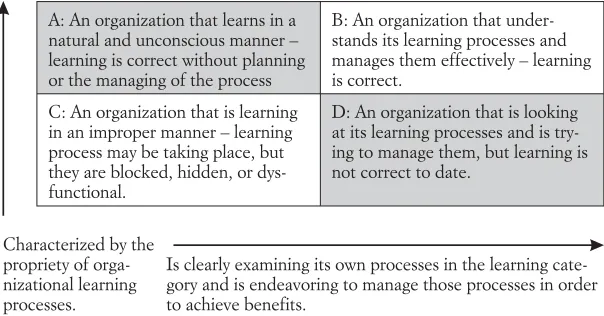
consciousness and multi–levelness of learning, the capacity for continuous change, as well as the satisfaction of employees, shareholders, suppliers, etc. Stress on the conscious nature of learning processes is also reflected in the views of J. G. Burgoyne (1995) who clearly differentiates between the concepts of organizational learning and a learning busi-ness. It may be assumed that organizational learning exits regardless of whether or not it is productive, conscious, and subject to management. A learning business encompasses organizational learning, but the two concepts are not equal. Such a business understands its learning processes and manages them in order to benefit. Possible options as sug-gested by J. G. Burgoyne are presented in Figure No. 1.
Similar views as to the importance of the consciousness of learning for the learning organization are contained in the definition used by a group of fifty American manage-ment practitioners (Calvert, Mobley, Marshall, 1994). According to the views of consul-tants and managers, the concept of a learning organization relates to organizations that excel in supported, systematic, and collective learning.
The learning organization “is an invention, not a discovery” (Burgoyne, 1995). Its creation necessitates a strengthening of organizational learning; such strengthening is possible if the business satisfies specific conditions. Assumptions that serve as a starting point for the support of learning are as follows (Garrat, 1995):
g Participants in the organization learn naturally during work, but they need help in
or-der to learn systematically and learning must itself be a requirement;
A: An organization that learns in a natural and unconscious manner – learning is correct without planning or the managing of the process
B: An organization that under-stands its learning processes and manages them effectively – learning is correct.
C: An organization that is learning in an improper manner – learning process may be taking place, but they are blocked, hidden, or dys-functional.
D: An organization that is looking at its learning processes and is try-ing to manage them, but learntry-ing is not correct to date.
Characterized by the propriety of orga-nizational learning processes.
[image:5.468.109.411.212.370.2]Is clearly examining its own processes in the learning cate-gory and is endeavoring to manage those processes in order to achieve benefits.
Figure No. 1.The learning organization and organizational learning.
g In order for learning to occur where it is needed requires both support on the part of
the system as well as a positive organizational climate;
g Learning must be seen as a value from the point of view of achieving organizational
objectives; and
g The organization is capable of beneficial change in a continuous manner through
learning.
Certain attributes may be attached to the learning organization in trying to character-ize it succinctly (Pedler, Burgoyne, Boydell, 1992; Pedler, Aspinwall, 1996). Such organi-zations also identify a specific subject for learning. Effective businesses learn to (Calvert, Mobley, Marshall, 1994):
g Utilize learning in order to achieve their aims;
g Help their employees in assessing the results of their learning;
g Avoid repeatedly committing the same errors;
g Disseminate information in a manner guarantying the undertaking of correct action;
g Combine the effectiveness of the unit with the effectiveness of the functioning of the
organization as a whole;
g Link compensation with key measures of effectiveness;
g Create structures and procedures that support the process of learning;
g Create the potential for continuous dialogue; and
g Create a sense of security facilitating the undertaking of risk by employees and
guar-antying openness of information.
A learning business encourages employees to try new behavior and allows for the making of mistakes. It processes the experiences of individuals in a manner making possi-ble the creation of an environment in which it can be successful. Each and every experi-ence is an opportunity for improvement. There are no permanent and final solutions to the problems that make their appearance. A learning business is a business that is con-stantly searching; improvement is a continuous process. A characteristic feature of a learning business is the facilitating and supporting of organizational learning; improve-ment should encompass learning itself (Argyris, Schön, 1996; Swieringa, Wierdsma, 1992). Such an organization learns how to learn. In a learning organization the creation, acquisition, and dissemination of knowledge as well as the modification of behavior makes possible the application of new knowledge in action undertaken by employees.
The Capacity of the Business to Learn in Light of Empirical Studies
which the process of learning and of the shaping of modern management practices in businesses active in a market economy can be observed, it was decided to check the level of the capacity to learn achieved by Polish businesses and find out if a high level of such capacity guaranties the efficiency of their functioning.1
The purpose behind empirical studies was the finding of an answer to the question: Is and to what extent does the capacity of a business to lean determine the effectiveness of its functioning?
The concept of the learning organization is an answer to questions regarding the qualities, behavior, and conditions that should apply to businesses if they want to be ef-fective. New management concepts are subjected to critical assessment and, where possi-ble, verified in practice. The concepts of a learning business and organizational learning should facilitate effective management, which signifies clear guidelines for practice. Rec-ommendations cannot be general in nature. They must suggest concrete restructuring programs. The variety of views as to the nature of organizational learning and the essence of a learning organization define the variety of strategies for creating effective businesses. A good starting point in creating a business’ capacity to learn may be the integration of various perspectives and concepts.
The main objectives of the study were:
g An ordering of perspectives, definitions, and attributes assigned to learning
organiza-tions and organizational learning; and
g The defining of relations present between the business’ capacity to learn and the
ef-fectiveness of its functioning.
Practical study objectives included:
g The proposal of a set of attributes of organizations oriented to learn serving the
eval-uation of the capacity of businesses to learn; and
g The development of methodology making possible an improvement in the capacity
of Polish businesses to learn.
Most new proposals relating to management appear in answer to questions regarding the qualities and behavior that should be characteristic of organizations if they want to achieve performance and efficiency. Literature devoted to learning organizations con-centrates on its desiderata: it recommends a flattened organizational structure, local au-tonomy, trust and collaboration throughout the whole organization over and above func-tional subdivisions. Efficiency desiderata should be extended, however, to encompass the premises of productive organizational learning. Thus, the subject of research
comes the conditions favoring learning—the discriminants of the learning organization also encompass factors facilitating productive organizational learning. The degree to which businesses possess such qualities is a reflection of their learning orientation. The way of understanding the qualities of the learning organization as well as their selection should make possible an evaluation of the capacity of the business to learn. Hence the following hypothesis:
Hypothesis #1
The strengthening of a business’ orientation to learn reflects the level of its capacity to learn.
The subject of the empirical studies is the capacity of businesses to learn as well as the level of effectiveness of their functioning. Assuming that Polish businesses function un-der conditions of uncertainty, the following hypothesis was formulated:
Hypothesis #2
The level of capacity of the business to learn is a factor molding the level of effectiveness of its functioning.
The study applied the assumption that, to a certain extent, the importance to a business of qualities of organizational learning have an impact on the degree to which they are present. Thus, the diagnosis of the business’ orientation to learn can be conducted in two dimensions: the importance to the business of the discriminants of organizational learn-ing, and the degree of satisfaction stemming from their strengthening. It may be expected that both the importance of discriminants as well as the level of satisfaction of the mana-gerial staff will find reflection in the level of effectiveness in the functioning of the busi-ness. The following fragmentary hypotheses were formulated taking into account the dif-ferences between a learning organization and organizational learning:
Hypothesis #2a
The importance to the business of qualities of organizational learning is a factor molding the level of effectiveness of its functioning.
Hypothesis #2b
The level of satisfaction of the business’ managerial staff with the strengthening of qualities of the learning organization is a factor molding the level of effectiveness of its functioning.
It is worth examining, however, if the involvement of the business in such a program finds reflection in its performance. Programs are merely procedures and customs facilitating organizational learning. The business utilizes various techniques and undertakes action to activate and maintain learning as well as to coax all employees to learn. It is for this rea-son that the following additional hypotheses have been developed:
Hypothesis #2c
The importance to the business of procedures and customs facilitating organizational learning is a factor molding the level of effectiveness of its functioning.
Hypothesis 2d
The degree of satisfaction of the business’ managerial staff with the level of utilization of procedures and customs facilitating organizational learning is a factor molding the level of effectiveness of its functioning.
Direct studies were conducted in line with the following methodologies:
g Studies of a strengthening of the learning orientation using own research tools;
g Studies of the level of business performance as based on indicators proposed by Jane
McKenzie (1996); and
g Analysis of the impact of strengthened learning orientation on the effectiveness of
the business.
The basic research method was a questionnaire serving to assess the capacity of the business to learn. The study was conducted in 1998. Ultimately, it encompassed twenty–seven out of the 500 Polish companies boasting the greatest revenues in 1997. Most entities examined were joint stock companies established as a result of the transfor-mation of former state–owned enterprises. The list does not contain financial institutions nor government agencies—the Agricultural Market Agency, the State Treasury Agricul-tural Property Agency, and the Industrial Development Agency. The questionnaire was forwarded with a request that it be completed by the managerial staff. All in all, forty–two questionnaires were returned of which thirty–eight were completed correctly by twenty–nine companies. The entities were chosen for testing in a non–random way. They cannot be considered representatives in terms of specific qualities. Thus, one of the phases in the statistical study is the statistical description.
Kendall’st
cindicator was applied in order to assess the correctness of the relation
be-tween the level of learning orientation and business effectiveness. That indicator served to calculate the correlation of rank and it was used in cases of significant quantities of linked ranks.
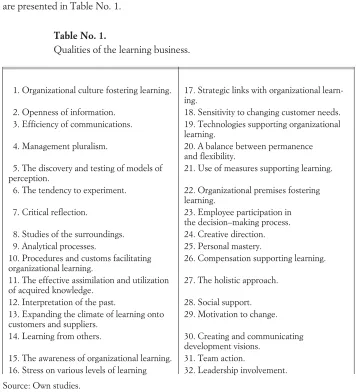
[image:10.468.54.411.173.565.2]The questionnaire encompassed thirty–two business qualities making possible a di-agnosis of the learning orientation, and thus an assessment of the capacity to learn (Batorski, 1999; Bartnicki, Batorski, 1999). Qualities identifying the learning business are presented in Table No. 1.
Table No. 1.
Qualities of the learning business.
1. Organizational culture fostering learning. 17. Strategic links with organizational learn-ing.
2. Openness of information. 18. Sensitivity to changing customer needs. 3. Efficiency of communications. 19. Technologies supporting organizational
learning.
4. Management pluralism. 20. A balance between permanence and flexibility.
5. The discovery and testing of models of perception.
21. Use of measures supporting learning.
6. The tendency to experiment. 22. Organizational premises fostering learning.
7. Critical reflection. 23. Employee participation in the decision–making process. 8. Studies of the surroundings. 24. Creative direction. 9. Analytical processes. 25. Personal mastery. 10. Procedures and customs facilitating
organizational learning.
26. Compensation supporting learning.
11. The effective assimilation and utilization of acquired knowledge.
27. The holistic approach.
12. Interpretation of the past. 28. Social support. 13. Expanding the climate of learning onto
customers and suppliers.
29. Motivation to change.
14. Learning from others. 30. Creating and communicating development visions.
15. The awareness of organizational learning. 31. Team action.
16. Stress on various levels of learning 32. Leadership involvement.
Source: Own studies.
important) was applied. In the case of points for the answer relating to the level of satis-faction, it ranged from 1 (lowest level) to 4 (highest level). An average for the diagnoses of business qualities was calculated on the basis of the acquired empirical material.
The group of examined businesses included economic entities functioning within the production, services, and trading areas. Percentage share of profits in revenues depend-ing on the object of activities was as follows:
g Production of pharmaceuticals – 31.60%, 8.04%
g Telecommunication services (cellular phone operator) – 27.86%
g Building construction joinery manufacturing – 15.51%
g Beer production – 14.45%, 11.71%
g Industrial facility construction – 9.40%
g Transportation and forwarding – 6.66%
g Lignite coal extraction – 5.85%
g Credit activities – 5.37%
g Metallurgical product manufacturing – 4.54%, 0.78%
g Meat processing – 4.30%, 4.03%
g Electric power generating – 2.79%
g Cement production – 1.50%
g TV set and electronic subassembly manufacturing – 1.18%
g Distribution services – 0.89%
g Bearing manufacturing –0.62%
g Electrical power distribution – 0.54%
g Engine and electric generator manufacturing – 3.41%
g Chemical product and semi–product production – 10.04%
g Trading – 4.67%, 2.62%, 1.44%, 1.16%, 0.98%
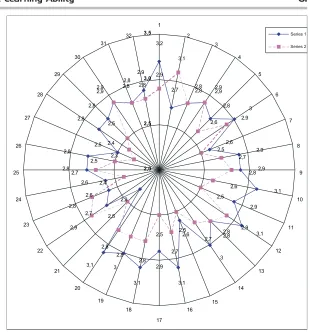
The median share of profits in revenues of the examined group amounted to 4.03%. Two groups of businesses were identified for the purposes of the study: entities in which the share of profits in revenues was less than 4.03% (Series 1), and those in which the value of that indicator was above average (Series 2).
Source materials were used to establish the importance of specific qualities of the learning organization, to establish the level of satisfaction with the strengthening of those qualities, and to analyze the relation between importance and level of satisfaction, and performance. This gave a graphic representation reflecting the learning capacity profiles of groups of companies with differing levels of effectiveness (Figure No. 2).
communi-cating of a development vision (4.0, 4.4). The lowest values were assigned to the utiliza-tion of measurements supporting learning (3.1, 2.8), and compensautiliza-tion (3.0, 3.2).
Respondents proved to be the most satisfied with organizational culture fostering learning (3.,2, 2.9), and the interpretation of past successes and failures (3.1, 2.9). The lowest rating was assigned to the holistic approach (2.5, 2.3), and again the utilization of measurements fostering learning (2.3, 2.5). Assessments of the level of satisfaction with the strengthening of qualities of the learning organization are usually greater than the neutral value (2.5). The degree to which that level is surpassed is not significant, however. It is doubtful if such a capacity to learn is sufficient to achieve success in the future.
The differences in points for specific groups of businesses were generally small; they did not exceed a level of 0.5. In analyzing the results it is possible to state that the more effective businesses ranked the importance of twelve parameters higher, where the
great-3,2
2,7 2,8 2,9
2,8 3 2,6 2,9 2,9 3,1 2,9 3,1 2,8 3 2,6 3,1 2,9 3,1 3 3,1 2,3 2,7 2,6 2,6 2,8 2,8 2,5 2,8 2,8 2,9 2,8 2,9 2,9 3,1 2,8 2,9 2,6 2,5 2,7 2,8 2,6 2,5 2,9 2,8 2,7 2,7 2,5 2,8 2,8 2,8 2,5 2,9 2,8 2,4 2,7 2,5 2,3 2,4 2,9 2,8 2,5 2,5 2,8 2,9 2,0 2,5 3,0 3,5 1 2 3 4 5 6 7 8 9 10 11 12 13 14 15 16 17 18 19 20 21 22 23 24 25 26 27 28 29 30 31
32 Series 1
[image:12.468.101.411.52.386.2]Series 2
est impact on performance is held by effective communication. The degree of satisfaction with the strengthening of qualities is higher or equal in twenty–eight cases. The positive direction between the level of satisfaction with the strengthening of the qualities of a learning organization and performance exists in most cases. It may be assumed that the reason behind the negative direction in the relationship between the importance of cer-tain qualities and business performance is the lack of desire and awareness of actions prior to the actual appearance of major difficulties.
The presented study demonstrates that a strengthening of business orientation fa-voring learning is a reflection of its capacity to learn. Moreover, it is possible to identify a set of business qualities that facilitate productive learning.
The results of the study of the examined group do not confirm the hypothesis that as-sumes that the importance of qualities of a learning organization to the business is a fac-tor shaping the level of its performance. Nor was the impact of the importance of proce-dures and customs facilitating organizational learning on the functional performance of the business confirmed.
The dominance of positive links between satisfaction from the strengthening of qual-ities of the learning organization and performance confirms, in the examined group, the correctness of the hypothesis assuming the existence of such a relationship. Also clear is the impact of the level of utilization of procedures and customs facilitating organizational learning on the performance of the business. This confirms, in the examined group of businesses, the overall hypothesis that assumes the existence of a dependence between the level of capacity to learn and the level of functional performance.
Today, it is generally known that the manner of organizing economic activity is sub-ject to fundamental transformation. At first glance, the noticeable transformation of busi-nesses places increasing stress on flexibility, innovation, and entrepreneurship. Also visi-ble is the growing concentration of attention on processes of organizational learning. It is on the basis of conducted research that the following conclusions may be drawn: 1. The performance of Polish businesses is positively correlated with proper processes of organizational learning.
2. The need for increased stress on learning in the business in not tied with other aspects of ineffectiveness. A frequent case is a situation in which the importance of learning orga-nization parameters is greater in businesses that are less effective.
suggests the need for improvement. The discriminants of a learning organization whose level in the examined businesses is the lowest, should include a holistic look and the use of measures favoring learning. Improvements in a business’ capacity to learn should be comprehensive, however. That signifies that businesses should encompass many parame-ters of the learning organization.
Literature
Argyris C., Schön D. A. 1978.Organizational Learning: A Theory of Action Perspective. Menlo Park: Addison Wesley.
Argyris C., Schön D. A. 1996.Organizational Learning II: Theory, Method and Practice. Reading: Addison Wesley.
Batorski J. 1999. “Ocena zdolnoœci przedsiêbiorstwa do uczenia siê” [An assessment of a business’ capacity to learn]. Unpublished doctoral thesis. Katowice: Katowice School of Economics.
Bratnicki M., Batorski J. 1999. “Czy polskie przedsiêbiorstwo jest w stanie przetrwaæ restrukturyzacjê?” [Is Polish business capable of surviving restructuring?] InSkutki restrukturyzacji i prywatyzacji przedsiêbiorstw w Polsce w dekadzie latdziewiêædziesi¹tych [The effects of restructuring and privatization of businesses in Poland in the
nineteen–nineties]. Sopot: UG.
Burgoyne J. G. 1995. “Feeding Minds to Grow the Business.”People Management. September 21, 1995.
Calvert G., Mobley S., Marshall L. 1994. “Grasping the Learning Organization.”
Training and Development. June.
Daft R. L. 1997.Management. Fort Worth: The Dryden Press.
Dixon N. 1994.The Organizational Learning Cycle: How We Learn Collectively. Maidenhead: McGraw-Hill.
Garrat B. 1995. “An Old Idea That Has Come of Age.”People Management. September 21, 1995.
McGill M. E.. Slocum J. W. 1994.The Smarter Organization. How to Build a Business that Learns and Adapts to Marketplace Needs. New York – Chichester – Toronto – Singapore: John Wiley and Sons.
McKenzie J. 1996. Paradox –The Next Strategic Dimension. Using Conflict to Re-energize Your Business. New York: McGraw-Hill.
Moss-Jones J. 1992.The Learning Organization. Corby: Institute of Management. Pedler M., Burgoyne J., Boydell T. 1992. The Learning Company. Maidenhead: McGraw-Hill.
Pedler M. J., Aspinwall K. 1996.Perfect plc? The Purpose and Practice of Organizational Learning. Maidenhead: McGraw-Hill.
Rutka R.1996. “Diagnozowanie zdolnoœci przedsiêbiorstw do ‘uczenia siê’” [Diagnosing the capacity of enterprises to learn]. InNowe kierunki w zarz¹dzaniu przedsiêbiorstwem – doœwiadczenia praktyczne[New directions in managing businesses – practical experience]. Wroc³aw: Wroc³aw School of Economics.
Senge P. M. 1998.Pi¹ta dyscyplina: teoria i praktyka organizacji ucz¹cych siê[The fifth discipline: the theory and practice of the learning organization]. Warsaw: ABC. Senge P. M. 1990. “The Leaders’ New Work: Building Learning Organizations.”Sloan Management Review. Fall 1990.
Swieringa J., Wierdsma A. 1992.Becoming a Learning Organization: Beyond the Learning Curve. Reading: Addison Wesley.