Journal of Chemical and Pharmaceutical Research, 2013, 5(12):89-95
Research Article
CODEN(USA) : JCPRC5
ISSN : 0975-7384
Model study of sprint motion image based on human joints automatic
identification system
Deqi Li
Department of Physical Education, Zhejiang Yuexiu University of Foreign Languages, Shaoxing, China
_____________________________________________________________________________________________
ABSTRACT
Reliability, mobility and operability of the motion image’s analysis system have a major impact on the research and analysis of sports techniques. In this paper, it take the national secondary level sprinter as the study object, designs human body joints’ automatic identification system for sprinter, analyzes the body contour for sprinters, by studying the analysis algorithm is simple and scientific, gives the tracking area of human body contour in the motion process, provides the measurement methods of the study object and the mathematical model of the joint points extraction, obtains the discrimination model and processing methods on the special circumstances as the joints of the visible side into the body contour lines, the blocking of the joints in the invisible side and the effects of hand on the hip joint determination, and provides a scientific basis for the motion analysis and sprint technical improvements.
Key words: Body articulation joints, mathematical model, automatic identification system, body contour effect _____________________________________________________________________________________________
INTRODUCTION
The development of modern science and technology to a large extent contributes to the progress of sports science and technology; since high-tech tools are widely used in sports analysis, sports training and athletic technical level has been significantly improved; in the exercise training using scientific training methods and monitoring tools to improve the effect of exercise training has become an important direction of sports development. The main scientific exercise training is based on the feedback information of performance monitoring and technical monitoring indicators; sports biomechanics is to monitor the exercise training from the perspective of technology monitoring; and the main means of monitoring are measuring kinematics parameters and kinetic parameters of the athletes during exercise in real time.
For the study of sports analysis system many scholar have made their efforts, the study of human joints’ automatic recognition to some extent affects the development of the technology; in the field of sprint sports reasonable motion analysis technology can provide a broader space for the development of the movement, and some domestic scholars give some ideas and conclusions [1].
Based on previous studies, this paper takes 10 national secondary sprinters as the study objects, designs Automatic Identification System of human body joints during exercise, analyzes the extraction system of the human body joints in the Sprint process, explores the human body tracking area, the software implementation process, mathematical models to determine the various joints, distinguish and treatment of special situations, provides a more scientific theoretical basis for the image analysis in sports, and contributes to scientific sports training and research .
Human joints’ automatic identification system model and software implementation
Currently, we mainly use the analysis system of the motion video to technically monitor the sports training; but due to the system has the slow information feedback and operational complexity and other shortcomings, leading to be unable to give the data information that real-time monitoring needs; so this paper takes sprint study objects, explores the human body joints’ automatic identification system of sprint; the construction of the system needs reasonable mathematical models and simple operation process, the following is elaborate explanation for the sprint mannequin and software implementation processes [7].
Human body model of sprint athletes: In the post-process of software image processing we should follow a certain percentage to restore the initial size of the human body. In order to study the tracking of human body joints, we first need to select the body’s tracking points, as shown in Fig.1.
Fig.1. Regional tracking and the length ratio determination of human body contour
In order to achieve the purpose of simplifying the calculation and the validity of recognition, we should conduct the tracking on the nearby area of the feature points in the movement process. Movement of sprinter has complexity, all links of his body is not uniform motion during exercise process; the traditional predicting the movement of the next time alone through the movement of previous time has been unable to accurately proceed; moreover in the identification process special circumstances will appear that joints of the visible side enter into the body contours and joints of invisible side are blocked , the impact of hand on hip joint determination, which makes the identification process disruptive. Thus this article first uses the obtained highest point A and lowest point B of the
body contours to determine the basic positioning of body movement and gain the basic proportions length
L
HI, andthen accordingly determine the most pointing C, D, E, F, G, H of the body outer contour, finally combined with the laws of sprint determine the tracking area of various joints in the human body in accordance with the obtained feature points; For the specificity of each joint point at each phase, we take a different radius and centers of the tracking region for the various joint points at each phase, and carry through self- adaptive adjustments in accordance with the consistency of action.
Sprint is a cyclical sport project. In order to facilitate the research, the movement can be seen consisting of complex steps; and each complex step is re-constituted by two single-steps; each single step is divided into the support phases, vacated 1phase and vacated 2phase totally three-phases; the distinguishing points of the three phases are the landing instant of the foot, the lifting instant of the foot, the moment when the lowest point changes from one foot to another and the landing instant of the foot once again.
The four moments’ feature distinguishing point of single-step three-phases is defined as follows in the corresponding image amplitude number:
3) The corresponding amplitude when the lowest point changes from the left foot to the right foot: the horizontal displacement of the body contour’s lowest point changes significantly, this change of the corresponding amplitude is beyond the set scope.
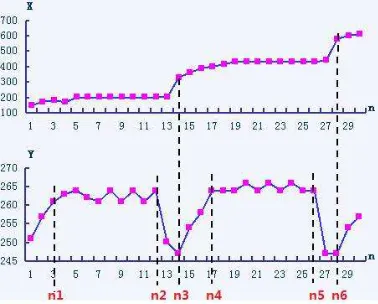
[image:3.595.84.528.183.288.2]The change condition of the coordinate values for the lowest point of the body contour in the vertical direction and the horizontal direction with the increase of the amplitude number is shown in Table 1; Y represents the coordinate in the vertical direction, and X represents the coordinate in the horizontal direction.
Table 1: The data list for the coordinate value changes of the contour’s lowest point
Amplitude numberX Coordinate Y CoordinateAmplitude numberX CoordinateY CoordinateAmplitude numberX CoordinateY Coordinate
1 148 251 11 200 261 21 430 264
2 172 257 12 200 264 22 430 266
3 179 261 13 203 250 23 430 264
4 169 263 14 330 247 24 430 266
5 200 264 15 360 254 25 430 264
6 200 262 16 390 258 26 430 264
7 200 261 17 400 264 27 440 247
8 200 264 18 415 264 28 580 247
9 200 261 19 430 264 29 600 254
10 200 264 20 430 266 30 610 257
The data distribution characteristics of the contour lowest point’ coordinate values with the amplitude number are shown in Fig.2.
Fig.2: The change trends of the contour lowest point’s coordinate values increase with the amplitude number
In Fig.2 n1 represents the corresponding amplitude at the landing instant at the first time; n2 represents the corresponding amplitude at the ground lifting instant at the first time; n3 represents the corresponding amplitude when the lowest point changes from the left foot to the right foot at the first time; n4 represents the corresponding amplitude at the landing instant of the second time; n5 represents the corresponding amplitude when the lowest point changes from the left foot to the right foot at the second time.
[image:3.595.211.400.334.486.2]The software implementation process of human motion modeling: Automatic recognition software system of human joints can be operated in the windows operating system platform; the system consists of seven modules as transforming a video into a jitter-free digital images, importing images, automatic recognition of human joints, manual modification of specific points, exporting data, quit and help. The architecture of software system is shown in Fig.3.
Fig.3, 1-13, means: automatic identification software systems of the body joints in sprint process, transforming a video into a jitter-free digital images, importing images, automatic recognition of human joints, manual modification of specific points, exporting data, quit, help, extract the contour line of moving human, determine the movement phase, determine the proportion length, the automatic identification and locating of the human body’ various joints, and process specific points.
After importing images, the system can automatically enter automatic identification stages of human joints without any manual operation; the identification process and some recognition results of the body joints for each image is shown in Fig.4.
Fig.4: Identification process and identification effect figure of human joint points
Finally, select the data output-> Print basic data reports from the menu, you can get the coordinates of the corresponding amplitude of each joint point.
Mathematical modeling of human body joints’ automatic recognition for sprinter
Study objects and measurement methods: Study subjects: this paper takes 10 secondary sprinters as the research object, clothing is dark tight-fitting sportswear and dark footwear, and any pasted sign spot does not exist on the body, the background color is light-colored of fixed wall.
Measuring method: use the measurement principle of two-dimensional fixed point shooting, the shooting frequency of the camera is 50HZ, and the placement position is shown in Fig.5.
Fig.5: Schematic diagram of two-dimensional fixed point shooting
In Fig.5 A represents the camera, B indicates the main optical axis, C represents the runway, D represents the direction of motion, E represents sprinter, F represents the original point.
Position A makes the main axis perpendicular to the runway; the camera head is 30m distant from athletes; machine height is 1.2m; the field range is 10m; the 10study objects start running successively and each athlete sprint for six times and its speed is 7m/s or so.
The determination of the human body's joints and their mathematical model: According to Hanna Fan mathematical model the human body can be represented by a mathematical model of 15 links connected together by ball hinge joints, the model divides the human body into 15 links as shown below.
1) Head - start from head to the seventh cervical vertebra, one;
8) Calf - start from the knee joint center to the ankle joint center, two; 9) Foot - start from the foot nodules to toe, two.
To sum up: 15 links totally determine 21 joints, respectively the head, the seventh cervical vertebra, the lower edge of the sternum, right shoulder joint, right elbow joint, right wrist joint, knuckles of right palm, right hip joint, right knee joint, right ankle joint, right foot nodules, right toe, left shoulder joint, left elbow joint, left wrist joint, knuckles of left palm, left hip joint, left knee joint, left ankle joint, left foot nodules and left toe.
Using the midpoint method of the shortest distance to determine the seventh cervical points, first we need to
determine the two points
A
(
X
A,
Y
A)
andB
(
X
B,
Y
B)
of the two contour’s shortest distance, and take the(
X
CY
C)
C
,
as the seventh cervical vertebra point as shown in Fig.6.
Fig.6: The seventh cervical vertebra point
We can obtain the coordinates
C
(
X
C,
Y
C)
of the seventh cervical vertebra point combining with equations (1).(
)
(
)
+ = + = B A C B A C Y Y Y X X X 2 1 2 1 (1)Using the link long method to determine the knee joint point; the basis of this method is in sprint course, the longitudinal axis of various aspects of moving human body is always perpendicular to the main axis of the camera; so the length of each part in the image remains unchanged, we should use the fixed link length to determine the coordinates of the joints.
During the time when the athletes drive legs and leave ground and the landing leg is about to landing, the knee joint angle is larger; characteristics of the inflection point of the contour line near the knee joint is not obvious, the midpoint method of the inflection point cannot be applied to determine the knee joint; Therefore draw a circle taking
the ankle joint
A
(
X
A,
Y
A)
as the circle center, the lengthL
CAof the leg as the radius of the circle, and theintersection with the contour line near the knee joint is
B,
C
, and the center of the these two intersection points is considered as the knee joint point, as shown in Fig.7.Fig.7: Knee joint point
The coordinates solving method of knee joint point
D
in Fig.7 is shown in the formula (2) below.Similarly, by using the link long method we can obtain the coordinates of hip point, head point and the lower edge of the sternum.
Using the tangent midpoint methods of vertical links we can obtain the coordinates of the shoulder joint, we first
need to determine the characteristic point
A
(
X
A,
Y
A)
andB
(
X
B,
Y
B)
of the contour line at the ends of the upperarm; We take point
F
(
X
F,
Y
F)
that locatesAB
5
1
from the point
A
on the line segmentAB
, draw vertical line ofthe vertical straight line segment
AB
, and the straight line is intersected with the contour linesat
C
(
X
C,
Y
C)
andD
(
X
D,
Y
D)
, and the midpointE
of the two intersection points is taken as the shoulder jointpoint as shown in Fig.8.
Fig.8: Shoulder joint point
As shown in Fig.8, the coordinates of point
E
can be obtained combining with equations (3).(
)
(
)
(
)
(
)
+ = + = − − = − − = − − − + = − + = D C E D C E D F F D A B A B C F F C A B A F A B A F Y Y Y X X X X X Y Y Y Y X X X X Y Y Y Y Y Y X X X X 2 1 , 2 1 5 1 , 5 1 (3)Similarly, by using the tangent midpoint method of vertical links we can obtain the coordinates of wrist joint and ankle point.
Discrimination and processing model of special situations: The human motion has complexity. In the sprint process special circumstances will appear that joints of the visible side enter into the body contours and joints of invisible side are blocked, the impact of hand on hip joint determination. In order to deal with special cases, you first need to determine when there will appear special circumstances; according to the displacement of the first three frames for certain joints, we can determine the movement trends of the joints for the athletes and determine the unique scope of the current frame; if the joints have the special circumstances, there will be a huge displacement fluctuations, which makes the displacement beyond the displacement range determined by the calculation, the center position of the displacement range at time
n
is calculated as in the formula (4) below.( )
( )
( )
( )
+
⋅
=
+
⋅
=
− − − − 2 1 1 2 1 12
1
2
1
t
y
a
t
y
v
y
t
x
a
t
x
v
x
n n n n n n (4)The relationship in the formula (4) shows that the larger the speed parameter is, the larger the search region becomes; whereas the smaller the speed parameter is, the smaller the search area is; the absolute value of the acceleration parameter is not equal, then the search area is increased; when the acceleration parameter is equal to zero, the search area size keeps unchanged.
supporting legs, the basis to determine the obstructed joint point is that the joint center must be located on the vertical axis and the link length is unchanged.
The determination method of the toe point in invisible side, foot nodule and knee joint point is the same with the problem processing method of the joints in visible side into the body contour; the hip joint in invisible side is always blocked, and the movement of left and right limb has symmetry, we can use the hip point of the visible side to calculate the coordinates of hip joint point in invisible side; the longitudinal axis of the various aspects of arm is not perpendicular to the main axis of the camera in the sprint process, in the image the arm length of each link is constantly changing, so you cannot use obscured treatment method of the legs; due to the symmetry of limb movement in the sprint process, the joints in the visible side can be applied to calculate coordinates of the corresponding joint point in the invisible side.
Since the position of the hand is near the hip joint, hand is possible to enter the tracking area that determines the hip joint; then the intersection points will be three or four; so compare the length of the adjacent line segments, and take the longest one as the coordinates that hip joint point needs; when the hand and torso are superimposed, the artwork can be extracted, set gray threshold to distinguish skin color and clothing color, and determine torso area and arms area.
CONCLUSION
This paper analyzes the tracking area of the body contour joints and human scale models during sprint exercise, provide a basis for building human joints’ automatic identification systems; it studies the operating procedures of human joints’ automatic recognition software implementation in sprint sport, demonstrates the recognition process and some human body effect picture of the sprint; it uses advanced cameras, measuring instruments and scientific measuring method, and provides a good foundation for the validity and credibility of the image data; it determines the body's 15 links and 21 joint points, and gives mathematical model to determine the various joints; it analyzes overlapping images and other special circumstances, establishes the discriminate model of the special circumstances, gives the handling method for situation like the joints of the visible side into the body contour lines, the blocking of the joints in the invisible side and the effects of hand on the hip joint determination, provides a scientific basis for the motion analysis and sprint technical improvements.
REFERENCES
[1]Lu De-ming. Sports Biomechanics measurement methods. Beijing: Beijing Sports University Press, 2001. [2]Wang Jin-sheng. Extraction and tracking of human joints in moving image. Hebei: Hebei University of technology, 2004.
[3]Yu Hong. Human motion recognition and tracking study based on video image. Hei Long-jiang: Harbin engineeringk university, 2006.
[4]Liu Guo-yu. Studies of human motion tracking technology based on video. Beijing: Institute of computing technology Chinese academy of science, 2005.
[5]Sun Yi. Tracing method and experimental study of human motion. Dalian: Dalian University of technology, 2007.