THE INFLUENCE OF ETHICS, EXPERIENCE AND COMPETENCE ON AUDITOR PROFESSIONAL SCEPTICISM
(A Study at BPKP Representative of Lampung Province)
Undergraduate Thesis
By
PANCA TIRTA YASA
FACULTY OF ECONOMICS AND BUSINESS UNIVERSITY OF LAMPUNG
ABSTRACT
THE INFLUENCE OF ETHICS, EXPERIENCE, AND COMPETENCE ON AUDITOR PROFESSIONAL SCEPTICISM
(Study at BPKP Representative of Lampung Province)
by
Panca Tirta Yasa
This study aims to prove empirically the influence of ethics, experience, and competence on auditor professional scepticism. In testing the hypotheses, 63 auditors at BPKP Representative of Lampung Province took part in responding to the questionnaires distributed. The criteria for auditors sampled: 1). Auditors who are directly involved in the assignment, especially in the process of collecting and testing audit evidences, like audit team members, audit tim leaders, audit supervisors and audit quality control, and 2). Auditors who are experienced in auditing for at least one year
Partial Least Square analysis method was used and processed with SmartPLS version 3.0 software and microsoft office excel 2007 program. As hypothesized, the results revealed that ethics, experience, and competence had positive influence on auditor professional scepticism. Discussion, limitation, and recommendation for future research are discussed.
THE INFLUENCE OF ETHICS, EXPERIENCE AND COMPETENCE ON AUDITOR PROFESSIONAL SCEPTICISM
(A Study at BPKP Representative of Lampung Province)
By:
PANCA TIRTA YASA
An Undergraduate Thesis
Submitted for Partial Fulfilment of The Requirements For The Bachelor Degree in Economics
In
Accounting Department
Faculty of Economics and Business, University of Lampung
FACULTY OF ECONOMICS AND BUSINESS UNIVERSITY OF LAMPUNG
AUTHOR BIOGRAPHY
Panca Tirta Yasa was born on October 27th,1986 in Bandar Lampung, Indonesia. The fifth child of five children from Siti Daryani and Auf Marga Saputra. The author started formal education at SDN 1 Gulak-Galik Bandar Lampung (1998), continued to junior high school at SLTP N 16 Bandar Lampung (2001), senior high school at SMAN 3 Bandar Lampung (2004) and STAN (2007).
After graduating from STAN, the author worked at Financial and Development Supervisory Agency (BPKP) Representative of Jambi Province for seven years. In 2015, the author received an opportunity to continue his education and pursue a Bachelor’s degree in accounting at University of Lampung through a schoolarship program named State Accountability Revitalization Project (STAR), a program organized and sponsored by BPKP in cooperation with Asian Development Bank (ADB).
The author is an active member in Economics English Club (EEC) at University of Lampung. In 2016, the author joined The 20th Asian Law Student’s Association (ALSA) held by University of Indonesia and place 3rdposition for News Casting competition. A year later, the author tried his luck at The 21stALSA and succesfully placed 1stplace for the same competition.
ACKNOWLEDGEMENT
This undergraduate thesis, entitled "The Influence of Ethics, Experience, and Competence on Auditor Professional Scepticism (A Study at BPKP Representative of Lampung Province)”, is submitted for partial fulfilment for the Bachelor Degree in Economics in the Accounting Department of Faculty of Business and Economics, University of Lampung.In finishing this undergraduate thesis, the author got a lot of support. Thanks for help, guidance, encouragement, and suggestion from various parties. The author would like deeply to thank to:
1. Allah SWT, for always giving guidance and blessing so that the author completed this research.
2. My big family, my mother Siti Daryani, my father Auf Marga Saputra, and all of my siblings: Wawan Kurniawan, Chandra Jaya Saputra, Febriyanti, and Adi Saputra. I would not have been this far without all of your supports.
3. Prof. Dr. H. Satria Bangsawan, S.E., M.Si., the Dean of Faculty of Economics and Business, University of Lampung.
4. Dr. Farichah, S.E., M.Si., Akt., the Head Program of Accounting Department of the Faculty of Economics and Business, University of Lampung.
5. Mrs. Yuztitya Asmaranti, S.E., M.Si., the Secretary Program of Accounting Departmet of the Faculty of Economics and Business, University of Lampung.
6. Mr. R. Weddie Andriyanto, S.E., Akt.,the author’s academic advisor 7. Mr. Yuliansyah, S.E., M.S.A., Ph.D., Akt CA., the Author’s Advisor who
8. Mrs. Ninuk D. Kesumaningrum, S.E., M.Sc., Akt., the Author’s Co-Advisor who always patiently provides her best time to encourage the author.
9. Dr. Rindu Rika Gamayuni, S.E., M.Si., the Assessor of this undergraduate thesis. I am deeply thankful for your criticism, evaluation and recommendation to improve this research.
10. Mrs. Agustina Awan, Mr. Noveriadi, Mrs. Mpok, Ms Diana, and all lecturers and staffs at the Faculty of Economics and Business, University of Lampung.
11. Mrs. Sally Salamah Ak., M.Prof.Acc., CA., QIA, the Head Office of BPKP Representative of Lampung Province. Big thanks for the support, encouragement and evaluation so the author could finish this undergraduate thesis.
12. BPKP Representative of Lampung Province, the place where the author did this research. Thanks for the time and cooperation.
13. My very best friends in Trio Gajah: Danang Respati, Awan Chubby and also Sitty Zulaikha. You all guys are awesome. Thanks for always being there in every situation. We shared joys and tears. And we will always share everything. Thanks. I mean it.
14. My best colleague, Aditya Priangga. Thanks for always sharing knowledge and information about everything. Thanks for your help. Wishing you all the best for your career.
15. My colleagues of STAR BPKP Batch 2 of University of Lampung. Thanks for the togetherness. I had amazing time with all of you.
16. All of Economics English Club (EEC) members. Thanks for the great times. Thanks for the support. I definitely had amazing moments with all of you. You guys rock!.
17. Big family of Namaste Lampung. We are not only yoga partners, but we are also being a big family. We create another level of friendship. Keep supporting each other.
This undergraduate thesis is still far from perfection and may have a lot of deficiencies. However, the author hopes that this research can benefit the readers and encourage further studies in related topic.
Bandar Lampung, September 27th, 2017
CONTENTS LIST
Page COVER ... ABSTRACT ... APPROVAL SHEET ... ADMISSION ... STATEMENT OF ORIGINALITY ... AUTHOR BIOGRAPHY ... ACKNOWLEDGEMENT ... CONTENT LIST... LIST OF TABLES ... LIST OF FIGURES……... LIST OF APPENDICES ... I. INTRODUCTION ...
1.1 Research Background ... 1.2 Research Questions ... 1.3 Objective of The Research ... 1.4 Significance of The Research ... II. LITERATURE REVIEW ...
2.1 Theoretical Base ... 2.1.1 Cognitive Dissonance Theory ... 2.1.2 Ethics ... 2.1.3 Experience ... 2.1.4 Competence ... 2.1.5 Auditor Professional Scepticism ... 2.2 Previous Studies ... 2.3 The Framework ... 2.4 Hypothesis Development ... 2.4.1 The Influence of Ethics on Auditor Professional Scepticism... 2.4.2 The Influence of Experience on Auditor Professional Scepticism .... 2.4.3 The Influence of Competence on Auditor Professional Scepticism .. III. RESEARCH METHOD...
3.1 Scope of The Research ... 3.2 Population and Sample ... 3.3 Data Sources ... 3.4 Variable Operational Definition ... 3.5 Data Analysis Methods ... 3.5.1 Descriptive Statistics ... 3.5.2 Measurement Model (Outer Model) ...
3.5.2.1 Validity Test ... 3.5.2.2 Reliability Test ... 3.6 Structural Model (Inner Model) ... 3.6.1 Determination Coefficient (Adjusted R2) ...
3.6.2 Path Coefficient (ß) ... 3.7 Hypothesis Test ... IV. RESEARCH RESULT AND DISCUSSION .………...
4.1 Data Collection Result ... 4.2 Data Analysis Results ... 4.2.1 Descriptive Statistics Result ... 4.2.2 Measurement Model (Outer Model) Testing Result ... 4.2.3 Structural Model (Inner Model) Testing Result ... 4.3 Hypothesis Testing Result... 4.4 Discussion ... 4.4.1 The Influence of Ethics on Auditor Professional Scepticism ... 4.4.2 The Influence of Experience on Auditor Professional Scepticism ... 4.4.3 The Influence of Competence on Auditor Professional Scepticism .. V. CONCLUSIONS AND RECOMMENDATION ……...
5.1 Conclusion ... 5.2 Limitation ... 5.3 Recommendation ...
LIST OF TABLES
Table Page
Table 3.1 Variable Measurements Table ... 24
Table 4.1 Questionnaires Distribution ... 32
Table 4.2 Respondent demography ... 32
Table 4.3 Descriptive Statistics of Research Variables ... 34
Table 4.4 Indicators that Did Not Match with Outer Loadings Criteria ... 37
Table 4.5 AVE Value ... 38
Table 4.6 Outer Loadings Validity Test Result ... 39
Table 4.7 Square Root of AVE with Laten Variables Correlation ... 40
Table 4.8 Cross Loading ... 41
Table 4.9 Reliability Test ... 42
Table 4.10 Coefficient of Determinant (R2) ... 44
LIST OF FIGURES
Figure Page
LIST OF APPENDICES
Appendix
Appendix 1 Research Questionnaire Appendix 2 Tabulation Results
Appendix 3 Initial Measurement Model (Outer Model) Output Appendix 4 Final Measurement Model (Outer Model) Output Appendix 5 Outer Loadings Validity Test Result
Appendix 6 Cross Loadings
CHAPTER I
INTRODUCTION
1.1 Research Background
Based on Corruption Perceptions Index (CPI) 2016 which was released by Transparency International (TI), over two-thirds of the 176 countries in 2016 fall below the midpoint of scale of 0 (highly corrupt) to 100 (very clean). Indonesia placed the 90thposition with the score of 37 (TI, 2017). With the global average score of 43 and Asia Pacific average score of 44, Indonesia is in emergency of corruption. Indonesian Corruption Watch (ICW) revealed that poor performance could be attributed to unaccountable governments.
A mapping research of corruption case handling trend 2016 by ICW revealed corruption cases based on government institutions as follows (ICW, 2017):
1). District government as many as 219 corruption cases with the amount of stated losses as much as Rp478 billion;
2
3). Village Government as many as 62 cases with the amount of stated losses as much as Rp206 billion;
4). Ministry as many as 28 cases with the amount of stated losses as much as Rp38 billion;
5) Regional owned entity as many as 20 cases with the amount of stated losses as much as Rp18 billion.
Since the era of reformation, the demand for transparency and accountability for public financial management have been stronger (Butar Butar and Perdana, 2017). Government internal auditors took part in this case. In Indonesia, the function of internal auditors become the focus agenda of change, therefore internal auditors role are being center of attention (Butar Butar and Perdana, 2017).
An auditor is demanded to generate a good quality and reliable audit. Auditors also must be able to detect fraud which may happen during the process of audit that can affect the auditors’ decision making. To do so, auditors must have an attitude of auditor professional scepticism.
3
not be satisfied with the unconvincing evidence, eventhough they think that the management of an entity is trustworthy (BPK RI, 2007).
Research conducted by the SEC (Securities and Exchange Commission) for 11 periods (January 1987 to December 2007) found that a third of the causes of audit failure is the inadequate level of auditor professional scepticism. Of the 40 audit cases examined, 24 cases (60%) included to be happened because the auditors did not apply adequate level of professional scepticism (Beasley et.al. (2001) in Noviyanti, 2008). This inadequate level of auditor professional scepticism can influence the public trust over auditors ability. Enofe, Ukpebor and Ogbomo (2015) explained that when auditors were unable to appropriately apply the professional scepticism, they might not obtain sufficient evidence to support their opinions.
The attitude of auditors professional scepticism can be governed by the auditors’ compliance of code of ethics. Pflugrath et.al. (2007) found that compliance with the code of conduct had a significant influence on professional accountant’s audit decision making. When auditors are able to uphold the ethics principles during the process of audit, the audit failure can be avoided. Minaryanti and Ridwan (2015) showed that the auditors who were responsible for detecting fraud would be able to prevent the failure audit since they were able to apply good audit methods, uphold the objective professional judgement and have attitude of professional scepticism.
4
internal audit body needs to develop various programs to enhance the knowledge and experience of their internal auditors. Libby and Frederick (1990) found the more experience, the more the auditors can generate various kinds of assumption in explaining the audit findings.
Auditors professional scepticism can be also governed by auditors competence. Baybutt (2014) found that an auditor competence was essential to ensure the audit quality. Auditors who have good competence within themselves are able to detect fraud during the process of audit.
This research is inspired by previous studies. The previous studies tested how ethics, experience and competence influenced the auditor professional scepticism. Enofe et.al. (2015), Oktarini and Ramantha (2016), Silalahi (2013), Suraida (2005), Winantyadi and Waluyo (2014) agreed that ethics, experience and competence had positive influence on the auditor professional scepticism.
5
1.2 Research Questions
The research will address these following questions:
1. Does the ethics influence the auditor professional scepticism at BPKP Representative of Lampung Province?
2. Does the experience influence the auditor professional scepticism at BPKP Representative of Lampung Province?
3. Does the competence influence the auditor professional scepticism at BPKP Representative of Lampung Province?
1.3 Objective of The Research
Specific objectives of the research are:
1. Testing the influence of ethics on auditor professional scepticism in BPKP Representative of Lampung Province.
2. Testing the influence of experience on auditor professional scepticism in BPKP Representative of Lampung Province.
6
1.4 Significance of The Research
This research will address the issue of auditor professional scepticism, focused on some internal factors from government auditors. In general, the findings of the research are expected to:
1. Theoritical significance
a. Researcher expects that this research can contribute benefits in terms of knowledge, understanding and experience development of researcher as well as giving contributiton to the development of audit knowledge. In addition, researcher also expects that this research can provide sufficient evidence of the influence of ethics, experience and competence of the auditor professional scepticism.
b. Researcher expects this research can add and develop literature related to the auditor professional scepticism for government auditors, remembering that there are still few number of researches related to the auditor professional scepticism for government auditors.
2. Practical Significance
7
3. Policy Significance
CHAPTER II
LITERATURE REVIEW
2.1 Theoretical base
2.1.1 Cognitive Dissonance Theory
Cognitive dissonance theory is a social psychological theory that discusses about the formation and change of attitude. This theory was first developed by Festinger (1957). Festinger (1957) explains that cognitive dissonance is a discrepancy or gap between two cognitive elements that are not consistent, creates psychological discomfort. This cognitive dissonance theory states that humans are basically consistent and tend to take on attitudes that do not contradict each other, and avoid actions that are inconsistent with their attitude (Noviyanti, 2008). However, in reality, humans are often forced to perform the behavior that is inconsistent with their attitude.
9
are motivated to resist change (Jermias, 2001). The cognitive elements corresponding to positive characteristics of the rejected alternatives, and those corresponding to negative characteristics of the chosen alternative, are dissonant with the knowledge of the action that has been taken (Festinger, 1957 in Jermias, 2001). Cognitive elements are things that are associated with itself, behavior and environment. Cognitive elements refer to the knowledge, opinions, beliefs or feelings about themselves or their environment.
Cognitive dissonance means uncomfortable and unpleasant psychological situation when there is a conflict between two cognitives or conflict between attitude and conduct (Noviyanti, 2008). Cognitive dissonance occurs to the auditors when before they do audit, they obtain tentative information that the auditee is honest and trustworthy party, but when the audit is taking place, the auditors discover discrepancies in the evidences of audit. This causes psychological discomfort and may affect the auditors in making decisions. It is contrary with Jermias (2001) who confirmed that people normatively know their judgement should be objective.
10
2.1.2 Ethics
According to online Oxford Dictionary, ethics is defined as moral principles that govern a person's behaviour or the conducting of an activity. Kamus Besar Bahasa Indonesia (2008) defines ethics is the science of what is good and what is bad, and about the right as well as a moral obligation, a set of principles or values regarding to the morals and principles that guide people’sbehavior. Code of conduct principly is a system of moral principles that are applied in a professional group, which are set together. The code of ethics of a profession is the provision of behavior that must be followed by any people who perform the task of their profession, such as doctors, lawyers, police officers, accountants, auditors, appraisers, and other professions.
In compliance with the code of conduct as an auditor, code of conduct for auditors at BPKP refers to Asosiasi Auditor Internal Pemerintah Indonesia (AAIPI) Number: KEP-005/AAIPI/DPN/2014 on the date of 29th of April, 2014 about Pemberlakuan Kode Etik Auditor Intern Pemerintah Indonesia, Standar Audit Intern Pemerintah
Indonesia, dan Pedoman Telaah Sejawat Auditor Intern Pemerintah Indonesia.
AAIPI mandates for all government internal control apparatus to apply and implement these audit standards and auditor code of ethics.
11
to run their duties and responsibilities and for the APIP leaders in evaluating the behavior of government internal auditors (AAIPI, 2014).
Research conducted by Pflugrath et.al. (2007) found that compliance with the code of conduct had a significant influence on professional accountant’s audit decision making. The results of similar studies were also obtained from studies conducted by Enofe et.al.(2015), Oktarini and Ramantha (2016), Silalahi (2013), Suraida (2005), and Winantyadi and Waluyo (2014), which revealed that ethics gave positive influence on auditor professional scepticism.
2.1.3 Experience
Audit experience is the auditor experience in auditing financial statements in terms of both duration and number of assignments that once handled (Suraida, 2005). Libby and Frederick (1990) found the more experience, the more the auditors can generate various kinds of assumption in explaining the audit findings.
12
Experience is expected to influence auditors’ judgments about management provided information when it is congruent with management’s self-interest (Kaplan et.al., 2008). Experience provides knowledge that helps auditors assign appropriate decision weights to the evidence they acquire because experience helps them develop more comprehensive knowledge structures, and improves their ability to use that knowledge more effectively (Kaplan et.al., 2008).
Tubbs (1992) stated that auditors who had more experiences could know the number of different types of errors. As auditors gain experience: (1) they know more errors, (2) they have more accurate error knowledge, (3) they know more atypical errors, and (4) the causally-related features of errors (when the errors occured and the internal control objectives violated) become relatively more salient (Tubbs, 1992).
The studies that were conducted by Anugerah et.al. (2012), Gullkvist and Jokipii (2015), Hurt et.al (2013), Oktarini and Ramantha (2016) and Silalahi (2013) also showed that experience gave a positive influence on the auditor professional scepticism.
2.1.4 Competence
13
Pemerintah Indonesia, dan Pedoman Telaah Sejawat Auditor Intern Pemerintah
Indonesia. Mentioned in section“Ethics Principles” that government internal auditors are expected to apply and uphold the ethics principles, which are integrity, objectivity, confidentiality, competence, accountable and professional behavior (AAIPI, 2014).
AAIPI (2014) explains that competence is the abilities and characteristics possessed by a person, in the form of knowledge, skills, and attitudes required in carrying out his/her official duties. In section of General Standard of Indonesia Government Internal Audit Standard, AAIPI (2014) clearly states that standard of competence which has to be possessed by an auditor as follows:
1. General competence, related to the general requirements to be considered as an auditor. General competence is the basic competence of being and behaving as an auditor, that is defined as an achievement trigger, analytical thinking, user orientated, cooperation, stress management, and organizational commitment.
2. Technical competence, related to the requirements that can carry out the task of internal audit, in accordance to the ladder of auditor position. The internal audit technical competence includes seven areas of competence:
1) Competence in the areas of Risk Management, Internal Control, and Public Sector Governance.
14
4) Competence in Professional Attitude; 5) Competence in Communication;
6) Competence in Governmental Environment; 7) Competence in Management Supervision.
3. Cumulative competence, meaning that competence at the level of a higher auditor position, is a cumulative competence in the level of auditor position plus specific competence in their position.
Furthermore, AAIPI (2014) states that in the term of upholding the principle of competence, government internal auditors must:
1. Provide services that can be completed as long as they have knowledge, skills and expertise, and experience required;
2. Conduct supervision in accordance with Indonesia Government Internal Audit Standards; and
3. Constantly improve the skills and effectiveness and also quality of the task, either derived from formal education, training, certification, or work experience.
15
Research conducted by Silalahi (2013), Suraida (2005) and Winantyadi and Waluyo (2014), showed that the competency has a positive influence on the auditor professional scepticism.
2.1.5 Auditor Professional Scepticism
Online Oxford Dictionary defines scepticism as a sceptical attitude; doubt as to the truth of something. Kamus Besar Bahasa Indonesia (2008) defines skeptical as lack of confidence or hesitation. Professional scepticism is a multi-dimensional individual characteristics (Hurtt, 2010). A sceptical auditor always considers the reliability and independency on a system that provides audit information (Hurtt, 2010).
AAIPI (2014) defines professional scepticism as an attitude that includes a questioning mind and critical assessment of the audit evidence. Auditors apply the attitude of of auditor professional scepticism during the process of audit.
Nelson (2009) defined professional scepticism as indicated by auditor judgments and decisions that reflect a heightened assessment of the risk that an assertion is incorrect, conditional on the information available to the auditor. Under this definition, Nelson (2009) stated that an auditor who had high professional scepticism needed relatively more convincing (in the form of a more persuasive set of evidence) before concluding that an assertion was correct.
16
Since the evidence is collected and evaluated during the process of auditing, professional scepticism should be used during the audit (SPKN, 2007).
2.2 Previous Studies
In addition to use the theory as a foundation in this research, there are some previous studies that can be used as references in this study. Past researches are more conducted in the public accounting firm. However, there are also some studies that use government auditors as respondents.
Suraida (2005) tested the influence of ethics, competence, experience audit and audit risk on the auditor professional scepticism by involving 100 public accountants who authorized to sign the auditor's report. Using the Structural Equation Model (SEM) model equations, it showed that ethics, competence, experience audit and audit risk influenced the auditor professional scepticism.
17
Winantyadi and Waluyo (2014) conducted a study involving 37 auditors at KAP in Yogyakarta. Hypothesis testing is executed using a simple regression and multiple regression tests. The results showed that the experience, expertise, audit situation, and ethics gave positive influence on the Auditor Professional Scepticism.
Anugerah et.al. (2012) conducted a study of 40 auditors from BPK RI Representative of Riau Province. The hypotheses were tested using the method of Partial Least Square (PLS). The result showed that there was a positive and significant relationship between ethics, experience, situational factors audits on auditor professional scepticism in BPK RI Representative of Riau Province.
2.3 The Framework
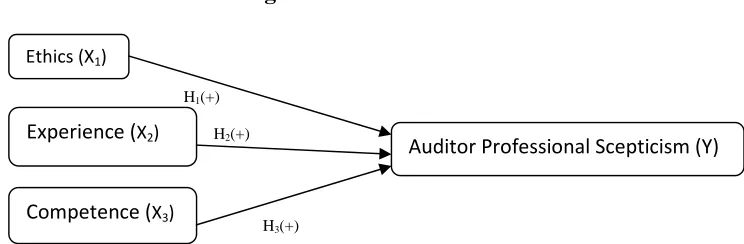
This study uses the theory of cognitive dissonance as a theoretical base. Cognitive dissonance theory is used to explain the influence of interaction between auditor professional scepticism in BPKP with the internal factors that influence the professional scepticism, which are ethics, experience and competence of the audit.
[image:32.612.147.519.586.708.2]Based on the explanation above, this study is compiled by the framework as shown in figure 2.1 below:
Figure 2.1 The Framework
H1(+)
H2(+)
H3(+) Ethics (X1)
Experience (X2)
Competence (X3)
18
2.4 Hypothesis Development
2.4.1 The Influence of Ethics on Auditor Professional Scepticism
The compliance of ethics will be reflected in the auditors’ attitudes and actions. Auditors who have a high awareness of professional ethics and uphold the code of ethics will work professionally. Professionals auditors will apply the attitude of professional scepticism in each performance of his/her duties.
Code of ethics for auditors at BPKP refers to Asosiasi Auditor Internal Pemerintah Indonesia (AAIPI) Number: KEP-005/AAIPI/DPN/2014 on the date of 29th of April, 2014 about Pemberlakuan Kode Etik Auditor Intern Pemerintah Indonesia, Standar Audit Intern Pemerintah Indonesia, dan Pedoman Telaah Sejawat Auditor Intern
Pemerintah Indonesia. This rule is used as guideliness for auditors at BPKP in
carrying out their responsibilities. The aim of this code of ethics is to prevent unethical behavior, fulfill the principles accountability and implement the controlling in order to create credible auditors with optimum performances (AAIPI, 2014). Codes of ethics are the norms, which rule the moral behavior of a profession through the provisions that must be met and adhered by every member of the profession (Anugerah et.al., 2012).
19
(2013), Suraida (2005), and Winantyadi and Waluyo (2014) that revealed ethics had positive influence on the auditor professional scepticism.
Thus, this lead to the following hyphothesis:
H1: Ethics positively influences auditor professional scepticism.
2.4.2 The Influence of Experience on Auditor Professional Scepticism
In a study conducted by Hurt et al (2013), it was explained that the experience of an auditor could strengthen the auditor's attitude of professional scepticism. The more experienced, the higher auditor will have attitude of auditor professional scepticism. The more experience, the more they can generate various kinds of assumption in explaining the audit findings (Libby and Frederick, 1990). Experienced auditor will have objective decisions in every assignment.
20
credibility of management had a stronger influence on judgments of the high experience group compared to judgments of the low-experience group.
According to Noviyanti (2008), the distinguish between experienced and inexperienced auditors is the length of auditors working as auditors in the office. The experienced auditors will be more aware in any errors happened during the process of audit.
The studies conducted by Anugerah et.al. (2012) revealed that experience positively influenced the auditors professional skepticism. This result is in line with studies conducted by Gullkvist and Jokipii (2015), Hurtt et al (2013), Oktarini and Ramantha (2016) and Silalahi (2013) that showed that experience had a positive influence on the auditor professional scepticism.
Thus, this lead to the following hyphothesis:
H2: Experience positively influences auditor professional scepticism.
2.4.3 The Influence of Competence on Auditor Professional Scepticism
21
seen by certificates received by auditors. After joining a technical training, seminar or consortium, auditors will get certificates to certify their skill. Competence of auditors through their general knowledge and special expertise can improve their professional scepticism. Wood (2004) added that competence will increase the confidence of the auditor.
Research conducted by Silalahi (2013) stated that competence had positive influence on auditor professional scepticim. This result is in line with Suraida (2005) and Winantyadi and Waluyo (2014) that revealed competence had a positive influence on the auditor professional scepticism.
Thus, this lead to the following hyphothesis:
CHAPTER III
RESEARCH METHOD
3.1 Scope of The Research
This study seeks to explain the causal relationship between independent variables and the dependent variable by testing the hypothesis. The independent variables in this study are ethics, experience and competence of the audit, while the dependent variable is the auditor professional scepticism.
23
3.2 Population and Sample
The subjects of population in this study are all auditors at BPKP Representative of Lampung Province. This study uses primary data by directly distributing questionnaires to the respondents. The collecting data technique used in this study is purposive sampling. Criteria of auditors sampled, namely:
a. Auditors who are directly involved in the assignment, especially in the process of collecting and testing audit evidences, like audit team members, audit tim leaders, audit supervisors and audit quality control.
b. Auditors who are experienced in auditing for at least one year. Based on the researcher’s judgement, relied to researcher’s own experience working at BPKP for more than 8 years, one year is enough for auditors at BPKP to have experience in audit.
3.3 Data Sources
24
an interview with a qualified respondent. In this time, the researcher will be having an interview with the Head of BPKP Representative of Lampung Province.
3.4 Variable Operational Definition
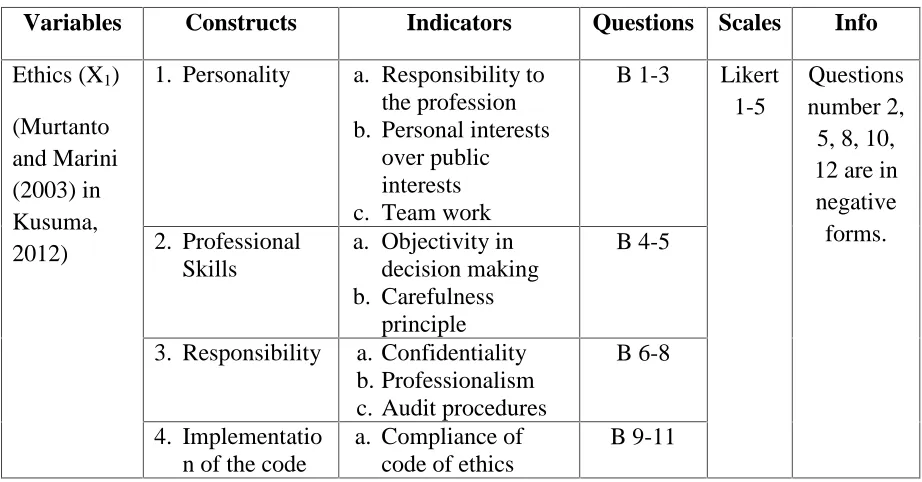
This study uses four variables: ethics (X1), experience (X2) and competence (X3) as the independent variable and the auditor professional scepticism (Y) as the dependent variable. The answers to the questionnaires are collected and measured by a 5-point Likert scale ranging from “strongly disagree” (1) to “strongly agree” (5). Some questions are arranged in negative forms. On any reversed indicators, a low score on the measurement scale indicates a high collision value, and vice versa.
[image:39.612.107.568.459.700.2]Each variables are measured in the following manner:
Table 3.1
Variable Measurements Table
Variables Constructs Indicators Questions Scales Info
Ethics (X1) (Murtanto and Marini (2003) in Kusuma, 2012)
1. Personality a. Responsibility to the profession b. Personal interests
over public interests c. Team work
B 1-3 Likert 1-5
Questions number 2, 5, 8, 10, 12 are in negative forms. 2. Professional
Skills
a. Objectivity in decision making b. Carefulness
principle
B 4-5
3. Responsibility a. Confidentiality b. Professionalism c. Audit procedures
B 6-8
4. Implementatio n of the code
a. Compliance of code of ethics
25
Variables Constructs Indicators Questions Scales Info
of ethics b. Implementation of code of ethics c. Uphold of code of
ethics 5. Interpretation
and refinement of the code of conduct
a. Code of ethics interpretation b. Better performance c. Code of ethics
interpretation B 12-14 Experience (X2) (Suraida (2005) and Ramdanials yah (2010) in Oktarini and Ramantha (2016))
a. Experience as important element in audit
b. Types of auditee c. Relationship between experience and decision making d. Relationship between experience and career development e. Number of audit
tasks
f. Duration of audit experience g. Relationship
between experience and fraud detection
C 1-7 Likert 1-5 All questions are in positive forms Competence (X3) (AAIPI, 2014) 1. Personal Quality
a. Team work b. Curiousity, wide
horizon,
uncertainty action c. Personal
Qualification d. Analysis ability
D 1-4 Likert 1-5 Questions number 1,5,7 are in negative forms. 2. General Knowledge a. Auditee understanding. b. Audit Standard
knowledge. c. Analytical review
26
Variables Constructs Indicators Questions Scales Info
ability d. Formal and
informal education and training
3. Special Skills a. Statistical skill b. Audit report skill c. Contribution of
owned special skills
d. Certificates in accounting and taxation D 9-12 Auditors Professional Scepticism (Y) (Hurtt, 2010, modified) 1. Self Determining
a. Accepting other people’s
explanantion without further thought
b. Immediately accept what other people tell
c. Accepting things seen, read, or heard at face value d. Noticing
inconsistencies in explanations. e. Agree with what
the others in my group think E 1 E 8 E 12 E 13 E14 Likert 1-5 Questions number 1,5,8,9 are in negative forms.
2. Suspension of Judgement
a. Taking time for decision making b. Time consuming in
decision making c. Dislike to make
decision quickly d. Decideing until
looked at all of the readily available information. e. Ensuring that has
27
Variables Constructs Indicators Questions Scales Info
available
information before making a decisión 3. Interpersonal Understanding 4. Questioning Mind 5. Self-Confidence 6. Search for
Knowledge
a. interested in what causes people to behave the way they do.
b. Uninterested in people’s actions c. understanding the
reason for other people’s behavior d. seldom considering
why people behave in a certain way. e. Other people’s
behavior doesn’t interest
a. Reject statements unless have proof that they are true b. Friends tell me that
I often question hings that I see or hear.
c. Frequently question things that seen or heard. Being confident of
28
3.5 Data Analysis Methods
3.5.1 Descriptive Statistics
Descriptive statistics aims to explain and describe research data profile (Abdillah and Jogiyanto, 2015). Descriptive statistics is used to analyze data by describing the data that has been collected and processed as it is without intending to make general conclusions or generalization (Sugiyono, 2011). Statistics technique that is commonly used is central tendention (mean, median, mode) and variability (Abdillah and Jogiyanto, 2015). Statistics measurement in this research used Microsoft Office Excel 2007 program.
3.5.2 Measurement Model (Outer Model)
29
3.5.2.1 Validity Test
Validity shows how much a test measures what should be measured (Jogiyanto, 2016). Validity testing includes:
1. Convergent Validity, scored based on the correlation between Average Variance Extracted (AVE) item score calculated by SmartPLS 3.0 application. Measurement scale of loading value > 0.5 is considered to be practical significance (Abdillah and Jogiyanto, 2015).
2. Discriminant Validity, by comparing the root square of the AVE score for each construct with the correlation between the construct and other constructs in the model. The model has sufficient discriminant validity if the AVE root for each construct is greater than the correlation between constructs and other constructs (Ghozali and Latan, 2015).
3.5.2.2 Reliability Test
30
3.6 Structural Model (Inner Model)
The researcher tested the structural model by measuring Coefficient of Determination (R2), which is a goodness-fit model and Path Coefficient (ß) (Ghozali and Latan, 2015).
3.6.1 Determination Coefficient (R2)
Determination coefficient (R2) aims to measure how far the ability of the model explains variations on the dependent variable. The coefficient of determination is between 0 and 1. The small R2 value indicates that the ability of independent variables explain the variation of dependent variable is limited.
3.6.2 Path Coefficient (ß)
This test is executed to ensure that the relationship between constructs is strong. The construct has a strong relationship if the coefficient test value of the path is greater than 0.10 and the latent relationship is said to be significant if the path coefficient test is at the 0.05 level (Ghozali and Latan, 2015).
3.7 Hypothesis Test
CHAPTER V
CONCLUSION AND RECOMMENDATION
5.1 Conclusion
This study is conducted to test the influence of three independent variables, namely ethics, experience and competence on auditor professional scepticism. Respondents in this study are auditors at BPKP Representative of Lampung Province, amounted to 76 people. The method used in analyzing data in this research is Structural Equation Model (SEM) with Partial Least Square (PLS) approach, with the following conclusion:
1. Ethics has positive influence on auditor professional scepticism.
52
2. Experience has positive influence on auditor professional scepticism.
This result supports second hypothesis. Experience is an important element in auditing. The experience of auditors in dealing with various types of audits and auditees can improve the auditor professional scepticism. The more experience, the greater the auditor's ability to detect problems professionally. Experience can be measured by both duration and number of assignments.
3. Competence has positive influence on auditor professional scepticism.
This result supports third hypothesi.s The competence of an auditor can be seen from the personal quality, general knowledge as well as the special expertise to carry out the audit task. By having competence, auditors can improve their professional scepticism. Competence is the abilities possessed by a person, in the form of knowledge, skills, and attitudes required in carrying out his/her official duties. As stated in General Standard of Indonesia Government Internal Audit Standard, standard of competence which has to possessed by government internal auditors are general competence, technical competence and cumulative competence.
5.2 Limitatiton
53
1. This research is limited only to the government auditors working at BPKP Representative of Lampung Province so that the research result can not be generalized to the auditor as a whole.
2. The auditor's tight of schedule caused the returning time of questionnaires shifted from the set timeline previously.
3. Data used in this study was from questionnaires so that there are some weaknesses encountered, such as inaccurate answers, dishonest answers, and miss interpretated questions.
5.3 Recommendation
Based on the research result and conclusion, the researcher recommend things as follows:
1. Head of BPKP Representative of Lampung Province conducts education and training programs that can improve auditor professional scepticism. Substantive and continuously education and training programs can improve auditor professional scepticism, especially for auditors at BPKP Representative of Lampung Province. Training program can be like In-House Training Program conducted at BPKP Representative of Lampung Province.
54
3. Further researchers can use other indicators that reflect the influence of experience on auditors professional scepticism to get more valid and convincing result. The experience indicators used in this research might not fully reflect the attitude of auditors professional scepticism since there were some indicators that had to be removed, though the result still supported the hypothesis.
REFERENCES
Anugerah, R., R.N. Sari, dan R.M. Frostiana. 2012. The Relationship Between Ethics, Expertise, Audit Experience, Fraud Risk Assessment, and Audit Situational Factors on Auditor Professional Scepticism. Available online http://repository.unri.ac.id accessed on November, 29, 2016.
Asosiasi Auditor Intern Pemerintah Indonesia. 2014. Republik Indonesia. Keputusan Nomor: KEP-005/AAIPI/DPN/2014 tentang Pemberlakuan Kode Etik Auditor Intern Pemerintah Indonesia, Standar Audit Intern Pemerintah Indonesia, dan Pedoman Telaah Sejawat Auditor Intern Pemerintah Indonesia. Jakarta.
Baybutt, Paul. 2014. Competency Requirements for Process Safety Auditors, AICHe
p.4.
Butar Butar, Sarina G.B.A., dan Halim Dedy P. Penerapan Skeptisisme Profesional Auditor Internal Pemerintah Dalam Mendeteksi Kecurangan (Studi Kasus pada Auditor Perwakilan BPKP Provinsi Jawa Tengah). Jurnal Ekonomi dan
Bisnis Vol 20 No.1, April 2017.
Duska, Ronald. 2005. The Good Auditor - Skeptic or Wealth Accumulator? Ethical Lessons Learned from the Arthur Andersen Debacle. Journal of Business Ethics, 57: 17-29.
Enofe, A.O., I. Ukpebor, N. Ogbomo. 2015. The Effect of Accounting Ethics in Improving Auditor Professional Scepticism. International Journal of Advanced Academic Research –Social Sciences and Education Vol. 1 Issue 2, Nov.2015 p.1-16.
Festinger, Leon. 1962. A Theory of Cognitive Dissonance. California. Accessed on December, 23, 2016, from Stanford University Press.
Gamayuni, Rindu Rika. 2016. Pengaruh Kompetensi dan Objektivitas Auditor Internal Terhadap Efektivitas Fungsi Audit Internal (Survey Pada Inspektorat Pemerintah Provinsi/Kota/Kabupaten di Pulau Jawa). The Journal of Accounting and Finance Vol. 21 No.2 p175.
Ghozali, Imam. 2013. Aplikasi Analisis Multivariate dengan Program SPSS. Badan Penerbit Universitas Diponegoro : Semarang,
56
Gloria. 2015. Auditor di Indonesia Hadapi Masalah Defisiensi Audit
http://www.ugm.ac.id/id/berita/10875-auditor.di.indonesia.hadapi.masalah.defisiensi.audit accessed on November, 28, 2016.
Gullkvist, Benita dan Annuka Jokipii. 2015. Factors Influencing Auditors’ Self-Perceived Ability to Assess Fraud Risk. Nordic Journal of Business Vol. 64 No. 1 (Spring 2015).
Hurtt, R. Kathy. 2010. Development of a Scale to Measure Professional Scepticism.
Auditing: A Journal of Practice and Theory Vol. 29 No 1 p.1.
---, Helen Brown-Liburd, Christine E. Earley, dan Ganesh Krishnamoorthy. 2013. Research on Auditor Professional Scepticism: Literature Synthesis and Opportunities for Future Research. Auditing: A Journal of Practice and Theory Vol. 32 Supplement I p.72.
Indonesian Corruption Watch. 2017. Research Corruption Case Handling Trend 2016 “The Failure of Bureaucratic Reform and Rise of The Local Elite Capture Phenomenon”.
Jermias, Johnny. 2001. Cognitive Dissonance and Resistance to change: The Infuence of Commitment Confirmation and Feedback on Judgment Usefulness of Accounting Systems. Accounting, Organization and Society Vol 26: 141-160.
Jogiyanto. 2016. Metodologi Penelitian Bisnis: Salah Kaprah dan Pengalaman-Pengalaman. Edsi 6. Publisher BPFE : Yogyakarta.
---, dan Willy Abdillah. 2015. Partial Least Square (PLS) – Alternatif Structural Equation Modelling (SEM) dalam Penelitian Bisnis. Penerbit Andi: Yogyakarta p.163.
Kaplan, Steven E., Edward F. O’Donnell, and Barbara M. Arel. 2008. The Influence of Auditor Experience on The Persuasiveness of Information Provided by Management. Auditing: A Journal of Practice and Theory Vol. 27 No.1, May, pp.67-83.
57
Minaryanti, A.A. dan M. Ridwan. 2015. Tanggung Jawab Pendeteksian Kecurangan sebagai Pencegahan Kegagalan Audit (Studi pada Kantor Akuntan Publik di Jakarta). Jurnal Trikonomika Vol. 14, No. 1, Juni 2015, p.57–65.
Nelson, Mark W. 2009. A Model and Literature Review of Professional Skepticism in Auditing. Auditing: A Journal of Practice and Theory Vol.28 No.2 November 2009 pp.1-34.
Noviyanti, S. 2008. Skeptisisme Profesional Auditor Dalam Mendeteksi Kecurangan. Jurnal Akuntansi dan Keuangan Indonesia Vol. 5, No. 1 June 2008 p.102-125.
Oktarini, Komang dan I Wayan Ramantha. 2016. Pengaruh Pengalaman Kerja dan Kepatuhan Terhadap Kode Etik Pada Kualitas Audit Melalui Skeptisisme Profesional Auditor. E-Jurnal Akuntansi Universitas Udayana Vol 15 1 April.
Online Oxford Dictionary. https://en.oxforddictionaries.com, accessed on December, 23, 2016.
Pflugrath, Garry, Nonna Martinov Bennie, and Liang Chen. 2007. The Impact Of Codes of Ethics and Experience on Auditor Judgments. Managerial Auditing Journal Vol. 22 No 6 p.583.
Pramesti, Getut. 2011. Aplikasi SPSS dalam Penelitian. Publisher PT Elex Media Komputindo : Jakarta.
Pusat Bahasa Departemen Pendidikan Nasional. 2008. Kamus Besar Bahasa Indonesia. Pusat Bahasa Departemen Pendidikan Nasional, Jakarta.
Republik Indonesia. 2007. Peraturan Badan Pemeriksa Keuangan Republik Indonesia No. 01 tahun 2007 tentang Standar Pemeriksaan Keuangan Negara (SPKN). 2007. Badan Pemeriksa Keuangan Republik Indonesia. Jakarta.
Seol, Inshik, Joseph Sarkis dan Frank Lefley. 2011. Factor Structure of the Competency Framework for Internal Auditing (CFIA) Skills for Entering Level Internal Auditors. International Journal of Auditing vol:15 p.217-230 Silalahi, Sem Paulus. 2013. Pengaruh Etika, Kompetensi, Pengalaman Audit dan
Risiko Audit Terhadap Skeptisisme Profesional Auditor. Jurnal Ekonomi Vol. 21 No 3.
58
Suraida, Ida. 2005. Pengaruh Etika, Kompetensi, Pengalaman Audit dan Risiko Audit Terhadap Skeptisisme Profesional Auditor dan Ketepatan Pemberian Opini Akuntan Publik. Sosiohumaniora Vol. 7 No.3: 186-202.
Transparency International. 2017. Corruption Perceptions Index 2016.
Tubbs, Richard M. 1992. The Effect of Experience on The Auditor’s Organization and Amount of Knowledge. The Accounting Review Vol 67 No.4, October, pp. 783-801. American Accounting Association.
Uranaka, Taiga dan Takahiko Wada. 2015.Japan fines Ernst & Young affiliate $17.4
Million over Toshiba Audit
http://www.reuters.com/article/us-toshiba-accounting-ernst-idUSKBNOU505S20151222 accessed on November, 28, 2016.
Uyanto, Stanislaus S. 2006. Pedoman Analisis Data Dengan SPSS. Edisi Kedua. Publisher Graha Ilmu : Yogyakarta.
Winantyadi, Ndaru dan Indarto Waluyo. 2014. Pengaruh Pengalaman, Keahlian, Situasi Audit, dan Etika Terhadap Skeptisisme Profesional Auditor (Studi Kasus pada KAP di Provinsi Daerah Istimewa Yogyakarta). Jurnal Nominal Vol III No 1.
Wood, David A. 2004. Increasing Value Through Internal and External Auditor Coordination. The IIA Research Foundation p.12.