PORTFOLIO FRAMEWORK FOR
RECOGNITION PRIOR LEARNING FOR
TECHNICAL PROGRAMMES IN MALAYSIA
NORAINI KAPRAWI
THE 3RD REGIONAL CONFERENCE ON
ENGINEERING EDUCATION
(RCEE 2010)
&
RESEARCH IN HIGHER EDUCATION 2010
(RHED 2010)
RCEE {£ RHEdZOlO Kuching, Sarawak 7 - 9 June 2010
Portfolio Framework for Recognition of Prior Learning for Technical Programmes in
Malaysia
Noraini Bt Kaprawi1 Wahid Bin Razzaly2 Raja Norazilla Bt Raja Yunus3 1,2 Universiti Tun Hussein Onn Malaysia (UTHM)
3 Politeknik Sultan Azlan Shah
Abstract
The objective of this reseach is to identify major domains and the necessary criteria in generating a Portfolio Framework for Recognition of Prior Learning (RPL) and to design a portfolio framework for the RPL for technical programmes in Malaysia. This quantitative research is based on document analysis, questionnaire and interviews of experts. About 28 experts from nine public and private institutions of higher learning (IHLs) have been chosen as the key respondents to undertake the questionnaires while a few RPL experts were selected for the interviews. The represented institutions involved in this research includes Malaysian Qualification Agency (MQA), Ministry of Higher Education, Universiti Tun Hussein Onn Malaysia (UTHM), The Open University Malaysia (OUM), Universiti Kuala Lumpur (UniKL), Institut Latihan Perindustrian (ILP), Ministry of Human Resource and industries. The result from this research indicated that there are seven domains required in the development of portfolio; namely candidate's profile, academic qualifications, non-academic qualification, prior learning courses attended, latest skills acquired, generic skills, and non-academic skills and work experience attestation. The findings may be used as guidelines for RPL assessment performance in Malaysia.
Key Word : Recognition of Prior Learning, Accreditation, Portfolio Framework, TVET.
1. Introduction
The New Economic Model (NEM) announced by Prime Minister of Malaysia envisions a Malaysian economy whose growth is propelled not just by capital but by productivity. This is espoused by the target to elevate the income of the people, being one of the three pillars upon which the NEM is built. Malaysian need to transform the way they work and think to adjust to a more competitive business climate and more liberalised and globalised environment. At the core of the economic Transformation Program spelled out in the NEM, among the components of Strategic Reform Initiatives (SRIs) is the development of quality workforce and reducing dependency on foreign labour and also ensuring sustainability of growth. Realising the ambitious targets set by NEM requires nothing short of the highest level of commitment to excellence, strong resolve and hard work, and major mindset transformation. Only by doing so can the nation make the quantum leap required to attain high-income status and to generate knowledge-based, innovative-driven economy, as envisioned by the NEM. Thus, Technical and Vocational Education (TVET) providers, being a key enabler of continuous training which facilitates much of the committed and resilient k-knowledge workforce, have a lot to play their part in helping the country attain the lofty aspirations spelled out in the NEM.
For that to happen, TVET providers must ensures the continuous training and development of skilled trainers and teachers, as lifelong learning is now commonly accepted as being a key economic necessity in the development of workforce in response to a changing labour market. But for training to be effective, the employees' existing skills need to be formally recognized because by doing so, the employers/industrie.s may be able to:
• identify current skills and skills gaps to target training investment
• increase productivity and improve working place reputation
• engage a greater variety of work and expand to new markets
• meet training/working objectives faster • Retain an edge over competitors.
Thus, the RPL is an important factor in the development of lifelong learning models, but this aspect presents a host of challenges. There is still academic resistance to competency assessment, and this remains a problem in promoting RPL. Those who have gone through a significant process in obtaining a qualification may resent those who obtain the same qualification without going through the same process, or be unconvinced of the quality of skills developed through informal learning. Further
RCEE & RHEd2010 Kuchifig, Sarawak 7 - 9 June 2010
understanding of the concept of RPL and how it differs from formal learning may also facilitate its implementation. If RPL is to act as a ladder in skills development, methods of assessing prior learning need to be rigorous, but also responsive to the needs of people who have developed skills outside of formal learning and may have had negative experiences of learning and assessment in the past.
However, careful implementation of RPL should be made, especially in the higher education level. Malaysian Qualifications Agency (MQA) framework has also prepared education routes by systematically correlating qualifications to enable individuals to develop themselves in tertiary education through credit mobility and RPL derived from formal education, informal education and non-formal education regardless of time and place, within the context of lifelong learning.
1.1 Objective
The objective of this research are as follows; (i) Identify the major domain and the related
criteria for the development of Portfolio framework for the Recognition of Prior Learning (RPL) in Technical and Vocational Education (TVET) course in Malaysia. (ii) Design portfolio framework which support
RPL processes for TVET course in Malaysia.
1.2 Background of Research Problem
TVET Institutions indicated a desire to offer RPL to identify skill gaps and to avoid unnecessary training through recognition of current skills gained via on-the-job training. Students applied for RPL because they have some work experience and did not want to repeat their training, as well as wanting to fast-track through a qualification, thereby saving time and entering the workforce sooner. The Australian National Vocational Education and Training (VET) statistics confirm that RPL helps students who are undertaking programs within their Qualifications Framework and who are seeking full qualifications. At present, RPL assessment processes are many and varied. Thus there is a need for individuals to be able to identify and describe evidence for RPL claims in a meaningful, consistent way, which would enhance their chance for a successful RPL claim, as well as support the RPL assessment process. Portfolio tools are among the popular approaches that could assist learners in documenting their RPL claim and maximise their chances of making successful claims, as well as make the process more streamlined, and potentially usable beyond the RPL process.
The EU-Asialink Project 4th International Meeting of the TT-TVET held in November 2007 in Melaka, Malaysia discussed the issue of Accreditation of Prior and Experiential Learning
(APEL) in the context of TVET teachers/trainers education. They proposed the use of e-Portfolio and highlighted the function for APEL's purpose and curriculum development for TVET.
1.3 Problem Statement
There are an increased demand for higher qualifications among TVET teachers, in order to elevate the competencies of TVET teachers in facing the rapid changes of the TVET systems and the needs of producing competent graduates. Enabling access to higher qualifications for those TVET teachers currently working, who do not have degree qualifications requires flexible but rigorous processes for RPL. Related to that, Musa Mohamad (2002) proposed that a system/programme must be planned to convert work experience to credit points to enable one to continue learning to a higher level. This experience must be translated to provide an alternative route or short-term bridging as a preparatory to enter a higher level. However, RPL is still in her infancy especially in the Malaysian Public Education although it has grown quite substantially in the last decade among the private universities like the Open Universities. While TVET institutions/agencies in Malaysia have in some way implement RPL assessment, the policy and procedures is still not well in placed. Although there are a few types of approaches for the assessment of prior learning, the usage of Portfolios assessment have been quite frequently used among TVET institutions/agencies. However the procedures involved in the compilation of evidence in the Portfolio, are not well developed and it might not be able to effectively demonstrate their 'true' competence. Thus this study particularly focused on the development of the Portfolio framework for RPL assessment. Also, based on the need to recognise TVET in Malaysia, the researcher felt that there is a need to perform an analysis study to determine the criteria of the major domain which will further developed the portfolio framework for the RPL. By analysing these criteria, it is hoped that the Portfolio Framework for RPL for TVET programme/courses in the development of accreditation framework will be developed. The research therefore focused on consulting with stakeholders in order to develop a valid and reliable framework of Portfolio development that would be clear and accessible to all.
2.0 Recognition of Prior Learning (RPL)
RPL is an integral component of the vocational education and training system in many developed countries like United States, United Kingdom and Australia. It is sometimes referred to by a number of other terms, such as recognition of current competencies, or simply RPL. RPL is one way to have current skills and knowledge assessed by a
RCEE & RHEd2010 Kuching, Sarawak 7 - 9 June 2010
registered organization or institution to see if they meet current organization or industry standards. RPL assessment recognizes skills and knowledge, no matter how, when or where the learning occurred. It can be used to achieve full or part qualifications and can be used to identify what further training may be needed to get a qualification and avoids duplication of training, maximising the value of vocational education and training expenditure. In this way, it reduce training costs and boost productivity and thus RPL save one's business time and money. Apart from that, gaining recognised qualifications can be a strong motivating factor for skilled employees to commit themselves in the workplace. RPL also provides pathways to higher qualifications for people who may not have access to further training. It creates a learning culture by valuing and recognising learning that has occurred in the workplace.
For TVET, streamlined, integrated RPL processes can help institutions and training providers build capacity and capability for future human capital growth. There are opportunities for TVET institutions to work with other training providers and agencies to facilitate a holistic approach to the career development planning, such as using RPL as a tool to develop workforce planning, succession planning and developmental pathways. Skills to be considered for recognition may have been gained through formal or informal training and education, work skills or knowledge, and general life experience. RPL can assist individuals to realise life and career goals. In particular it can help to re-enter the workforce, move from volunteer work to paid employment, gain a promotion, change and improve jobs security, and meet the minimum entry requirements for a training course.
2.1 Assessment of RPL
RPL assessment should be done in consultation with the related agencies/industry and through profiling 'jobs' where it is often possible to cluster units of competency or develop skill sets. Expectations of the assessment and what it will entail should be outlined for the RPL candidate both verbally and in writing. Competency conversations are used widely in the RPL process. Having a competency conversation is a method of briefing and informing the client and gathering evidence. An essential step is to maintain a positive, 'appreciative' approach and to support, acknowledge and value the skills and experience of the participant. Where assessment is a process of collecting evidence and making judgments on whether competency has been achieved; this summative approach is used mainly for certification purposes. While it may be an important part of the process it may not identify their strengths and weaknesses' and inform them of a learning pathway assisting them to achieve competency. Therefore a formative assessment that involves using
evidence and feedback to identify where learners are in their learning may be an approach that needs to be further enhance in the RPL processes.
The RPL process should ensure:
• obtaining information about the learner • planning 'conversations/interactions'
featuring thoughtful questions, careful listening and reflective responses
• observing learning • giving feedback
• supporting learners in self assessment • negotiating flexible options
• understanding of what is involved
• constructive guidance about how to improve (pinpointing learners strengths and advising on how to develop them in a constructive manner)
• providing opportunities to improve • developing self assessment so it is reflective
According to Connie(2005), assessment and RPL means an assessment process which brings various evaluation method which helps adults transfer, explain and display the proposed knowledge so that this knowledge reaches one level of standard. Assessment and RPL are knowledge derived from experience, a formal course contributing educational credit including work experience, firsthand learning, community work, course without credit, job training, joint training programme or daily life. Among the evaluation method commonly used are based on the portfolio produced. Portfolio means a package or document with evidence or proof which is sent to back the individual to support qualification of the individual to claim credit recognition. Portfolio development is a process where individuals have to gather and certify documents required to gather credit and support the RPL.
RCEE & RHEd2010 Kuching, Sarawak 7 - 9 June 2010
University College (WOUC) and Universiti Tun Abdul Razak (UNITAR) as early as 2006. RPL has also been implemented in the Public Universities to a certain extent but the policies and procedures have yet to be in well developed.
(a) Accreditation Of Prior Achievement ( A.P.A )/ MLVK Programmes in Malaysia
[image:5.595.74.293.338.479.2]The method used for this accreditation varies between the courses offered. This method has given opportunity to skilled workers to get accreditation of the skills that they have. The experienced skills workers without any certification can apply to get the Malaysian Skills Certification(SKM) or Malaysian Skills Diploma(DKM) or Malaysian Skills Advanced Diploma(DLKM) without going for training or sitting for special exams. The candidate only need to provide proofs of skills that they have acquired to be evaluated and certified, besides meeting the requirements that have been identified. In order to apply for the Vocational Trainer Officer Programme, one needs to have experience in the fields shown in Table 1.
Table 1: Duration of working experience for those applying for the Vocational Trainer Officer Programme in order to gain accreditation
Certification Level Duration of working experience *
Malaysian Skills 7 years and above Certification Level 2
Malaysian Skills 5 years and above Certification Level 3
Malaysian Skills Diploma,
Malaysian Skills Advanced 3 years Diploma (DKM/ DLKM)
Note: Not inclusive of training period, if programme/couise was undertaken at the training centre
(b) RPL Implementation in Malaysian Private Universities
As the pioneer Open University in the country, OUM has received the seal of approval from the Ministry of Higher Education (MOHE) to implement Open Entry and RPL. The first stage of screening for RPL implemented by OUM is to ensure that candidates have the necessary knowledge, skills and aptitude for the specific course or programme. The minimum qualifications to apply for RPL are divided into 2 categories which are first degree in conventional institutes of higher education and university leavers. Applicants are also required to show proof of prior knowledge/experience related to the program they are applying for. The assessment method for prior knowledge / experience by OUM is conducted through evidence, challenges test and credit transfer. Applicants must also provide supporting details and documents to proof that they have the knowledge and skills that they must have prior learning knowledge gained by preparing a
portfolio. The portfolio prepared must have the knowledge and experience gained by the applicants through their life experiences including at the work place and the evidence that they may have that knowledge and skills. OUM will evaluate the applicant's portfolio and help them change prior experience to apply for prior learning Credits. Three steps that the applicant will take to produce the portfolio is (i) attend a portfolio course for 8 hours which is supervised by OUM facilitators (ii) portfolio development in two to three weeks and (iii) passing up the portfolio to OUM before the deadline of the application.
MOHE has given the seal of approval to WOUC to register adult learners aged 21 and above at the year of application with minimal academic qualifications, at least with Sijil Rendah Pelajaran Malaysia (SRP/LCE) or PMR and its equivalent. It undergoes t he first stage of screening just like in OUM but WOUC has also designed an assessment based on certificate of attestation, work experience and diagnostic tests including certification based on the programmes offered in WOUC. Just Like OUM, candidate is also expected to furnish a portfolio outlining their work experiences, knowledge skills, etc. The diagnostic test is used to gauge literacy and scholastic aptitude of the candidate. WOUC takes account of documentary evidence of certificates obtained by the candidate. The level of attestation is divided into three broad categories of Band A, B, C according to the relevancy of the certificate(s) in relation to the learning outcomes of the degree programmes and courses applied for by the candidate. The decision to place candidates into various bands is done in consultation by a panel of trained counselors in RPL assessment together with the academic faculty members and technical advisors of respective courses.
The same first stage of screening process is involved in UNITAR. However, candidates will be provided a four hour training session in assembling of the portfolio. The applicant's completed portfolio will be sent to the faculty for assessment and verification. An interview session will be conducted to gauge the applicant's ability to enroll direct into a programme of study. The preparatory programme is designed for the student who as a result of the interview sessions is deemed to be required to undergo a preparatory programme to prepare him for the course of study.
2.2 Portfolio Assessment in RPL
RCEE & RHF,d2010 Kuching, Sarawak 7 - 9 June 2010
life experience which may be equivalent to the course content (learning outcomes) and expectations of the program. Normally, in any institution, the portfolio is assessed for course credit(s) by program faculty. A portfolio can support good practice RPL model by capturing self-assessment results, skills profiles and reflections, the validation of a mix of direct and indirect evidence, third party reports and can aid communication between the candidate and the assessor. RPL should be encouraged and the process should be supportive of the learner (AQTF
2007 essential standards). The good practice
approach to skills recognition call for a learner centred approach, customisation of learning and assessment services and sound record keeping. A portfolio supports all of these.
The evidence a learner provide may take a variety of forms and could include certification, references from past employers, testimonials from clients and work samples. When offering qualifications as proof of RPL, the applicant must present certified copies of the original document/s. Portfolio is a very thorough document which identifies and documents learning from work and/or life that proves course specific learning has occurred. An excellent portfolio must meet the learning outcomes for the related course. The assessor must ensure that the evidence a learner provide is authentic, valid, current and sufficient.
3.0 Methodology
In this chapter, several aspects that are related to implement this study are discussed such as sampling, population, location of study, data collection method, instrumentation, pilot study and data analysis method. The population of the study were experts chosen from several institutions that are involved in the curriculum development, assessment and life long learning which is Malaysia Qualifications Agency (MQA), Ministry of Higher Education (MOHE), University Tun Hussein Onn Malaysia(UTHM), Open University Malaysia (OUM), University Kuala Lumpur(UniKL), ILP, Ministry of Human Resource, Research Units and Skills and Technical Unit. The samples used for this study from these institutions are 28 experts comprising Deans, Head of Units, Head of Departments and Directors, Deputy Directors, Research Officers and individuals involved in prior learning assessment and individuals assembling portfolios for RPL. Questionnaire are used as instrument apart from using semi-structured interviews to enrich and triangulate the data from questionnaires. Data from questionnaires were analysed by following the sequence of questions quantitatively where each item answered each research question. Furthermore, data from the first and second research question were analysed using descriptive statististics from the mean score derived. Whereas, qualitative data analysis was used to reinforce quantitative method.
4.0 Result and Discussion
In this section, the questionnaire was administered to gather data on the main domains required to evaluate RPL and the criterion to develop portfolios.
4.1 The Appropriate Method to evaluate RPL in Malaysia
Table 2 shows that the highest mean was derived from the Portfolio Development with a mean of 4.36 and the lowest mean was 3.79 from the Work
experience/Prior Learning domain. Based on the
mean for each domain, the importance of the domains can be ranked as shown below.
Table 2: Mean Score and the Level of 'Need' for RPL Assessment Methods
No. Main Domain Mean Level Rank 1 Portfolio Development 4.36 Agree 1
2 Interviews 4.32 Agree 2
3 Challenge Test 4.21 Agree 3
4 Work place Assessment 4.14 Agree 4
5 Artifacts Assessment 4.14 Agree 5
6 Assignment 3.89 Agree 6
7 Demonstration 3.86 Agree 7
8 Work Experience Test 3.79 Fairly Agree
8
Scale: 1.00 - 2 . 4 0 = Disagreed, 2.41 - 3 . 8 0 = Fairly Agreed, 3.81 - 5.00 = Agreed
4.2 Main Domains for the Portfolio Framework
With reference to Table 3, all the items in the main domains for the portfolio framework has achieved the agreement level of agree with a mean score range of 4.18 and 4.75. This result indicates that all the item s are essential to be used in the the process of portfolio development framework for RPL.
Table 3: Mean Scores for the main domains for the Portfolio Framework
No. Domain Criteria Mean SD Level 1 Applicants personal 4.68 0.61 Agree
details
2 Academic qualifications 4.5 0.69 Agree 3 Non-academic 4.32 0.95 Agree
qualifications
4 Prior Experience or 4.75 0.52 Agree Courses/ Training
5 Latest Skills 4.64 0.62 Agree 6 Soft Skills 4.18 0.95 Agree 7 Academic Skills and 4.46 0.79 Agree
Woik Experience attestation
RCEE & RHEd2010 Kuchifig, Sarawak 7 - 9 June 2010
Scale: 1.00 - 2.40 = Disagreed, 2.41 - 3 . 8 0 = Fairly Agreed, 3.81 - 5.00 = Agreed
[image:7.596.75.529.62.746.2]4.3 C riteria for Main Domains for Portfolio Framework.
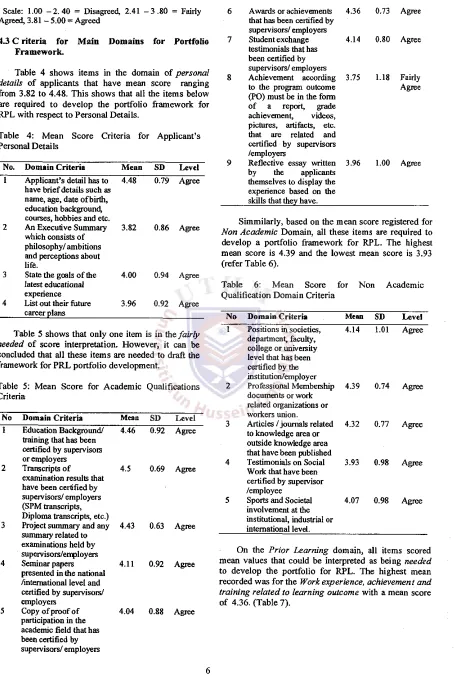
Table 4 shows items in the domain of personal
details of applicants that have mean score ranging
[image:7.596.304.499.66.267.2]from 3.82 to 4.48. This shows that all the items below are required to develop the portfolio framework for RPL with respect to Personal Details.
Table 4: Mean Score Criteria for Applicant's Personal Details
No. Domain Criteria Mean SD Level 1 Applicant's detail has to
have brief details such as name, age, date of birth, education background, courses, hobbies and etc.
4.48 0.79 Agree
2 An Executive Summary 3.82 0.86 Agree
1 which consists of 1 philosophy/ ambitions
and perceptions about life.
3 State the goals of the latest educational experience
4.00 0.94 Agree
4 List out their future career plans
3.96 0.92 Agree
Table 5 shows that only one item is in the fairly
needed of score interpretation. However, it can be
concluded that all these items are needed to draft the framework for PRL portfolio development.
Table 5: Mean Score for Academic Qualifications Criteria
No Domain Criteria Mean SD Level 1 Education Background/
training that has been certified by supervisors or employers
2 Transcripts of
examination results that have been certified by supervisors/ employers (SPM transcripts, Diploma transcripts, etc.) 3 Project summary and any
summary related to examinations held by supervisors/employers 4 Seminar papers
presented in the national /international level and certified by supervisors/ employers
5 Copy of proof of participation in the academic field that has been certified by supervisors/ employers
4.46 0.92 Agree
4.5 0.69 Agree
4.43 0.63 Agree
4.11 0.92 Agree
4.04 0.88 Agree
Awards or achievements that has been certified by supervisors/ employers Student exchange testimonials that has been certified by supervisors/ employers Achievement according to the program outcome (PO) must be in the form of a report, grade achievement, videos, pictures, artifacts, etc. that are related and certified by supervisors /employers
Reflective essay written by the applicants themselves to display the experience based on the skills that they have.
4.36 0.73 Agree
4.14 0.80 Agree
3.75 1.18 Fairly Agree
3.96 1.00 Agree
Simmilarly, based on the mean score registered for
Non Academic Domain, all these items are required to
develop a portfolio framework for RPL. The highest mean score is 4.39 and the lowest mean score is 3.93 (refer Table 6).
Table 6: Mean Score for Non Academic Qualification Domain Criteria
No Domain Criteria Mean SD Level 1 Positions in societies,
department, faculty, college or university level that has been certified by the institution/employer
4.14 1.01 Agree
2 Professional Membership documents or work related organizations or workers union.
4.39 0.74 Agree
3 Articles / journals related to knowledge area or outside knowledge area that have been published
4.32 0.77 Agree
4 Testimonials on Social 3.93 0.98 Agree Work that have been
Agree
certified by supervisor /employee
5 Sports and Societal 4.07 0.98 Agree involvement at the
Agree
institutional, industrial or international level.
On the Prior Learning domain, all items scored mean values that could be interpreted as being needed to develop the portfolio for RPL. The highest mean
recorded was for the Work experience, achievement and
training related to learning outcome with a mean score
of 4.36. (Table 7).
RCEE & RHEd2010 Kuchifig, Sarawak 7 - 9 June 2010
Table 7: Mean Score for Prior Learning Domain Criteria
No Domain Criteria Mean SD Level 1 Work experience,
achievement and training related to learning outcome
2 Developing guidelines for professional courses that have been certified by supervisor/employer. 3 Undergo Industrial
Training, Learning Camps or In-Service Training (hat has been certified by
supervisor/employer. 4 Attend seminars,
workshops organized by any institutions and have been certified by supervisor/employer. 5 Work related experience
related to part time or professional jobs or outside profession that have been certified by supervisor/ employer. 6 Input/Efficiency of work
gathered from industry
7 Evaluation of sample work/assignment or produced documents that have been certified by supervisor/ employer. 8 Individual learning from
reading books, online resources that has been annotated in the bibliography.
4.36 0.91 Agree
4 0.90 Agree
4.25 0.80 Agree
4.29 0.85 Agree
4.21 0.92 Agree
4.14 0.89 Agree
4.14 0.85 Agree
3.89 0.83 Agree
No. Domain Criteria Mean SD Level
1 Technical Skills in area of knowledge (Example: using tools, technical skills depending on field of study/courses undertaken) 2 ICT Skills (Software
related to field of study /courses undertaken) 3 Skills and proficiency in
Malay language 4 Skills and proficiency in
English language
4.39 0.87 Agree
4.29 0.90 Agree
4.36
4.36 0.91
0.87 Agree
Agree
Skills and proficiency in a third language (other than English and Malay)
3.75 0.89 Fairly Agree
[image:8.594.53.540.79.652.2]In reference to Table 9, almost all the items in the soft skills domain have achieved the mean score range of 3.68 and 4.48. Only one item (entrepreneurship) fell in the fairly agree level which indicates that all the items are 'required' to develop a portfolio framework for RPL.
Table 9: Mean Score Criteria for Soft Skills Domains
No. Domain Criteria Mean SD Level 1 Communications Skills 4.39 0.63 Agree 2 Information Management 4.04 0.92 Agree 3 Teamwork Skills 4.18 0.91 Agree 4 Problem Solving Skills 4.20 0.90 Agree 5 Critical Thinking 4.07 0.81 Agree 6 Lifelong learning 4.00 0.90 Agree 7 Entrepreneurship 3.68 0.98 Fairly Agree 8 Ethics 4.36 0.56 Agree 9 Professionalism 4.48 0.63 Agree 10 Leadership Skills 4.18 0.82 Agree
Table 10 demonstrates the mean score for
Academic Qualifications Certification and Work Experiences domain that could be interpreted as
'essential' in the development of portfolio framework for RPL.
Table 10: Mean Score Criteria for Academic Qualifications Certification and Work Experience
Referring to Table 8, most of the items on the
Latest Skills domain scored a mean range of 3.75 and
4.39. It can be concluded that almost all the items above are needed/essential to develop a portfolio framework for RPL.
Table 8: Mean Score for the Latest Skills Domain Criteria
No. Domain Criteria Mean SD Level
1 Must be certified by employer/ supervisor that has wide experience in the field and the expertise in the applicants area of expertise
4.21 1.20 Agree
2 Attach the name of referees that can be contacted for reference purposes
4.43 0.63 Agree
4.4 Interview Data Analysis
Separate semi structured interviews were conducted with the key individuals such as the RPL Assessment Coordinator from OUM, Director of Curriculum Development and Assessment from MOHE and the Deputy Director of NOSS department in the Ministry of Human Resources. From these four interviews of prior learning assessment and curriculum development and assessment experts, it was found that there is no any significance difference in the process of portfolio framework development based on the criteria that have been determined by the researcher. All the experts also gave their
RCEE {£ RHEdZOlO Kuching, Sarawak 7 - 9 June 2010
opinions on the directions of RPL in TVET. Both institutions conduct the process of RPL assessment based on the same criteria, however, the assessment method varies slightly with the Curriculum Development and Assessment officer from MOHE who emphasized on the assessment be conducted at the work place to certify the candidate's attestation. However in the OUM, the emphasis is on candidates to take the Challenge Test as the assessment method, that is more academic and be able to evaluate the candidate's learning outcome compared to the practical skills.
4.0 Conclusion and Discussion
From the literature review, applicable methods of assessment used to assess a candidate's prior learning is through portfolio development. Nevertheless, there are other methods such as interview, challenging test, workplace assessment, artifact product assessment, assignment and demonstration. The result shows that seven domains method of assessment which can be used to assess a candidate's prior learning. These are portfolio development domain, interview, challenging test, workplace assessment, artifact product assessment, assignment and demonstration. However, the dominant method agreed by respondents was the portfolio development which provide evidence to all the skills, knowleges, and candidate's previous experiences.
Result of discussion with an expert in prior learning assessment from OUM, indicates that portfolio development is very relevant for technical field/course. Through interview, a candidate will be given chances to prepare extra evidences to support their credit claim stated in the portfolio development. Besides, the purpose of interview was to check candidate's knowledge level (Ho Siew Lan, 2006). Challenging test is also an important domain in assessing prior learning dan skills owned by the candidate. Maczerk(2003)
stated that it is not the last course but as a preparation for candidate before they are being assessed. The research findings also found that, workplace assessment and artifact product assessment have the same level of importance while the researcher proposed that each candidate in technical course/program must undergo an overall assessment at workplace to observe job details that they have done. For artifact assessment method, Maczeck(2003) stated that candidate's job also include activity in producing physical products and these product/artifact can be assessed. Research finding also showed that assessment method through assignment dan demonstration can still be used but with a caution. Researcher is of the opinion that candidate who has skills and work experiences does not have enough skill in producing a report as well as using computer software. On the other hand, candidates that have some experience in management and administration do not have any problem to complete their given task to assess their prior learning.
By referring to the level of necessity for each domain, the researcher designed an effective portfolio framework for RPL in TVE program/course in Malaysia. Based on the research findings and analysis carried out, the researcher proposes that future studies should gather more data by employing Delphi method as well as conducting an evaluation study on the implementation of the RPL processes.
Finally, this study has identified the seven domains namely candidate's profile, academic qualification, non-academic qualification, prior learning or courses attended, latest skills, humanity skills, and academic qualification confession and working experience as RPL domains which may be put into practice, provided that all claims must be provided with the right evidences.
Acknowledgem ents
References
1. Asset skills (2007). "APEL route for Energy Assessment (Operational Ratings, Display Energy Certificates and Advisory Reports)." Exeter.
2. Australia Life Saving Academy (2007)."Guidelines for Applying for Recognition of Prior Learning (RPL), For Application." Surf Life Saving NSW.
3. Connie Harrison (2005). Best Practices in Prior Learning Assessment and Recognition (PLAR) Handbook, Alberta Council on Admissions and Transfer.
4. Hands-On Training Manual On Peer Review for Accreditation of Academic Institutions and
Programs (2002). Indian Council of Agricultural Research.
5. Harvinder Kaur Dharam Singh (2007). "A Guide for Developing Your Portfolio (Postgraduate), " Centre For Assessment of Prior Learning, Open University Malaysia. 6. Ho Siew Lan (2006). "Guide to Open Entry
and Recognition of Prior Learning." Open University Malaysia.
7. Jailani Md Yunos (2004). "Views from the field, UNESCO International Meeting on Innovation and Excellence in TVET Teacher/Trainer Education (2004)." 8 - 1 0 November 2004, Hangzhou, China. 8. John Wilcox and Richard Brown (2003).
"Accreditation Of Prior And Experiential Learning". UK Centre for Material education (APEL), Bradford College. Version 4.
RCEE & RHEd2010 Kuching, Sarawak 7-9 June 2010
9. Maczeck, J. (2003). "Recognition To Prior Learning and Articulation." Mechanical Engineering Department, Nelson Mandela Metropolitan University, South Africa. Rev.l. 10. K erangka Kelayakan Malaysia (2007).
Kementerian Pengajian Tinggi Malaysia. 11.Ligaya D. Valmonte (2006). Achieving
Sustainable Development Through TVET: Experiences Of International Organizations Working With Members States In Asia And The Pasific.
12. N elson Marlborough Institute Of Technology (NMIT) (2007). "Guidelines for Applying for Recognition of Prior Learning (RPL)." ITPNZ Academy Quality Standard: 9.0.
13. No raini, Aleix, Hans-Dieter, Pekka, Suwarno (2007). "Accreditation of prior and experiential learning in the context of Teacher Education for TVET". Report of Working Group 3 at The 4th International Meeting of the TT-TVET Project. 29.10. - 2.11.2007, Melaka, Malaysia. 14. Pan duan Perlaksanaan Persijilan Kemahiran