Ehrlich-type Methods with King’s Correction for the
Simultaneous Approximation of Polynomial Complex
Zeros
Roselaine Neves Machado
1,
Luiz Guerreiro Lopes
2,∗1FederalInstituteofRioGrandedoSul,BentoGonc¸alvesCampus,95700-206BentoGonc¸alves,RS,Brazil
2FacultyofExactSciencesandEngineering,UniversityofMadeira,PenteadaCampus,9020-105Funchal,MadeiraIs.,Portugal
Received August 7, 2019; Revised August 30, 2019; Accepted September 7, 2019
Copyright c2019 by authors, all rights reserved. Authors agree that this article remains permanently open access under the terms of the Creative Commons Attribution License 4.0 International License
Abstract
Thereare many simultaneousiterative methods for approximating complex polynomial zeros, from more traditionalnumericalalgorithms,suchasthewell-knownthird orderEhrlich–Aberthmethod,tothemorerecentones. Inthis paper,wepresentanewfamilyofcombinediterativemethods forthesimultaneousdeterminationofsimplecomplexzerosof apolynomial,whichusestheEhrlichiterationandacorrection based on King’s family of iterative methods for nonlinear equations. The use of King’s correction allows increasing theconvergenceorderof the basicmethodfromthreetosix. Some numerical examples are given to illustrate the convergencebehaviourandeffectivenessoftheproposedsixth orderEhrlich-likefamilyofcombinediterativemethodsforthe simultaneous approximation of simple complex polynomial zeros.Keywords
Polynomial Zeros, Simultaneous Iterative Methods, Combined Methods, Ehrlich Method1
Introduction
The importance of the problem of finding polynomial zeros in the different branches of Science and Engineering has led to the development of many different methods for their numer-ical determination. There is also a significant interest in the development of new and efficient numerical iterative methods for determining the zeros of real and complex polynomials.
These methods can approximate the zeros of a polynomial either in a sequential or simultaneous manner. However, the determination of all zeros of a given polynomial by a sequential method involves repeated deflations, which can lead to very inaccurate results due to the problem of accumulating rounding errors when using finite precision floating-point arithmetic.
In turn, the simultaneous methods for polynomial zeros have
the advantage of being inherently parallel and avoid the pro-cess of deflation, although these iterative methods usually need good initial approximations for all the zeros in order to con-verge.
In this work, a new family of numerical methods for the si-multaneous approximation of simple complex polynomial ze-ros is presented. The proposed simultaneous methods are con-structed on the basis of the well-known third order Ehrlich– Aberth iteration [1, 6], combined with an iterative correction from the optimal fourth order two-step King’s method for solv-ing nonlinear equations [10].
2
A family of high order Ehrlich-type
simultaneous methods with King’s
correction
2.1
The third order Ehrlich methodLetPbe a monic polynomial of degreen, with (real or com-plex) simple zerosζ1, . . . , ζn,
P(z) =zn+an−1zn−1+· · ·+a1z+a0= n
Y
j=1
(z−ζj), ai∈C.
(1) Considering the correction termN(z) =P(z)/P0(z)from the second order Newton’s method zˆ = z−N(z) (where, for notation simplicity,zˆrepresents a new approximation for a zeroζ) and taking its logarithmic derivative with respect to
z, we obtain
N(z) = P(z)
P0(z) =
d
dzlogP(z)
−1
=
n
X
j=1 1
z−ζj
−1
.
But we have
n
X
j=1
1
z−ζj
−1
=
1
z−ζi +
n
X
j=1 j6=i
1
z−ζj
−1
, (3)
and then
N(z) = 1 1
z−ζi +
n
X
j=1
j6=i 1
z−ζj
. (4)
From (4), we can easily derive the following fixed-point re-lation:
ζi=z−
1
1
N(z)− n
X
j=1 j6=i
1
z−ζj
(i= 1, . . . , n). (5)
Now, letz1, . . . , zn be distinct approximations to the zeros
ζ1, . . . , ζnof the polynomialP.
Puttingζi 'zˆiin (5), wherezˆiis a new approximation for
the zero ζi, settingz = zi, and substituting the zeros ζj by
their approximationszj(j 6=i)on the right-hand side of the
above identity, we obtain the well-known Ehrlich method (also known as Ehrlich–Aberth method or Maehly–Ehrlich–Aberth method) for the simultaneous approximation of simple polyno-mial zeros.
Therefore, Ehrlich’s method for the simultaneous determi-nation of polynomial zeros is given by
ˆ
zi=zi−
1
1
N(zi) −
n
X
j=1
j6=i 1
zi−zj
(i= 1, . . . , n). (6)
This important result was independently derived by several different authors, including Maehly [11], B¨orsch-Supan [3], Dochev and Byrnev [5], Ehrlich [6], Weißenhorn [15], Aberth [1], and Farmer and Loizou [7].
The Ehrlich method is cubically convergent for simple roots [2, 6].
2.2
Ehrlich-type simultaneous methods with King’s cor-rectionIt is evident from the fixed-point relation (5) that better ap-proximationszjwill produce more accurate approximationszˆi
for the zerosζi.
In order to achieve this, and aiming to improve the conver-gence rate and efficiency of the iterative scheme due to Ehrlich, we propose a family of simultaneous iterative methods con-structed on the basis of the third order Ehrlich iteration, com-bined with a correction based on the optimal fourth order two-step King’s method for nonlinear equations [10].
The well-known King’s family of fourth order multipoint it-erative methods for determining a simple root of a nonlinear
equationf(x) = 0requires only two evaluations of the func-tion and one of its first derivative per full iterafunc-tion, and is de-fined by
yn=xn−
f(xn)
f0(x n)
,
xn+1=yn−
f(yn)
f0(x n)
f(xn) +βf(yn)
f(xn) + (β−2)f(yn)
, (7) whereβ∈Cis a parameter.
The family of simultaneous iterative methods here proposed is obtained by combining the scheme of the third order Ehrlich iteration (6) with an iterative correction term obtained from King’s fourth order iteration (7), given by
CK(zj) =
P(y(zj))
P0(z j)
P(zj) +βP(y(zj))
P(zj) + (β−2)P(y(zj))
, (8) where
y(zj) =zj−
P(zj)
P0(z j)
,
andβis a parameter.
Using the King approximationzj −CK(zj)in (6) instead
ofzj, we obtain a new one-parameter family of Ehrlich-type
simultaneous iterative methods with King’s correction, defined by
ˆ
zi=zi−
1
1
N(zi) −
n
X
j=1
j6=i
1
zi−zj+CK(zj)
(i= 1, . . . , n),
(9) whereCK(zj)is the iterative correction appearing in (8).
3
Order of convergence of the new
fam-ily of combined methods
In this section, we analyze the order of convergence of the proposed family of Ehrlich-type simultaneous iterative meth-ods with King’s correction, which is established in the follow-ing theorem.
Theorem 1. Letz1(0), . . . , z(0)n be sufficiently close initial ap-proximations to the simple zerosζ1, . . . , ζn of the polynomial
P. Then, the order of convergence of the one-parameter family of iterative methods defined in(9)is six.
Proof. Consider the abbreviations
λi,j =zi−zj+CK(zj), (10)
θi= n
X
j=1
j6=i
zj−ζj−CK(zj) (zi−ζj)λi,j
, (11)
and letiandˆibe the errors of the numerical approximations
defined as follows:
i=zi−ζi, (12) ˆ
Rearranging (9), we have
ˆ
zi=zi−
N(zi)
1−N(zi)
n
X
j=1
j6=i
1
zi−zj+CK(zj)
(i= 1, . . . , n).
(14) Substituting (2) into (14), we obtain
ˆ
zi=zi−
n X j=1 1
zi−ζj
−1 1− n X j=1 1
zi−ζj
−1 n X j=1
j6=i
1
zi−zj+CK(zj)
,
(15) and expanding this equation and simplifying, we get
ˆ
zi=zi−
1 n
X
j=1 1 (zi−ζj)
− n
X
j=1
j6=i
1
zi−zj+CK(zj)
. (16)
However, wheni6=j, we can write
n
X
j=1
1 (zi−ζj)
= 1
(zi−ζi) +
n
X
j=1
j6=i 1 (zi−ζj)
. (17)
Substituting (17) into (16) yields
ˆ
zi=zi−
1
1
zi−ζi +
n
X
j=1
j6=i 1 (zi−ζj)
− n
X
j=1 j6=i
1
zi−zj+CK(zj)
,
(18) and substituting (12) into this equation gives
ˆ
zi=zi−
1 1 i + n X j=1
j6=i 1 (zi−ζj)
− n
X
j=1 j6=i
1
zi−zj+CK(zj)
. (19)
But, by (12) and (13), we have
ˆ
i+ζi =i+ζi−
1 1 i + n X j=1
j6=i 1
zi−ζj −
n
X
j=1
j6=i
1
zi−zj+CK(zj)
.
(20) Simplifying and replacing the denominator of the second summation by (10), we get
ˆ
i=i−
1 1 i + n X j=1 j6=i
1
zi−ζj −
n
X
j=1 j6=i
1
λi,j
. (21)
Multiplying and dividing the last equation byi, we have ˆ
i=i−
i
1 +i
n X j=1 j6=i
1
zi−ζj −
n
X
j=1 j6=i
1 λi,j , (22)
and joining the two summations together, we obtain
ˆ
i=i−
i
1 +i
n X j=1 j6=i
λi,j−(zi−ζj) (zi−ζj)λi,j
. (23)
Considering (10) again, we have
ˆ
i=i−
i
1 +i
n X j=1
j6=i
zi−zj+CK(zj)−zi+ζj (zi−ζj)λi,j
, (24)
and simplifying, we obtain
ˆ
i=i−
i
1 +i
n X j=1 j6=i
CK(zj)−zj+ζj (zi−ζj)λi,j
, (25)
where the summation that appears within parentheses in this equation is, according to (11), equal to−θi.
By making the proper substitution in (25), we get
ˆ
i=i−
i 1 +i(−θi)
. (26)
Reducing to the common denominator and simplifying, we finally obtain
ˆ
i= −2iθi
1−iθi
. (27)
By the assumption of the theorem, the errors are small enough in modulus, and thus it can be assumed that i = Om(j)andˆi = Om(ˆj)for i, j ∈ {1, . . . , n}, where this
notation means that the moduli of the pairs of complex num-bers involved have the same order, that is,|i| =O(|j|)and |ˆi|=O(|ˆj|), where the symbolOindicates the order of
mag-nitude.
Analyzing (10) and (11), we observe that, for sufficiently close approximations to the corresponding zeros, the expres-sion in the denominator of (11) is bounded and tends to
(ζi−ζj)2, fori6=j.
Considering this, and taking into account that each method of the family of King’s methods is of fourth order of conver-gence [10], i.e., for these methods,zˆ−ζ=Om((z−ζ)4), we
find that
θi=Om(4). (28)
Using this result with (27), we conclude that
ˆ
Thus, the order of convergence of the family of Ehrlich-type simultaneous iterative methods with King’s correction (9) is six.
4
Numerical examples
In this section, some numerical examples are presented to illustrate the convergence behaviour and effectiveness of the proposed family of simultaneous iterative methods.
It is important to note here that not all values of the parame-terβ lead to convergence of the fourth order King’s method (7) [4]. Some convenient values of this parameter can be found in the literature, includingβ =−1/2[10],β =−9/2,
β= 3.9 + 0.1i[4] andβ= 3−2√2i[12].
In the three examples here considered, we have adopted the valueβ = −7/10for this parameter, which was determined through a computational parameter optimization.
In the examples presented, the initial approximations were chosen by using Aberth’s approach [1]. The starting approx-imations to the zeros of each polynomial calculated by the Aberth’s initialization procedure are equidistantly distributed along the circumference|z+a1/n| =r0, wherea1is the
co-efficient of the second leading term of the monic polynomial considered,nis the polynomial degree, andr0is the radius of
a disk centered at the origin of the complex plane containing all the zeros of the polynomial, obtained as usual (see, e.g., [13]) by applying the Guggenheimer’s upper bound for the zeros [9]. The numerical tolerance was set to1×10−12and the maxi-mum number of iterations was fixed to 50.
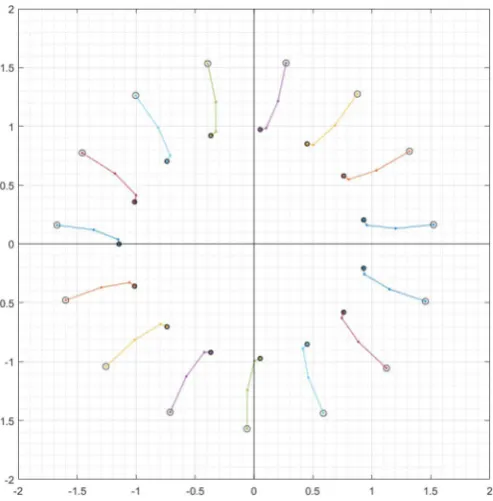
Example 1. The first example considered is that of a complex polynominal of degree 10, extracted from [8], with zeros±1,
±i,±√2/2(1±i),2i, and3i:
P1(z) =z10−5iz9−6z8−z2+ 5iz+ 6.
Figure 1 presents the trajectories of approximations for the polynomialP1(z)generated by the simultaneous iterative method (9) witha1=−5i,r0= 10andβ =−7/10.
The requested accuracy of10−12 was achieved in eigth it-erations, while Ehrlich’s method (6), on which the proposed method is based, required 14 iterations.
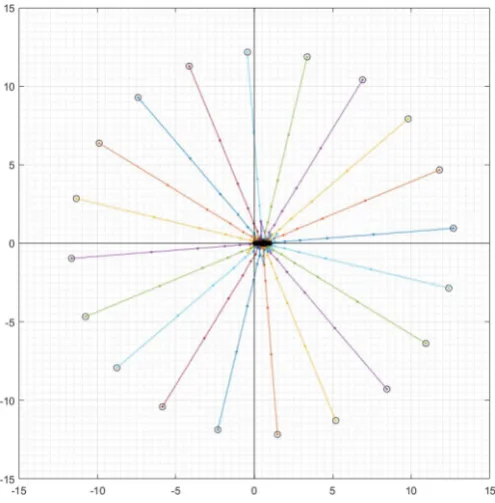
Example 2. In the second example, the proposed method (9), withβ =−7/10, was applied to a real polynomial of degree 15, extracted from [14], which has only a real zero:
P2(z) =z15+z14+ 1.
The trajectories of approximations for the polynomialP2(z),
generated by the method (9) witha1 = 1,r0 = 2andβ =
−7/10, are presented in Figure 2.
In this case, the proposed combined iterative method re-quired five iterations to obtain approximations to the zeros of the given polynomial with the requested accuracy.
[image:4.595.301.554.121.378.2]For comparison, Ehrlich’s method needed nine iterations to achieve the same accuracy.
Figure 1.Trajectories of approximations for Example 1.
[image:4.595.306.553.476.727.2]Example 3. The last example here considered is a real poly-nomial of degree 20, extracted from [16], known as the scaled Wilkinson polynomial:
P3(z) = 20
Y
k=1
(z− k
20).
Figure 3 shows the trajectories of approximations for the scaled Wilkinson polynomial generated by the method (9) with
[image:5.595.302.553.85.336.2]a1=−10.5,r0= 21andβ =−7/10.
Figure 3.Trajectories of approximations for Example 3.
A more detailed view of the trajectories of approximations for the same polynomial corresponding to the last 11 iterations generated by the proposed simultaneous method is shown in Figure 4.
The third order Ehrlich method needed 45 iterations to reach the required accuracy, whereas the proposed method (9), with
β = −7/10, performed only 15 iterations to reach the same desired accuracy.
Table 1 contains a summary of the results obtained, showing the number of iterations required by the simultaneous iterative methods (6) and (9) to produce approximations to the zeros of the polynomials of Examples 1 to 3 with the requested accu-racy of10−12.
Table 1.Number of iterations necessary to obtain approximations accurate to within10−12.
Method Eq. No. of iterations
P1 P2 P3
Ehrlich (6) 14 9 45
Ehrlich-King (β=−7/10) (9) 8 5 15
Figure 4.Detail of the trajectories of approximations for Example 3.
5
Conclusion
In this paper, a new sixth order family of combined iterative methods for the simultaneous approximation of simple com-plex zeros of a polynomial was introduced and discussed.
The proposed one-parameter family of simultaneous meth-ods was constructed on the basis of the third order Ehrlich iter-ation, combined with an iterative correction based on King’s family of optimal fourth order iterative methods for solving nonlinear equations.
It was proved that the use of King’s correction allows to increase the order of convergence of the basic simultaneous method from three to six.
The results of some numerical examples corroborate the the-oretical analysis and illustrate the effectiveness and rapid con-vergence of the proposed Ehrlich-type methods with King’s correction for the simultaneous approximation of polynomial complex zeros.
Acknowledgement
This work was carried out as part of the first author’s PhD research at the University of Madeira, Portugal, and was sup-ported by the Federal Institute of Rio Grande do Sul (IFRS), Brazil.
REFERENCES
[image:5.595.43.291.231.483.2][2] G. Alefeld, J. Herzberger. On the convergence speed of some algorithms for the simultaneous approximation of polynomial roots, SIAM Journal on Numerical Analysis, Vol. 11, No. 2, 237–243, 1974. doi:10.1137/0711023.
[3] W. B¨orsch-Supan. A posteriori error bounds for the zeros of polynomials, Numerische Mathematik, Vol. 5, No. 1, 380–398, 1963. doi:10.1007/BF01385904.
[4] A. Cordero, J. Garc´ıa-Maim´o, J. R. Torregrosa, M. P. Vas-sileva, P. Vindel. Chaos in King’s iterative family, Ap-plied Mathematics Letters, Vol. 26, No. 8, 842–848, 2013. doi:10.1016/j.aml.2013.03.012.
[5] K. Dochev, P. Byrnev. Certain modifications of Newton’s method for the approximate solution of algebraic equa-tions, USSR Computational Mathematics and Mathematical Physics, Vol. 4, No. 5, 174–182, 1964. doi:10.1016/0041-5553(64)90148-X.
[6] L. W. Ehrlich. A modified Newton method for polynomials, Communications of the ACM, Vol. 10, No. 2, 107–108, 1967. doi:10.1145/363067.363115.
[7] M. R. Farmer, G. Loizou. A class of iteration functions for improving, simultaneously, approximations to the ze-ros of a polynomial, BIT, Vol. 15, No. 3, 250–258, 1975. doi:10.1007/BF01933657.
[8] I. Gargantini. Parallel Laguerre iterations: the complex case, Numerische Mathematik, Vol. 26, No. 3, 317–323, 1976. doi:10.1007/BF01395948.
[9] H. Guggenheimer. Bounds for roots of algebraic equations, Archiv der Mathematik, Vol. 31, No. 1, 568–569, 1978. doi:10.1007/BF01226493.
[10] R. F. King. A family of fourth order methods for nonlinear equa-tions, SIAM Journal of Numerical Analysis, Vol. 10, No. 5, 876–879, 1973. doi:10.1137/0710072.
[11] H. J. Maehly. Zur iterativen Aufl¨osung algebraischer Gleichun-gen, Zeitschrift f¨ur Angewandte Mathematik und Physik, Vol. 5, No. 3, 260–263, 1954. doi:10.1007/BF01600333.
[12] B. Neta, M. Scott, C. Chun. Basins of attraction for several methods to find simple roots of nonlinear equations, Applied Mathematics and Computation, Vol. 218, No. 21, 10548–10556, 2012. doi:10.1016/j.amc.2012.04.017.
[13] M. S. Petkovi´c, S. Ili´c, I. Petkovi´c. A posteriori error bound methods for the inclusion of polynomial zeros, Journal of Com-putational and Applied Mathematics, Vol. 208, No. 2, 316–330, 2007. doi:10.1016/j.cam.2006.09.014.
[14] P. D. Proinov, M. T. Vasileva. On the convergence of high-order Ehrlich-type iterative methods for approximating all zeros of a polynomial simultaneously, Journal of Inequalities and Applica-tions, Vol. 2015, Art. No. 336, 2015. doi:10.1186/s13660-015-0855-5.
[15] F. Weißenhorn. Ein Beitrag zur Bestimmung der Nullstellen aus einer Polynom in Summenform und aus der Summe von Polynomen in Produktform, Archiv f¨ur Elektronik und
¨
Ubertragungstechnik, Vol. 24, 372–378, 1970.