Journal of Chemical and Pharmaceutical Research, 2012, 4(1):617-632
Research Article
CODEN(USA) : JCPRC5
ISSN : 0975-7384
Effect of temperature on the molecular dynamics of
some binary mixtures by ultrasonic method
S. J. Askar Ali
PG and Research Dept of Chemistry, The New College (Autonomous) Chennai, Tamilnadu, India
_____________________________________________________________________________________________
ABSTRACT
Ultrasonic velocities (U), densities (ρ), and coefficient of viscosities (η) are measured for binary mixtures containing
(i) cholorobenzene - 1 – propanol and (ii) cholorobenzene – benzylalcohol at 303K, 308K, and 313K to under
stand the molecular interaction. Various acoustical parameters such as adiabatic compressibility (β) , free length
(Lf), acoustic impedance (Z), relaxation time (τ), free volume (Vf), available volume (Va), and internal pressure
( i), are calculated from the measured values of U, ρ, and η. The trend in acoustical parameters also substantiates
to asses weak and strong molecular interacations. Other interesting features were observed and they are discussed.
Key words: Ultrasonic velocities, Binary mixture, Free volume and Internal pressure.
_____________________________________________________________________________________________
INTRODUCTION
Ultra sonic studies provide a wealth of information about the state of the liquid. Ultra sonic velocity measurement has been adequately employed to understand the nature of the molecular interactions in binary mixtures[1,2] and ionic interactions in aqueous electrolytic solutions[3].Measurement of ultrasonic velocity and other acoustical properties can be related to physico-chemical behaviors and molecular interactions in a number of binary systems. Sehal and Porter studied the non-linear parameter for alcohol and water mixtures and based on this parameter discussed the inter molecular interactions [4]. Anwar ali and co-workers carried out investigations on the interactions of ion-solvent system by ultrasonic method [5]. In this paper, ultra sonic studies were carried out in the following binary mixtures
(i) Chlorobenzene -1 – propanol and (ii) chlorobenzene-benzylalcohol at 303K, 308K and 313K. The acoustical parameters have been calculated for these two binary mixtures at different concentration of chlorobenzene.
EXPERIMENTAL SECTION
1. ADIABATIC COMPRESSIBILITY (β)
The adiabatic compressibility values for various compositions of the binary liquid mixtures have been calculated from the measured ultrasonic velocities and densities.
ρ
β
21
U
=
2. FREE LENGTH (Lf)
The free length in a liquid mixture is related to ultrasonic velocity and density as,
U
K
L
fρ
=
Where, K = 2 x 10⁻⁶
3. ACOUSTIC IMPEDANCE (Z)
The specific acoustic impedance is related to density and ultrasonic velocity by the relation.
Z = Uρ
4. RELAXATION TIME (ττττ)
Relaxation time can be calculated from viscosity coefficient density and ultrasonic velocity of binary liquid mixtures and is given by,
2
3
4
U
ρ
η
τ
=
5. FREE VOLUME (Vf)
The free volume of binary liquid mixture is given by
Vf = [Meff U / K η] 3/2
Where, K = 4.28 x 10⁹
Meff = Effective molecular weight.
Effective molecular weight of liquid binary mixture is given by
Meff = X1 M1 + X2 M2
Where X1 & X2 are the mole fractions of the first and second components and M1 & M2 are the molecular weights of first and second components respectively.
6. AVAILABLE VOLUME (Va)
Another parameter which can be calculated from ultrasonic velocity is the available volume and is given by,
Va = V [1 – U/U∞]
Where, U∞= Schaaf’s limiting value taken as 1600 m/s for liquids.
7. INTERNAL PRESSURE (ππππi)
Internal pressure is given by,
6 / 7 3 / 2 2 / 1 2 / 1
)
(
)
(
)
(
)
(
eff iM
x
U
K
bRT
η
ρ
π
=
Where,
b = the cubic packing factor which is assumed to be two Or (solution) liquid state.
RESULTS AND DISCUSSION
Ultrasonic Velocity (U)
[image:3.595.208.404.177.316.2]The measured ultrasonic velocity, with increase in mole fraction of chlorobenzene with 1-propanol and benzyl alcohol at three different temperatures are given in Tables 1-6
Table 1 Ultrasonic Velocity (U), density (ρρρρ), and viscosity (η) values for the binary mixture of chlorobenzene- 1-propanol at303 K
Mole fraction of Chlorobenzene
Ultrasonic Velocity U
(ms-1)
Density ρρρρ (Kg m-3)
Viscosity
η x 10-3
(Nm-2 s)
0.00 1187.2 794.4 1.611
0.08 1195.2 824.3 1.417
0.16 1198.4 856.2 1.277
0.24 1203.2 886.6 1.187
0.33 1207.2 915.2 1.077
0.42 1210.0 946.9 0.988
0.52 1220.8 975.9 0.922
0.63 1238.8 1004.8 0.849
0.75 1246.4 1033.7 0.822
0.87 1248.0 1065.5 0.808
[image:3.595.209.403.361.498.2]1.00 1258.4 1095.3 0.803
Table 2 Ultrasonic Velocity (U), density (ρρρρ), and viscosity (η) values for the binary mixture of chlorobenzene- 1-propanol at308 K
Mole fraction of Chlorobenzene
Ultrasonic Velocity U
(ms-1)
Density ρρρρ (Kg m-3)
Viscosity
η x 10-3
(Nm-2 s)
0.00 1178.4 793.1 1.563
0.08 1182.4 822.1 1.377
0.16 1185.6 854.4 1.225
0.24 1190.0 883.7 1.105
0.33 1193.2 912.5 1.015
0.42 1197.2 943.7 9.231
0.52 1202.0 975.4 8.606
0.63 1205.2 1002.4 8.212
0.75 1215.2 958.8 7.249
0.87 1217.6 1061.6 7.556
1.00 1235.6 1092.6 7.735
Table 3 Ultrasonic Velocity (U), density (ρρρρ), and viscosity (η) values for the binary mixture of chlorobenzene- 1-propanol at313 K
Mole fraction of Chlorobenzene
Ultrasonic Velocity U
(ms-1)
Density ρρρρ (Kg m-3)
Viscosity
η x 10-3
(Nm-2 s)
0.00 1161.6 792.2 1.477
0.08 1166.0 821.2 1.327
0.16 1170.4 853.2 1.161
0.24 1172.8 882.1 1.065
0.33 1170.8 909.0 0.998
0.42 1173.2 942.3 0.897
0.52 1174.4 972.4 0.846
0.63 1177.6 1000.3 0.790
0.75 1194.4 957.1 0.695
0.87 1197.2 1059.8 0.744
1.00 1214.8 1087.8 0.746
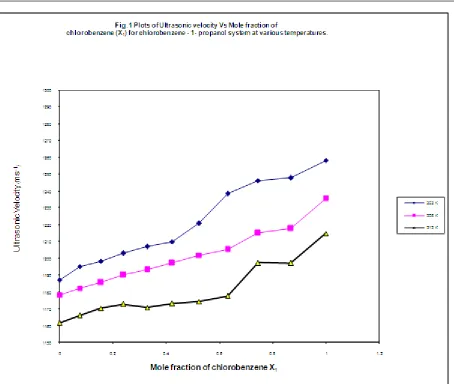
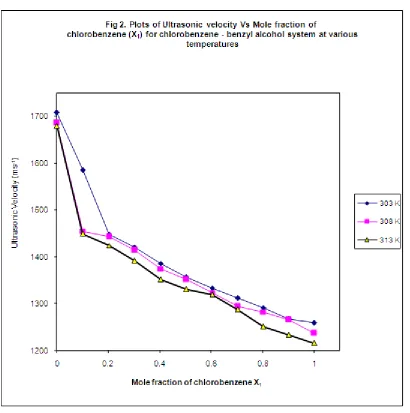
[image:3.595.211.402.544.682.2]The plots of ultrasonic velocity versus mole fraction of chlorobenzene for chlorobenzene 1-propanol system at three different temperatures are given in fig.1.
Table 4 Ultrasonic Velocity (U), density (ρρρρ), and viscosity (η) values For the binary Mixture of chlorobenzene-benzyl alcohol at303 K
Mole fraction of Chlorobenzene
Ultrasonic Velocity U
(ms-1)
Density ρρρρ (Kg m-3)
Viscosity
η x 10-3
(Nm-2 s)
0.0 1707.6 1038.1 4.528
0.1 1584.8 1042.5 3.655
0.2 1446.8 1048.9 2.925
0.3 1420.4 1054.2 2.384
0.4 1385.2 1059.9 1.941
0.5 1356.0 1065.2 1.612
0.6 1332.0 1072.1 1.343
0.7 1311.2 1075.1 1.147
0.8 1290.8 1082.4 0.924
0.9 1266.0 1087.0 0.812
[image:4.595.209.404.323.462.2]1.0 1258.4 1094.8 0.703
Table 5 Ultrasonic Velocity (U), density (ρρρρ), and viscosity (η) values For the binary Mixture of chlorobenzene- benzyl alcohol at308 K
Mole fraction of Chlorobenzene
Ultrasonic Velocity U
(ms-1)
Density ρρρρ (Kg m-3)
Viscosity
η x 10-3
(Nm-2 s)
0.0 1685.6 1037.4 4.065
0.1 1454.4 1042.3 3.382
0.2 1442.0 1048.6 2.821
0.3 1413.6 1054.1 2.266
0.4 1374.0 1059.6 1.857
0.5 1351.2 1063.8 1.500
0.6 1323.2 1071.4 1.272
0.7 1293.6 1075.0 1.100
0.8 1281.6 1081.1 0.903
0.9 1264.8 1086.4 0.784
1.0 1235.6 1092.6 0.684
Table 6 Ultrasonic Velocity (U), density (ρρρρ), and viscosity (η) values For the binary Mixture of chlorobenzene- benzyl alcohol at313 K
Mole fraction of Chlorobenzene
Ultrasonic Velocity U
(ms-1)
Density ρρρρ (Kg m-3)
Viscosity
η x 10-3
(Nm-2 s)
0.0 1678.8 1034.3 3.719
0.1 1448.8 1040.7 3.335
0.2 1423.6 1046.7 2.771
0.3 1391.2 1051.6 2.200
0.4 1350.8 1056.9 1.810
0.5 1330.0 1062.9 1.506
0.6 1319.2 1069.3 1.223
0.7 1287.2 1073.0 1.059
0.8 1250.0 1079.1 0.887
0.9 1232.4 1084.2 0.778
1.0 1214.8 1087.9 0.667
[image:4.595.210.402.507.644.2]Acoustical Parameters
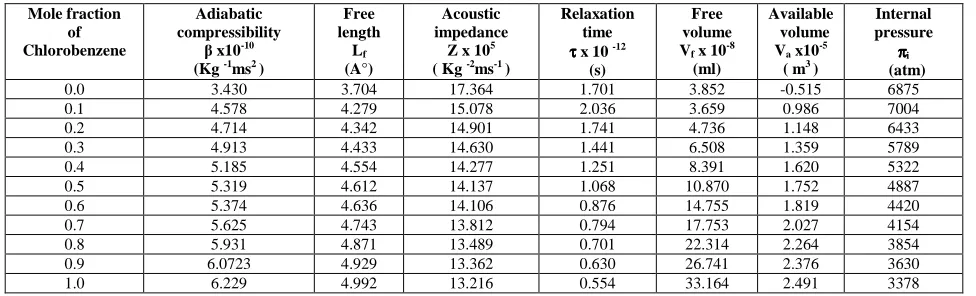
[image:5.595.83.537.61.445.2]The acoustic parameters for various compositions of chlorobenzene with 1-propanol and benzyl alcohol at various temperatures 303K, 308K and 313K, are calculated from the measured ultrasonic velocity, density and viscosity values. These data’s are given in Tables 7-12.
Table 7 Acoustic parameters for chlorobenzene – 1-propanol binary liquid mixture at 303 K
Mole fraction of Chlorobenzene
Adiabatic compressibility
β x 10-10
(Kg –1 ms2)
Free length
Lf
(A°)
Acoustic impedance
Z x 105
(Kg -2ms-1 )
Relaxation time ττττ x 10 -12
(s)
Free volume Vf x 10-8
(ml)
Available volume
Va x10-5
( m3 )
Internal pressure
ππππi (atm)
0.00 8.931 5.977 9.431 1.919 3.328 1.952 8671
0.08 8.492 5.828 9.852 1.605 4.483 1.966 7712
0.16 8.132 5.703 10.261 1.385 5.785 2.000 6965
0.24 7.791 5.582 10.668 1.233 7.142 2.032 6373
0.33 7.498 5.476 11.048 1.077 9.115 2.075 5756
0.42 7.213 5.371 11.457 0.951 11.425 2.119 5239
0.52 6.876 5.244 11.914 0.845 14.116 2.127 4779
0.63 6.485 5.093 12.447 0.734 17.918 2.095 4317
0.75 6.227 4.991 12.884 0.683 20.844 2.122 4013
0.87 6.026 4.910 13.297 0.649 23.563 2.182 3769
Table 8 Acoustic parameters for chlorobenzene – 1-propanol binary liquid mixture at 308 K
Mole fraction of Chlorobenzene
Adiabatic compressibility
β x10-10
(Kg -1ms2)
Free length
Lf
(A°)
Acoustic impedance
Z x 105
(Kg –2 ms-1)
Relaxation time ττττ x 10-12
(s)
Free volume Vf x 10-8
(ml)
Available volume
Va x10-5
( m3 )
Internal pressure
ππππi (atm)
0.00 9.080 6.0267 9.346 1.892 3.445 1.997 8704
0.08 8.701 5.899 9.721 1.597 4.610 2.034 7753
0.16 8.327 5.771 10.130 1.360 6.064 2.069 6960
0.24 7.991 5.654 10.516 1.177 7.822 2.107 6271
0.33 7.697 5.549 10.888 1.042 9.789 2.155 5702
0.42 7.393 5.438 11.298 0.910 12.457 2.196 5162
0.52 7.096 5.328 11.724 0.814 15.286 2.234 4729
0.63 6.868 5.241 12.081 0.752 18.074 2.295 4369
0.75 7.0623 5.315 11.651 0.683 24.235 2.489 3689
0.87 6.354 5.041 12.926 0.640 25.093 2.379 3743
Table 9 Acoustic parameters for chlorobenzene – 1-propanol binary liquid mixture at 313 K
Mole fraction of Chlorobenzene
Adiabatic compressibility
β x 10-10
(Kg –1 ms2)
Free length Lf (A°) Acoustic impedance
Z x 105
(Kg –2 ms-1 )
Relaxation time, ττττ x 10 -12
(s)
Free volume Vf x 10-8
(ml)
Available volume
Va x10-5
( m3 )
Internal pressure
ππππi (atm)
0.00 9.355 6.117 9.202 1.842 3.670 2.079 8654
0.08 8.957 5.986 9.575 1.585 4.770 2.112 7784
0.16 8.556 5.850 9.986 1.325 6.442 2.147 6926
0.24 8.242 5.742 10.345 1.170 8.087 2.199 6295
0.33 8.026 5.666 10.643 1.068 9.760 2.282 5786
0.42 7.710 5.553 11.055 0.922 12.623 2.330 5218
0.52 7.456 5.461 11.420 0.841 15.133 2.396 4812
0.63 7.209 5.370 11.780 0.760 18.492 2.461 4400
0.75 7.324 5.413 11.432 0.679 25.146 2.628 3699
0.87 6.583 5.132 12.688 0.653 25.037 2.510 3802
[image:7.595.57.558.271.422.2]1.00 6.229 4.992 13.215 0.620 28.002 2.491 3573
Table 10 Acoustic parameters for chlorobenzene – benzyl alcohol binary liquid mixture at 303 K
Mole fraction of Chlorobenzene
Adiabatic compressibility
β x 10-10
(Kg –1 ms2)
Free length Lf
(A°)
Acoustic impedance Z x 105
( Kg-2 ms-1 )
Relaxation time ττττ x 10 -12
(s)
Free volume Vf x 10-8
(ml)
Available volume
Va x10-5
( m3 )
Internal pressure ππππi (atm)
0.0 3.304 3.635 17.727 1.994 2.942 - 0.701 7299
0.1 3.819 3.909 16.522 1.861 3.649 0.010 6794
0.2 4.555 4.268 15.175 1.776 4.473 0.995 6356
0.3 4.702 4.337 14.974 1.495 5.948 1.166 5784
0.4 4.917 4.435 14.682 1.273 7.845 1.392 5279
0.5 5.106 4.519 14.444 1.098 10.100 1.580 4856
0.6 5.257 4.586 14.280 0.942 13.009 1.731 4470
0.7 5.410 4.652 14.097 0.828 16.188 1.868 4153
0.8 5.545 4.710 13.972 0.683 22.000 1.994 3756
0.9 5.740 4.792 13.761 0.622 26.092 2.153 3549
[image:7.595.64.552.452.600.2]1.0 5.768 4.803 13.777 0.541 32.282 2.195 3313
Table 11Acoustic parameters for chlorobenzene – benzyl alcohol binary liquid mixture at 308 K
Mole fraction of Chlorobenzene
Adiabatic compressibility
β x10-10
(Kg -1ms2 )
Free length Lf (A°) Acoustic impedance
Z x 105
( Kg -2ms-1 )
Relaxation time ττττ x 10 -12
(s)
Free volume Vf x 10-8
(ml)
Available volume
Va x10-5
( m3 )
Internal pressure
ππππi (atm)
0.0 3.430 3.704 17.364 1.701 3.852 -0.515 6875
0.1 4.578 4.279 15.078 2.036 3.659 0.986 7004
0.2 4.714 4.342 14.901 1.741 4.736 1.148 6433
0.3 4.913 4.433 14.630 1.441 6.508 1.359 5789
0.4 5.185 4.554 14.277 1.251 8.391 1.620 5322
0.5 5.319 4.612 14.137 1.068 10.870 1.752 4887
0.6 5.374 4.636 14.106 0.876 14.755 1.819 4420
0.7 5.625 4.743 13.812 0.794 17.753 2.027 4154
0.8 5.931 4.871 13.489 0.701 22.314 2.264 3854
0.9 6.0723 4.929 13.362 0.630 26.741 2.376 3630
1.0 6.229 4.992 13.216 0.554 33.164 2.491 3378
ADIABATIC COMPRESSIBILITY (β)
The plots of adiabatic compressibility against mole fraction of chlorobenzene of 1-propanol-chlorobenzene binary mixture at 303K, 308K and 313K are given in fig.3
According to Forte and Moore [16] hydrogen bonding between unlike components makes a negative contribution to compressibility. It may be noted that in the three different temperatures, the β value decreases with increase in concentration of the first component indicating the possibility of stronger interactions at higher concentration. It is also observed that the interactions are more at lower temperature at a specific concentration.
Table 12 Acoustic parameters for chlorobenzene – benzyl alcohol binary liquid mixture at 313 K
LINEAR FREE LENGTH (Lf)
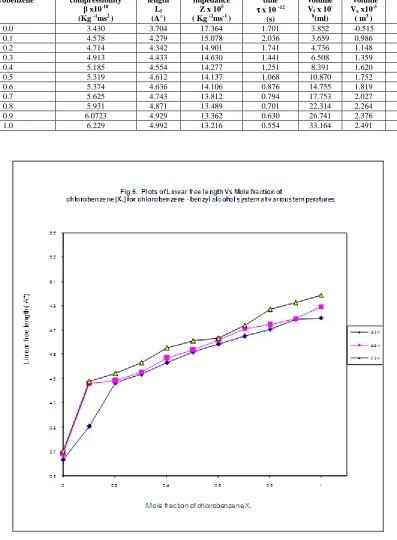
The free length of a system is a measure of intermolecular attraction between the components in binary mixtures. This increase in free length indicates weakening of intermolecular attraction. As the ultrasonic velocity increases due to the increase in concentration, the intermolecular free length has to decrease and vice versa [17].
Mole fraction of
Chlorobenzene
Adiabatic compressibility
β x10-10
(Kg -1ms2 )
Free length
Lf
(A°)
Acoustic impedance
Z x 105
( Kg -2ms-1 )
Relaxation time ττττ x 10 -12
(s)
Free volume Vf x 10
-8
(ml)
Available volume
Va x10-5
( m3 )
Internal pressure
ππππi (atm)
0.0 3.430 3.704 17.364 1.701 3.852 -0.515 6875
0.1 4.578 4.279 15.078 2.036 3.659 0.986 7004
0.2 4.714 4.342 14.901 1.741 4.736 1.148 6433
0.3 4.913 4.433 14.630 1.441 6.508 1.359 5789
0.4 5.185 4.554 14.277 1.251 8.391 1.620 5322
0.5 5.319 4.612 14.137 1.068 10.870 1.752 4887
0.6 5.374 4.636 14.106 0.876 14.755 1.819 4420
0.7 5.625 4.743 13.812 0.794 17.753 2.027 4154
0.8 5.931 4.871 13.489 0.701 22.314 2.264 3854
0.9 6.0723 4.929 13.362 0.630 26.741 2.376 3630
alcohol system at all the three different temperatures which indicates the strong attractions present in lower concentration of chlorobenzene. Fig.5 contains plots of linear free length against mole fraction of chlorobenzene for chlorobenzene - 1- propanol system at 303K, 308K and 313K.
ACOUSTIC IMPEDANCE (Z)
The acoustic impedance increases uniformly in chlorobenzene- 1-propanol system at all the temperatures investigated. The increase in acoustic impedance with concentration can be explained on the basis of lyophobic interaction between solute and solvent molecules [18, 19]. The plots of acoustic impedance versus mole fraction of chlorobenzene in chlorobenzene-1-propanol system at different temperatures are given in fig.7.
RELAXATION TIME(ττττ)
FREE VOLUME (Vf)
Tables 7-12 contain the free volume values for two systems at three different temperatures. Fig.11 contains plots of free volume against mole fraction of chlorobenzene for chlorobenzene - 1-propanol system at 303K, 308K and 313K. Fig 12 contains plots of free volume against mole fraction of chlorobenzene for chlorobenzene -benzyl alcohol system at 303K, 308K and 313K.
The trend present in chlorobenzene-1-propanol and chlorobenzene-benzyl alcohol systems is that the free volume increases with increase in concentration of first component.
INTERNAL PRESSURE (ππππi)
The variation of internal pressure with respect to the mole fraction of chlorobenzene in chlonobenzene-benzyl alcohol system at 303K, 308K and 313K is given in fig.14. The internal pressure value decreases when the free volume of the system increases.
CONCLUSION
In the present study, it can be inferred that there are intermolecular interactions among the components of the binary mixtures, leading to the possible hydrogen bond formation of the type Cl...H-O- between the two components of each binary system.The molecular attraction increases with increase in the concentration of chlorobenzene in chlorobenezene-1-propanol system investigated. But the molecular interaction decreases with increase in concentration of chlorobenzene in chlorobenzene-benzyl alcohol system due to steric hindrance. In both the system when the temperature increases, the interaction between the components decreases.
Acknowledgement
The author thanks the Principal and the Management of The New College, Chennai-14. for the support and the encouragement given.
REFERENCES
[1]D Vengatesulu, and DK Prabhakara Rao. j . Acous. Soc. of India, 1999, Vol XXVII, No. 1-4, 320. [2](a)SJ Askar Ali; K Rajathi and A Rajendran. J. Chem. Pharm . Res., 2011,3 (5): 348-358
[3](b)VD.Bhandarkkar; OP.Chimankar and NR.Pawar. J. Chem. Pharm . Res., 2010,2 (4): 873-877 [4](c) OP.Chimankar; R.Shiriwas and VA.Tabhane. J. Chem. Pharm . Res., 2011,3 (3 ):587-596 [5](d)SR.Aswale; SS.Aswale andAB.Dhote. J. Chem. Pharm . Res., 2011,3 (6 ):233-237
[6](e)K.Sreekanth; D.Sravanakumar, M.Kondaiah and D.Krishna Rao. J. Chem. Pharm . Res., 2011,3 (4 ):229-241 [7]MBR Murthy; RI Patil, and DK Deshpande. Ind. J. Pure. & Appl. Phys. 1991, 29, 134.
[8]CM Seghal and BR Porter J. Acoust. Soc. Amer., 1986 79, 410.
[9]Anwar Ali and Anil Kuamar Nain. J. Pure Appl. Ultrason., 1994, 16., 74. [10]PS Nikam; MC Jadhav, and M Hasan. Acoustica Acta Acoustica 1997, 83, 86. [11]PS Nikam; RB Pathak, and MJ Hasan, pure and Appl. Ultrasonic. 1996, 18, 19. [12]PS Nikam; TR Mahale, and M Hasan. Acoustica Acgta Acoustica 1998, 84, 579. [13]PS Nikam; MC Jadhav and MJ Hasan. Mol. Liq. 1998, 76, 1.
[14]PS Nikam; TR Mahale, and M Hasan. Indian J. Pure and Appl. Phys. 1999, 37, 92. [15]V Kannappan; R Jaya Santhi and EJP Malar. Phy Chem Liq 2000, 40 133.
[17]Anwar Ali and Anil Kumar Nain. Acoustics Lett, 1996 19 181.
[18]SC Bhatt Harikrishnan Semwal and Vijendra Lingwal. J Acous Soc Ind, 2000 28 275. [19]PS Nikam and Hiray. Indian J Pure & Appl Phys, 1991 29 601.
[20]RJ Forte and WR Moore . Trans Faraday Soc. 1965, 61, 2102 [21]H Eyring and JF Kincaid. J. Chem. Phys.,1931, 6,620.
[22]J Ishwara Bhat and HR Shiva Kumar. Ind. J. Chem A., 1998, 37, 252. [23]J Ishwara Bhat Pure & Appl Phys., 2000 38 306.