3063
PRELIMINARY INSIGHTS INTO THE CONCERNS OF
ONLINE PRIVACY AND SECURITY AMONG MILLENNIALS
IN A DEVELOPING ECONOMY
1ACHEAMPONG OWUSU, 2FREDERICK EDEM BRONI JNR, 3PRINCE KOBBY AKAKPO
Operations and Management Information Systems (OMIS) Department, University of Ghana Business School
Email: 1[email protected], 2[email protected], 3[email protected]
ABSTRACT
Millennials, described as tech-savvies are knowledgeable and using the internet for a couple of things ranging from social media, education, e-commerce, entertainment and so on. However, there are growing concerns lately about online privacy and security with the emergence of the Web 2.0 technologies that allow a lot of multimedia online which is attractive to the millennials. Although there is a threat to what the millennials are agreeing to and the information they provide online, yet there are limited studies that have explored the online privacy issues concerning millennials. Thus, in this study, we investigated millennials and their awareness concerning online privacy threats and security, whether they are bothered about what they put online, as well as measures they have put in place to mitigate this menace from a developing economy perspective. The study employed a quantitative approach where survey data was gathered through self-administration questionnaires with a random sample of 700 undergraduate students in a public university in Ghana. The findings revealed that most of the millennials are aware and concerned about online privacy threats. They are also bothered about privacy effects concerning the information they put online. Therefore, they wish there are laws and regulations protecting consumers about their online privacy in Ghana. The originality of the paper stems from the fact that there is paucity of research about online privacy especially among the millennials in sub-Saharan African countries and our paper is the first to be done in the Ghanaian context.
Keywords - Online privacy, Millennials, Internet, Developing economies, Ghana
1. INTRODUCTION
Subscribing to the terms and conditions and privacy policies of online service providers is becoming a day-to-day routine for a huge chunk of the world’s population today. When individuals tick the checkboxes as a statement of consent, they usually give unsolicited authorization to websites to gather, share and sell data to third parties as an exchange for other different online services. Personal data most certainly is major forefront for varying business models and in recent times is the goldmine for several online companies such as Google, Facebook, and Amazon [1]. In spite of giving formal permission, consumers are usually ignorant of what these digital exchanges comprise of [2] and also have partial knowledge about the outcomes of giving out personal data, when, how and why their information will be collected and with whom this information will be shared with
3064 and cell phones have been extensively embraced in America in the past 15 years, and Millennials have been the foremost technology enthusiasts. For them, these advancements give in excess of an endless source of information and entertainment and more than another novel network for their social lives.
In a study by Anderson and Rainie [9], a whopping 69% of respondents agreed that “By 2020, members of Generation Y (today’s ‘digital natives’) will continue to be ambient broadcasters who disclose a great deal of personal information in order to stay connected and take advantage of social, economic, and political opportunities. Even as they mature, have families, and take on more significant responsibilities, their enthusiasm for widespread information sharing will carry forward” against 28% who think otherwise. The Millennials, described as tech-savvies [9] are knowledgeable and using the internet for a couple of things ranging from social media, education, e-commerce, entertainment and so on. With the advent of the web 2.0 technologies which have brought interactivity amongst users, millennials are now always connected through the web 2.0 services such as blogs, Google (not only as a search engine, but also as a tool for file sharing, google docs, and to connect with others, Yahoo mail), Skype, Facebook, Vsco, Twitter, Snapchat, Tubidy, Instagram and WhatsApp [10].
Whilst there exists deficient literature [11] concerning online privacies and how to mitigate against threats associated with it, it is even worse in the case of millennials as limited studies have explored their online privacy issues concerning what they are agreeing to on the internet. In addition, in the case of developing economies, we don’t know what pertains in terms of the millennials and their online privacy concerns as there is a paucity of literature [12]. This study will attempt to address these gaps in literature.
The rate of internet penetration keeps on increasing in Ghana and other developing economies. The increase with regards to internet penetration can be associated with the use of smartphones and the affordability of internet services. Most of the universities in these developing countries also provide campus-wide internet access to all students at little or no cost at all. Thus, many students are now using mobile personal computers and handheld devices to access the internet everywhere ranging from their hostels, libraries, classrooms etc. Consequently, exploring their awareness concerning online privacy issues
to ascertain if they know and understand what they are putting online, and its implications is justifiable in this paper.
The main purpose of this study is to investigate the awareness of online privacy and security threats amongst millennials from a developing economy perspective.
Specifically, the study seeks to:
1. Explore whether Ghanaian millennials are
aware of online privacy and its associated security threats
2. Explore whether Ghanaian millennials are
concerned about their online privacy
3. Examine what measures Ghanaian
millennials have taken to protect their online privacy and its associated threats.
Based on these objectives, the study addressed the following research questions:
1. Are Ghanaian millennials aware of online
privacy and its associated security threats?
2. Are Ghanaian millennials concerned
about their online privacy?
3. What measures have Ghanaian
millennials taken to protect their online privacy and its associated threats?
The rest of the paper follows this outline: Section 2 reviews relevant literature on online privacy and its security threats. Section 3 presents the research methods while Section 4 presents analyses and findings of the survey. Finally, Section 5 concludes the paper with its contribution to practice and recommendation for more research in the area of online privacy.
2. LITERATURE REVIEW
2.1 The Concept of Online Privacy
3065 the dangers and potential negative outcomes related to sharing information [16], [17].
Baruh, Secinti, & Cemalcilar [18] asserted that the
concept of privacy concernsrefers to “individuals’
beliefs about the risks and potential negative consequences associated with sharing information” [16], [17]. Thus, individuals are more likely to reveal private information only when they trust whom or the entity, they are given their information to. As a result, people may release personal information when they trust the e-tailer and they perceive the benefit of disclosing the information to be high, else sensitive personal information may be withheld by them if possible [19].
Individuals become more acquainted with online sites as a result of familiarity, hence, are more comfortable giving out or taking information from
these sites regardless of their privacy concerns [20]. There are a number of issues relating to online privacy, ranging from using web cookies to track consumers to the sending of unsolicited emails to individuals. From these issues, individuals tend to feel unsafe using the internet and also shy away from the use of technology [21].
2.2 Related studies of Online Privacy
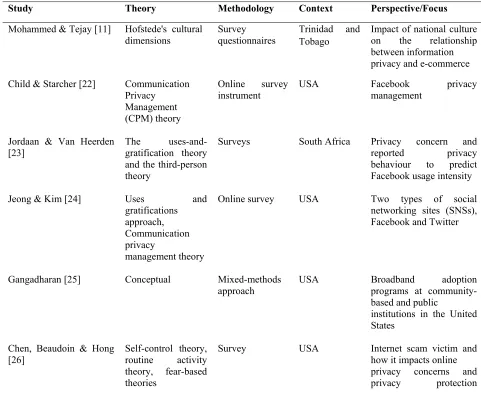
With the advancement of the Internet with web 2.0 technologies that has enabled easier collaboration among online users, issues about privacy concerns is on ascendency. As a result, privacy concerns are gaining popularity lately. Table 1 shows a list of selected papers that have studied online privacy and security concerns in diverse perspective and
[image:3.612.82.563.330.730.2]different context.
Table 1: Selected papers on Online Privacy Concerns
Study Theory Methodology Context Perspective/Focus
Mohammed & Tejay [11] Hofstede's cultural
dimensions Survey questionnaires Trinidad and Tobago
Impact of national culture
on the relationship
between information privacy and e-commerce
Child & Starcher [22] Communication
Privacy Management (CPM) theory
Online survey
instrument USA Facebook management privacy
Jordaan & Van Heerden
[23] The gratification theory
uses-and-and the third-person theory
Surveys South Africa Privacy concern and
reported privacy
behaviour to predict
Facebook usage intensity
Jeong & Kim [24]
Uses gratifications and
approach, Communication privacy
management theory
Online survey USA Two types of social
networking sites (SNSs), Facebook and Twitter
Gangadharan [25] Conceptual Mixed-methods
approach
USA Broadband adoption
programs at community-based and public
institutions in the United States
Chen, Beaudoin & Hong
[26] Self-control theory, routine activity
theory, fear-based theories
Survey USA Internet scam victim and
how it impacts online privacy concerns and
3066
behaviors
Martin, Gupta, Windgreen & Mills [27]
Westin’s theory of Personal
Information Privacy
(PIP) and
Concourse theory
A Q-sort
instrument/ survey
New Zealand Personal information
privacy
Metzger [19]
CPM theory Survey USA Information and privacy within e-disclosure
commerce relationships
Fortes & Rita [28] The theory of
planned behaviour, the theories of trust and risk, and the Technology
Acceptance Model (TAM)
Online survey Portugal Analysis of how privacy
concerns about the
Internet can impact on the consumer’s intention to make online purchases.
Fodor & Brem [29] Concern for
Information Privacy (CFIP) and Internet Users’ Information
Privacy Concerns
(IUIPC)
Online survey Germany Location-Based Services
(LBS) adoption
Bergström [30] Conceptual Mail survey Sweden Digital use and
manipulation of personal information
Krishen, Raschke, Close
& Kachroo [31] Theory on the
power-responsibility equilibrium
Mixed method USA Location-based services
(LBS) and consumers' concerns about privacy and fairness that pertain to these services
In reference to Table 1, the literature revealed that most of the research concerning privacy issues have focused on diverse areas including e-commerce, social networking sites (SSNs), location-based services (LBSs), personal information privacy, Internet scam, security among others. However, there is not much focus in terms of the millennials and their online privacy concerns although they are mostly online lately. In addition, most of these studies were done in the developed
world leaving developing countries
especially SSA economies with paucity of research. This study thus fills these identified gaps in literature with the focus on the millennials and their online presence and
what they do, whether they are aware of privacy issues and what measures they’ve put in place to curtail it. In addition, the study is also done from a developing economy context, Ghana which will also help to enrich the IS literature from a developing economy context.
3. RESEARCH METHODOLOGY
3067 Questionnaires were used to collect data from
the students. The questionnaire was developed in English and administered on the university campus. The questions in the survey instrument were questions adapted from existing studies [32]–[38] and modified to suit the context of this study. The questionnaire consists of 2 parts. In the first part, questions about demographics were asked which includes questions demanding “Yes/No” responses whilst online security awareness and concerns, information privacy and internet usage made up the second part of the questionnaire. The second part of the
questionnaire demands answers from respondents
measured as “Yes, No, Not Sure, Does not apply”.
Others include “Very concerned, Somewhat concerned, Not very concerned, Not concerned at all, Not sure” as well as “Very Important, Somewhat Important, Not too important, Not at all, Does not Apply, Don’t Know”.
4. ANALYSIS, FINDINGS, AND DISCUSSIONS
SPSS v22 was used to analyze the data. The statistical test performed was Descriptive Statistics. Out of the 700 primary data collected, 7 were rejected because of the incompleteness of the questions. Thus, a total of 693 samples were used for the final analysis.
[image:5.612.139.476.298.361.2]4.1 Descriptive profiles of the respondents
Table 2: Gender of respondents
Frequency Percent Valid Percent Cumulative Percent
Valid Male 348 50.2 50.2 50.2
Female 345 49.8 49.8 100.0
Total 693 100.0 100.0
Concerning the Gender of respondents (Table 2), the descriptive statistics indicate that 348 (50.2%) were males and 345(49.8%) were
[image:5.612.135.478.430.502.2]females. Thus, both sexes were highly represented with the males marginally ahead of the females.
Table 3: Age of respondents
Frequency Percent Valid Percent
Cumulative Percent
Valid Below 20 254 36.7 36.7 36.7
21-25 429 61.9 61.9 98.6
26-30 10 1.4 1.4 100.0
Total 693 100.0 100.0
In terms of Age (Table 3), 254 (36.7%) were below 20, 429 (61.9%) were between 21-25 years category whilst a small number of 10 (1.4%) were between the ages of 26-30. This
indicates that a higher percentage of the target respondents were highly represented in this study based on the PEW Research who defined the millennials with
age range from “18-29” [39].
Table 4: Internet usage of respondents
Frequency Percent Valid Percent Cumulative Percent
Valid Yes 676 97.5 97.5 97.5
No 17 2.5 2.5 100.0
Total 693 100.0 100.0
We also seek to know the level of Internet usage among the millennials (Table 4). The findings indicated that 676 (97.5%) of the respondents are using the Internet with a small figure 17 (2.5%) not
using the internet. The findings thus confirm that of the PEW Research where 75% of the millennials confirmed they own social media account and also 90% confirming they used the Internet and also send and receive email
[image:5.612.144.468.584.643.2]3068
Table 5: Smart Phones for respondents
Frequency Percent Valid Percent Cumulative Percent
Valid Yes 687 99.1 99.1 99.1
No 6 .9 .9 100.0
Total 693 100.0 100.0
Concerning the devices they used to access the internet (Table 5), 687 (99.1%) said they have smartphones with 6 (.9%) not having it. Thus, this confirms that of the PEW Research which shows 83% of the millennials even
sleep with the cell phones and 88% who said they have been using their cell phones for texting.
[image:6.612.120.496.365.436.2]In addition, 596 (86%) said they own laptops with 97(14%) not having it as shown in Table 6.
Table 6: Laptops for respondents
Frequency Percent Valid Percent Cumulative Percent
Valid Yes 596 86.0 86.0 86.0
No 97 14.0 14.0 100.0
Total 693 100.0 100.0
Table 7: Mostly used device of respondents
Frequency Percent Valid Percent Cumulative Percent
Valid Computer/Laptop 41 5.9 5.9 5.9
Smartphone 415 59.9 59.9 65.8
Both 237 34.2 34.2 100.0
Total 693 100.0 100.0
In terms of the device they used to access the internet mostly (Table 7), a whopping figure 415 (59.9%) said they used their smartphones, 237 (34.2%) said they used both their Laptop/Smartphone whilst 41 (5.9%) said they used their Laptop. This is an indication of the high penetration of smart phones usage in accessing Internet in
Ghanaian universities due to the widespread of campus Wi-Fi implementation.
4.2 Ghanaian millennials awareness of online privacy
To explore the awareness level of the millennials in terms of privacy, we asked them a basic question: “Are you familiar with the term privacy?” with response option
as “Yes, No, and Not sure”.
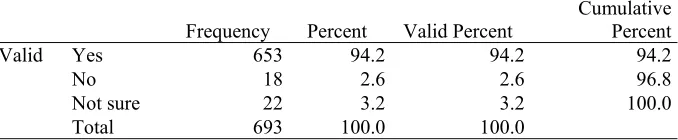
Table 8: Privacy familiarity among the millennials
Frequency Percent Valid Percent Cumulative Percent
Valid Yes 653 94.2 94.2 94.2
No 18 2.6 2.6 96.8
Not sure 22 3.2 3.2 100.0
Total 693 100.0 100.0
As indicated in Table 8, 653 respondents representing 94.2% responded “Yes” with 18 (2.6%) responding “No” and 22 (3.2%) responding “Not sure”. This is a clear
[image:6.612.137.476.587.657.2]3069 many "Millennials have built their lives
around social media, they treat the technology seriously” and it is this seriousness which motivates them to take control of their online information [12].
4.3 Preliminary insights into Ghanaian millennials concern about their online privacy
To find the preliminary insights into the millennials concern about their online privacy, two different questions were used. First, the respondents were asked about
[image:7.612.105.505.278.375.2]“How concerned are you about the availability of your private information on the Internet?” which was measured as “Very concerned, Somewhat concerned, Not very concerned, Not concerned at all, and Not sure”. Secondly, they were also asked to scale their private information online with the question “Are you concerned about this personal information being on the internet?”. The personal information was “Your cell phone number, Your credit/debit card information or bank details, Your home address, Your date of birth”. These were also measured as: “Very concerned, Somewhat concerned, Not very concerned, Not concerned, and Not sure”. Tables 9 outlined the information about the millennials online concern about their privacy.
Table 9: Respondents concern about their privacy information
Frequency Percent Valid Percent Cumulative Percent
Valid Very concerned 535 77.2 77.2 77.2
Somewhat concerned 112 16.2 16.2 93.4
Not very concerned 40 5.8 5.8 99.1
Not concerned at all 3 .4 .4 99.6
Not sure 3 .4 .4 100.0
Total 693 100.0 100.0
From Table 9, there is a high degree of privacy concern among the millennials as 535 (77.2%) of the respondents said they are “Very concerned” about their information online. This is followed by 112 (16.2%) who expressed “Somewhat concerned” with the rest forming a smaller chunk of less than 7%.
To further probe the millennials about their information online and how concerned they are about them, information about their “Phone Numbers, Bank Details, Home Address and Date of Birth” were also asked. Tables 10, 11, 12, and 13 illustrates their response.
[image:7.612.105.508.503.597.2]
Table 10: Respondents concern about their privacy information (Phone Number online)
Frequency Percent Valid Percent Cumulative Percent
Valid Very concerned 437 63.1 63.1 63.1
Somewhat concerned 140 20.2 20.2 83.3
Not very concerned 87 12.6 12.6 95.8
Not concerned at all 28 4.0 4.0 99.9
Not sure 1 .1 .1 100.0
Total 693 100.0 100.0
From Table 10, 437 (63.1%) said they are “Very concerned” with 140 (20.2%) responding “Somewhat concerned”. This is
an indication that the majority of the millennials in this study take their privacy seriously.
Table 11: Respondents concern about their privacy information (Bank details online)
Frequency Percent Valid Percent Cumulative Percent
Valid Very concerned 617 89.0 89.0 89.0
[image:7.612.113.506.670.714.2]3070
Not very concerned 14 2.0 2.0 95.2
Not concerned at all 18 2.6 2.6 97.8
Not sure 15 2.2 2.2 100.0
Total 693 100.0 100.0
From Table 11, 437 (89%) said they are “Very concerned” with 29 (4.2%) responding “Somewhat concerned” when asked about
[image:8.612.107.505.215.309.2]their Bank Details online. This is an indication that the majority of the millennials in this study does not joke with sensitive information such as their Bank details.
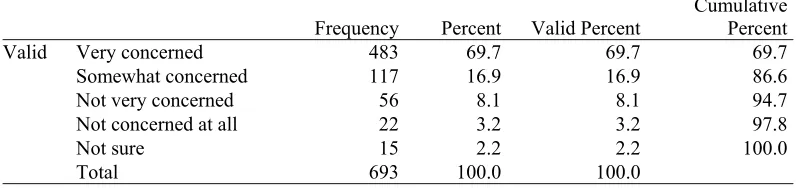
Table 12: Respondents concern about their privacy information (Home Address online)
Frequency Percent Valid Percent Cumulative Percent
Valid Very concerned 483 69.7 69.7 69.7
Somewhat concerned 117 16.9 16.9 86.6
Not very concerned 56 8.1 8.1 94.7
Not concerned at all 22 3.2 3.2 97.8
Not sure 15 2.2 2.2 100.0
Total 693 100.0 100.0
In terms of their Home Address online, from Table 12, 483 (69.7%) said they are “Very concerned” with 117 (16.9%) responding
“Somewhat concerned”. This is also another indication that shows that most millennials in this study take their privacy seriously.
Table 13: Respondents concern about their privacy information (Date of Birth online)
Frequency Percent Valid Percent Cumulative Percent
Valid Very concerned 306 44.2 44.2 44.2
Somewhat concerned 177 25.5 25.5 69.7
Not very concerned 161 23.2 23.2 92.9
Not concerned at all 46 6.6 6.6 99.6
Not sure 3 .4 .4 100.0
Total 693 100.0 100.0
Lastly, in terms of the Date of Birth online, from Table 13, 306 (44.2%) said they are “Very concerned” with 177 (25.5%)
responding “Somewhat concerned”.
Surprisingly, 161 (23.2%) responded “Not very concerned”. Thus, although the millennials seem to be bothered about their online privacy information, yet in the case of their date of birth, they seem not to be too bothered.
4.4 Measures Ghanaian millennials have taken to protect their online privacy
[image:8.612.107.506.379.473.2]3071
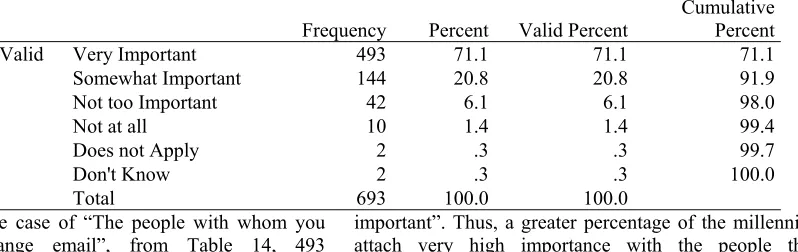
Table 14: Respondents care about who they exchange email with
Frequency Percent Valid Percent Cumulative Percent
Valid Very Important 493 71.1 71.1 71.1
Somewhat Important 144 20.8 20.8 91.9
Not too Important 42 6.1 6.1 98.0
Not at all 10 1.4 1.4 99.4
Does not Apply 2 .3 .3 99.7
Don't Know 2 .3 .3 100.0
Total 693 100.0 100.0
In the case of “The people with whom you exchange email”, from Table 14, 493 (71.1%) responded “Very important” with
144 (20.8%) responding “Somewhat
[image:9.612.109.502.287.391.2]important”. Thus, a greater percentage of the millennials attach very high importance with the people they exchange emails with.
Table 15: Respondents care about the contents of their online chats
Frequency Percent Valid Percent Cumulative Percent
Valid Very Important 526 75.9 75.9 75.9
Somewhat Important 109 15.7 15.7 91.6
Not too Important 40 5.8 5.8 97.4
Not at all 12 1.7 1.7 99.1
Does not Apply 3 .4 .4 99.6
Don't Know 3 .4 .4 100.0
Total 693 100.0 100.0
In the case of “The content of your online chats”, from Table 15, 526 (75.9%) responded “Very important” with 109
[image:9.612.109.501.460.569.2](15.7%) responding “Somewhat important”. Thus, a greater percentage of the millennials attach very high importance concerning their online chats.
Table 16: Respondents care about the websites they browse
Frequency Percent Valid Percent Cumulative Percent
Valid Very Important 288 41.6 41.6 41.6
Somewhat Important 238 34.3 34.3 75.9
Not too Important 137 19.8 19.8 95.7
Not at all 24 3.5 3.5 99.1
Does not Apply 2 .3 .3 99.4
Don't Know 4 .6 .6 100.0
Total 693 100.0 100.0
In the case of “The websites you browse”, from Table 16, 288 (41.6%) responded “Very important” with 238 (34.3%) responding “Somewhat important”, and 137 (19.8%) responding “Not too important”.
3072
Table 17: Respondents care about the applications or programs they use
Frequency Percent Valid Percent Cumulative Percent
Valid Very Important 244 35.2 35.2 35.2
Somewhat Important 247 35.6 35.6 70.9
Not too Important 165 23.8 23.8 94.7
Not at all 30 4.3 4.3 99.0
Does not Apply 3 .4 .4 99.4
Don't Know 4 .6 .6 100.0
Total 693 100.0 100.0
Likewise, in the case of “The applications or programs you use”, from Table 17, 244 (35.2%) responded “Very important” with
247 (35.6%) responding “Somewhat
important”, and 165 (23.8%) responding
[image:10.612.109.502.309.414.2]“Not too important”. Thus, although a greater percentage of the millennials attach importance concerning the applications or programs use online, yet it seems not to be too much important to some of them.
Table 18: Respondents care about the contents and files they download
Frequency Percent Valid Percent Cumulative Percent
Valid Very Important 380 54.8 54.8 54.8
Somewhat Important 194 28.0 28.0 82.8
Not too Important 90 13.0 13.0 95.8
Not at all 25 3.6 3.6 99.4
Does not Apply 2 .3 .3 99.7
Don't Know 2 .3 .3 100.0
Total 693 100.0 100.0
In the case of “The content and files that you download”, from Table 18, 380 (54.8%) responded “Very important” with 194
(28.0%) responding “Somewhat important”. Thus, a greater percentage of the millennials attach high importance concerning what they download.
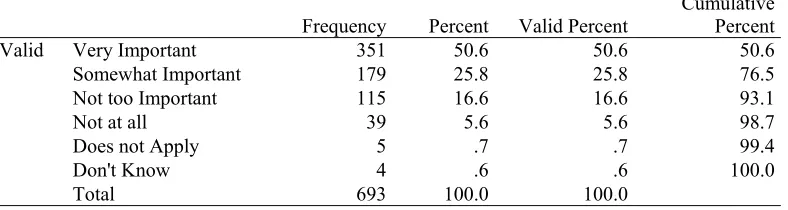
Table 19: Respondents care about the physical location they connect to the internet
Frequency Percent Valid Percent Cumulative Percent
Valid Very Important 351 50.6 50.6 50.6
Somewhat Important 179 25.8 25.8 76.5
Not too Important 115 16.6 16.6 93.1
Not at all 39 5.6 5.6 98.7
Does not Apply 5 .7 .7 99.4
Don't Know 4 .6 .6 100.0
Total 693 100.0 100.0
In the case of “The place where you are physically located when you use the Internet”, from Table 19, 351 (50.6%) responded “Very important” with 179 (25.8%) responding “Somewhat important” and 115 (16.6%) responding “Not too important”. Thus, a
greater percentage of the millennials attach high importance concerning the location where they physically access the internet.
[image:10.612.111.505.487.592.2]3073
Table 20: Respondents care about the times of the day they are online
Frequency Percent Valid Percent Cumulative Percent
Valid Very Important 191 27.6 27.6 27.6
Somewhat Important 213 30.7 30.7 58.3
Not too Important 204 29.4 29.4 87.7
Not at all 77 11.1 11.1 98.8
Does not Apply 4 .6 .6 99.4
Don't Know 4 .6 .6 100.0
Total 693 100.0 100.0
Likewise, in the case of “The times of the day you are online”, from Table 20, 191 (27.6%) responded “Very important” with
213 (30.7%) responding “Somewhat
important”, 204 (29.4%) responding “Not too
[image:11.612.109.503.308.414.2]important” and 77 (11.1%) responding “Not at all”. Thus, although a greater percentage of the millennials attach importance concerning the times of the day they are online, yet it seems not to be too much important to some of them.
Table 21: Respondents care about the contents of their email
Frequency Percent Valid Percent Cumulative Percent
Valid Very Important 478 69.0 69.0 69.0
Somewhat Important 128 18.5 18.5 87.4
Not too Important 56 8.1 8.1 95.5
Not at all 19 2.7 2.7 98.3
Does not Apply 7 1.0 1.0 99.3
Don't Know 5 .7 .7 100.0
Total 693 100.0 100.0
In the case of “The contents of your email”, from Table 21, 478 (69.0%) responded “Very important” with 128 (18.5%) responding
“Somewhat important”. Thus, a greater percentage of the millennials attach high importance concerning their email contents.
Table 22: Respondents care about the searches they perform online
Frequency Percent Valid Percent Cumulative Percent
Valid Very Important 355 51.2 51.2 51.2
Somewhat Important 208 30.0 30.0 81.2
Not too Important 99 14.3 14.3 95.5
Not at all 26 3.8 3.8 99.3
Does not Apply 2 .3 .3 99.6
Don't Know 3 .4 .4 100.0
Total 693 100.0 100.0
Likewise, in the case of the “The searches you perform”, from Table 22, 355 (51.2%) responded “Very important” with 208 (30.0%) responding “Somewhat important”. Thus, a greater percentage of the millennials attach high importance concerning their online searches.
The findings outlined above in terms of the millennials concern about privacy is clearly in support of the findings of [12] which
stated that “older generations seek privacy by avoiding the internet, while Millennials seek privacy by controlling it.”
4.5 Current laws and their protections of people’s privacy about their online activities
[image:11.612.110.503.485.592.2]3074 First, we asked them: “Thinking about
current laws in your country, does your country have laws that provide reasonable protections of people’s privacy about their online activities?” measured with three responses as “Yes, No, and Don't know”.
[image:12.612.131.482.189.259.2]Secondly, we asked: “Do you think that it is important for your country to have laws that provide reasonable protections of people’s privacy about their online activities?” This was also measured with three responses as “Yes, No, and Don't know”.
Table 23: Laws in the country for protecting online consumers
Frequency Percent Valid Percent Cumulative Percent
Valid Yes 186 26.8 26.8 26.8
No 231 33.3 33.3 60.2
Don't Know 276 39.8 39.8 100.0
Total 693 100.0 100.0
Concerning the current laws for protection (Table 23), 186 (26.8%) responded “Yes”, 231 (33.3%) responded “No” whilst 276 (39.8%) responded “Don’t Know”. Thus, a greater percentage of the respondents are not
aware of any existing laws protecting consumers in terms of their online activities.
Table 24: Importance of Laws in the country protecting online consumers
Frequency Percent Valid Percent Cumulative Percent
Valid Yes 642 92.6 92.6 92.6
No 31 4.5 4.5 97.1
Don't Know 20 2.9 2.9 100.0
Total 693 100.0 100.0
In addition, concerning the importance of the country having laws protecting consumers (Table 24), 642 (92.6%) of the respondents answered “Yes” with 31 (4.5%) responding “No” and 20 (2.9%) responding “Don’t Know”. Thus, although majority of the respondents are not aware of existing laws protecting consumers, they want such laws to be enacted to protect consumers about their online activities.
5. CONCLUSION
This study preliminarily seeks to explore the awareness concerning online privacy threats and security of Ghanaian millennials, whether they are bothered about what they put online, as well as measures they have put in place to mitigate this menace. The findings have established that indeed the millennials are aware of online privacy and are also concerned about what they put online. Nevertheless, most of them are not aware of the laws protecting consumers online behavior and wish policy makers and
regulators will enact laws that will be widely accessible to all online users to allay the negative effects of online consumer behavior.
With online privacy issues becoming pervasive lately, the findings from this preliminary study has given us optimism that the millennials are not just online and sending anything but are more focused and concerned about what they put and access online.
5.1 Implications
Thus, in terms of implications for practice, government should enact laws not only for the brick-and-mortar business such as the Consumer Protection Law which was passed recently (Ghana.gov.gh, 2019), but should include legislations and regulations that will protect consumers online behavior as well.
5.2 Limitations and suggestions for future studies
[image:12.612.131.485.355.422.2]3075 schools as most of the millennials are still in
school. Also, this study adopted a quantitative approach in terms of data collection and analysis. Future studies can do a qualitative or mixed method study to validate the findings of this study.
In addition, the authors will like to do a comprehensive study about the online privacy issues involving Ghanaian workers across various sectors with a strong theoretical support which is lacking in this preliminary paper.
REFERENCES
[1] R. Casadesus-Masanell and A.
Hervas-Drane, “Competing with Privacy,” Ssrn,
2013.
[2] A. Acquisti, C. Taylor, L. Wagman, A. Acquisti, C. Taylor, and L. Wagman,
“The Economics of Privacy,” J. Econ.
Lit., vol. 54, no. 2, pp. 442–492, 2016.
[3] T. Vila, R. Greenstadt, and D. Molnar, “Why we can’t be bothered to read privacy policies models of privacy economics as a lemons market,” 2004, no. May, pp. 403–407.
[4] J. L. Parrish, J. L. Bailey, and J. F. Courtney, “A Personality Based Model for Determining Susceptibility to
Phishing Attacks,” Southwest Decis. Sci.
Inst. Annu. Meet., no. February 2015, pp. 285–296, 2009.
[5] E. Vanderhoven, T. Schellens, M. Valcke, and A. Raes, “How safe do teenagers behave on facebook? An
observational study,” PLoS One, vol. 9,
no. 8, 2014.
[6] S. Kokolakis, “Privacy attitudes and privacy behaviour : A review of current research on the privacy paradox phenomenon Privacy attitudes and privacy behaviour : A review of current research on the privacy paradox
phenomenon,” Comput. Secur., vol. 64,
pp. 122–134, 2017.
[7] E. Dincelli and S. Goel, “Can Privacy and Security Be Friends? A Cultural Framework to Differentiate Security and Privacy Behaviors on Online Social
Networks,” Proc. 50th Hawaii Int. Conf.
Syst. Sci., pp. 4011–4020, 2017.
[8] L. E. Arab and G. A. Díaz, “Impacto de las redes sociales e internet en la adolescencia: aspectos positivos y
negativos,” Rev. Médica Clínica Las
Condes, vol. 26, no. 1, pp. 7–13, 2015. [9] J. Q. Anderson and L. Rainie,
“Millennials will make online sharing in networks a
lifelong habit,” Pew Research Center, pp. 1–28,
2010.
[10] M. Pieri and D. Diamantini, “Mobile Learning and an
Experience with Blended Mobile Learning,” Encycl.
Inf. Commun. Technol., no. 2003, pp. 548–553, 2009. [11] Z. A. Mohammed and G. P. Tejay, “Examining
privacy concerns and ecommerce adoption in developing countries: The impact of culture in shaping individuals’ perceptions toward technology,” Comput. Secur., vol. 67, pp. 254–265, 2017.
[12] M. J. Sher, “Millennial Dissonance : An Analysis of
the Privacy Generational Gap,” in In XVIII Congreso
Argentino de Ciencias de la Computación, 2012. [13] F. Belanger and R. E. Crossler, “Privacy in the
Digital Age: A Review of Information Privacy
Research in Information Systems,” MIS Q., vol. 35,
no. 4, pp. 1017–1041, 2011.
[14] S. Livingstone, “Taking risky opportunities in youthful content creation: Teenagers’ use of social networking sites for intimacy, privacy and
self-expression,” New Media Soc., vol. 10, no. 3, pp. 393–
411, 2008.
[15] K. M. Mallan and N. Giardina, “QUT Digital
Repository : Title,” First Monday, vol. 16, no. 6, pp.
45–50, 2009.
[16] H. Cho, J. S. Lee, and S. Chung, “Optimistic bias about online privacy risks: Testing the moderating effects of perceived controllability and prior
experience,” Comput. Human Behav., vol. 26, no. 5,
pp. 987–995, 2010.
[17] T. Zhou and H. Li, “Understanding mobile SNS continuance usage in China from the perspectives of
social influence and privacy concern,” Comput.
Human Behav., vol. 37, no. August, pp. 283–289, 2014.
[18] L. Baruh, E. Secinti, and Z. Cemalcilar, “Online Privacy Concerns and Privacy Management: A
Meta-Analytical Review,” J. Commun., vol. 67, no. 1, pp.
26–53, 2017.
[19] M. J. Metzger, “Communication privacy
management in electronic commerce,” J. Comput.
Commun., vol. 12, no. 2, pp. 335–361, 2007.
[20] G. Bansal, F. M. Zahedi, and D. Gefen, “Information & Management Do context and personality matter ? Trust and privacy concerns in disclosing private
information online,” Inf. Manag. 53 1–21, vol. 53,
3076 [21] E. Rho, A. Kobsa, and C. Nguyen,
“Differences in Online Privacy & Security Attitudes Based on Economic Living Standards: a Global Study of 24
Countries,” in 26th European
Conference on Information Systems (ECIS 2018), 2018, pp. 1–17.
[22] J. T. Child and S. C. Starcher, “Fuzzy Facebook privacy boundaries: Exploring mediated lurking, vague-booking, and
Facebook privacy management,”
Comput. Human Behav., vol. 54, pp. 483–490, 2016.
[23] Y. Jordaan and G. Van Heerden, “Online privacy-related predictors of Facebook
usage intensity,” Comput. Human
Behav., vol. 70, pp. 90–96, 2017. [24] Y. Jeong and Y. Kim, “Privacy concerns
on social networking sites: Interplay among posting types, content, and
audiences,” Comput. Human Behav., vol.
69, pp. 302–310, 2017.
[25] S. P. Gangadharan, “The downside of digital inclusion: Expectations and experiences of privacy and surveillance
among marginal Internet users,” New
Media Soc., vol. 19, no. 4, pp. 597–615, 2017.
[26] H. Chen, C. E. Beaudoin, and T. Hong, “Securing online privacy: An empirical test on Internet scam victimization, online privacy concerns, and privacy
protection behaviors,” Comput. Human
Behav., vol. 70, pp. 291–302, 2017. [27] G. Martin, H. Gupta, S. C. Wingreen,
and A. M. Mills, “An Analysis of Personal Information Privacy Concerns
using Q-Methodology,” in Australasian
Conference on Information Systems, 2015, pp. 1–10.
[28] N. Fortes and P. Rita, “Privacy concerns and online purchasing behaviour:
Towards an integrated model,” Eur. Res.
Manag. Bus. Econ., vol. 22, no. 3, pp. 167–176, 2016.
[29] M. Fodor and A. Brem, “Do privacy concerns matter for Millennials? Results from an empirical analysis of Location-Based Services adoption in Germany,” Comput. Human Behav., vol. 53, pp. 344–353, 2015.
[30] A. Bergström, “Online privacy concerns: A broad approach to understanding the concerns of different groups for different
uses,” Comput. Human Behav., vol. 53, pp. 419–426,
2015.
[31] A. S. Krishen, R. L. Raschke, A. G. Close, and P. Kachroo, “A power-responsibility equilibrium framework for fairness: Understanding consumers’ implicit privacy concerns for location-based
services,” J. Bus. Res., vol. 73, pp. 20–29, 2017.
[32] L. Rainie, S. Kiesler, R. Kang, and M. Madden,
“Anonymity, privacy, and security online,” Pew Res.
Cent., pp. 1–35, 2013.
[33] M. Ackerman, L. Cranor, and J. Reagle, “Privacy in e-commerce: examining user scenarios and privacy
preferences,” EC ’99 Proc. 1st ACM Conf. Electron.
Commer., pp. 1–8, 1999.
[34] A. Owusu, G. C. Agbemabiese, D. T. Abdurrahman, and B. A. Soladoye, “DETERMINANTS OF
BUSINESS INTELLIGENCE SYSTEMS
ADOPTION IN DEVELOPING COUNTRIES : AN EMPIRICAL ANALYSIS FROM GHANAIAN
BANKS,” J. Internet Bank. Commer., vol. 22, no. S8,
pp. 1–25, 2017.
[35] D. T. Abdurraham, A. Owusu, B. A. Soladoye, and K. R. Kalimuthu, “Celebrity-Brand Endorsement: A Study on its Impacts on Generation Y-ers in Nigeria,” Asian J. Sci. Res., vol. 11, no. 3, pp. 415–427, 2018. [36] A. Owusu, “Business intelligence systems and bank
performance in Ghana : The balanced scorecard
approach,” Cogent Bus. Manag., vol. 4, no. 1364056,
pp. 1–22, 2017.
[37] A. Owusu, A. Ghanbari-baghestan, and A. Kalantari, “Investigating the Factors Affecting Business Intelligence Systems Adoption : A Case Study of
Private Universities in Malaysia,” Int. J. Technol.
Diffus., vol. 8, no. 2, pp. 1–25, 2017.
[38] A. S. Bakare, A. Owusu, and D. T. Abdurrahaman, “The behavior response of the Nigerian youths toward mobile advertising : An examination of the
influence of values , attitudes and culture,” Cogent
Bus. Manag., vol. 4, no. 1353231, pp. 1–18, 2017.
[39] A. Kohut et al., “MILLENNIALS - A Portrait of
Generation Next. Confident. Connected. Open to
Change,” Pew Research Center, no. February, pp. 1–