BIROn - Birkbeck Institutional Research Online
Artale, A. and Kontchakov, Roman and Ryzhikov, V. and Zakharyaschev,
Michael (2011) Tailoring temporal description logics for reasoning over
temporal conceptual models. In: Tinelli, C. and Sofronie-Stokkermans, V.
(eds.) Frontiers of Combining Systems. Lecture Notes in Computer Science
6989. Berlin, Germany: Springer, pp. 1-11. ISBN 9783642243639.
Downloaded from:
Usage Guidelines:
Please refer to usage guidelines at
or alternatively
Tailoring Temporal Description Logics for Reasoning
over Temporal Conceptual Models
A. Artale,1R. Kontchakov,2V. Ryzhikov,1and M. Zakharyaschev2
1
KRDB Research Centre Free University of Bozen-Bolzano, Italy
{lastname}@inf.unibz.it
2
Dept. of Comp. Science and Inf. Sys. Birkbeck College, London, UK
{roman,michael}@dcs.bbk.ac.uk
Abstract. Temporal data models have been used to describe how data can evolve in the context of temporal databases. Both the Extended Entity-Relationship (EER) model and the Unified Modelling Language (UML) have been temporally ex-tended to design temporal databases. To automatically check quality properties of conceptual schemas various encoding to Description Logics (DLs) have been proposed in the literature. On the other hand, reasoning on temporally extended DLs turn out to be too complex for effective reasoning ranging from 2EXPTIME
up to undecidable languages. We propose here to temporalize the ‘light-weight’
DL-Litelogics obtaining nice computational results while still being able to rep-resent various constraints of temporal conceptual models. In particular, we con-sider temporal extensions ofDL-LiteNbool, which was shown to be adequate for
capturing non-temporal conceptual models without relationship inclusion, and its fragmentDL-LiteNcorewith most primitive concept inclusions, which are
never-theless enough to represent almost all types of atemporal constraints (apart from covering).
1
Introduction
Conceptual data modelling formalisms such as the Unified Modelling Language (UML) and the Extended Entity-Relationship (EER) model have become ade factostandard in database design and software engineering by providing visual means to describe ap-plication domains in a declarative and reusable way. Both UML and EER turn out to be closely connected to description logics (DLs), which can encode constraints ex-pressible in these conceptual modelling formalisms (see, e.g., [11, 12, 1]). This encod-ing provides us with a rigorous definition of variousquality propertiesof conceptual schemas. For instance, given a conceptual schema, we can check itsconsistency(i.e., whether its constraints contain no contradictions), entity and relationship satisfiabil-ity (i.e., whether given entities and relationships in the schema can be instantiated),
instance checking (i.e., whether a given individual belongs to a given entity in every instance of the schema), andlogical entailment(i.e., whether a given constraint is log-ically implied by the schema). The encoding of conceptual models as DL knowledge bases (KBs) opens a way for utilizing existing DL reasoning services (reasoners) for automated checking of these quality properties, and so for providing an effective rea-soning support for the construction phase of a conceptual model schema.
temporal database instances. Temporal constraints can be grouped in three categories: timestamping, evolution and temporal cardinality constraints.Timestamping constraints
discriminate between those entities, r relationships and attributes that change over time and those that are time-invariant [31, 21, 16, 7, 26].Evolution constraintscontrol how the domain elements evolve over time by ‘migrating’ from one entity to another [22, 25, 29, 26, 6]. We distinguish betweenquantitativeevolution constraints that specify the exact time of migration andqualitativeevolution constraints that describe eventual tem-poral behaviour (i.e., whether all instances will eventually migrate or will always belong to the same entity). Temporal cardinality constraintsrestrict the number of times an instance participates in a relationship;snapshotcardinality constraints do it at each mo-ment of time, whilelifespancardinality constraints impose restrictions over the entire existence of the instance [30, 24].
Temporal conceptual models can be encoded in various temporal description logics (TDLs), which have been designed and investigated since the seminal paper [28] with the aim of understanding the computational price of introducing a temporal dimension in DLs (see [23] for a survey). A general conclusion one can draw from the obtained results is that—as far as there is a nontrivial interaction between the temporal and DL components—TDLs based on full-fledged DLs likeALCturn out to be too complex for effective reasoning ranging from 2EXPTIMEup to undecidable languages.
The aim of this paper is to show how temporalizing the ‘light-weight’DL-Lite log-ics [13, 14, 27, 2, 3] we can represent various constraints of temporal conceptual models. In particular, we considerDL-LiteNbool, which was shown to be adequate for capturing non-temporal conceptual models without relationship inclusion [1], and its fragment
DL-LiteNcore with most primitive concept inclusions, which are nevertheless enough to represent almost all types of atemporal constraints (apart from covering). To capture temporal constraints, we interpret the TDLs over the flow of time(Z, <), in which (1)
the future and past temporal operators can be applied to concepts (entities); (2) roles can be declared flexible or rigid; (3) the ‘undirected’ temporal operators ‘always’ and ‘some time’ can be applied to roles; (4) the concept inclusions (TBox) hold at all mo-ments of time (i.e., global) and the database assertions (ABox) are specified to hold at particular moments of time.
Complexity results for reasoning in TDLs based onDL-Lite have been presented in [5, 8, 9]. The most expressive TDL based onDL-LiteNbooland featuring all of (1)–(4) turns out to be undecidable. This ‘negative’ result has motivated our study of various fragments of the full language by restricting not only the DL but also the temporal com-ponent. Concerning TDLs with temporalized roles, in addition to the undecidability re-sult, we have also shown that using the undirected temporal operators always/sometime together with temporalized roles overDL-LiteNboolresults in an NP-complete language.
2
DL-Lite
logics
We briefly introduceDL-Lite and its relatives (see [14, 3] for more details). The lan-guage ofDL-LiteNboolcontainsobject namesa0, a1, . . .,concept namesA0, A1, . . ., and
role namesP0, P1, . . ..RolesR,basic conceptsBandconceptsCof this language are
defined by the rules:
R ::= Pk | Pk−,
B ::= ⊥ | Ak | ≥q R,
C ::= B | ¬C | C1uC2,
whereqis a positive integer. ADL-LiteNboolTBox,T, is a finite set ofconcept inclusion axiomsof the form
C1 v C2.
AnABox,A, is a finite set of assertions of the form
Ak(ai), ¬Ak(ai), Pk(ai, aj), ¬Pk(ai, aj).
Taken together, T andA constitute the DL-LiteNbool knowledge base (KB, for short)
K= (T,A).
AninterpretationI = (∆I,·I)of this and otherDL-Litelanguages consists of a
domain∆I 6=∅and an interpretation function·I that assigns to each object namea
i
an elementaIi ∈∆I, to each concept nameAk a subsetAIk ⊆∆
I, and to each role
namePka binary relationPkI ⊆∆
I×∆I. As in databases, we adopt theunique name assumption(UNA) according to whichaIi 6= aIj for alli 6= j. The role and concept constructs are interpreted inIas follows:
(Pk−)I = {(y, x)∈∆I×∆I|(x, y)∈PI
k}, ⊥I = ∅,
(≥q R)I =
x∈∆I |]{y∈∆I|(x, y)∈RI} ≥q ,
(¬C)I = ∆I\CI,
(C1uC2)I = C1I∩C
I
2,
where]Xdenotes the cardinality ofX. Thesatisfaction relation|=is defined as usual:
I |=C1vC2 iff C1I ⊆C2I,
I |=Ak(ai) iff aIi ∈AIk, I |=¬Ak(ai) iff aIi ∈/ AIk, I |=Pk(ai, aj) iff (aIi, a
I
j)∈P
I
k, I |=¬Pk(ai, aj) iff (aIi, a
I
j)∈/P
I
k.
A knowledge baseK = (T,A)is said to besatisfiable(orconsistent) if there is an interpretation,I, satisfying all the members ofT andA. In this case we writeI |=K
The two sub-languages ofDL-LiteNboolwe deal with in this article are obtained by
re-stricting the Boolean operators on concepts. InDL-LiteNkromTBoxes,1concept inclusions
are of the form
B1 v B2, B1 v ¬B2 or ¬B1 v B2. (krom)
(Here and below theBiare basic concepts.) InDL-LiteNcore, we can only use concept
inclusions of the form
B1 v B2 or B1uB2 v ⊥. (core)
As B1 v ¬B2 is equivalent to B1 u B2 v ⊥, DL-LiteNcore is a sub-language of DL-LiteNkrom.
The extra expressive power, gained from covering constraints, comes at a price: the satisfiability problem is NLOGSPACE-complete for DL-LiteNcore andDL-LiteNkrom KBs and NP-complete forDL-LiteNboolKBs [2].
3
Temporal Conceptual Modelling
Temporal conceptual data models extend standard conceptual schemas with means to visually represent temporal constraints imposed on temporal database instances [31, 20, 21, 4, 26]. When introducing a temporal dimension into conceptual data models, time is usually modelled by a linearly ordered set of time instants, so that at each moment we can refer to its past and its future. We assume that the flow of time is isomorphic to the strictly linearly ordered set(Z, <)of integer numbers. (For a survey of other options,
including various interval-based and branching models of time, consult, e.g. [18, 19, 17].)
A basic assumption made in temporal conceptual models is that entities, relation-ships and attributes may freely change over time—as long as they satisfy the schema constraints ateachtime instant. Temporal constructs are then used to impose constraints on the temporal behaviour of various components of conceptual schemas. We group these constructs into three categories—timestamping,evolution constraints and tem-poral cardinality constraints—and illustrate them using the temporal data model in Figure 1.
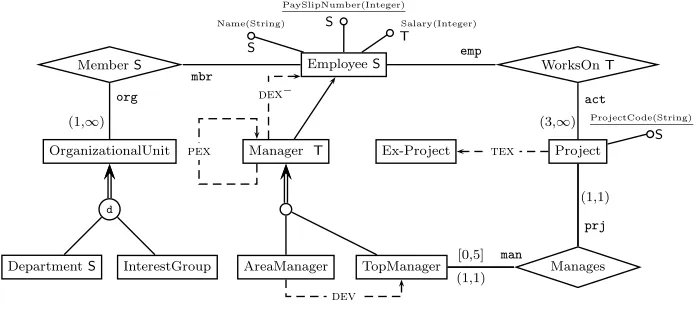
Timestamping constraints[31, 21, 26] distinguish between entities, relationships and attributes that aretemporary, i.e., cannot keep a single element over the whole time-line; snapshot, or time-invariant; andunconstrained (all others). In temporal entity-relationship (TER) diagrams, temporary entities, entity-relationships and attributes are marked withTand snapshot ones withS. In Figure 1, ‘Employee’ and ‘Department’ are snap-shot entities, ‘Name,’ ‘PaySlipNumber’ and ‘ProjectCode’ are snapsnap-shot attributes and ‘Member’ a snapshot relationship. On the other hand, ‘Manager’ is a temporary entity, ‘Salary’ a temporary attribute and ‘WorksOn’ a temporary relationship.
1
DepartmentS InterestGroup OrganizationalUnit
d
MemberS
(1,∞)
org
mbr EmployeeS
Name(String)
S
PaySlipNumber(Integer)
S Salary(Integer)
T
Manager T
TopManager AreaManager
dex−
dev pex
WorksOnT
(3,∞)
act emp
Project
ProjectCode(String)
S
Ex-Project tex
Manages
man
(1,1) [0,5]
prj
(1,1)
[image:6.612.137.485.122.277.2]1
Fig. 1.A temporal conceptual model of a company information system.
To represent timestamping constraints in temporal description logics we employ the
temporal operator2∗, which is read as ‘always’ or ‘at all—past, present and future—
time instants.’ Intuitively, for a conceptC,2∗Ccontains those elements that belong toC
at all time instants. Using this operator, the constraints ‘Employee is a snapshot entity’ and ‘Manager is a temporary entity’ can be represented as follows:
Employee v 2∗Employee, (1)
2∗Manager v ⊥. (2)
The first inclusion says that, at any moment of time, every element of ‘Employee’ has always been and will always be an element of ‘Employee.’ The second one states that no element can belong to ‘Manager’ at all time instants. Note that we consider concept inclusions to holdglobally, that is, at all moments of time.
The same temporal operator2∗together with rigid roles (i.e., roles that do not change
over time) can be used to capture timestamping of (reified) relationships. Rigid roles can also represent snapshot attributes, while temporary attributes can be captured by using temporalized roles:∃2∗salary v ⊥,where2∗salarydenotes the intersection of
the relationssalaryat all time instants, modelsalaryas a temporary attribute.
Evolution constraintscontrol how the domain elements evolve over time by ‘migrat-ing’ from one entity to another [22, 25, 29, 26, 6]. We distinguish betweenqualitative
evolution constraints that describe eventual temporal behaviour and do not specify the moment of migration, andquantitativeevolution (or transition) constraints that spec-ify the exact moment of migration. The dashed arrow marked withTEXin Figure 1 is an example of a quantitative evolution constraint meaning that each ‘Project’ expires in exactly one year and becomes an ‘Ex-Project.’ The dashed arrow marked withDEV
a ‘Manager’ will always be a ‘Manager’ and cannot be demoted. In temporal descrip-tion logic, these evoludescrip-tion constraints are represented using temporal operators such as ‘at the next moment of time’F, ‘some time in the future’3F, ‘some time in the past’ 3P and ‘always in the future’2F:
Project v FEx-Project, (3)
AreaManager v 3FTopManager, (4)
Manager v 3PEmployee, (5)
Manager v 2FManager. (6)
We note again that these concept inclusions hold at every moment of time.
Temporal cardinality constraints[30, 24, 20] restrict the number of times an in-stance participates in a relationship.Snapshotcardinality constraints do it at each mo-ment of time, whilelifespancardinality constraints impose restrictions over the entire existence of the instance. In Figure 1, we use(k, l)to specify the snapshot cardinalities and[k, l]the lifespan cardinalities: for example, every ‘TopManager’ manages exactly one project at each moment of time (snapshot cardinality), but not more than five differ-ent projects over the whole career (lifespan cardinality). If the relationship ‘manages’ is represented by a role in temporal description logic then these two constraints can be expressed by the following concept inclusions:
TopManager v ≤1manages,
TopManager v ≤53∗manages,
where3∗ means ‘sometime’ (in the past, present or future), and so3∗managesis the
union of the relationsmanagesoveralltime instants.
Finally, to represent temporal database instances associated to a temporal concep-tual model, we use assertions likePManager(bob)for ‘Bob was a manager last year’ andFmanages(bob,cronos)for ‘Bob will manage project Cronos next year.’
3.1 TemporalDL-Lite logics
It is known from temporal logic [18] that all the temporal operators used in the previous section can be expressed in terms of the binary operators ‘since’S and ‘until’U. So we formulate our ‘base’ temporal extension TU SDL-LiteNboolof the description logic DL-LiteNboolusing only these two operators. The language ofTU SDL-LiteNboolcontains
object names a0, a1, . . ., concept names A0, A1, . . .,flexible role namesP0, P1, . . .
andrigid role namesG0, G1, . . ..Role namesS,rolesR,basic conceptsB,concepts Candtemporal conceptsDare defined by the following rules:
S ::= Pi | Gi,
R ::= S | S−,
B ::= ⊥ | Ai | ≥q R,
C ::= B | D | ¬C | C1uC2,
where, as before,qis a positive integer. ATU SDL-LiteNboolTBox,T, is a finite set of
concept inclusionsof the formC1vC2. AnABox,A, consists of assertions of the form
nAk(ai), n¬Ak(ai), nS(ai, aj) and n¬S(ai, aj),
whereAkis a concept name,Sa (flexible or rigid) role name,ai,ajobject names and,
forn∈Z,
n=F· · ·F
| {z }
ntimes
, ifn≥0 and n=P· · ·P | {z } −ntimes
, ifn <0.
Taken together, the TBoxT and ABoxAform theknowledge base(KB)K= (T,A). Atemporal interpretation,I, gives a standard DL interpretation, I(n), for each time instantn∈Z:
I(n) = ∆I, aI0, . . . , A
I(n) 0 , . . . , P
I(n) 0 , . . . , G
I
0, . . .
.
We assume, however, that the domain∆Iand the interpretationsaIi ∈∆Iof the object names andGI0 ⊆∆I×∆I of rigid role names are fixed for all time. (Recall also that
we adopt the UNA.) The interpretationsAIi(n) ⊆∆I of concept names andPI(n) i ⊆ ∆I×∆I of flexible role names can vary. The atemporal constructs are interpreted in
I(n)as before; we write CI(n) for the extension of concept C in the interpretation I(n). The interpretation of the temporal operators is as in temporal logic:
(C1UC2)I(n) =
[
k>n
C2I(k)∩ \ n<m<k
C1I(m)
,
(C1SC2)I(n) =
[
k<n
C2I(k)∩ \ n>m>k
C1I(m)
.
Concept inclusions are interpreted inIglobally:
I |=C1vC2 iff CI (n) 1 ⊆C
I(n)
2 foralln∈Z.
And for the ABox assertions, we set:
I |=nAk(ai) iff aIi ∈A
I(n)
k , I |= n¬A
k(ai) iff aIi ∈/A
I(n) k , I |=nS(ai, aj) iff (aIi, aIj)∈SI
(n),
I |=n¬S(ai, aj) iff (aIi, aIj)∈/ SI (n).
We callIamodelof a KBKand writeI |=K ifI satisfies all elements ofK. IfK
has a model then it is said to besatisfiable. A conceptC(roleR) issatisfiablew.r.t.K
if there are a modelI ofKandn∈Zsuch thatCI(n) 6=∅(respectively,RI(n)6=∅).
It is readily seen that the concept and role satisfiability problems are equivalent to KB satisfiability.
We now define a few fragments and extensions of the base languageTU SDL-LiteNbool.
Recall that to say thatCis a snapshot concept, we need the ‘always’ operator2∗ with
the following meaning:
(2∗C)I(n) = \ k∈Z
In terms ofS andU, this operator can be represented as2∗C = ¬(> S ¬C)uCu ¬(> U ¬C). DefineTUDL-LiteNboolto be the sublanguage ofTU SDL-LiteNboolthe
tem-poral conceptsDin which are of the form:
D ::= C | 2∗C. (U)
Thus, inTUDL-LiteNbool, we can express timestamping constraints (see Section 3).
The temporal operators3F (‘some time in the future’) and3P (‘some time in the
past’) that are required for qualitative evolution constraints with the standard temporal logic semantics
(3FC)I(n) =
[
k>n
CI(k) and (3PC)I(n) =
[
k<n CI(k)
can be expressed viaU andS as3FC = > UC and3PC = > SC; the operators 2F (‘always in the future’) and2P (‘always in the past’) are defined as dual to3Fand 3P:2FC =¬3F¬Cand2PC =¬3P¬C. We define the fragmentTFPDL-LiteNbool
ofTU SDL-LiteNboolby restricting the temporal conceptsDto the form:
D ::= C | 2FC | 2PC. (FP)
Clearly, we have the following equivalences:
2∗C=2F2PC and 3∗C=3F3PC.
In what follows they will be regarded as definitions for 2∗ and 3∗ in the languages,
where they are not explicitly present. Thus,TFPDL-LiteNbool is capable of expressing
both timestamping and qualitative (but not quantitative) evolution constraints.
The temporal operatorsF (‘next time’) andP (‘previous time’), used in quanti-tative evolution constraints, can be defined asFC =⊥ UCandPC =⊥ SC, so that we have:
(FC)I(n)=CI(n+1) and (
PC)I(n)=CI(n−1).
The fragment ofTU SDL-LiteNboolwith temporal concepts of the form
D ::= C | 2FC | 2PC | FC | PC (FPX)
will be denoted byTFPXDL-LiteNbool. In this fragment, we can express timestamping,
qualitative and quantitative evolution constraints.
We have the following inclusions between the languages:
TUDL-LiteNbool ⊆ TFPDL-LiteboolN ⊆ TFPXDL-LiteNbool ⊆ TU SDL-Lite N bool.
Similarly to the non-temporal case, we can also identify sub-Boolean fragments of the above languages. A temporal TBoxT will be called aKrom (core) TBox if it contains only concept inclusions of the form:
respectively, where theDi are temporal concepts defined by (FPX), (FP) or (U) with C::=B|D(so, no Boolean operators are allowed in theDi). This gives us 6 different
fragmentsTFPXDL-LiteNα, TFPDL-LiteNα and TUDL-LiteNα, forα ∈ {core,krom}.
We do not consider the core and Krom fragments of the full language withU/S be-cause these operators allow one to go beyond the language of binary clauses of the core and Krom fragments; the resulting languages would have the same complexity as
TU SDL-LiteNbooland yet be less expressive (see [9] for more details).
We note here that both Krom and Bool TBoxes have the full negation, and so one can freely use3-shaped counterparts of the2temporal operators allowed in the language. This is not the case for the core fragments where timestamping can still be expressed (cf. (1) and (2)) but evolution constraints involving3(e.g., aManager was once an
[image:10.612.137.487.297.473.2]Employee; cf. (5)) are not expressible.
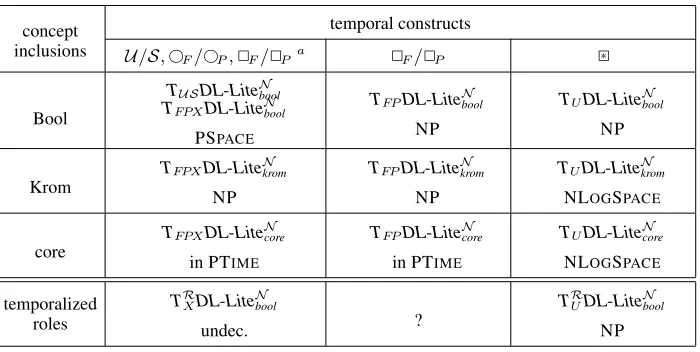
Table 1.The temporal extendedDL-Litefamily and complexity of its members.
temporal constructs concept
inclusions U/S,F/P,2F/2Pa 2
F/2P 2∗
Bool
TUSDL-LiteNbool
TFPXDL-LiteNbool
PSPACE
TFPDL-LiteNbool
NP
TUDL-LiteNbool
NP
Krom
TFPXDL-LiteNkrom
NP
TFPDL-LiteNkrom
NP
TUDL-LiteNkrom
NLOGSPACE
core
TFPXDL-LiteNcore
in PTIME
TFPDL-LiteNcore
in PTIME
TUDL-LiteNcore
NLOGSPACE
temporalized roles
TRXDL-LiteNbool
undec. ?
TRUDL-LiteNbool
NP
aSub-boolean fragments of the language withU/Sare not defined.
As we have seen in our running example, in order to express lifespan cardinality constraints, temporal operators on roles are required: for a roleRof the form
R ::= S | S− | 3∗R | 2∗R,
the extensions of3∗Rand2∗Rin an interpretationIare defined as
(3∗R)I(n)= [ k∈Z
RI(k) and (2∗R)I(n)= \ k∈Z
RI(k).
We denote byTRβDL-Lite
N
bool, forβ ∈ {FPX,FP,U}, the extensions of the respective
Bool fragments with temporalized roles.
4
Conclusions
From the complexity-theoretic point of view, the best candidates for reasoning about TCMs appear to be the TDLsTFPXDL-LiteNcore andTFPXDL-LiteNbool, the former of
which is NP-complete and the latter PSPACE-compete. Moreover, as showed in [9], the reduction ofTFPXDL-LiteNcoretoLT Lcan be done deterministically, thus standard
LT Lprovers can be used for TCM reasoning. We also believe thatTFPXDL-LiteNcore
extended with temporalized roles can be decidable, which remains one of the most chal-lenging open problems. But it seems to be next to impossible to reason in an effective way about all TCM constrains without any restrictions.
References
1. A. Artale, D. Calvanese, R. Kontchakov, V. Ryzhikov, and M. Zakharyaschev. Reasoning over extended ER models. InProc. of the26th
Int. Conf. on Conceptual Modeling (ER’07), volume 4801 of Lecture Notes in Computer Science, pages 277–292. Springer, 2007. 2. A. Artale, D. Calvanese, R. Kontchakov, and M. Zakharyaschev. DL-Lite in the light of
first-order logic. InProc. of the 22ndNat. Conf. on Artificial Intelligence (AAAI 2007), pages 361–366, 2007.
3. A. Artale, D. Calvanese, R. Kontchakov, and M. Zakharyaschev. TheDL-Litefamily and relations.J. of Artificial Intelligence Research, 36:1–69, 2009.
4. A. Artale, E. Franconi, and F. Mandreoli. Description logics for modelling dynamic infor-mation. In J. Chomicki, R. van der Meyden, and G. Saake, editors, Logics for Emerging Applications of Databases. Lecture Notes in Computer Science, Springer, 2003.
5. A. Artale, R. Kontchakov, C. Lutz, F. Wolter, and M. Zakharyaschev. Temporalising tractable description logics. In 14th Int. Symposium on Temporal Representation and Reasoning (TIME07). IEEE Computer Society, 2007.
6. A. Artale, C. Parent, and S. Spaccapietra. Evolving objects in temporal information systems.
Annals of Mathematics and Artificial Intelligence, 50(1-2):5–38, 2007.
7. A. Artale and E. Franconi. Foundations of temporal conceptual data models. In Concep-tual Modeling: Foundations and Applications, volume 5600 of Lecture Notes in Computer Science. Springer, 2009.
8. A. Artale, R. Kontchakov, V. Ryzhikov, and M. Zakharyaschev.DL-Litewith temporalised concepts, rigid axioms and roles. InProc. of FroCoS-09, volume 5749 of Lecture Notes in Artificial Intelligence, pages 133–148. Springer, 2009.
9. A. Artale, R. Kontchakov, V. Ryzhikov, and M. Zakharyaschev. TDL-Lite: How to cook decidable temporal description logics.To be submitted, 2011.
10. A. Artale, R. Kontchakov, V. Ryzhikov, and M. Zakharyaschev. Complexity of reasoning over temporal data models. InProc. of the29thInt. Conf. on Conceptual Modeling (ER’10), volume 6412 of Lecture Notes in Computer Science, pages 174–187. Springer, 2010. 11. F. Baader, D. Calvanese, D. McGuinness, D. Nardi, and P.F. Patel-Schneider, editors. The
Description Logic Handbook: Theory, Implementation and Applications. Cambridge Uni-versity Press, 2003. (2nd edition, 2007).
12. D. Berardi, D. Calvanese, and G. De Giacomo. Reasoning on UML class diagrams.Artificial Intelligence, 168(1–2):70–118, 2005.
14. D. Calvanese, G. De Giacomo, D. Lembo, M. Lenzerini, and R. Rosati. Tractable reason-ing and efficient query answerreason-ing in description logics: TheDL-Litefamily. J. of Artificial Intelligence Research (JAIR), 39(3):385–429, 2007.
15. C. Combi, S. Degani, and C. S. Jensen. Capturing temporal constraints in temporal ER models. InProc. of the27thInt. Conf. on Conceptual Modeling (ER’08). Lecture Notes in Computer Science. Springer, 2008.
16. M. Finger and P. McBrien. Temporal conceptual-level databases. In D. Gabbay, M. Reynolds, and M. Finger, editors, Temporal Logics – Mathematical Foundations and Computational Aspects, pages 409–435. Oxford University Press, 2000.
17. D. Gabbay, A.Kurucz, F. Wolter, and M. Zakharyaschev. Many-dimensional modal logics: theory and applications. Studies in Logic. Elsevier, 2003.
18. D. Gabbay, I. Hodkinson, and M. Reynolds. Temporal Logic: Mathematical Foundations and Computational Aspects, Volume 1. Oxford University Press, 1994.
19. D. Gabbay, M. Finger, and M. Reynolds. Temporal Logic: Mathematical Foundations and Computational Aspects, volume 2. Oxford University Press, 2000.
20. H. Gregersen and J.S. Jensen. Conceptual modeling of time-varying information. Technical Report TimeCenter TR-35, Aalborg University, Denmark, 1998.
21. H. Gregersen and J.S. Jensen. Temporal Entity-Relationship models – a survey.IEEE Trans-actions on Knowledge and Data Engineering, 11(3):464–497, 1999.
22. G. Hall and R. Gupta. Modeling transition. InProc. of ICDE’91, pages 540–549, 1991. 23. C. Lutz, F. Wolter, and M. Zakharyaschev. Temporal description logics: A survey. InProc. of
15th Int. Symposium on Temporal Representation and Reasoning (TIME08). IEEE Computer Society, 2008.
24. P. McBrien, A.H. Seltveit, and B. Wangler. An Entity-Relationship model extended to de-scribe historical information. InProc. of CISMOD’92, pages 244–260, Bangalore, India, 1992.
25. A.O. Mendelzon, T. Milo, and E. Waller. Object migration. In Proc. of the 13th
ACM SIGACT-SIGMOD-SIGART Symposium on Principles of Database Systems (PODS94),
pages 232–242, New York, NY, USA, 1994. ACM Press.
26. C. Parent, S. Spaccapietra, and E. Zimanyi.Conceptual Modeling for Traditional and Spatio-Temporal Applications—The MADS Approach. Springer, 2006.
27. A. Poggi, D. Lembo, D. Calvanese, G. De Giacomo, M. Lenzerini, and R. Rosati. Linking data to ontologies.J. on Data Semantics, X:133–173, 2008.
28. K. Schild. Combining terminological logics with tense logic. InProc. of the 6th Portuguese Conf. on Artificial Intelligence, pages 105–120, London, UK, 1993. Springer.
29. J. Su. Dynamic constraints and object migration. Theoretical Computer Science, 184(1– 2):195–236, 1997.
30. B. Tauzovich. Towards temporal extensions to the entity-relationship model. InProc. of the Int. Conf. on Conceptual Modeling (ER’91). Lecture Notes in Computer Science. Springer, 1991.